An alkene ‘X’ (C H ) does not exhibit cis/trans isomerism. Reaction of ‘X’ with Br /CCL , followed by reaction with reagent ‘Y’ gave ‘Z’ (C H ). What are ‘Y’ and ‘Z’ respectively?
1
aq.KOH ; CH CH C = CH
2
alc.KOH ; CH C = CCH
3
(i) alc.KOH, (ii) NaNH ; CH CH C = CH
4
(i) alc.KOH, (ii) NaNH ; CH C = CCH
Official Solution
Correct Option:
(3)
The reaction of ‘X’ with Br /CCL produces a vicinal dibromide. The subsequent treatment with alcoholic KOH causes elimination to form an alkene, which can undergo dehydrohalogenation with NaNH to give the required alkyne. Thus, the answer is (i) alc.KOH and (ii) NaNH .
02
PYQ 2025
medium
chemistryID: ts-eamce
What are X and Y respectively in the following reaction sequence?
1
1
2
2
3
3
4
4
Official Solution
Correct Option:
(1)
Step 1: Recall Friedel-Crafts reactions.
Friedel-Crafts reactions occur in the presence of anhydrous and can be of two types: - \Alkylation: - \Acylation:
Step 2: Analyze the given transformation.
The given sequence is:
The final product is Toluene ( ), while the starting compound is Acetophenone ( ). To obtain Toluene from Acetophenone, the carbonyl group ( ) must effectively be replaced by a methyl group ( ).
Step 3: Logical reagent sequence.
If and , then: - First reaction ( ): Friedel-Crafts acylation adds an acyl group, forming Acetophenone from Benzene. - Second reaction ( ): Friedel-Crafts alkylation adds a methyl group, forming Toluene from Benzene. This matches the overall relationship between Toluene and Acetophenone in the sequence.
Step 4: Final conclusion.
Thus, the correct reagents are and .
03
PYQ 2025
medium
chemistryID: ts-eamce
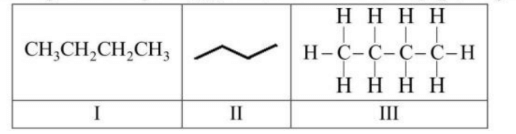
The condensed, bond line and complete formulae of n-butane are respectively
1
II, I, III
2
I, II, III
3
I, III, II
4
II, III, I
Official Solution
Correct Option:
(2)
Step 1: Define n-butane and its structure.
n-butane is a straight-chain alkane with the molecular formula .
The structure is a chain of four carbon atoms.
Step 2: Identify the Condensed Formula.
The condensed structural formula shows the atoms in a molecule in a line, with groups attached to each carbon atom explicitly stated, but without showing every single bond.
For n-butane, this is .
This corresponds to item I.
Step 3: Identify the Bond Line (Skeletal) Formula.
The bond line formula (also called the skeletal formula) is a simplified representation where carbon atoms are at the ends and vertices of the lines, and hydrogen atoms attached to carbons are generally omitted.
For n-butane ( ), this is represented by a zig-zag line with four points (two ends and two vertices).
This corresponds to item II in the diagram (the zig-zag line with no letters).
Step 4: Identify the Complete (Expanded) Structural Formula.
The complete structural formula (also called the expanded formula) shows all the atoms in the molecule and all the bonds connecting them.
For n-butane, this shows the chain of four carbons and all ten hydrogens explicitly bonded to the carbons.
This corresponds to item III in the diagram (the one with all H's and C's shown).
Step 5: Determine the required order.
The question asks for the order: Condensed, Bond Line, Complete.
The order is I, II, III.
04
PYQ 2025
medium
chemistryID: ts-eamce
Which of the following is a least stable carbocation?
1
CH - C H
2
CH = C H
3
CH = CH - C H
4
C H - C H
Official Solution
Correct Option:
(2)
The stability of carbocations depends on factors such as hyperconjugation, resonance, and inductive effects. (A) CH - C H (Ethyl cation): This is a primary carbocation. Stability is provided by the +I effect of the methyl group and hyperconjugation with three alpha-hydrogens. (B) CH = C H (Vinyl cation): The positive charge is on an sp-hybridized carbon of a double bond. Carbon with higher s-character is more electronegative, destabilizing the positive charge. The empty p-orbital is perpendicular to the -bond, preventing resonance. This makes the vinyl carbocation extremely unstable. (C) CH = CH - C H (Allyl cation): The positive charge is adjacent to a double bond. Resonance delocalizes the positive charge: Resonance stabilization makes the allyl cation relatively stable. (D) C H - C H (Benzyl cation): The positive charge is adjacent to a benzene ring, allowing resonance delocalization over the aromatic system. This makes the benzyl cation very stable. Comparing the stabilities: Benzyl (D) and allyl (C) cations are stabilized by resonance, ethyl cation (A) by hyperconjugation and inductive effect, while vinyl cation (B) is highly destabilized.
05
PYQ 2025
medium
chemistryID: ts-eamce
Arrange the following in decreasing order of their boiling points
(A) 2-Methylbutane
(B) 2,2-Dimethylpropane
(C) Pentane
(D) Hexane
1
D>C>A>B
2
B>A>C>D
3
D>A>C>B
4
B>C>A>D
Official Solution
Correct Option:
(1)
The boiling point of non-polar alkanes depends on the strength of the intermolecular van der Waals forces. These forces increase with:
1. Increasing molecular mass (more electrons).
2. Increasing surface area (for isomers). Let's analyze the given compounds. (A) 2-Methylbutane: Formula C H . It is a branched isomer of pentane.
(B) 2,2-Dimethylpropane: Formula C H . It is another, more branched isomer of pentane.
(C) Pentane: Formula C H . It is a straight-chain alkane.
(D) Hexane: Formula C H . It is a straight-chain alkane. Step 1: Compare based on molecular mass.
Hexane (D) has the highest molecular mass (C H ). Therefore, it will have the strongest van der Waals forces and the highest boiling point. So, D is first. Step 2: Compare the isomers of pentane (A, B, C).
All three have the same molecular mass (C H ). Their boiling points will depend on their surface area.
- Pentane (C) is a straight-chain molecule, giving it the largest surface area for intermolecular contact.
- 2-Methylbutane (A) has one branch, making it more compact than pentane.
- 2,2-Dimethylpropane (B) has two branches on the same carbon, making it the most compact and spherical of the three. As branching increases, the molecule becomes more spherical, the surface area decreases, and the van der Waals forces become weaker. This leads to a lower boiling point. Therefore, the order of boiling points for the isomers is:
Pentane (C)>2-Methylbutane (A)>2,2-Dimethylpropane (B). Step 3: Combine the results.
Hexane (D) has the highest boiling point, followed by the isomers of pentane in the order C>A>B. The complete decreasing order of boiling points is D>C>A>B.
06
PYQ 2025
medium
chemistryID: ts-eamce
An alkyne has the molecular formula C₆H₁₀. The number of 1-alkyne isomers (excluding stereoisomers) possible for it is
1
2
2
5
3
3
4
4
Official Solution
Correct Option:
(4)
Step 1: Understanding the Concept:
The problem asks for the number of structural isomers of C₆H₁₀ that are 1-alkynes (also known as terminal alkynes). A 1-alkyne is a hydrocarbon with a carbon-carbon triple bond at the end of the carbon chain (i.e., between carbon 1 and carbon 2). We need to find all possible arrangements of the 6 carbon atoms that satisfy this condition. Step 2: Systematic Approach to Finding Isomers:
We will consider different parent carbon chain lengths and place the triple bond at position 1.
1. Parent Chain: Hexane (6 carbons) The only possibility is a straight chain with the triple bond at the end. Name: Hex-1-yne. (1 isomer)
2. Parent Chain: Pentane (5 carbons) We have a 5-carbon chain with the triple bond at C-1, and one methyl group as a substituent. The methyl group cannot be on C-1 or C-2. - Place methyl on C-3: Name: 3-Methylpent-1-yne. (1 isomer) - Place methyl on C-4: Name: 4-Methylpent-1-yne. (1 isomer)
3. Parent Chain: Butane (4 carbons) We have a 4-carbon chain with the triple bond at C-1, and two methyl groups as substituents. The substituents cannot be on C-1 or C-2. Both must be on C-3. - Place two methyls on C-3: Name: 3,3-Dimethylbut-1-yne. (1 isomer) (Placing one ethyl group on the butane chain is not possible for a 1-alkyne without extending the parent chain). Step 3: Total Count:
Summing up the isomers from each parent chain: 1 (from hexane) + 2 (from pentane) + 1 (from butane) = 4 isomers. Step 4: Final Answer:
There are 4 possible 1-alkyne isomers for the formula C₆H₁₀. Therefore, option (D) is correct.
07
PYQ 2025
medium
chemistryID: ts-eamce
The empirical formula of the compound 'D' formed in the given reaction sequence is C₂H₄ A B C D
1
CHCl
2
CCl
3
CH₂Cl
4
CHCl₂
Official Solution
Correct Option:
(2)
Step 1: Understanding the Concept:
This is a multi-step organic synthesis problem. We need to identify the product at each stage of the reaction sequence to determine the final product 'D' and then find its empirical formula. Step 2: Detailed Reaction Sequence:
- Step 1: Ethene (C₂H₄) to A Ethene undergoes electrophilic addition with bromine in an inert solvent (CCl₄) to form 1,2-dibromoethane. So, A is 1,2-dibromoethane.
- Step 2: A to B This is a double dehydrohalogenation. Alcoholic KOH (a moderate base) removes one HBr to form vinyl bromide. Sodamide (NaNH₂, a very strong base) is required to remove the second HBr from the less reactive vinyl halide to form ethyne (acetylene). So, B is ethyne.
- Step 3: B to C Ethyne undergoes cyclic polymerization (trimerization) when passed through a red-hot iron tube at high temperature to form benzene. So, C is benzene.
- Step 4: C to D Benzene undergoes electrophilic aromatic substitution (chlorination) in the presence of a Lewis acid catalyst (AlCl₃). Since excess chlorine is used, all six hydrogen atoms on the benzene ring are substituted by chlorine atoms to form hexachlorobenzene. So, D is hexachlorobenzene. Step 3: Finding the Empirical Formula of D:
The molecular formula of the final product D (hexachlorobenzene) is C₆Cl₆.
The empirical formula is the simplest whole-number ratio of atoms in the compound. To find it, we divide the subscripts by their greatest common divisor, which is 6. Step 4: Final Answer:
The empirical formula of compound D is CCl. Therefore, option (B) is correct.
08
PYQ 2025
medium
chemistryID: ts-eamce
An alcohol 'X' (C H O) reacts with conc. HCl at room temperature and gives chloride. 'X' on dehydration followed by ozonolysis gives 'Y' and 'Z'. Find 'Y' and 'Z'.
1
Acetone; Formaldehyde
2
Propionaldehyde; Formaldehyde
3
Acetaldehyde; Acetaldehyde
4
Propionaldehyde; Formic acid
Official Solution
Correct Option:
(2)
Alcohol X is 1-butanol. Dehydration gives butene, ozonolysis splits double bond → propionaldehyde (Y) + formaldehyde (Z). Reaction sequences involve standard dehydration and ozonolysis steps.
09
PYQ 2025
medium
chemistryID: ts-eamce
Consider the following statements Statement I: Benzene undergoes electrophilic substitution with excess chlorine in the presence of anhydrous AlCl Statement - II: Benzene also undergoes electrophilic substitution with chlorine in the presence of UV light. The correct answer is
1
Both statements I and II are correct
2
Both statements I and II are not correct
3
Statement I is correct, but statement II is not correct
4
Statement I is not correct, but statement II is correct
Official Solution
Correct Option:
(3)
1. Statement I: Benzene undergoes electrophilic aromatic substitution with Cl /AlCl , forming chlorobenzene (C H Cl), as AlCl generates Cl electrophile, correct.
2. Statement II: With Cl under UV light, benzene undergoes free radical addition, forming hexachlorocyclohexane (C H Cl ), not electrophilic substitution, incorrect.
3. Electrophilic substitution requires electrophile attack on aromatic ring, maintaining aromaticity, unlike radical addition.
4. Thus, the answer is (3) Statement I is correct, but statement II is not correct.
About Hydrocarbons - TS-EAMCET
Hydrocarbons is a vital chapter for TS-EAMCET aspirants. Mastering the concepts covered in this chapter is essential for securing a top rank.
By rigorously practicing the previous year questions associated with this chapter, you can identify high-yield topics, understand the examiner's perspective, and boost your confidence during the actual exam.
Frequently Asked Questions
Why focus on Hydrocarbons PYQs?
Analyzing PYQs for this specific chapter reveals the most frequently tested concepts and the typical complexity of questions, allowing you to tailor your study plan efficiently.
How to best use this analysis?
Review the topic breakdown to see which sub-topics within Hydrocarbons carry the most weight. Then, tackle the questions iteratively to solidify your understanding.