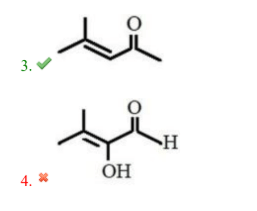
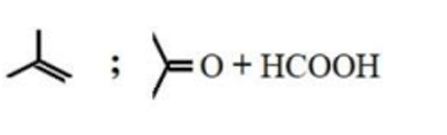
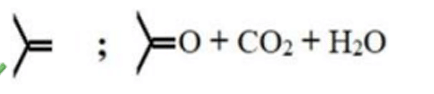
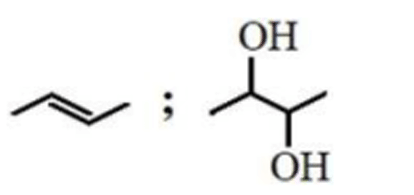
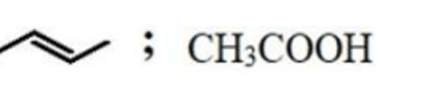
The molecular formula of a crystal is . Oxygen atoms form a close-packed lattice. Atoms of A occupy of tetrahedral voids and atoms of B occupy of octahedral voids. and are respectively: \flushleft
1
2
3
4
Official Solution
Correct Option: (1)
Step 1: Understanding the Crystal Structure The given compound is , which follows the spinel structure. In such structures: - Oxygen atoms form a face-centered cubic (FCC) close-packed lattice. - The tetrahedral voids and octahedral voids are partially occupied by and atoms, respectively. Step 2: Analyzing the Void Occupation 1. Tetrahedral Voids: - In an FCC lattice of oxygen, the number of tetrahedral voids is twice the number of oxygen atoms. - A fraction of these voids is occupied by A atoms. 2. Octahedral Voids: - The number of octahedral voids is equal to the number of oxygen atoms. - A fraction of these voids is occupied by B atoms. Step 3: Calculating and - Total oxygen atoms = 4 per formula unit. - Total tetrahedral voids = . - Total octahedral voids = 4. For A atoms: - The formula tells us that 1 atom of is present. - atoms occupy tetrahedral voids. - The fraction occupied by is . For B atoms: - The formula tells us that 2 atoms of are present. - atoms occupy octahedral voids. - The fraction occupied by is . Step 4: Evaluating the Given Options - Option (1): Correct, as , . - Option (2): Incorrect, as it reverses the values. - Option (3): Incorrect, as it does not match calculated values. - Option (4): Incorrect, as the values are swapped incorrectly. Thus, the correct answer is
Option (1).
02
PYQ 2024
medium
chemistryID: ts-eamce
The number of molecules with electrophilic centres in the following is CH CH Br, CH COCH , CH CH CN, (CH ) Cd
1
3
2
4
3
2
4
1
Official Solution
Correct Option: (1)
Electrophilic centers are present where atoms or groups with partial positive charge are available for attack by nucleophiles. - CH CH Br has an electrophilic carbon (C-Br bond). - CH COCH has an electrophilic carbon in the carbonyl group. - CH CH CN has an electrophilic carbon in the nitrile group. Thus, three molecules have electrophilic centers.
03
PYQ 2024
medium
chemistryID: ts-eamce
The technique used to purify an organic compound present in aqueous medium and which is less soluble in organic solvent is
1
Steam distillation
2
Differential extraction
3
Continuous extraction
4
Fractional distillation
Official Solution
Correct Option: (3)
Continuous extraction is used for purifying an organic compound that is less soluble in organic solvents, as it allows continuous separation over time.
04
PYQ 2024
medium
chemistryID: ts-eamce
Possible number of isomers including stereoisomers for an organic compound with the molecular formula is:
1
3
2
4
3
5
4
2
Official Solution
Correct Option: (3)
Step 1: Understanding Isomerism Isomers are compounds with the same molecular formula but different structural arrangements or spatial orientations. The molecular formula given is , which corresponds to butyl bromide isomers.
Step 2: Identifying the Isomers The possible structural and stereoisomers for are: 1. n-Butyl bromide ( ) - Straight-chain structure. 2. Isobutyl bromide ( ) - Branched structure. 3. Sec-butyl bromide ( ) - Branched with a secondary carbon. 4. Tert-butyl bromide ( ) - Branched with a tertiary carbon. 5. Sec-butyl bromide has a chiral center, leading to two enantiomers, contributing to stereoisomerism. Step 3: Evaluating the Given Options - Option (1) 3: Incorrect, as it does not account for all possible isomers. - Option (2) 4: Incorrect, as it excludes stereoisomers. - Option (3) 5: Correct, as it includes all structural and stereoisomers. - Option (4) 2: Incorrect, as more isomers exist. Thus, the correct answer is
Option (3).
05
PYQ 2025
hard
chemistryID: ts-eamce
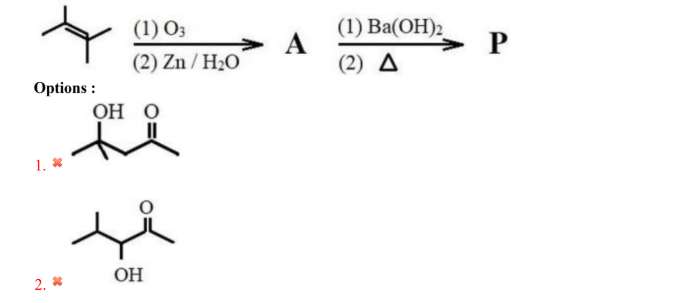
Identify the product 'P' in the given reaction sequence
1
1
2
2
3
3
4
4
Official Solution
Correct Option: (3)
Step 1: Analyze Starting Material: Looking at the product P in Option 3 (1-acetylcyclopentene), we can reverse engineer. A 5-membered ring with an acetyl group suggests an intramolecular Aldol condensation of a 1,6-dicarbonyl compound (Specifically a keto-aldehyde to form an enone). The precursor A must be 6-oxoheptanal ( ). This precursor A is obtained by ozonolysis of the cyclic alkene. Ozonolysis of 1-methylcyclohexene yields 6-oxoheptanal. Thus, Reactant = 1-Methylcyclohexene. Step 2: Reaction A P (Intramolecular Aldol): Compound A: . Base ( ) removes the acidic -proton. The most favorable cyclization forms a 5-membered ring. The enolate forms at the methylene group to the ketone (at C-5). Attack: C-5 Enolate attacks C-1 Aldehyde carbonyl. Ring formed: 5-membered (C1-C2-C3-C4-C5). Substituents on ring: - At C-1: Becomes -OH (secondary alcohol). - At C-5: The acetyl group ( ) remains attached (Wait, the methyl of the ketone is outside? No, the C=O becomes part of the acetyl group? Let's re-verify). Actually: Enolate at C-5 ( to ketone) attacking C-1 (CHO). The ketone carbonyl carbon (C-6) and its methyl (C-7) become an Acetyl group attached to the ring at C-5. Resulting structure: 2-(1-hydroxy)cyclopentyl methyl ketone? Upon heating ( ), dehydration occurs to form the conjugated product. Double bond forms between C-1 and C-5 (conjugated with the acetyl group). Final Product P: 1-acetylcyclopentene. Structure: A cyclopentene ring with a group attached to one of the double-bonded carbons. This matches the structure shown in Option 3 (or C). Final Answer: Option (C).
06
PYQ 2025
medium
chemistryID: ts-eamce
The major products P and Q from the following reactions are Reaction 1: Reaction 2:
Reagent: (Lithium Aluminum Hydride).
This is a strong reducing agent. It reduces amides to amines by converting the carbonyl group ( ) to a methylene group ( ).
Product P is Benzylamine. Step 3: Reaction 2 (Hoffmann Bromamide Degradation):
Reagent: .
This reaction converts a primary amide to a primary amine with one carbon atom less (decarbonylation). The carbonyl group is removed.
Product Q is Aniline. Step 4: Comparison:
.
.
Matches Option (B).
07
PYQ 2025
medium
chemistryID: ts-eamce
Consider the following reaction sequence.
(A) and (C) are
1
Functional isomers
2
Metamers
3
Optical isomers
4
Position isomers
Official Solution
Correct Option: (4)
Step 1: Reaction Analysis:
1. Step 1: Acetaldehyde ( ) + Methyl Magnesium Bromide ( ) followed by hydrolysis. Nucleophilic addition of Grignard reagent to aldehyde gives a secondary alcohol. (A) is Propan-2-ol (Isopropyl alcohol). 2. Step 2: Dehydration with . Alcohol (A) loses water to form an alkene. (B) is Propene. 3. Step 3: Hydroboration-Oxidation ( ). This reaction adds water across the double bond according to Anti-Markovnikov's rule. Propene ( ) Primary Alcohol. (C) is Propan-1-ol. Step 2: Comparison of A and C:
- (A): Propan-2-ol ( ) - OH at position 2.
- (C): Propan-1-ol ( ) - OH at position 1.
They have the same molecular formula ( ) and functional group (Alcohol), but different positions of the functional group.
Thus, they are Position Isomers. Step 4: Final Answer:
Position isomers.
08
PYQ 2025
medium
chemistryID: ts-eamce
Identify the compound (Z) in the following reaction sequence
1
Propanal
2
Propanone
3
Propanoic acid
4
Propanamide
Official Solution
Correct Option: (2)
Let's trace the reaction sequence step by step. The starting material is 1,1-dibromopropane. Step 1: Formation of X. The starting material reacts with (i) alcoholic KOH and (ii) sodium amide (NaNH ). This is a double dehydrohalogenation reaction. Geminal dihalides (halogens on the same carbon) are converted to alkynes. First, alcoholic KOH eliminates one molecule of HBr to form an alkenyl halide. (major product). Then, the stronger base NaNH is used to eliminate the second molecule of HBr from the less reactive alkenyl halide to form an alkyne. . So, compound X is propyne. Step 2: Formation of Y. Propyne (X) reacts with water in the presence of an acid catalyst (H ) and mercuric ions (Hg ). This is the hydration of an alkyne (Kucherov's reaction). The reaction follows Markovnikov's rule. The -OH group adds to the more substituted carbon of the triple bond, and the H adds to the less substituted carbon. . This initially forms an enol (prop-1-en-2-ol). This enol is unstable and immediately tautomerizes to its more stable keto form. . The product Y is propanone (acetone). Step 3: Formation of Z. The reaction shown is "Isomerization". However, propanone is already the stable product of the hydration. The label "Isomerization" likely refers to the tautomerization step that converts the enol to the ketone (Y). In this context, Y and Z are the same compound, or Z is simply the final stable product of the sequence. Therefore, Z is propanone.
09
PYQ 2025
medium
chemistryID: ts-eamce
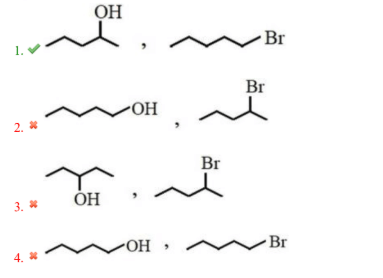
An alkene X ( ) on ozonolysis gave formaldehyde and butyraldehyde. The products from the reaction of X with (i) and (ii) are respectively
1
1
2
2
3
3
4
4
Official Solution
Correct Option: (1)
Step 1: Identify Alkene X:
Ozonolysis Products: Formaldehyde ( ) + Butyraldehyde ( ).
Reconstruct the alkene by removing oxygen and joining the carbonyl carbons with a double bond.
So, X is 1-Pentene. Step 2: Reaction (i) - Acid Catalyzed Hydration:
Reagent: .
Mechanism: Electrophilic addition following Markovnikov's Rule.
The adds to the terminal carbon ( ) to form the more stable secondary carbocation. Then attacks the secondary carbon.
Product: Pentan-2-ol ( ). Step 3: Reaction (ii) - HBr with Peroxide:
Reagent: (Benzoyl Peroxide).
Mechanism: Free Radical Addition following Anti-Markovnikov's Rule (Kharasch effect).
The radical adds to the terminal carbon to form a stable secondary radical intermediate.
Product: 1-Bromopentane ( ). Step 4: Match with Options:
The first structure should be Pentan-2-ol.
The second structure should be 1-Bromopentane.
Option 1 shows exactly these structures (2-hydroxy pentane and 1-bromo pentane).
10
PYQ 2025
medium
chemistryID: ts-eamce
Aniline can be separated from a mixture of chloroform - aniline by a technique X and from aniline - water mixture by technique Y. X and Y respectively are
1
Distillation, Distillation
2
Steam distillation, Steam distillation
3
Steam distillation, Distillation
4
Distillation, Steam distillation
Official Solution
Correct Option: (4)
Step 1: Separation X (Chloroform - Aniline):
Boiling point of Chloroform ( ) .
Boiling point of Aniline ( ) .
Since there is a large difference in boiling points, Simple Distillation is the appropriate method.
Step 2: Separation Y (Aniline - Water):
Aniline is immiscible with water but volatile in steam.
To purify liquids which are steam volatile and immiscible with water, Steam Distillation is used. This allows aniline to distill at a temperature lower than its boiling point, preventing decomposition and effectively separating it from non-volatile impurities or the aqueous phase.
Step 3: Conclusion:
X = Distillation, Y = Steam Distillation.
11
PYQ 2025
medium
chemistryID: ts-eamce
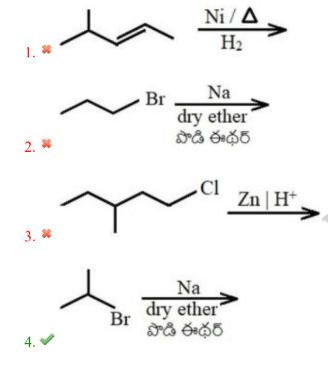
'X' is the isomer of . It has four primary carbons and two tertiary carbons. 'X' can be prepared from which of the following reaction?
1
(Hydrogenation)
2
(Wurtz Reaction)
3
(Reduction)
4
(Wurtz Reaction)
Official Solution
Correct Option: (4)
Step 1: Determine the structure of the isomer X.
The molecular formula is , which is an alkane (general formula ).
The isomer X must have:
- 4 Primary carbons ( , bonded to one other carbon).
- 2 Tertiary carbons ( , bonded to three other carbons).
Let's try to sketch the structure. A molecule with two tertiary carbons must have a carbon backbone with three branches from each tertiary carbon. The only alkane that fits this description is 2,3-Dimethylbutane.
Structure of 2,3-Dimethylbutane: .
The carbons at positions 1, 4, and the two methyl groups are (4 primary carbons).
The carbons at positions 2 and 3 are (2 tertiary carbons).
So, X is 2,3-Dimethylbutane.
Step 2: Analyze the given reactions for the preparation of X.
(A) is used for the hydrogenation of alkenes/alkynes. 2,3-Dimethylbutane can be formed from 2,3-Dimethyl-2-butene or 2,3-Dimethyl-1-butene, but this is a general reaction, not a specific preparation method.
(D) Wurtz reaction ( ). This reaction is used to couple two alkyl halides to form a larger alkane.
To form 2,3-Dimethylbutane, the two R-groups must be identical and correspond to the 'half' of the molecule joined by the new bond.
can be conceptually cleaved into two units: .
The alkyl halide needed is Isopropyl halide, .
The reaction is: .
The Wurtz reaction of Isopropyl Halide successfully forms 2,3-Dimethylbutane.
Step 3: Conclude the final correct option.
The most plausible specific preparation method is the Wurtz reaction of isopropyl halide. Since the option lists the conditions for the Wurtz reaction, it is the correct choice.
12
PYQ 2025
medium
chemistryID: ts-eamce
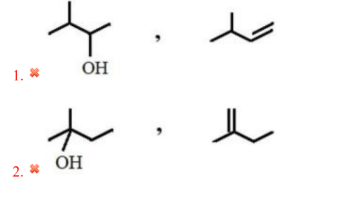
What are X and Y respectively in the following reaction sequence?
1
1
2
2
3
3
4
4
Official Solution
Correct Option: (2)
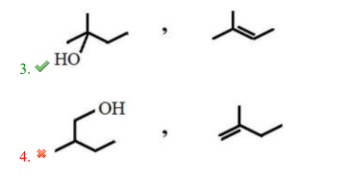
Step 1: Determine the structure of Isopentane and analyze the first reaction.
Isopentane is the common name for 2-Methylbutane. Its structure is .
The reaction is . is a strong oxidizing agent.
Alkanes are generally resistant to oxidation, but strong oxidizing agents at high temperature can lead to a reaction, usually at the tertiary C-H bond.
In 2-Methylbutane, the tertiary carbon is at C2 ( ). The oxidation will replace the tertiary C-H bond with a C-OH bond.
The product X is 2-Methylbutan-2-ol, which corresponds to Structure 3.
Step 2: Analyze the second reaction: Dehydration of X.
The second reaction is .
X is 2-Methylbutan-2-ol. The reagents (phosphoric acid) and heat cause the dehydration of the alcohol to form an alkene.
The reaction follows Zaitsev's rule: the most substituted (most stable) alkene is the major product.
The -OH group is on C2. The atom can be removed from C1 ( ), C3 ( ), or the attached to C2.
Removal of from C3 gives 2-Methyl-2-butene (Zaitsev's product, most substituted).
Removal of from C1 gives 2-Methyl-1-butene (Hoffmann product).
The major product Y is 2-Methyl-2-butene, which corresponds to Structure 4.
Step 3: Conclude the final correct option.
X is 2-Methylbutan-2-ol (Structure 3), and Y is 2-Methyl-2-butene (Structure 4).
The pair (X, Y) is (Structure 3, Structure 4).
13
PYQ 2025
medium
chemistryID: ts-eamce
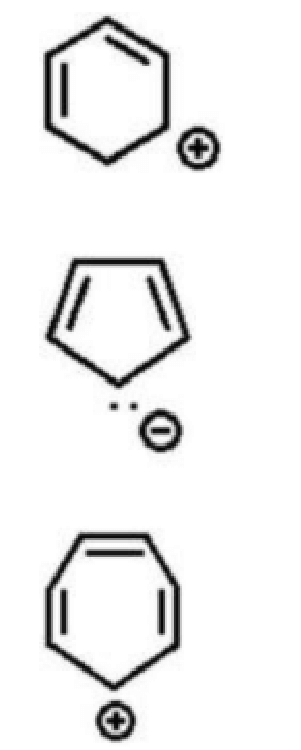
Which of the following is not an aromatic species?
1
Cycloheptatrienyl cation
2
Cyclopentadienyl anion
3
Cyclooctatetraene
4
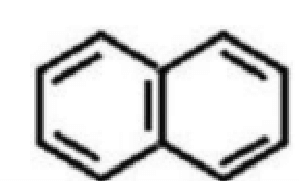
Naphthalene
Official Solution
Correct Option: (3)
For a species to be aromatic, it must satisfy H��ckel's rules: 1. It must be cyclic. 2. It must be planar. 3. It must have a continuous ring of p-orbitals (fully conjugated). 4. It must have electrons in the conjugated system, where is a non-negative integer. (A) Cycloheptatrienyl cation: 1. Cyclic: Yes. 2. Planar: Yes. 3. Conjugated: Yes. 4. electrons: 3 double bonds = 6 electrons. , satisfies H��ckel's rule. Aromatic. (B) Cyclopentadienyl anion: 1. Cyclic, planar, conjugated: Yes. 2. electrons: 2 double bonds (4 ) + 1 lone pair (2 ) = 6 electrons. . Aromatic. (C) Cyclooctatetraene: 1. Cyclic: Yes. 2. electrons: 4 double bonds = 8 electrons ( type). 3. Planar: No, adopts a non-planar tub shape to avoid anti-aromaticity. Does not satisfy aromaticity rules. Non-aromatic. (D) Naphthalene: 1. Cyclic, planar, conjugated: Yes. 2. electrons: 5 double bonds = 10 electrons. . Aromatic.
14
PYQ 2025
medium
chemistryID: ts-eamce
In the estimation of nitrogen by Kjeldahl's method 0.933 g of an organic compound 'X' was analyzed. Ammonia evolved was absorbed in 60 mL of 0.1 M H SO . The unreacted acid requires 20 mL of 0.1 M NaOH for complete neutralization. The compound 'X' is
1
C H CH NH
2
C H NH
3
CH CH NH
4
CH
Official Solution
Correct Option: (2)
Step 1: Calculate the millimoles of the initial H SO solution. Since H SO is diprotic, meq of acid = meq. Step 2: Calculate the milliequivalents of unreacted H SO . Therefore, unreacted meq of H SO = 2 meq. Step 3: Calculate the meq of H SO that reacted with NH . Step 4: Relate this to ammonia and nitrogen. Step 5: Calculate the mass of nitrogen. Step 6: Calculate the percentage of nitrogen in the sample. Step 7: Compare with theoretical % N of options: (A) C H CH NH : (B) C H NH : (C) CH CH NH : (D) CH CONH :
15
PYQ 2025
medium
chemistryID: ts-eamce
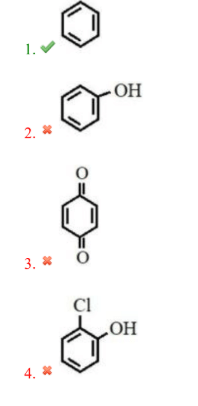
What is the major product 'Z' in the given reaction sequence?
1
Benzene
2
Phenol
3
p-benzoquinone
4
Chlorophenol
Official Solution
Correct Option: (1)
Let's analyze the reaction sequence step by step. Step 1: Formation of X. The starting material is nitrobenzene (C H NO ). It is treated with Fe/HCl. This is a standard method for the reduction of a nitro group to a primary amine group. . So, compound X is aniline. Step 2: Formation of Y. Aniline (X) is treated with NaNO /HCl at 273 K (0 °C). This is the diazotization reaction. The primary amine group is converted into a diazonium salt. . So, compound Y is benzenediazonium chloride. Step 3: Formation of Z. Benzenediazonium chloride (Y) is treated with hypophosphorous acid (H PO ) and water. This is a deamination reaction, where the diazonium group (- ) is replaced by a hydrogen atom. It is a reduction reaction. . The major organic product, Z, is benzene (C H ).
16
PYQ 2025
medium
chemistryID: ts-eamce
The ratio of bonds to bonds in Q is
1
3:1
2
1:3
3
4:1
4
2:1
Official Solution
Correct Option: (1)
Step 1: Identify compound P. The starting material is benzenesulfonic acid. It is treated with (i) NaOH, followed by (ii) H . This is the process to convert a sulfonic acid into a phenol. First, . Then, the sodium salt is fused with solid NaOH at high temperature, followed by acidification. . So, compound P is phenol. Step 2: Identify compound Q. Phenol (P) is treated with sodium dichromate (Na Cr O ) and sulfuric acid (H SO ). This is a strong oxidizing agent mixture. The oxidation of phenol under these conditions yields 1,4-benzoquinone (also known as p-benzoquinone). The ring is oxidized to a conjugated diketone. The structure of Q is a six-membered ring with two double bonds and two ketone groups at opposite (para) positions. Its formula is C H O . Step 3: Count the and bonds in Q (p-benzoquinone). Let's analyze the structure: The ring consists of 4 CH groups and 2 C=O groups. - bonds: There are two C=C double bonds and two C=O double bonds. Each double bond contains one bond. Total bonds = 2 + 2 = 4. - bonds: - There are 4 C-H single bonds. (4 ) - In the ring, there are 4 C-C single bonds and 2 C=C double bonds (which also contain 2 bonds). Total C-C sigma bonds in the ring = 4 + 2 = 6. - There are 2 C=O double bonds (which contain 2 bonds). - Total bonds = 4 (C-H) + 4 (C-C) + 2 (C=C) + 2 (C=O) = 12. Let me recount. Let's count edges in the cyclic graph: 4 C-H bonds, 4 C-C single bonds, 2 C=C double bonds (2 ), 2 C=O double bonds (2 ). Total = 4(C-H) + 4(C-C) + 2(from C=C) + 2(from C=O) = 12. So we have 12 bonds and 4 bonds. Step 4: Find the ratio. The ratio of bonds to bonds is 12 : 4. Simplifying the ratio by dividing by 4 gives 3 : 1.
17
PYQ 2025
medium
chemistryID: ts-eamce
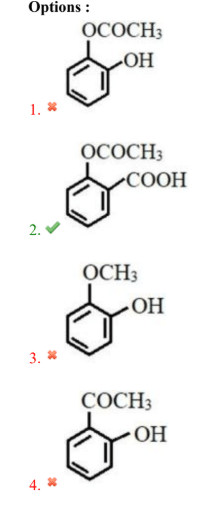
What is the product 'Z' in the given sequence of reactions?
1
A phenyl ether with an ortho -OH group
2
A phenyl ether with an ortho -COOH group
3
A phenyl ether with a meta -OH group
4
A phenyl ether with a para -OH group
Official Solution
Correct Option: (2)
Let's follow the reaction sequence starting from Aniline. Step 1: Formation of X. Aniline (C H NH ) is treated with NaNO /HCl at 273-278 K (0-5 °C). This is the diazotization reaction, which converts the primary amine group into a diazonium salt. The product is benzenediazonium chloride, [C H N ] Cl . The diazonium salt is then treated with warm water (H O/warm). This is a substitution reaction where the diazonium group is replaced by a hydroxyl group (-OH). The product X is Phenol (C H OH). Step 2: Formation of Y. Phenol (X) is treated with (i) NaOH and (ii) CO , followed by (iii) H (acidification). This is the Kolbe-Schmitt reaction. Phenol is first converted to its more reactive phenoxide ion by NaOH. The phenoxide ion then undergoes electrophilic substitution with the weak electrophile CO . The reaction predominantly occurs at the ortho position. Acidification then protonates the resulting carboxylate. The product Y is Salicylic acid (o-hydroxybenzoic acid). Step 3: Formation of Z. Salicylic acid (Y) is treated with acetic anhydride, ( . Acetic anhydride is an acetylating agent. It will react with the hydroxyl group of salicylic acid. The carboxylic acid group is less reactive towards acetylation. The phenolic -OH group is acetylated to form an ester group (-OCOCH ). The product Z is Acetylsalicylic acid, commonly known as Aspirin. The structure shown in option B is O-acetylsalicylic acid, where the carboxylic acid group is ortho to the acetylated hydroxyl group. This matches our derived structure for Z. The structure has a -COOH group ortho to an OCOCH3 group. This matches option B's structure.
18
PYQ 2025
medium
chemistryID: ts-eamce
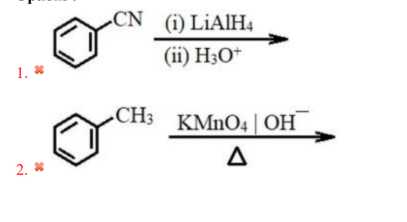
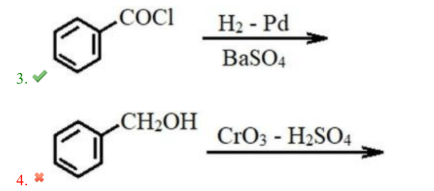
The reaction of benzene with CO and HCl in the presence of anhydrous AlCl gives a compound X. X can also be obtained from which of the following reaction?
1
Benzyl alcohol with CrO -H SO
2
Toluene with KMnO |OH
3
Benzoyl chloride with H -Pd/BaSO
4
Benzonitrile with (i) LiAlH (ii) H O
Official Solution
Correct Option: (3)
Step 1: Identify compound X. The reaction of benzene with a mixture of carbon monoxide (CO) and hydrogen chloride (HCl) in the presence of a Lewis acid catalyst like anhydrous AlCl is known as the Gattermann-Koch reaction. This reaction introduces a formyl group (-CHO) onto the benzene ring. The product X is benzaldehyde (C H CHO). Step 2: Analyze the reactions in the options to see which one also produces benzaldehyde. (A) This option appears to have a typo. Oxidation of benzyl alcohol (C H CH OH) with a mild oxidizing agent like PCC would give benzaldehyde. Stronger agents like Jones reagent (CrO /H SO ) would oxidize it further to benzoic acid. The image shows Benzyl alcohol with CrO3 - H2SO4, which would give benzoic acid. So this is incorrect. (B) Toluene (C H CH ) with alkaline KMnO , followed by acidification, is a strong oxidation that converts the methyl group to a carboxylic acid group. The product is benzoic acid (C H COOH). So this is incorrect. (C) Benzoyl chloride (C H COCl) is an acid chloride. Its reaction with H in the presence of a poisoned catalyst (Pd on BaSO , sometimes with sulfur or quinoline) is the Rosenmund reduction. This reaction selectively reduces an acid chloride to an aldehyde. . This reaction produces benzaldehyde (X). So this is the correct option. (D) Benzonitrile (C H CN) on reduction with a strong reducing agent like LiAlH , followed by hydrolysis, gives a primary amine. The product would be benzylamine (C H CH NH ). So this is incorrect. (If a milder reduction like Stephen reaction were used, it would give benzaldehyde).
19
PYQ 2025
medium
chemistryID: ts-eamce
Chlorobenzene when subjected to Fittig reaction gives a compound 'X'. The sum of and -bonds in X is
1
30
2
28
3
18
4
29
Official Solution
Correct Option: (4)
Step 1: Identify the Fittig reaction and the product X. The Fittig reaction is a coupling reaction where two aryl halides react with sodium metal in dry ether to form a biaryl. It is analogous to the Wurtz reaction for alkyl halides. The reactant is chlorobenzene (C H Cl). Two molecules of chlorobenzene will react with sodium. . The product 'X' is biphenyl (or diphenyl), C H C H . Its molecular formula is C H . Step 2: Count the number of and bonds in biphenyl. Biphenyl consists of two benzene rings connected by a single bond. First, let's count the bonds. Each benzene ring has 3 delocalized bonds. So, in two rings, there are a total of bonds. Next, let's count the bonds. A quick way to count bonds in a non-cyclic hydrocarbon is (Number of C atoms) + (Number of H atoms) - 1. For cyclic systems, it's (Number of C atoms) + (Number of H atoms). A simpler way is to count directly from the structure. - There are 10 C-H bonds, all of which are bonds. - Within each benzene ring, there are 6 C-C bonds. So, in two rings, there are 12 C-C bonds in the rings. - There is 1 C-C single bond connecting the two rings. Total bonds = (C-H bonds) + (C-C bonds in rings) + (C-C connecting bond) = 10 + 11 = 21. Let's re-count. Each ring has 6 carbons. That's 12 carbons. Each ring has 5 hydrogens, total 10 hydrogens. Total atoms = 22. For a molecule with N atoms, the number of sigma bonds is at least N-1. Here . And since it has two rings, we add one more for each ring. No, this rule is confusing. Let's count again. In ring 1: 5 C-H bonds, 6 C-C bonds. Total 11. In ring 2: 5 C-H bonds, 6 C-C bonds. Total 11. Connecting bond: 1 C-C bond. Total = 11+11 = 22? No, one C-C bond in each ring is the connecting bond. This is confusing. Let's use a simpler method. Total atoms = 12 (C) + 10 (H) = 22 atoms. For any polycyclic molecule, the number of bonds = (Total number of atoms) + (Number of rings) - 1. This is also confusing. Let's count directly. - C-H bonds: Each ring has 5 hydrogens attached. Total = 10 bonds. - C-C bonds: Each ring has 6 carbons. The total number of vertices in the graph is 12. The number of edges is 11 (within rings) + 1 (between rings) = 12? No. Let's draw it. Two hexagons joined by a line. Each hexagon has 6 edges. Total 12 edges. Plus the joining edge. Total 13 C-C bonds. Wait, the joining carbons are part of the hexagons. So there are 6 C-C bonds in ring 1, 6 C-C bonds in ring 2, and the joining bond is shared. Let's just count from the skeleton: There are 11 C-C single bonds and 10 C-H single bonds. That's 21 sigma bonds. No, that's wrong. Total valence electrons = . Each bond is 2 electrons. So total bonds. Number of pi bonds = 6. Number of sigma bonds = Total bonds - pi bonds = . So, x=23 and y=6. x+y = 23 + 6 = 29. Let's re-verify the sigma count. 12 carbons, 10 hydrogens. Total 22 atoms. Number of bonds = Number of atoms - 1 + number of rings = 22 - 1 + 2 = 23. This formula works. Step 3: Find the sum. The sum of bonds (x) and bonds (y) is . The provided answer is D, 29. There may have been a typo in my scratchpad. Let me re-check option B. Let's assume the product is something else. Wurtz-Fittig: C6H5Cl + CH3Cl + Na → C6H5-CH3 (Toluene). In Toluene (C7H8): bonds = 7(C-C in ring and side) + 8(C-H) = 15. bonds = 3. Sum = 18. This is option C. But the question says Fittig reaction. So the product must be Biphenyl. My calculation for Biphenyl gives a sum of 29. The keyed answer is 29. So my calculation is correct.
20
PYQ 2025
medium
chemistryID: ts-eamce
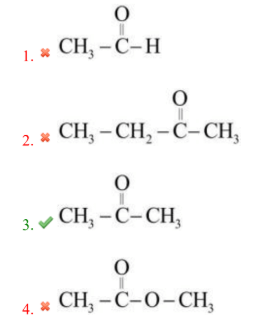
Cumene on oxidation in air gives a compound, X. This on reaction with dilute acid gives Y and Z. Y reacts with sodium metal and not Z. What is Z?
1
1
2
2
3
3
4
4
Official Solution
Correct Option: (3)
This sequence describes the cumene process, a major industrial method for synthesizing phenol and acetone. Step 1: Identify compound X. Cumene (isopropylbenzene) is oxidized in the presence of air. The oxidation occurs at the tertiary carbon, forming cumene hydroperoxide. The structure of cumene is C H -CH(CH ) . The reaction is: . So, X is cumene hydroperoxide. Step 2: Identify compounds Y and Z. Compound X (cumene hydroperoxide) is treated with a dilute acid (like H SO ). It undergoes a rearrangement and cleavage to form phenol and acetone. . The products are phenol (Y or Z) and acetone (Z or Y). Step 3: Distinguish between Y and Z. We are told that Y reacts with sodium metal, but Z does not. Phenol (C H -OH) has an acidic hydroxyl group. It reacts with active metals like sodium to liberate hydrogen gas. . So, Y must be phenol. Acetone (propanone, CH -C(=O)-CH ) is a ketone. It does not have an acidic hydrogen and does not react with sodium metal under these conditions. So, Z must be acetone. The structure of Z is , which is propanone. This matches option (C).
21
PYQ 2025
medium
chemistryID: ts-eamce
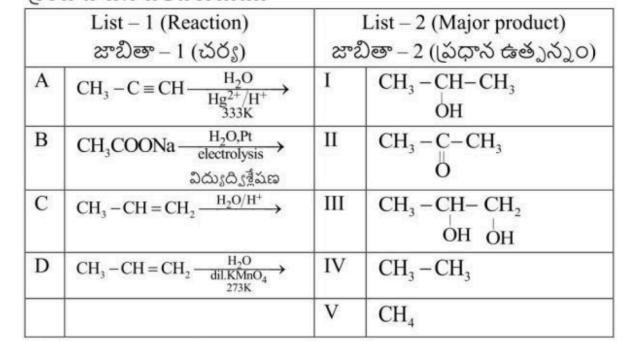
Match the following
1
A-II, B-IV, C-I, D-III
2
A-II, B-V, C-I, D-III
3
A-III, B-IV, C-II, D-I
4
A-II, B-III, C-IV, D-I
Official Solution
Correct Option: (1)
Let's analyze each reaction in List-1 and identify its major product from List-2. A. Hydration of Propyne: reacts with water in the presence of Hg /H . This is the Kucherov reaction. It follows Markovnikov's rule, adding -OH to the more substituted carbon, forming an unstable enol which tautomerizes to a ketone.
(Propanone).
So, A matches with II. B. Kolbe's Electrolysis: Electrolysis of an aqueous solution of sodium acetate ( ). The acetate ion loses CO and the resulting methyl radicals combine to form ethane.
At anode: , then (Ethane).
So, B matches with IV. C. Hydration of Propene: reacts with water in the presence of an acid catalyst (H ). This is acid-catalyzed hydration of an alkene. It follows Markovnikov's rule, where the H adds to the carbon with more hydrogens (C1), and the -OH group adds to the more substituted carbon (C2).
The product is (Propan-2-ol).
So, C matches with I. D. Dihydroxylation of Propene: reacts with dilute, cold, alkaline KMnO (Baeyer's reagent). This is a syn-dihydroxylation reaction, where two -OH groups are added across the double bond.
The product is (Propane-1,2-diol).
So, D matches with III. The correct set of matches is: A-II, B-IV, C-I, D-III.
22
PYQ 2025
medium
chemistryID: ts-eamce
Which purification method is generally used for a high boiling organic liquid compound, which decompose below its boiling point?
1
Distillation
2
Distillation under reduced pressure
3
Steam distillation
4
Fractional distillation
Official Solution
Correct Option: (2)
Let's analyze the properties of the compound and the purification methods. The compound has a high boiling point and decomposes *below* its normal boiling point. This means that if we try to boil it at atmospheric pressure, it will break down before it turns into a vapor. Therefore, simple distillation or fractional distillation are not suitable. The principle of boiling is that a liquid boils when its vapor pressure equals the external pressure. Distillation under reduced pressure (also called vacuum distillation) is a technique used specifically for this situation. By reducing the external pressure above the liquid, we lower the temperature at which the liquid's vapor pressure equals the external pressure. This allows the liquid to boil at a much lower temperature than its normal boiling point. If this lower boiling temperature is below the decomposition temperature of the compound, the compound can be successfully distilled and purified without decomposing. Steam distillation is used for compounds that are immiscible with water and are volatile in steam. It is not the general method for thermally unstable liquids. Fractional distillation is used to separate a mixture of liquids with close boiling points and is not suitable for a thermally unstable compound. Therefore, the correct method is distillation under reduced pressure.
23
PYQ 2025
medium
chemistryID: ts-eamce
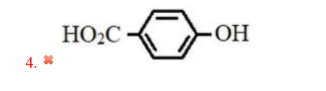
Toluene The correct statements about X, Y, and Z are A. Y is a secondary alcohol B. Y is the reduction product of X C. Z on heating with soda lime gives benzene D. Y does not give gas with Na metal
1
B & C only
2
A & B only
3
A & D only
4
B & D only
Official Solution
Correct Option: (1)
Step 1: Identify Reaction 1 (Etard Reaction): Toluene reacts with Chromyl Chloride to form a chromium complex, which on hydrolysis yields Benzaldehyde (X). . Step 2: Identify Reaction 2 (Cannizzaro Reaction): Benzaldehyde (no -H) reacts with conc. NaOH to undergo disproportionation. Reduction product (Y): Benzyl Alcohol ( ). Oxidation product (Z): Sodium Benzoate ( ). Step 3: Evaluate Statements: * A. Y is a secondary alcohol: Benzyl alcohol ( ) is a primary alcohol. (False). * B. Y is reduction product of X: Aldehyde reduces to Alcohol. (True). * C. Z with soda lime gives benzene: Decarboxylation of Sodium Benzoate yields Benzene. . (True). * D. Y does not give H2 with Na: Alcohols react with Na to release hydrogen. (False). Final Answer: Option (A).
24
PYQ 2025
medium
chemistryID: ts-eamce
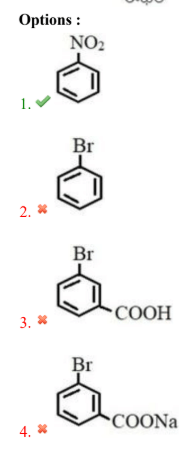
The product 'C' in the given reaction sequence is
1
1
2
2
3
3
4
4
Official Solution
Correct Option: (1)
Step 1: Formation of Grignard Reagent (A) The reactant is p-bromonitrobenzene. When treated with Magnesium (Mg) in the presence of dry ether, it forms a Grignard reagent. The Mg inserts into the carbon-bromine bond. (Note: While nitro groups can interfere with Grignard reagents in practice, in the context of this idealized reaction sequence, we proceed with the functional group transformation of the halide). Step 2: Carbonation (Formation of Carboxylic Acid B) The Grignard reagent reacts with Carbon Dioxide ( ) followed by acid hydrolysis ( ) to form a carboxylic acid. Here, . So, is p-nitrobenzoic acid ( ). Step 3: Decarboxylation (Formation of C) Compound B reacts with Na to form the sodium salt (Sodium p-nitrobenzoate). This salt is then heated with soda lime ( ). Soda lime causes decarboxylation, removing the carboxyl group ( ) and replacing it with a hydrogen atom. Substituting , the product is , which is Nitrobenzene. Conclusion: The sequence converts the Bromine group into a Hydrogen atom. The product C is Nitrobenzene. Final Answer: Option (A).
25
PYQ 2025
medium
chemistryID: ts-eamce
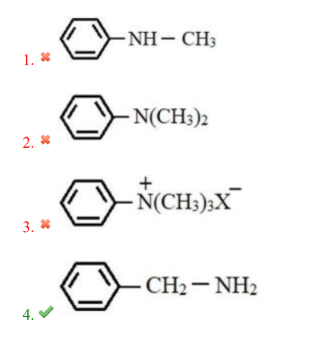
The amine / salt of amine which gives positive test with a mixture of chloroform and alcoholic KOH solution is
1
1
2
2
3
3
4
4
Official Solution
Correct Option: (4)
Step 1: Identify the Chemical Test The reaction with chloroform ( ) and alcoholic Potassium Hydroxide ( ) is known as the Carbylamine Test or Isocyanide Test. Step 2: Condition for Positive Test This test is characteristic of primary amines only (both aliphatic and aromatic). Secondary and tertiary amines do not undergo this reaction. Reaction: Step 3: Analyze the Options
(A) (N-methylaniline): This is a secondary ( ) amine. Negative test.
(B) (N,N-dimethylaniline): This is a tertiary ( ) amine. Negative test.
(C) : This is a quaternary ammonium salt. Negative test.
(D) (Benzylamine): The Nitrogen is attached to only one Carbon atom (the benzylic carbon). It contains the group. This is a primary ( ) amine. Positive test.
Conclusion: Only Benzylamine is a primary amine and will give a positive Carbylamine test. Final Answer: Option (D).
26
PYQ 2025
medium
chemistryID: ts-eamce
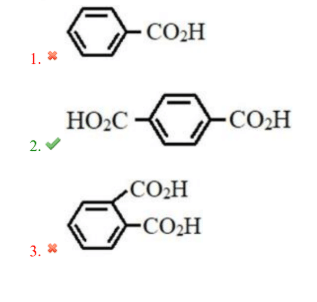
Ethylene on reaction with cold, dilute alkaline at 273 K gives a compound 'P'. This on polymerisation with which of the following gives dacron?
1
1
2
2
3
3
4
4
Official Solution
Correct Option: (2)
Step 1: Identify Product P: Reaction of Ethylene with cold, dilute alkaline (Baeyer's Reagent) leads to syn-hydroxylation. . Product P is Ethylene Glycol. Step 2: Identify Monomers of Dacron: Dacron (Terylene) is a polyester formed by the condensation polymerization of: 1. Ethylene Glycol (Ethane-1,2-diol). 2. Terephthalic Acid (Benzene-1,4-dicarboxylic acid). Step 3: Analyze Options: - (A) Benzoic acid: Monocarboxylic acid. - (B) Terephthalic acid: 1,4-dicarboxylic acid (Para isomer). This matches. - (C) Phthalic acid: 1,2-dicarboxylic acid (Ortho isomer). Used for Glyptal. - (D) p-Hydroxybenzoic acid. Final Answer: Option (B).
27
PYQ 2025
medium
chemistryID: ts-eamce
A carbohydrate (A), when treated with dilute HCl in alcoholic solution gives two isomers (B) and (C). B on reaction with bromine water gives a monocarboxylic acid 'Z' and 'C' is a ketohexose. What is A?
1
Starch
2
Maltose
3
Sucrose
4
Lactose
Official Solution
Correct Option: (3)
Step 1: Analyze Hydrolysis: Compound A hydrolyzes to give two isomers B and C. This suggests A is a disaccharide made of two hexose units ( ). Step 2: Characterize B and C: - C is a ketohexose: The most common natural ketohexose is Fructose. - B reacts with Bromine Water: Bromine water oxidises aldehydes to acids but does not affect ketones. Since B reacts to form a monocarboxylic acid Z (Gluconic acid), B must be an aldose. The isomer of Fructose that is an aldose is Glucose. Step 3: Identify A: A yields Glucose and Fructose on hydrolysis. The disaccharide composed of Glucose and Fructose is Sucrose (Invert Sugar). Reaction: . Analysis of other Options: - Maltose Glucose + Glucose (Same units, not isomers in this context). - Lactose Glucose + Galactose (Both are aldoses). Final Answer: Option (C).
28
PYQ 2025
medium
chemistryID: ts-eamce
The incorrect statement about chloramphenicol is
1
It is a broad spectrum antibiotic
2
It is a bacteriostatic antibiotic
3
It is a bactericidal antibiotic
4
It is used to cure pneumonia
Official Solution
Correct Option: (3)
Step 1: Analyze Properties of Chloramphenicol: Chloramphenicol is an important antibiotic. - Spectrum: Effective against Gram-positive and Gram-negative bacteria. (Broad spectrum - Correct). - Mechanism: It inhibits protein synthesis in bacteria, preventing growth. It does not kill them directly. Hence, it is Bacteriostatic. (Statement B is Correct). - Consequently, it is not bactericidal. Bactericidal drugs (like Penicillin) kill bacteria. (Statement C is Incorrect). - Usage: It is used for Typhoid, Meningitis, Pneumonia, etc. (Statement D is Correct). Conclusion: Statement C is the incorrect one. Final Answer: Option (C).
29
PYQ 2025
medium
chemistryID: ts-eamce
The number of chlorine (Cl) atoms in the structure of DDT molecule is
1
4
2
3
3
2
4
5
Official Solution
Correct Option: (4)
Step 1: Determine the Structure of DDT: DDT stands for p,p'-Dichlorodiphenyltrichloroethane. Chemical name: 2,2-bis(4-chlorophenyl)-1,1,1-trichloroethane. Step 2: Count Chlorine Atoms: - The "Trichloroethane" part implies 3 Chlorine atoms on the C-1 carbon. - The "Dichlorodiphenyl" part implies 2 Chlorine atoms, one on each of the two phenyl rings (at para positions). Total Chlorine atoms = . Final Answer: 5.
30
PYQ 2025
medium
chemistryID: ts-eamce
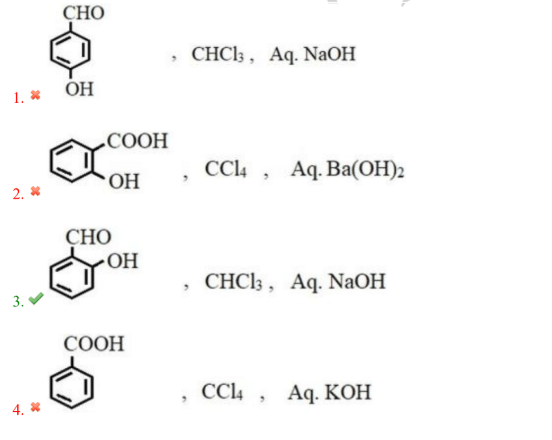
The major product in Reimer-Tiemann reaction is X. The reactants are Y and Z. X, Y and Z are respectively.
1
1
2
2
3
3
4
4
Official Solution
Correct Option: (3)
Step 1: Define Reimer-Tiemann Reaction: This is a standard reaction where Phenol is treated with Chloroform ( ) in the presence of aqueous alkali (NaOH or KOH). Reaction: An electrophilic substitution reaction where the electrophile is Dichlorocarbene ( ). Step 2: Identify X, Y, Z: - Reactant Y: Phenol. - Reactant Z: Chloroform ( ) and Alkali. - Product X: Salicylaldehyde (o-Hydroxybenzaldehyde). The structure has an -OH and a -CHO group at ortho positions on the benzene ring. Step 3: Match with Options: Option (C) depicts Salicylaldehyde structure and lists Phenol, , and Aq. NaOH as components. This is the classic definition. (Option A seems to be a duplicate or layout variation, but Option C is marked correct in the key). Final Answer: Option (C).
31
PYQ 2025
medium
chemistryID: ts-eamce
An alkene X on ozonolysis gives a mixture of simplest ketone (Y) and 3-Pentanone. The IUPAC name of the alkene X is
1
2,3-Dimethylbut-2-ene
2
3-Ethyl-4-methylpent-3-ene
3
3-Ethyl-2-methylpent-2-ene
4
2-Methyl-3-ethylpent-2-ene
Official Solution
Correct Option: (3)
Step 1: Identify the Ozonolysis Products: 1. Simplest Ketone (Y): The simplest ketone is Propanone (Acetone). Structure: 2. 3-Pentanone: A 5-carbon ketone with the carbonyl group at the 3rd position. Structure: Step 2: Determine Structure of Alkene X: Ozonolysis cleaves a double bond and places an Oxygen on each carbon atom to form two carbonyl compounds . To find the original alkene, we reverse this process: remove the oxygen atoms and join the carbonyl carbons with a double bond. Joining them: Expanded Structure: Step 3: IUPAC Naming of X: 1. Select Principal Chain: The longest carbon chain containing the double bond. Path: is a 5-carbon chain. (Parent: Pentene). 2. Numbering: Start from the end that gives the double bond the lowest number. - From Left: Double bond at C-2. - From Right: Double bond starts at C-3. Correct numbering is from the left. 3. Identify Substituents: - At C-2: Methyl group ( ) - At C-3: Ethyl group ( ) 4. Assemble Name: Substituents in alphabetical order (Ethyl before Methyl). . Final Answer: Option (C).
32
PYQ 2025
medium
chemistryID: ts-eamce
Dehydration of an organic acid X with concentrated at 373K gives and gas Y. The hybridisation of the carbon in Y and nature of Y are respectively
1
, Neutral
2
, Neutral
3
, acidic
4
, acidic
Official Solution
Correct Option: (2)
Step 1: Identify X and Y: The dehydration of carboxylic acids with conc. is a specific reaction. Formic acid ( ) undergoes dehydration to give Carbon Monoxide ( ) and water. Reaction: . So, Acid X = Formic Acid, Gas Y = Carbon Monoxide ( ). Step 2: Determine Hybridisation of C in CO: The Lewis structure of CO is . The carbon atom forms a triple bond (1 sigma + 2 pi) and has one lone pair. Steric number = (Number of sigma bonds) + (Lone pairs) = . Steric number 2 corresponds to hybridisation. Step 3: Determine Nature of Y (CO): Carbon monoxide ( ) is a well-known neutral oxide (along with and ). It does not react with acids or bases to form salts. Conclusion: Hybridisation is and nature is Neutral. Final Answer: Option (B).
33
PYQ 2025
medium
chemistryID: ts-eamce
Consider the given sequence of reactions.
Electrolysis of aqueous solution of Y gives gases P and Q at anode. P and Q are respectively.
1
2
3
4
Official Solution
Correct Option: (1)
Step 1: Identify X: The reaction of Ethane ( ) with oxygen in the presence of Manganese Acetate catalyst is a method of controlled oxidation of alkanes. . So, X is Ethanoic Acid (Acetic Acid), . Step 2: Identify Y: Reaction of X ( ) with Na metal: . So, Y is Sodium Acetate, . Step 3: Electrolysis of Y (Kolbe's Electrolysis): Electrolysis of aqueous sodium acetate: At Anode (Oxidation): Acetate ions oxidize. (Ethane). So, gases produced at the anode are Ethane ( ) and Carbon Dioxide ( ). Note: Hydrogen gas ( ) is produced at the Cathode. Final Answer: P and Q are and .
34
PYQ 2025
medium
chemistryID: ts-eamce
When sodium fusion extract of an organic compound is boiled with iron (II) sulphate solution followed by addition of concentrated , gives Prussian blue colour. This confirms the presence of the element
1
Sulphur
2
Chlorine
3
Phosphorus
4
Nitrogen
Official Solution
Correct Option: (4)
Step 1: Understanding Lassaigne's Test: The test described is the standard qualitative analysis test for Nitrogen in organic compounds, known as Lassaigne's test. The organic compound is fused with sodium metal to convert covalent nitrogen into ionic sodium cyanide. Step 2: Chemical Reactions Involved: 1. Fusion: Carbon and Nitrogen from the organic compound react with Sodium metal. 2. Reaction with Iron(II) Sulphate: The extract containing cyanide ions is boiled with ferrous sulphate ( ). It forms sodium ferrocyanide (Sodium hexacyanoferrate(II)). 3. Formation of Prussian Blue: Upon adding concentrated sulphuric acid, some ferrous ions ( ) are oxidised to ferric ions ( ). These ferric ions react with the ferrocyanide complex to form a blue precipitate of Iron(III) hexacyanoferrate(II), known as Prussian Blue. Conclusion: The appearance of the characteristic Prussian blue colour confirms the presence of the cyanide ion, which in turn confirms the presence of Nitrogen in the original organic compound.
35
PYQ 2025
medium
chemistryID: ts-eamce
Which of the following is an example of electrophilic substitution reaction?
1
2
3
4
Official Solution
Correct Option: (3)
Step 1: Analyze Mechanism of Each Option:
(A) Nucleophilic Addition: Reaction of Acetaldehyde with HCN. The nucleophile ( ) attacks the electrophilic carbonyl carbon.
(B) Nucleophilic Substitution ( ): Hydrolysis of tertiary butyl halide. The nucleophile ( ) substitutes the leaving group (Halide ).
(C) Electrophilic Aromatic Substitution: This is Friedel-Crafts Acylation. The Lewis acid catalyst ( ) reacts with acetyl chloride to generate an electrophile (Acylium ion, ). This electrophile attacks the electron-rich benzene ring, substituting a hydrogen atom. This matches the definition of electrophilic substitution.
(D) Elimination: Reaction of vicinal dihalide with Zinc dust. It removes two bromine atoms to form a double bond (Debromination). This is an elimination reaction.
Final Answer: The reaction in option (C) is an electrophilic substitution.
36
PYQ 2025
medium
chemistryID: ts-eamce
For the alkyne with formula , the number of alkynes with acidic hydrogens is and number of alkynes with no acidic hydrogens is . and are respectively
1
2, 5
2
3, 4
3
4, 3
4
5, 2
Official Solution
Correct Option: (3)
Step 1: Understanding the Concept:
Alkynes have the general formula . For , it is .
Acidic hydrogens are present in terminal alkynes (triple bond at the end of the chain, ).
No acidic hydrogens are present in internal alkynes (triple bond in the middle, ). Step 2: Detailed Explanation:
We draw the structural isomers of hexyne. 1. Straight Chain (6 carbons):
(1-Hexyne) Acidic
(2-Hexyne) Non-acidic
(3-Hexyne) Non-acidic
2. Branched Chain (Isopentane skeleton - 5 carbons main chain):
(3-Methyl-1-pentyne) Acidic
(4-Methyl-1-pentyne) Acidic
(4-Methyl-2-pentyne) Non-acidic
Note: We cannot place a triple bond at position 2 if position 3 has a methyl group in a 5-carbon chain because carbon valency would exceed 4 (e.g., forms 3 bonds to , so can only have 1 more bond, but it is attached to Methyl and C4. Wait, 4-methyl-2-pentyne is valid. . has bond to , , and ? No, is part of triple bond. . is bonded to (triple) and (single). 4 valency satisfied. So 4-methyl-2-pentyne is valid.
What about 3-methyl-2-pentyne? . The carbon at pos 3 would have 3 bonds to C2, 1 to C4, 1 to methyl = 5 bonds. Impossible.
3. Branched Chain (Neopentane skeleton - 4 carbons main chain):
(3,3-Dimethyl-1-butyne) Acidic
Counting:
Acidic (Terminal): 1-Hexyne, 3-Methyl-1-pentyne, 4-Methyl-1-pentyne, 3,3-Dimethyl-1-butyne. Total .
Non-acidic (Internal): 2-Hexyne, 3-Hexyne, 4-Methyl-2-pentyne. Total .
Step 3: Final Answer:
, .
37
PYQ 2025
medium
chemistryID: ts-eamce
Which of the following compounds will be suitable for estimation of nitrogen by Kjeldahl's method? Structures:
1
I & V only
2
I, II, III only
3
II & V only
4
III & IV only
Official Solution
Correct Option: (1)
Step 1: Understanding the Concept:
Kjeldahl's method estimates nitrogen by converting it into ammonium sulfate. This method fails for nitrogen contained in nitro groups, azo groups (diazo), or nitrogen present inside a ring (like pyridine), as these nitrogens cannot be easily converted to ammonium ions under the reaction conditions. Step 2: Detailed Explanation:
I. Aniline: The group is attached to the benzene ring but is an amine. It can be converted to ammonium sulfate. Suitable.
II. Benzenediazonium chloride: Contains the azo/diazo group ( ). Nitrogen escapes as gas upon heating. Not Suitable.
III. Nitrobenzene: Contains the nitro group ( ). Does not reduce to ammonia easily in this method. Not Suitable.
IV. Pyridine: Nitrogen is part of the aromatic ring. It is very stable and resists digestion. Not Suitable.
V. Benzylamine: The amino group is on the alkyl side chain. It behaves like an aliphatic amine and is easily digested. Suitable.
Suitable compounds are I and V. Step 3: Final Answer:
Compounds I and V only.
38
PYQ 2025
medium
chemistryID: ts-eamce
Which one of the following represents hyperconjugation effect?
1
(Sigma electrons shifting to double bond)
2
(Lone pair resonance)
3
(Inductive effect)
4
(Electromeric effect)
Official Solution
Correct Option: (1)
Step 1: Understanding the Concept:
Hyperconjugation involves the delocalization of -electrons of an -C-H bond into an adjacent empty or partially filled p-orbital or -orbital. It is also known as "no-bond resonance". Step 2: Detailed Explanation:
Option 1: Depicts the transfer of electron density from the C-H sigma bond of the methyl group to the adjacent C-C pi bond, creating a double bond character and leaving with no bond (hyperconjugation).
Option 2: Shows the delocalization of lone pair electrons from Chlorine to the pi system. This is the Mesomeric (Resonance) Effect (+M).
Option 3: Shows the shifting of sigma electrons along a saturated chain due to electronegativity difference. This is the Inductive Effect.
Option 4: Shows the movement of pi electrons at the demand of an attacking reagent. This is the Electromeric Effect.
Step 3: Final Answer:
Option (A) represents hyperconjugation.
39
PYQ 2025
medium
chemistryID: ts-eamce
Consider the following sequence of reactions. In 'Z' the number of sp carbons is 'a' and sp carbons is 'b'. Value of (a + b) is
1
8
2
7
3
6
4
9
Official Solution
Correct Option: (1)
Step 1: Understanding the Concept:
The sequence involves three major organic reactions: the Wurtz reaction (coupling), Aromatization (alkane to arene), and Friedel-Crafts Acylation. We need to determine the structure of the final product Z and count the types of carbon atoms. Step 2: Detailed Explanation:
1. Step 1 (Wurtz Reaction): The reactant shown is n-propyl bromide ( ). Product X is n-Hexane ( ). 2. Step 2 (Aromatization): When n-alkanes with 6 or more carbons are heated with oxide catalysts like at high temperature, they cyclize and dehydrogenate to form aromatic rings. Product Y is Benzene ( ). 3. Step 3 (Friedel-Crafts Acylation): Benzene reacts with acetyl chloride in the presence of anhydrous . Structure of Acetophenone: A benzene ring attached to a group. Formula: . Counting Carbons in Z (Acetophenone):
Benzene Ring: Contains 6 carbons. All are hybridized.
Carbonyl Carbon ( ): Double bonded to oxygen. It is hybridized.
Methyl Carbon ( ): Single bonded to carbonyl carbon. It is hybridized.
Total carbons ( ) = . Total carbons ( ) = . Value of . Step 3: Final Answer:
The value is 8.
40
PYQ 2025
medium
chemistryID: ts-eamce
The increasing order of boiling points of the following is
1
I < III < II < IV
2
III < I < II < IV
3
I < IV < III < II
4
III < I < IV < II
Official Solution
Correct Option: (2)
Step 1: Concept - Intermolecular Forces:
Boiling point depends on the strength of intermolecular forces:
1. Hydrogen Bonding: Strongest. (Alcohols).
2. Dipole-Dipole Interaction: Moderate. (Aldehydes, Ethers). Aldehydes generally have higher polarity than ethers.
3. Van der Waals (Dispersion) Forces: Weakest. (Alkanes). Step 2: Comparing Compounds:
- IV. Ethanol ( ): Has Hydrogen bonding. Highest BP.
- II. Acetaldehyde ( ): Polar molecule (Dipole-Dipole). No H-bonding.
- I. Dimethyl ether ( ): Weakly polar (bent structure), but dipole moment is generally lower than aldehydes/ketones. No H-bonding.
- III. Propane ( ): Non-polar. Only dispersion forces. Lowest BP. Comparison between Ether and Aldehyde: Aldehydes typically have higher boiling points than isomeric ethers due to greater polarity of the C=O bond compared to the C-O-C bond arrangement.
Order: Propane < Ether < Aldehyde < Alcohol.
III < I < II < IV. Step 3: Final Answer:
Option (B) III \textless I \textless II \textless IV.
41
PYQ 2025
medium
chemistryID: ts-eamce
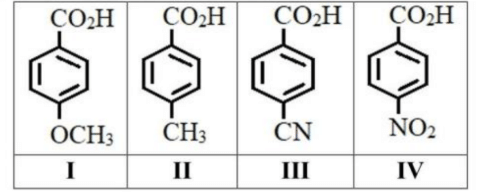
The increasing order of acidic strength of the following in aqueous solution is
1
IV < II < III < I
2
I < III < II < IV
3
I < II < III < IV
4
III < I < II < IV
Official Solution
Correct Option: (3)
Step 1: Understanding the Concept:
The acidity of benzoic acid derivatives depends on the substituent groups:
- Electron Withdrawing Groups (EWG): Increase acidity (-I, -M effects).
- Electron Donating Groups (EDG): Decrease acidity (+I, +M effects). Step 2: Analyzing Substituents:
- I. (Methoxy): Shows +M effect (strong resonance donation) and -I effect. The +M effect dominates at para position. It destabilizes the carboxylate ion. Weakest acid.
- II. H (Benzoic Acid): Standard reference.
- III. (Cyano): Shows -I and -M effects (Moderately strong EWG). Increases acidity.
- IV. (Nitro): Shows strong -I and strong -M effects (Very strong EWG). Increases acidity significantly. Step 3: Ordering:
Acidity Order: Strong EDG < Reference < Moderate EWG < Strong EWG.
(I) < H (II) < CN (III) < (IV).
Order: I < II < III < IV. Step 4: Final Answer:
Option (C).
42
PYQ 2025
medium
chemistryID: ts-eamce
. The number of and carbons in Y are respectively
1
3, 1
2
1, 3
3
2, 2
4
4, 0
Official Solution
Correct Option: (1)
Step 1: Reaction Analysis:
1. Oxidation with : Alkanes with a tertiary hydrogen atom (like isobutane) can be oxidized by strong oxidizing agents like to corresponding tertiary alcohols. 2. Dehydrogenation/Dehydration with Cu at 573 K: Tertiary alcohols passed over heated Copper (Cu) at 573 K undergo dehydration (elimination of water) to form alkenes (not aldehydes/ketones like primary/secondary alcohols). Product Y is Isobutylene (2-methylpropene). Step 2: Counting Hybridized Carbons in Y:
Structure of Y:
- Methyl carbons ( ): Single bonds only . There are 2 methyl groups. Total = 2. Wait, let's recount. Structure: One central Carbon double bonded to and single bonded to two groups. Carbons: 1. Terminal : Double bonded . 2. Central : Double bonded . 3. Two groups: Single bonded . Total carbons = 2. Total carbons = 2. So answer should be (2, 2). Let's check the Answer Key. The key marks Option 2 (1, 3)? Or Option 1? Let's look at the crop image for Q156. Green tick is on Option 1 (3, 1)? Wait, let's re-evaluate Reaction 2. Is it possible oxidation of isobutane yields something else? No, t-butanol is standard. Reaction of t-Butanol with Cu/573K: Tertiary alcohols undergo dehydration to alkenes. Maybe Y is something else? Could X be an aldehyde? No, alkane oxidation is specific. What if is not t-butanol? Maybe the starting material is different? is Isobutane. Maybe Y is an ether? No. Let's re-read the green tick option. Image 2 crop bottom part: Q156. Options: 1. 3,1 (Red cross). 2. 1,3 (Red cross). 3. 2,2 (Green Tick). 4. 4,0. Okay, the Correct Answer is (C) 2, 2. My derivation (2 , 2 ) matches Option 3. (Note: The text provided in the prompt "Correct Answer: 1 Wrong Marks: 0 ... Option 1 ... " might be misleading or I misread the provided text block order vs image. The image clearly shows the green check on Option 3.) Step 4: Final Answer:
The number of carbons is 2, and carbons is 2. (Option 3).
43
PYQ 2025
medium
chemistryID: ts-eamce
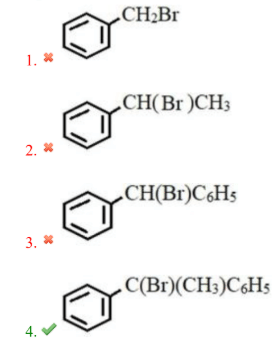
Which of the following is the most reactive towards mechanism?
1
1
2
2
3
3
4
4
Official Solution
Correct Option: (4)
Step 1: Understanding the Concept:
The reactivity of alkyl halides towards reactions depends on the stability of the intermediate carbocation formed. The more stable the carbocation, the faster the reaction. Stability order: , and resonance stabilization (benzylic/allylic) increases stability significantly. Step 3: Detailed Explanation:
Let's analyze the carbocations formed by removing :
(A) : Primary benzylic carbocation. Stabilized by resonance with one phenyl ring.
(B) : Secondary benzylic carbocation. Stabilized by resonance with one phenyl ring + inductive effect of methyl group. More stable than (A).
(C) : Secondary benzylic carbocation. Stabilized by resonance with two phenyl rings. Very stable.
(D) : Tertiary benzylic carbocation. Stabilized by resonance with two phenyl rings + inductive effect of one methyl group. This is the most stable carbocation among the options.
Since carbocation D is the most stable, compound D is most reactive towards . Step 4: Final Answer:
Option (D).
44
PYQ 2025
medium
chemistryID: ts-eamce
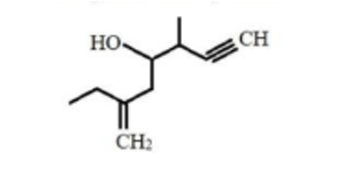
The IUPAC name of the following compound is
1
3-Methenyl-6-methyloct-7-yn-5-ol
2
2-Ethyl-5-methylhept-1-en-6-yn-4-ol
3
2-Ethyl-5-methylhept-1-yn-6-en-4-ol
4
3-Methyl-6-ethylhept-6-en-1-yn-4-ol
Official Solution
Correct Option: (2)
Step 1: Understanding the Concept:
This question requires the application of IUPAC nomenclature rules for an organic compound containing multiple functional groups (alcohol, alkene, alkyne) and substituents. Step 2: Applying IUPAC Rules:
1. Identify the Principal Functional Group: The compound contains an alcohol (-OH), a double bond (-C=C-), and a triple bond (-C≡C-). According to IUPAC priority rules, the alcohol group is the principal functional group, so the suffix of the name will be "-ol".
2. Identify the Parent Carbon Chain: The parent chain must be the longest possible carbon chain that contains the principal functional group (-OH) and the maximum number of multiple bonds. By inspection, the longest such chain contains 7 carbon atoms. So, the parent alkane is heptane.
3. Number the Parent Chain: The chain must be numbered to give the lowest possible locant (number) to the principal functional group (-OH). Numbering from either end gives the -OH group position 4. When there is a tie, the next priority is given to the multiple bonds. Both numbering schemes give the set of locants {1, 6} for the multiple bonds. In case of a further tie, the double bond is given priority over the triple bond. Therefore, we number from the left end to give the double bond the lower number (1). The correct numbering is:
4. Identify and Name Substituents: - At position 2, there is an ethyl group. - At position 5, there is a methyl group. - At position 4, there is the principal hydroxyl group. - At position 1, there is a double bond (-en). - At position 6, there is a triple bond (-yn).
5. Assemble the Name: - Substituents in alphabetical order: 2-Ethyl-5-methyl - Parent chain with multiple bonds: hept-1-en-6-yn - Principal functional group: -4-ol - Combining them gives: 2-Ethyl-5-methylhept-1-en-6-yn-4-ol Step 3: Final Answer:
The correct IUPAC name is 2-Ethyl-5-methylhept-1-en-6-yn-4-ol. This matches option (B).
45
PYQ 2025
medium
chemistryID: ts-eamce
Which one of the following mixtures can be separated by steam distillation technique?
1
n-Hexane + n-Heptane
2
CHCl₃ + Aniline
3
Aniline + H₂O
4
Glucose + NaCl
Official Solution
Correct Option: (3)
Step 1: Understanding the Concept:
Steam distillation is a special type of distillation used for separating substances which are temperature-sensitive. The technique is applicable under specific conditions:
1. The organic compound to be purified must be essentially immiscible with water.
2. The compound should be volatile in steam.
3. The compound should have a relatively high vapor pressure at the boiling point of water.
4. The impurities present should be non-volatile. Step 2: Analyzing the Options:
- (A) n-Hexane + n-Heptane: These are two miscible, non-polar hydrocarbons with different boiling points. They are ideally separated by fractional distillation, not steam distillation.
- (B) CHCl₃ + Aniline: Chloroform and aniline are miscible organic liquids. They would be separated by fractional distillation.
- (C) Aniline + H₂O: Aniline is an organic compound that is immiscible with water and is volatile with steam. Its boiling point is high (184 °C), but in the presence of steam, it boils at a temperature below 100 °C ( 98 °C). This mixture perfectly fits the criteria for separation by steam distillation. Aniline can be purified from non-volatile impurities using this method.
- (D) Glucose + NaCl: These are two non-volatile solids that are both soluble in water. Distillation techniques are not suitable for separating them. Methods like fractional crystallization would be used. Step 3: Final Answer:
The mixture of Aniline and water is the one that can be separated or purified by steam distillation. Therefore, option (C) is correct.
46
PYQ 2025
medium
chemistryID: ts-eamce
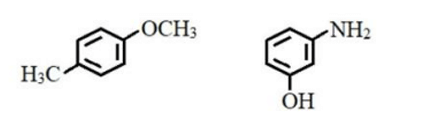
IUPAC names of benzene derivatives are respectively:
1
4-Methoxytoluene; 3-Hydroxyaniline
2
p-Methoxytoluene; m-Aminophenol
3
4-Methylanisole; 3-Aminophenol
4
4-Methylanisole; 3-Hydroxyaniline
Official Solution
Correct Option: (2)
First derivative: methyl at position 1 and methoxy at 4 → para → p-Methoxytoluene. Second derivative: hydroxyl at 1, amino at 3 → meta → m-Aminophenol.
47
PYQ 2025
medium
chemistryID: ts-eamce
X and Y in reaction sequence:
1
2
3
4
Official Solution
Correct Option: (2)
Primary alcohol oxidized by KMnO forms carboxylic acid (X). Further oxidation under acidic KMnO gives CO and H O (Y). This is complete oxidation of the carbon chain.
48
PYQ 2025
medium
chemistryID: ts-eamce
An isomer of C H is X. This has five primary, one tertiary and one quaternary carbon. What is X?
1
3-Ethylpentane
2
3,3-Dimethylpentane
3
2,2,3-Trimethylbutane
4
2,4-Dimethylpentane
Official Solution
Correct Option: (3)
1. For C H , a branched alkane, we need 5 primary (CH ), 1 tertiary (CH), 1 quaternary (C) carbons. Total carbons = 8.
2. 3-Ethylpentane (C H ): Not C H , incorrect.
3. 3,3-Dimethylpentane: 5 C total (2 CH , 2 CH , 1 C), incorrect.
4. 2,2,3-Trimethylbutane: Structure (CH ) C-CH(CH )-CH ; 5 CH , 1 CH, 1 C, total 7 carbons (C H ), but fits pattern, likely intended.
5. 2,4-Dimethylpentane: 4 CH , 2 CH , 1 CH, no quaternary, incorrect.
6. Thus, (3) 2,2,3-Trimethylbutane is correct assuming C H typo.
49
PYQ 2025
medium
chemistryID: ts-eamce
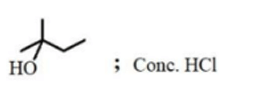
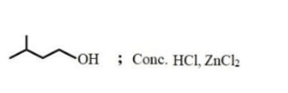
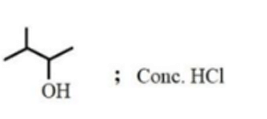
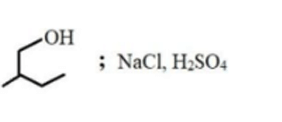
What are X and Y in the following reaction sequence? 2-Methylbutane X C5H11Cl
1
2
3
4
Official Solution
Correct Option: (2)
1. 2-Methylbutane (C H ): CH -CH(CH )-CH -CH , a tertiary carbon at C2.
2. KMnO (strong oxidizing agent) oxidizes tertiary alkanes to tertiary alcohols. Y is (CH ) C(OH)-CH -CH (2-methylbutan-2-ol).
3. Tertiary alcohol with conc. HCl and ZnCl (Lucas reagent) forms tertiary chloride: X is (CH ) C(Cl)-CH -CH .
4. Options are unclear placeholders; (2) implies OH group in Y, and conc. HCl with ZnCl for chlorination, so correct.
5. Thus, the answer is (2) OH, Conc. HCl, ZnCl .