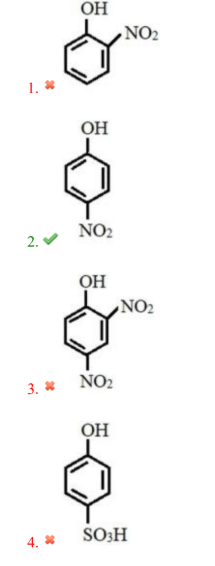
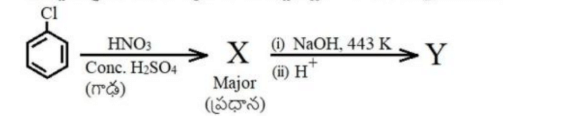
Identify the product 'Y' in the given sequence of reactions. (Chlorobenzene reacts with Conc. HNO and Conc. H SO to give X (Major). X then reacts with (i) NaOH, 443 K and (ii) H to give Y.)
1
Image of 2,4-Dinitrophenol
2
Image of 4-Nitrophenol
3
Image of Picric acid (2,4,6-trinitrophenol)
4
Image of 4-Nitrobenzenesulfonic acid
Official Solution
Correct Option: (1)
Step 1: The first reaction is the nitration of chlorobenzene. Chlorobenzene reacts with a mixture of concentrated nitric acid (HNO ) and concentrated sulfuric acid (H SO ). This is an electrophilic aromatic substitution reaction. The chloro group (-Cl) is an ortho, para-directing group, but it is also deactivating due to its strong -I effect. Nitration will primarily occur at the ortho and para positions. Due to steric hindrance at the ortho position, the para product is usually the major product. However, under forcing conditions, dinitration can occur. The presence of one deactivating group (-Cl) and one activating/directing group (-NO ) makes the second nitration occur at the other ortho/para position relative to -Cl. Chlorobenzene 1-chloro-2-nitrobenzene (minor) + 1-chloro-4-nitrobenzene (major). If the reaction is forced further, dinitration occurs. The -Cl is o,p directing and the -NO group is meta-directing.
Starting from 1-chloro-4-nitrobenzene, the next nitration will be directed to the ortho position relative to the -Cl group (which is also meta to the -NO group).
This gives 1-chloro-2,4-dinitrobenzene. This is often the major product under strong nitrating conditions. Let's assume X is 1-chloro-2,4-dinitrobenzene. So, X = 1-chloro-2,4-dinitrobenzene. Step 2: The second reaction is nucleophilic aromatic substitution. Compound X (1-chloro-2,4-dinitrobenzene) is treated with aqueous NaOH at 443 K, followed by acidification (H ). The presence of two strong electron-withdrawing nitro groups (-NO ) at the ortho and para positions strongly activates the benzene ring towards nucleophilic substitution. The C-Cl bond becomes susceptible to attack by nucleophiles like OH . The OH ion from NaOH will replace the Cl ion. This is a nucleophilic aromatic substitution (S Ar) reaction. 1-chloro-2,4-dinitrobenzene + NaOH Sodium 2,4-dinitrophenoxide + NaCl. The second step is acidification (ii) H . The phenoxide ion is protonated to form the phenol. Sodium 2,4-dinitrophenoxide + H 2,4-Dinitrophenol. So, the final product Y is 2,4-Dinitrophenol. This corresponds to option (A).
02
PYQ 2025
medium
chemistryID: ts-eamce
The correct statements about the products B and C in the given reactions are
(Ethanol reacts with HCl/Anhy ZnCl to give A. A reacts with ethanolic AgCN to give B (Minor) and C (Major)).
I. B and C are functional isomers
II. With H |Catalyst B gives 1 amine and C gives 2 amine
III. B on acid hydrolysis gives formic acid and C gives C H O
IV. C forms isocyanate with HgO
1
I & III
2
II & III
3
I, II & IV
4
II, III & IV
Official Solution
Correct Option: (3)
Step 1: Identify products A, B, and C. Reaction 1: CH CH OH (Ethanol) + HCl A - This is the Lucas test reaction (nucleophilic substitution, -OH replaced by -Cl). - A = CH CH Cl (Ethyl chloride) Reaction 2: CH CH Cl (A) + ethanolic AgCN B (Minor) + C (Major) - AgCN is covalent; N atom attacks the ethyl group, forming isocyanide as major product. - Minor product forms via C-attack forming nitrile. - B (Minor) = CH CH CN (Propionitrile) - C (Major) = CH CH NC (Ethyl isocyanide) Step 2: Evaluate statements about B and C. I. B and C are functional isomers: - B is a nitrile (R-CN), C is an isocyanide (R-NC). - Same molecular formula (C H N) but different functional groups. - Correct statement. II. With H |Catalyst, B gives 1 amine and C gives 2 amine: - Reduction of B: CH CH CN + 2H CH CH CH NH (Primary amine) - Reduction of C: CH CH NC + 2H CH CH NHCH (Secondary amine) - Correct statement. III. B on acid hydrolysis gives formic acid and C gives C H O : - Hydrolysis of B: CH CH CN + 2H O + H CH CH COOH (Propanoic acid) + NH - Hydrolysis of C: CH CH NC + 2H O + H CH CH NH + HCOOH (Formic acid) - Statement is reversed, so incorrect. IV. C forms isocyanate with HgO: - CH CH NC + HgO CH CH NCO (Ethyl isocyanate) + Hg - Correct statement.
03
PYQ 2025
medium
chemistryID: ts-eamce
Consider the following set of reactions.
What are A and B respectively?
1
2
3
4
Official Solution
Correct Option: (2)
Step 1: Identify the nature of intermediate and product: The reaction sequence is given as: Compound gives a positive test with -DNP, which confirms the presence of a carbonyl group (aldehyde or ketone). Thus, must be benzaldehyde, i.e., Further, compound is soluble in dilute , indicating that it is basic in nature, most likely a primary amine. Hence, Step 2: Determine the type of transformations: Conversion of nitrile to aldehyde represents a partial reduction, while conversion of nitrile to a primary amine represents a complete reduction.
Step 3: Identify the reagents involved: Partial reduction of nitriles to aldehydes is achieved using Hence, Complete reduction of nitriles to primary amines can be carried out using Thus, Step 4: Conclusion: Therefore, the correct option is (B).
04
PYQ 2025
medium
chemistryID: ts-eamce
The reagent which is used to distinguish primary, secondary and tertiary amines from the mixture is
1
Fehling's reagent
2
Tollens reagent
3
Lucas reagent
4
Hinsberg's reagent
Official Solution
Correct Option: (4)
Step 1: Understanding the Concept:
The question asks for a chemical test that can differentiate between primary (1Β°), secondary (2Β°), and tertiary (3Β°) amines. This requires a reagent that reacts differently with each class of amine based on the number of hydrogen atoms attached to the nitrogen. Step 2: Analyzing the Reagents:
- (A) Fehling's reagent and (B) Tollens' reagent: These are mild oxidizing agents used to distinguish aldehydes from ketones. They do not react with amines in a way that allows for their differentiation.
- (C) Lucas reagent (Anhydrous ZnClβ + Conc. HCl): This reagent is used to distinguish between primary, secondary, and tertiary alcohols based on the rate of formation of alkyl chlorides. It does not distinguish between amines.
- (D) Hinsberg's reagent (Benzenesulfonyl chloride, CβHβ SOβCl): This is the classic reagent used for the distinction of primary, secondary, and tertiary amines. The test is based on the formation of sulfonamides. - Primary amines (R-NHβ): Have two H-atoms on N. They react with Hinsberg's reagent to form an N-alkylbenzenesulfonamide. This product has an acidic hydrogen on the nitrogen, making it soluble in aqueous alkali (like KOH or NaOH). - Secondary amines (RβNH): Have one H-atom on N. They react with Hinsberg's reagent to form an N,N-dialkylbenzenesulfonamide. This product has no acidic hydrogen on the nitrogen, so it is insoluble in alkali. - Tertiary amines (RβN): Have no H-atoms on N. They do not react with Hinsberg's reagent at all (under these conditions).
Thus, by observing the reaction with Hinsberg's reagent and the subsequent solubility in alkali, one can distinguish between the three classes of amines. Step 3: Final Answer:
Hinsberg's reagent is used to distinguish primary, secondary, and tertiary amines. Therefore, option (D) is correct.
05
PYQ 2025
medium
chemistryID: ts-eamce
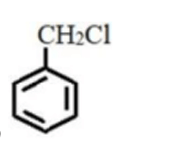
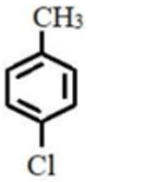
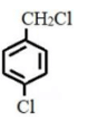
What is the product 'Z' in the following reaction sequence?
1
2
3
4
Official Solution
Correct Option: (3)
Step 1: Understanding the Concept:
This is a multi-step organic synthesis starting from a diazonium salt. It involves a Sandmeyer reaction, a Wurtz-Fittig reaction, and an electrophilic aromatic substitution reaction. Step 2: Tracing the Reaction Sequence:
- Step 1: Formation of X The starting material is benzenediazonium chloride (CβHβ NβCl). The reaction with CuβClβ/HCl is a Sandmeyer reaction. This reaction replaces the diazonium group (-NβCl) with a chlorine atom. So, X is chlorobenzene.
- Step 2: Formation of Y Chlorobenzene (X) is reacted with methyl chloride (CHβCl) and sodium metal in dry ether. This is a Wurtz-Fittig reaction, which couples an aryl halide with an alkyl halide to form an alkylbenzene. So, Y is toluene (methylbenzene).
- Step 3: Formation of Z Toluene (Y) is reacted with chlorine (Clβ) in the presence of iron (Fe) in the dark. This is a halogenation reaction, which is an electrophilic aromatic substitution. The methyl group (-CHβ) is an ortho-, para-directing and activating group. The reaction will produce a mixture of o-chlorotoluene and p-chlorotoluene. So, Z is a mixture of ortho- and para-chlorotoluene. Step 3: Identifying Z from the Options:
We need to find the option that represents ortho- and/or para-chlorotoluene.
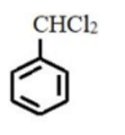
- Option (A): Benzyl chloride (CβHβ CHβCl). This would be formed by free-radical chlorination in the presence of UV light, not Fe/dark.
- Option (B): Toluene (Y). This is an intermediate.
- Option (C): This image shows p-chlorotoluene and o-chlorotoluene. This is the correct product mixture for Z. The image seems to show the para isomer.
- Option (D): Dichloromethane on a benzene ring, which is not a plausible product.
Looking at the options, option (C) correctly depicts one of the major products of the final step (p-chlorotoluene). Step 4: Final Answer:
The product Z is a mixture of o-chlorotoluene and p-chlorotoluene. The structure shown in option (C) is p-chlorotoluene, a major product of the reaction. Therefore, (C) is the correct answer.