The number of amphoteric, basic, and acidic oxides among the following respectively are:
1
3, 2, 3
2
3, 3, 2
3
3, 4, 1
4
2, 5, 3
Official Solution
Correct Option:
(2)
Step 1: Classify the oxides as acidic, basic, or amphoteric:
- Basic oxides:
- Acidic oxides:
- Amphoteric oxides:
Step 2: Count the oxides in each category:
- Amphoteric: 3 ( )
- Basic: 3 ( )
- Acidic: 2 ( ) Thus, the correct answer is option (2).
02
PYQ 2024
medium
chemistryID: ts-eamce
Identify the correct statements from the following:
I. is a basic oxide.
II. is more ionic in nature than .
III. Boron reacts with dinitrogen at high temperature to form BN.
1
I, II only
2
I, III only
3
II, III only
4
I, II, III
Official Solution
Correct Option:
(4)
- Statement I: is a basic oxide. This is correct, as behaves as a basic oxide. - Statement II: is more ionic in nature than . This is true. is more ionic compared to due to the difference in oxidation states of titanium. - Statement III: Boron reacts with dinitrogen at high temperature to form BN. This is correct, as boron nitride (BN) is formed under these conditions. Thus, all statements are correct.
03
PYQ 2024
medium
chemistryID: ts-eamce
In group 14 elements, the element with highest melting point is X and element with lowest melting point is Y. X and Y respectively are
1
Si, C
2
Si, Pb
3
C, Sn
4
Sn, C
Official Solution
Correct Option:
(4)
In group 14 elements: - Silicon (Si) has a relatively high melting point. - Tin (Sn) has the lowest melting point. Thus, the correct order is Sn (lowest melting point) and C (highest melting point).
04
PYQ 2025
medium
chemistryID: ts-eamce
An acid `X' is prepared by acidifying an aqueous solution of borax. Which of the following statements are true for `X'?
I. It is white liquid with soapy touch
II. It is sparingly soluble in water
III. It is strong monobasic acid
IV. It acts as Lewis acid
1
II, IV only
2
II, III, IV only
3
I, II, III only
4
I, III only
Official Solution
Correct Option:
(1)
Step 1: Identify Acid 'X':
When an aqueous solution of Borax ( ) is acidified (usually with HCl or ), it yields Orthoboric acid ( ).
Reaction:
So, X is Boric Acid ( ). Step 2: Analyze the Statements about Boric Acid:
Statement I: It is a white crystalline solid (not liquid) with a soapy touch. So, "liquid" makes this statement False.
Statement II: Boric acid is sparingly soluble in cold water but highly soluble in hot water. True.
Statement III: It is a very weak monobasic acid (not strong). It does not donate directly; rather, it accepts from water. False.
Statement IV: It acts as a Lewis acid because the central boron atom has an incomplete octet (electron deficient) and accepts an electron pair from ion of water ( ). True.
Step 3: Conclusion:
Statements II and IV are true.
05
PYQ 2025
medium
chemistryID: ts-eamce
Among the following the neutral oxide is
1
2
3
4
Official Solution
Correct Option:
(2)
Step 1: Analyze the Nature of Oxides:
: Germanium(II) oxide is acidic/amphoteric in nature.
: Carbon monoxide is a well-known neutral oxide (it reacts with neither acids nor bases to form salts).
: Germanium(IV) oxide is distinctly acidic (and slightly amphoteric).
: Carbon dioxide is an acidic oxide (forms carbonic acid with water).
Step 2: Identify Neutral Oxides:
Common neutral oxides are , , and . Step 3: Conclusion:
is the neutral oxide.
06
PYQ 2025
medium
chemistryID: ts-eamce
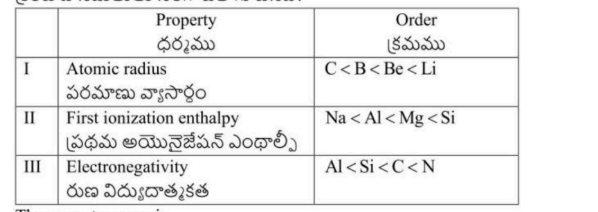
Which of the following sets are correctly matched?
1
I, II, III
2
I, II Only
3
II, III Only
4
I, III Only
Official Solution
Correct Option:
(1)
Step 1: Check Set I (Atomic Radius):
Trend: Atomic radius decreases from left to right across a period due to increasing effective nuclear charge.
Elements: Li ( ), Be ( ), B ( ), C ( ).
Correct Order: (or ).
Status: Correct. Step 2: Check Set II (Ionization Enthalpy - IE):
Trend: Generally increases left to right.
Exceptions:
Be ( )>B ( ) (Penetration/Stability).
Mg ( )>Al ( ) (Stability of full s-orbital).
Elements: Na ( ), Mg ( ), Al ( ), Si ( ).
Correct Order: . (Al comes before Mg due to the exception).
Status: Correct. Step 3: Check Set III (Electronegativity):
Trend: Increases left to right across a period.
Elements from Group 13 to 15: Al (1.61), Si (1.90), C (2.55), N (3.04).
Although Al and Si are period 3 and C and N are period 2, N is the most electronegative, followed by C. Metals/Metalloids (Al, Si) have lower EN.
Correct Order: .
Status: Correct. Step 4: Conclusion:
All three sets are correctly matched.
07
PYQ 2025
medium
chemistryID: ts-eamce
The reaction/s which represent the production of diborane on an industrial scale is/are:
I. 4BF + 3LiAlH → 2B H + 3LiF + 3AlF
II. 2NaBH + I → B H + 2NaI + H
III. 2BF + 6NaH → B H + 6NaF
1
III only
2
I, II only
3
I only
4
I, III only
Official Solution
Correct Option:
(2)
Industrial production of diborane (B H ) commonly uses the reduction of BF with metal hydrides. Reaction I uses LiAlH and Reaction II uses NaBH . Reaction III is less practical industrially. Therefore, I and II are correct reactions.
08
PYQ 2025
medium
chemistryID: ts-eamce
The correct order of atomic radii of Al, Ga, In, Tl is
1
Al < Ga < In < Tl
2
Ga < Al < In < Tl
3
Ga < Al < Tl < In
4
Al < In < Ga < Tl
Official Solution
Correct Option:
(2)
1. Atomic radii generally increase down a group due to additional electron shells.
2. For group 13 (Al, Ga, In, Tl), expect Al
3. Approximate radii: Al (143 pm), Ga (135 pm), In (167 pm), Tl (170 pm).
4. Thus, the order is Ga
5. Therefore, the correct option is (2) Ga < Al < In < Tl.
09
PYQ 2025
medium
chemistryID: ts-eamce
Which of the following set of Oxides is not correctly matched?
1
SnO, PbO - Neutral
2
SnO , PbO - Amphoteric
3
SiO , GeO - Acidic
4
CO , GeO - Acidic
Official Solution
Correct Option:
(1)
1. In group 14, the nature of oxides changes down the group, with acidity decreasing and basicity increasing.
2. Option (1): SnO and PbO are amphoteric oxides, meaning they can react with both acids and bases. For example, SnO + 2HCl → SnCl + H O (acidic) and SnO + 2NaOH → Na SnO + H O (basic). Similarly for PbO. They are not neutral, so this set is incorrectly matched.
3. Option (2): SnO and PbO are amphoteric, reacting with acids (e.g., SnO + 4HCl → SnCl + 2H O) and bases (e.g., SnO + 2NaOH → Na SnO + H O), correct.
4. Option (3): SiO and GeO are acidic oxides. SiO reacts with bases to form silicates (SiO + 2NaOH → Na SiO + H O), and GeO is similar, correct according to standard classifications.
5. Option (4): CO is acidic (forms carbonic acid with water), and GeO is acidic (behaves like an acidic oxide), correct.
6. Therefore, the set not correctly matched is (1) SnO, PbO - Neutral.
10
PYQ 2025
medium
chemistryID: ts-eamce
Correct statements regarding halides of group 14 elements:
I. Stability of dihalides: SiX > GeX > SnX > PbX
II. SnF , PbF are ionic
III. PbI does not exist
1
II, III only
2
I, III only
3
I, II only
4
I, II, III
Official Solution
Correct Option:
(1)
The inert pair effect makes Pb(IV) less stable, so PbI does not exist. Fluorides of Sn and Pb are ionic due to the high electronegativity of F. The trend in statement I does not correctly reflect the effect of inert pair.
11
PYQ 2025
medium
chemistryID: ts-eamce
Ionization enthalpies of the elements X, Y, Z having successive atomic numbers respectively are 2080, 496, 737 kJ mol . X, Y, Z are:
1
Na, Mg, Al
2
Ne, Na, Mg
3
B, C, N
4
O, N, F
Official Solution
Correct Option:
(1)
• Ionization enthalpy: energy required to remove an electron.
• X = 2080 kJ/mol → very high, corresponds to noble gas configuration after first electron removed, so Na → Ne configuration.
• Y = 496 kJ/mol → Mg (low, easy to remove electron).
• Z = 737 kJ/mol → Al.
• Hence elements X, Y, Z = Na, Mg, Al.
12
PYQ 2025
medium
chemistryID: ts-eamce
Identify the number of metalloids from the following: Sb, Be, P, Ge, Te, S, Cs, Tc, I
1
3
2
4
3
5
4
2
Official Solution
Correct Option:
(1)
1. Metalloids exhibit properties intermediate between metals and nonmetals, typically along the staircase in the p-block.
2. Standard metalloids: B, Si, Ge, As, Sb, Te, Po, At.
3. From the list: Sb (antimony) – yes; Ge (germanium) – yes; Te (tellurium) – yes.
4. Be (beryllium) – metal; P (phosphorus) – nonmetal; S (sulfur) – nonmetal; Cs (cesium) – metal; Tc (technetium) – metal; I (iodine) – nonmetal.
5. Thus, 3 metalloids.
6. Therefore, the correct option is (1) 3.
About The P Block Elements - TS-EAMCET
The P Block Elements is a vital chapter for TS-EAMCET aspirants. Mastering the concepts covered in this chapter is essential for securing a top rank.
By rigorously practicing the previous year questions associated with this chapter, you can identify high-yield topics, understand the examiner's perspective, and boost your confidence during the actual exam.
Frequently Asked Questions
Why focus on The P Block Elements PYQs?
Analyzing PYQs for this specific chapter reveals the most frequently tested concepts and the typical complexity of questions, allowing you to tailor your study plan efficiently.
How to best use this analysis?
Review the topic breakdown to see which sub-topics within The P Block Elements carry the most weight. Then, tackle the questions iteratively to solidify your understanding.