Ziegler-Natta Catalyst is used in the manufacture of
1
Polyacrylonitrile
2
Terylene
3
High density polythene
4
Low density polythene
Official Solution
Correct Option: (3)
Step 1: Understand the Ziegler-Natta Catalyst:
The Ziegler-Natta catalyst is a compound used in the polymerization process, primarily in the manufacture of high-density polyethylene (HDPE) and low-density polyethylene (LDPE). It facilitates the polymerization of alkenes and can also be used for producing other types of plastics.
Step 2: Identify the Correct Product of Ziegler-Natta Catalyst:
The Ziegler-Natta catalyst is particularly used in the polymerization of ethylene to produce polyethylene, which can be either high-density or low-density polyethylene depending on the polymerization conditions.
Step 3: Analyze the Options:
Polyacrylonitrile: This is a synthetic polymer, but it is not produced by the Ziegler-Natta catalyst. It is produced through a different process, so this option is incorrect.
Terylene: Terylene (also known as polyester) is a synthetic polymer made from terephthalic acid and ethylene glycol. It is not made using the Ziegler-Natta catalyst, so this option is incorrect.
High density polyethylene (HDPE): This is produced using the Ziegler-Natta catalyst, making this the correct option.
Low density polyethylene (LDPE): This is also produced using the Ziegler-Natta catalyst under different conditions, so this option is incorrect.
Final Answer: The correct product made using the Ziegler-Natta catalyst is High density polyethylene (HDPE).
02
PYQ 2024
medium
chemistryID: ts-eamce
Kaolinite is a silicate mineral of metal 'X' and calamine is a carbonate mineral of metal 'Y'. X and Y respectively are:
1
Fe, Cu
2
Zn, Al
3
Al, Zn
4
Zn, Cu \bigskip
Official Solution
Correct Option: (3)
Step 1: Understanding Kaolinite ( ) - Kaolinite is a silicate mineral that contains Aluminium (Al). - The chemical formula of kaolinite is . - Since Aluminium (Al) is the primary metal present in kaolinite, X = Al. Step 2: Understanding Calamine ( ) - Calamine is a carbonate mineral that contains Zinc (Zn). - The chemical formula of calamine is (Zinc carbonate). - Since Zinc (Zn) is the primary metal present in calamine, Y = Zn. Step 3: Identifying the Correct Option - X = Al, Y = Zn matches Option (3). ✅ - The other options contain incorrect metal assignments. \bigskip
03
PYQ 2024
medium
chemistryID: ts-eamce
Cellulose is a polysaccharide and is made of:
1
- units joined through 1,4-glycosidic linkages
2
- units joined through 1,4-glycosidic linkages
3
- units joined through 1,6-glycosidic linkages
4
- units joined through 1,6-glycosidic linkages
Official Solution
Correct Option: (1)
Cellulose is a linear polysaccharide made of - units. These glucose units are connected by 1,4-glycosidic linkages, forming long chains. The alternating -configuration allows for hydrogen bonding, making cellulose a strong and rigid structure. Hence, the correct answer is - units joined through 1,4-glycosidic linkages.
04
PYQ 2024
medium
chemistryID: ts-eamce
At 300 K, 0.06 kg of an organic solute is dissolved in 1 kg of water. The vapour pressure of the solution is 3.768 kPa. If the vapour pressure of pure water at that temperature is 3.78 kPa, what is the molar mass of the solute (in g mol )?
1
180
2
120
3
340
4
260 \bigskip
Official Solution
Correct Option: (3)
Step 1: Using the Relative Lowering of Vapour Pressure Formula
where, = vapour pressure of pure water = 3.78 kPa = vapour pressure of solution = 3.768 kPa = moles of solute = moles of solvent Step 2: Calculating Moles of Water Step 3: Calculating Molar Mass of Solute Solving for , Thus, the molar mass of the solute is 340 g/mol. \bigskip
05
PYQ 2024
medium
chemistryID: ts-eamce
In which of the following ions the spin-only magnetic moment is lowest?
1
2
3
4
\bigskip
Official Solution
Correct Option: (1)
Step 1: Finding the Electronic Configuration - has an electronic configuration of → 1 unpaired electron.
- has → 5 unpaired electrons.
- has → 2 unpaired electrons.
- has → 3 unpaired electrons. Step 2: Magnetic Moment Calculation Magnetic moment ( ) is given by:
For :
Since has the lowest unpaired electrons, it has the lowest magnetic moment. \bigskip
06
PYQ 2024
easy
chemistryID: ts-eamce
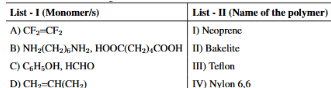
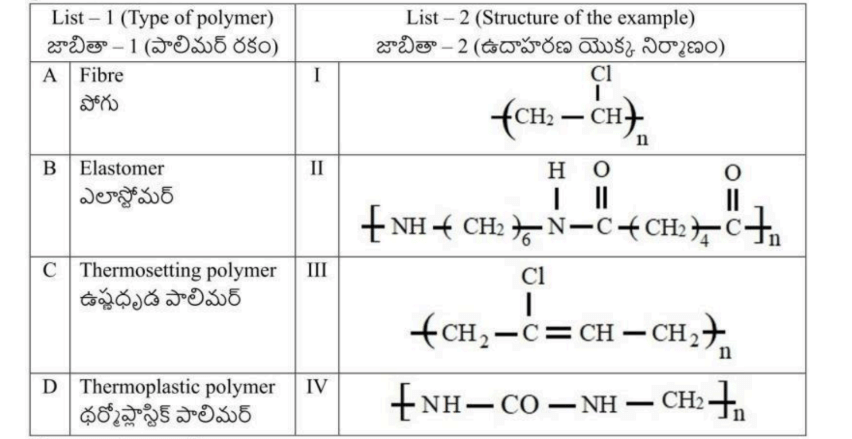
Match the following:
The correct answer is:
1
A-II; B-III; C-I; D-IV
2
A-III; B-IV; C-II; D-I
3
A-III; B-IV; C-I; D-II
4
A-III; B-I; C-IV; D-II
Official Solution
Correct Option: (2)
Let's analyze each monomer and match it with the correct polymer:
A. CF2=CF2 (Tetrafluoroethylene) is the monomer used to produce Teflon. B. NH2(CH2)6NH2 (Hexamethylenediamine) and HO2C(CH2)4CO2H (Adipic acid) are the monomers used to produce Nylon 6,6. C. C6H5OH (Phenol) and HCHO (Formaldehyde) are the monomers used to produce Bakelite. D. CH2=CH(Cl)-CH=CH2 (Chloroprene) is the monomer used to produce Neoprene.
Therefore, the correct matching is:
A - III (Teflon)
B - IV (Nylon 6,6)
C - II (Bakelite)
D - I (Neoprene)
Final Answer: (2) A-III; B-IV; C-II; D-I
07
PYQ 2024
medium
chemistryID: ts-eamce
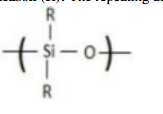
Assertion (A): Silicones are used for waterproofing of fabrics. Reason (R): The repeating unit in silicones is
1
(A) and (R) are correct, but (R) is not the correct explanation of (A).
2
(A) and (R) are correct, (R) is the correct explanation of (A).
3
(A) is not correct but (R) is correct.
4
(A) is correct but (R) is not correct. \bigskip
Official Solution
Correct Option: (1)
Step 1: Understanding Assertion (A) - Silicones are widely used for waterproofing fabrics because they form a hydrophobic layer. - This property arises due to their low surface energy and non-polarity. - Thus, Assertion (A) is correct. Step 2: Understanding Reason (R) - The basic repeating unit in silicones consists of Si-O-Si linkages with organic groups (R) attached to silicon. - The repeating unit given in the reason is correct. Step 3: Checking Explanation Validity - While (R) correctly describes the structure of silicones, it does not explain why silicones are used for waterproofing. - Waterproofing occurs due to hydrophobicity, which is influenced by surface chemistry rather than just the repeating unit. - Since (R) does not explain (A) directly, the correct answer is option (1). \bigskip
08
PYQ 2024
medium
chemistryID: ts-eamce
The monomer which is present in both Bakelite and Melamine polymers is:
1
Methanal
2
Methanol
3
Phenol
4
Ethane-1, 2-diol
Official Solution
Correct Option: (1)
Step 1: Understand the Monomers of Bakelite and Melamine - Bakelite and Melamine are both thermosetting polymers, and both are made by the polymerization of formaldehyde (methanal). - Bakelite is formed by the reaction of phenol with formaldehyde, while Melamine is made by polymerizing melamine (a nitrogen-rich compound) with formaldehyde.
Step 2: Identify the Common Monomer - The common monomer for both Bakelite and Melamine polymers is formaldehyde (methanal), which reacts with different monomers (phenol for Bakelite, melamine for Melamine) to form the respective polymers. Hence, the correct answer is methanal.
09
PYQ 2024
medium
chemistryID: ts-eamce
The number average molecular weight (M ) of a polymer is 1500. In this polymer, 800 molecules of molar mass 1000, 100 molecules of molar mass 2000 and x molecules of molar mass 5000 are present. What is the value of x?
1
200
2
400
3
100
4
50
Official Solution
Correct Option: (3)
The number average molecular weight is calculated using the formula: where is the number of molecules of molar mass . Substituting the given values: Simplifying the equation: Multiplying both sides by : Solving for : Thus, the value of is 100.
10
PYQ 2024
medium
chemistryID: ts-eamce
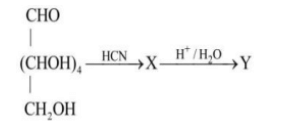
What is the IUPAC name of the product Y in the given reaction sequence?
1
2,3,4,5,6,7 - hexahydroxyheptanoic acid
2
2,3,4,5,6,7 - pentahydroxyhexanoic acid
3
3,4,5,6 - trihydroxyheptanoic acid
4
3,4,5 - trihydroxy hexanoic acid
Official Solution
Correct Option: (1)
The reaction sequence starts with an aldehyde group, which reacts with cyanide to form a cyanohydrin intermediate. Upon hydrolysis, the cyano group is converted into a carboxyl group, resulting in hexahydroxyheptanoic acid as the product Y.
11
PYQ 2024
medium
chemistryID: ts-eamce
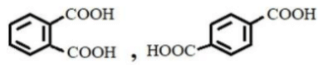
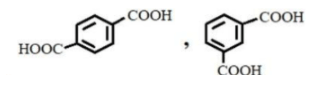
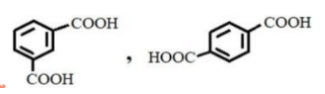
What are ‘X’ and 'Y' respectively in the following reactions?

1
2
3
4
Official Solution
Correct Option: (1)
Step 1: Identifying the Reaction Pathway 1. The given transformation involves polymerization reactions: - The first step converts a polymer used in making safety helmets into ethylene glycol ( ). - The second step converts ethylene glycol into a polymer used in paint manufacturing. 2. Identifying the polymers: - The polymer used in safety helmets is polycarbonate or poly(terephthalic acid-co-bisphenol A). - The polymer used in paint manufacturing is polyester, commonly synthesized from terephthalic acid and ethylene glycol. Step 2: Determining X and Y - Y (Reactant for first step): Terephthalic acid derivative leading to ethylene glycol formation. - X (Reactant for second step): Terephthalic acid, which reacts with ethylene glycol to form polyester. Step 3: Evaluating the Given Options - Option (1): Correct, as it correctly identifies the structure of terephthalic acid derivatives leading to polymer formation. - Option (2): Incorrect, as it swaps the structures incorrectly. - Option (3): Incorrect, as it does not correctly represent the intermediate. - Option (4): Incorrect, as it provides incorrect reactants. Thus, the correct answer is
Option (1).
12
PYQ 2024
medium
chemistryID: ts-eamce
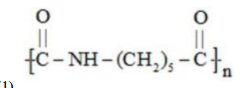
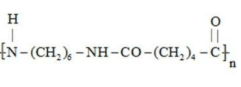
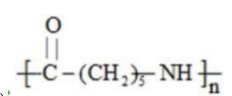
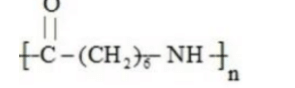
Identify the structure of the polymer ‘P’ formed in the given reaction:

1
2
3
4
Official Solution
Correct Option: (3)
Step 1: Understanding the Polymerization of Caprolactam - Caprolactam undergoes ring-opening polymerization to form Nylon-6.
- The repeating unit of Nylon-6 is . Step 2: Identifying the Correct Structure - The correct option corresponds to Nylon-6 polymer structure. \bigskip
13
PYQ 2024
medium
chemistryID: ts-eamce
The number average molecular weight (M ) of a polymer is 1500. In this polymer, 800 molecules of molar mass 1000, 100 molecules of molar mass 2000 and x molecules of molar mass 5000 are present. What is the value of x?
1
200
2
400
3
100
4
50
Official Solution
Correct Option: (3)
The number average molecular weight is calculated using the formula: where is the number of molecules of molar mass . Substituting the given values: Simplifying the equation: Multiplying both sides by : Solving for : Thus, the value of is 100.
14
PYQ 2024
medium
chemistryID: ts-eamce
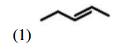
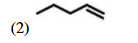
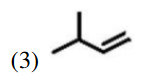
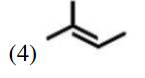
An alkene ( ) on reaction with gave ( ). undergoes hydrolysis via an mechanism. What is ?
1
2
3
4
Official Solution
Correct Option: (4)
Step 1: Understanding the Reaction - The given alkene X ( ) reacts with HBr to form Y ( ). - The formed Y undergoes hydrolysis via the mechanism.
Step 2: Identifying the Mechanism - The mechanism involves the formation of a stable carbocation intermediate. - Tertiary carbocations are more stable than secondary and primary carbocations.
Step 3: Analyzing the Given Alkenes - Option (1): Forms a primary carbocation upon HBr addition (Least stable) - Option (2): Forms a secondary carbocation (Less stable) - Option (3): Forms a primary carbocation, unfavorable for - Option (4): Forms a tertiary carbocation, which is the most stable
Step 4: Conclusion - Since the most stable tertiary carbocation is formed in option (4), this is the correct alkene .
15
PYQ 2024
medium
chemistryID: ts-eamce
Which of the following vitamins is also called pyridoxine?
1
2
3
4
\bigskip
Official Solution
Correct Option: (1)
Step 1: Understanding Pyridoxine - Pyridoxine is another name for Vitamin . - It plays a crucial role in amino acid metabolism, neurotransmitter synthesis, and hemoglobin production. \bigskip
16
PYQ 2024
medium
chemistryID: ts-eamce
A polymer contains 800 molecules of molar mass 1000, 100 molecules of molar mass 2000 and 100 molecules of molar mass 5000. What is its number average molecular weight ( )?
1
150
2
15000
3
1500
4
150000
Official Solution
Correct Option: (3)
To find the number average molecular weight ( ), we use the formula: where:
- is the number of molecules of each type,
- is the molar mass of each type. Given the data:
- and ,
- and ,
- and . Now, calculating : Thus, the number average molecular weight .
17
PYQ 2025
medium
chemistryID: ts-eamce
Match the following The correct answer is
1
A-II, B-IV, C-I, D-III
2
A-II, B-III, C-IV, D-I
3
A-III, B-I, C-IV, D-II
4
A-III, B-II, C-IV, D-I
Official Solution
Correct Option: (2)
Let's identify each polymer structure and match it to its type. Structure I:
This is the repeating unit of Polyvinyl chloride (PVC). PVC is a classic example of a thermoplastic polymer. It softens on heating and can be remolded.
So, D I. Structure II:
This is the structure of Nylon 6,6. Nylons are polyamides characterized by strong intermolecular forces (hydrogen bonds), which lead to close packing of chains. This makes them strong and crystalline, a characteristic of fibres.
So, A II. Structure III:
This is the structure of Neoprene (polychloroprene), a synthetic rubber. Rubbers are characterized by weak intermolecular forces and coiled polymer chains, allowing them to stretch and return to their original shape. They are elastomers.
So, B III. Structure IV: The image shows a highly cross-linked structure derived from urea and formaldehyde. The repeating unit is that of Urea-formaldehyde resin. This resin forms an extensive 3D network of covalent bonds upon heating, which sets into a hard, infusible solid. It cannot be remolded. This is the definition of a thermosetting polymer.
So, C IV. Matching the pairs:
A II
B III
C IV
D I This corresponds to option (B).
18
PYQ 2025
easy
chemistryID: ts-eamce
The polymer chains are held together by hydrogen bonding in a polymer X. Polymer X is formed from monomers Y and Z. What are Y and Z?
Official Solution
Correct Option: (1)
19
PYQ 2025
medium
chemistryID: ts-eamce
Consider the following statements
Statement - I : Natural rubber is a polymer of 2-chloro-1, 3-butadiene
Statement - II : 1, 3-Butadiene-styrene copolymer is synthetic rubber
The correct answer is

1
Both statements I and II are correct
2
Both statements I and II are not correct
3
Statement I is correct, but statement II is not correct
4
Statement I is not correct, but statement II is correct
Official Solution
Correct Option: (4)
Step 1: Analyze Statement I:
Natural rubber is a linear polymer of Isoprene (2-methyl-1,3-butadiene), specifically cis-1,4-polyisoprene.
The polymer of 2-chloro-1,3-butadiene (Chloroprene) is called Neoprene (synthetic rubber).
Therefore, Statement I is Incorrect. Step 2: Analyze Statement II:
1,3-Butadiene-styrene copolymer is known as Buna-S (SBR - Styrene Butadiene Rubber). This is a widely used synthetic rubber.
Therefore, Statement II is Correct. Step 3: Conclusion:
Statement I is False, Statement II is True. Matches Option (D).
20
PYQ 2025
medium
chemistryID: ts-eamce
Neoprene is the polymer of a monomer X. IUPAC name of X is
1
1,3-Butadiene
2
2-Methyl-1,3-butadiene
3
2-Iodo-1,3-butadiene
4
2-Chloro-1,3-butadiene
Official Solution
Correct Option: (4)
Step 1: Understanding the Concept:
This question tests the knowledge of common addition polymers and their corresponding monomers. Neoprene is a synthetic rubber known for its good chemical stability and resistance to oil and heat. Step 2: Identifying the Monomer of Neoprene:
Neoprene is the trade name for the polymer polychloroprene. It is formed by the free-radical polymerization of its monomer unit, chloroprene.
The structure of chloroprene is:
The polymerization reaction is:
Step 3: Determining the IUPAC Name of the Monomer (X):
The monomer is chloroprene, with the structure .
- The parent chain is a four-carbon chain containing two double bonds: a butadiene.
- The double bonds start at carbon 1 and carbon 3.
- There is a chlorine substituent at carbon 2.
- Therefore, the IUPAC name is 2-Chloro-1,3-butadiene. Step 4: Analyzing Other Options:
- (A) 1,3-Butadiene is the monomer for Buna rubbers (e.g., Buna-S, Buna-N).
- (B) 2-Methyl-1,3-butadiene is the monomer for natural rubber. Its common name is isoprene.
- (C) 2-Iodo-1,3-butadiene is not a common monomer for a well-known polymer. Final Answer:
The IUPAC name of the monomer X for neoprene is 2-Chloro-1,3-butadiene. Therefore, option (D) is correct.
21
PYQ 2025
medium
chemistryID: ts-eamce
The catalyst used in the preparation of high density polythene is
1
2
3
Persulphate
4
Official Solution
Correct Option: (1)
1. High-density polyethylene (HDPE) is produced via Ziegler-Natta catalysis, which uses a combination of triethylaluminium ( ) and titanium tetrachloride ( ).
2. This catalyst enables stereospecific polymerization of ethylene, forming linear, high-density polymers.
3. Option (2) benzoyl peroxide is used for free radical polymerization (e.g., polystyrene). Option (3) persulphate initiates low-density polyethylene. Option (4) is used in polyester synthesis.
4. Thus, the answer is (1) .
22
PYQ 2025
medium
chemistryID: ts-eamce
Arrange the following polymers in increasing order of intermolecular forces:
1
II < III < I
2
III < II < I
3
II < I < III
4
II < III < I
Official Solution
Correct Option: (3)
Polymers with phenyl groups have strongest Van der Waals forces due to bulky aromatic rings. Ester linkages allow moderate hydrogen bonding. C=C polymer has weakest intermolecular forces. Hence II < I < III.