Evolution
39 previous year questions.
High-Yield Trend
Chapter Questions 39 MCQs
% Diagram placeholder \begin{center} \includegraphics[scale=0.8]{Q18.png} \end{center}
(b) Cite an example where more than one adaptive radiation has occurred in an isolated geographical area. Name the type of evolution your example depicts.
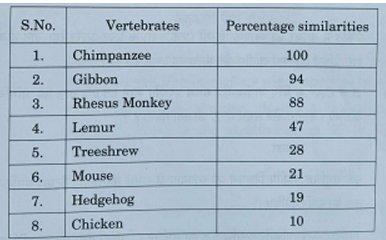
Read the following passage and answer the questions that follow. According to evolutionary theory, every evolutionary change involves the substitution of a new gene for the old one and the new allele arises from the old one. Continuous accumulation of changes in the DNA coding for proteins leads to evolutionary differences. The chemical composition of DNA is basically the same in all living beings, except for differences in the sequence of nitrogenous bases. Given below are percentage relative similarities between human DNA and DNA of other vertebrates: 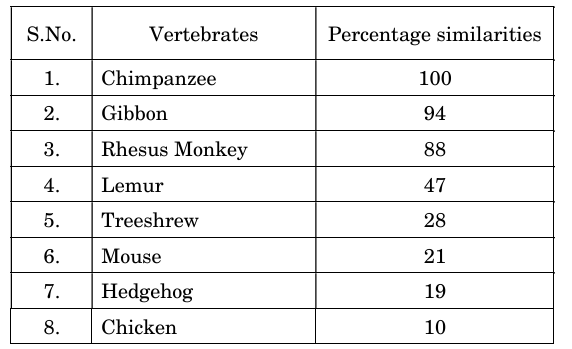
(a) What is the term used for the substitution of a new gene for the old one and the new allele arising from the old one during evolutionary process?
(b) Which one of the following holds true for the data provided in the above table?
- [(A)] Greater the evolutionary distance, greater are the differences in the nitrogenous bases.
- [(B)] Lesser the evolutionary distance, greater are the differences in the nitrogenous bases.
- [(C)] Greater the evolutionary distance, lesser are the differences in the nitrogenous bases.
- [(D)] Lesser the evolutionary distance, lesser are the differences in the nitrogenous bases.
(c) [(i)] To which category of evolution (divergent or convergent) does the following relationship belong? Justify your answer.
Human and Rhesus Monkey
OR
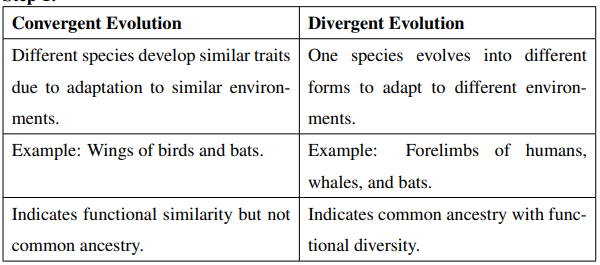
[(ii)] Differentiate between Convergent and Divergent evolution.
Reason (R): Effects of industrialisation were more marked in rural areas of England.
(i) Ferns (ii) Ginkgo (iii) Zosterophyllum (iv) Gnetales
Choose the correct option.
(b) Cite an example where more than one adaptive radiation has occurred in an isolated geographical area. Name the type of evolution your example depicts.
- 15 mya — Primates walking like gorillas and chimpanzees existed.
- 3–4 mya — Man-like primates walked in Eastern Africa. Fossils of their bones were discovered.
- 2 mya — This ancestor lived in the East African grasslands and ate fruits.
- 1.5 mya — This hominid had a brain size of 900 cc and probably ate meat.
- [(a)] Name one primate about 15 mya.
- [(b)] Name one place where fossils of primates were discovered in Eastern Africa.
- [(c)] Name the ancestor that lived in the East African grasslands about 2 mya.
- [(d)] Name the hominid that was found around 1.5 mya.
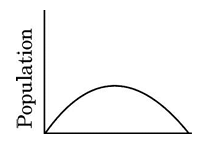
The given graph shows the range of variation among population members, for a trait determined by multiple genes. If this population is subjected to disruptive selection for several generations, which of the following distributions is most likely to result?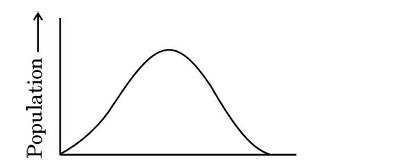
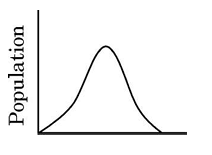
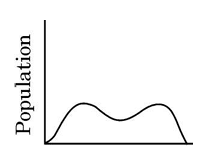
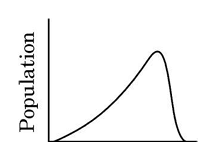
Read the following passage and answer the questions that follow:
In 2021, 5.3 percent of 15 to 16-year-olds worldwide (13.5 million individuals) had used Cannabis in the past year according to UNODC. The adolescent brain is still developing and drug use can have long-term negative effects. Early drug use initiation can lead to faster development of dependence than in adults and other problems in adulthood. Parts of the Amazon Basin are at the intersection of multiple forms of organized crimes that are accelerating devastation, with severe implications for the security, health, and well-being of the population across the region. The direct impact of coca cultivation on deforestation is minimal, but indirectly it acts as a catalyst for "Narco-deforestation." The laundering of drug trafficking profits into land speculation etc. is posing a growing danger to the world's largest rainforest.
(a) Which age group or period of growth are people more vulnerable to drug abuse?
(b) Explain the negative impact of coca cultivation on the world's largest rainforest.
(c)
(i) From which part of the plant are cannabinoids mainly obtained? Mention any one negative effect of this drug on adolescents.
OR
(ii) State the scientific name of the plant from which coca alkaloids are derived and state one negative impact of the use of excessive dosage of cocaine.
Which of the following combinations is a correct example of convergent evolution in Australian marsupials and placental mammals? 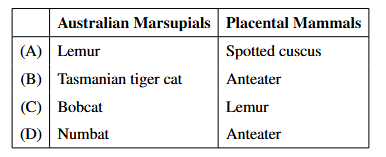
Read the following passage and answer the questions that follow.
The most convincing evidence to trace evolutionary relationships between humans and different groups of animals come from the basic similarities seen at the molecular level. Study the table given below that depicts the number of amino acid differences between the haemoglobin polypeptide of a few animals with that of humans and answer the questions that follow.
| S.No. | Animal | No. of amino acid differences in haemoglobin with that of humans |
|---|---|---|
| 1. | Macaque | 08 |
| 2. | Dog | 32 |
| 3. | Bird | 45 |
| 4. | Frog | 67 |
| 5. | Lamprey | 125 |
(a) To which category of evolution (Divergent or Convergent) do the following evolutionary relationships belong to:
(i) Humans and Macaque
(ii) Humans and Frog
(b) What do the biochemical similarities in haemoglobin suggest about the evolutionary relationship between humans, frog, and lamprey?
(c) (i) Which one of the two – lampreys’ or macaques’ evolution is more closely related to humans and why?
OR
(c) (ii) Which one of the two – frogs’ or dogs’ evolution is more closely related to humans and why?
According to evolutionary theory, every evolutionary change involves the substitution of a new gene for the old one and the new allele arises from the old one. Continuous accumulation of changes in the DNA coding for proteins leads to evolutionary differences. The chemical composition of DNA is basically the same in all living beings, except for differences in the sequence of nitrogenous bases. Given below are percentage relative similarities between human DNA and DNA of other vertebrates:
(i) Seaweed
(ii) Invertebrates
(iii) Jawless fish
Reason (R) : In Industrial environment lichen covered trees were replaced by soot-covered trees offering better camouflage to dark coloured moths.
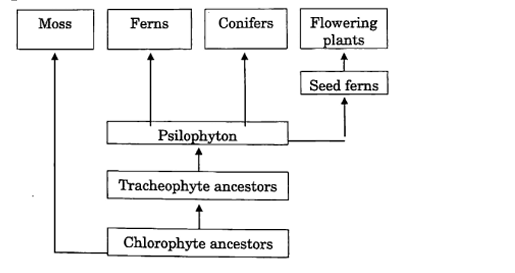
(b) Name the nearest ancestors of flowering plants.
(c) Name the most primitive group of plants.
(d) Psilophytan provides common ancestry to which classes?
(e) Name the common ancestor of psilophytan and seed ferns.
(f) Name the common ancestor of mosses and tracheophytes.
About Evolution - CBSE-CLASS-XII
Evolution is a vital chapter for CBSE-CLASS-XII aspirants. Mastering the concepts covered in this chapter is essential for securing a top rank.
By rigorously practicing the previous year questions associated with this chapter, you can identify high-yield topics, understand the examiner's perspective, and boost your confidence during the actual exam.
Frequently Asked Questions
Why focus on Evolution PYQs?
Analyzing PYQs for this specific chapter reveals the most frequently tested concepts and the typical complexity of questions, allowing you to tailor your study plan efficiently.
How to best use this analysis?
Review the topic breakdown to see which sub-topics within Evolution carry the most weight. Then, tackle the questions iteratively to solidify your understanding.