Principles Of Inheritance And Variation
57 previous year questions.
High-Yield Trend
Chapter Questions 57 MCQs
A karyotype of a human suffering from a certain disorder is given below: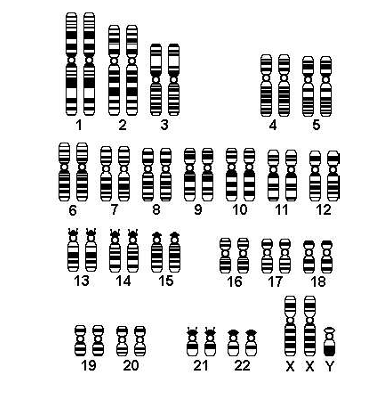
Answer the following:
- [(a)] Identify the disorder.
- [(b)] Write the symptoms of the disorder.
- [(c)] Give reason for such a disorder.
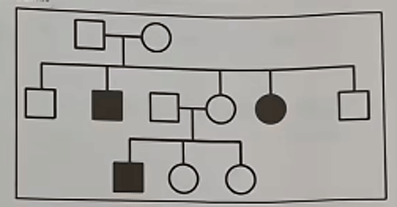
In the given pedigree chart, a cross between a normal couple resulted in a son who was haemophilic and a normal daughter. In course of time, when the daughter was married to a normal man, to their surprise the grandson was also haemophilic.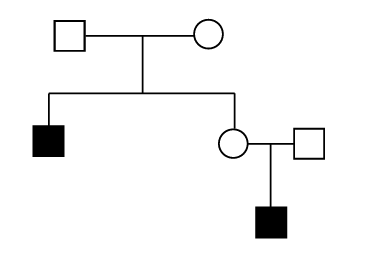
Choose the option that indicates the correct inheritance of trait in the above pedigree chart:
1. Perform a cross between two sickle cell carriers. What ratio is obtained between carrier, disease free and diseased individuals in F1 progeny? Name the nitrogenous base substituted, in the haemoglobin molecule in this disease.
2. Explain the difference in inheritance pattern of flower colour in garden pea plant and snap-dragon plant with the help of monohybrid crosses.
OR,
Explain with the help of well-labelled diagrams how lac operon operates in E. coli :
1. In presence of an inducer.
2. In absence of an inducer.
Study the pedigree chart given below, showing the inheritance pattern of blood group in a family:
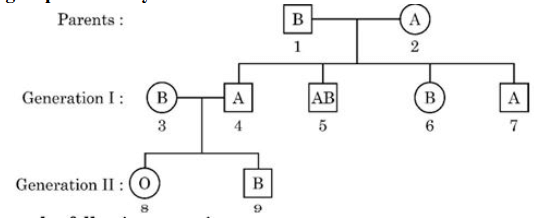
Answer the following questions:
(a) Give the possible genotypes of individual 1 and 2.
(b) Which antigen or antigens will be present on the plasma membranes of the R.B.Cs of individuals ‘5’ and ‘8’?
The sequence of nitrogenous bases in a segment of a coding strand of DNA is
5' – AATGCTAGGCAC – 3'. Choose the option that shows the correct sequence of nitrogenous bases in the mRNA transcribed by the DNA.
In the pedigree chart given below, what should be the genotype of the indicated member? 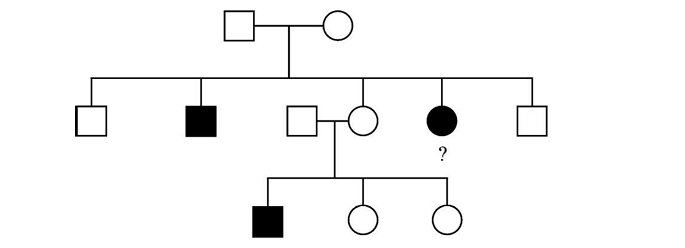
Answer the following questions with respect to the sex determining mechanism observed in honey bee.
- [(a)] Name the type of sex determination system observed in honey bee.
- [(b)] Fill in the blanks (i), (ii) and (iii) in the given question.
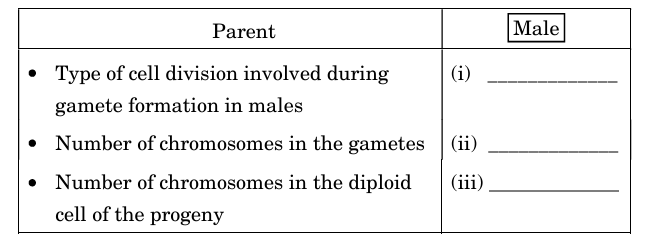
- [(c)] What will be the sex and chromosome number of the progeny formed from the unfertilised eggs of honey bee?
Reason (R): Two genes present on different chromosomes show linkage and recombination in Drosophila.
Study the pedigree chart of a family sharing the inheritance of sickle cell anemia.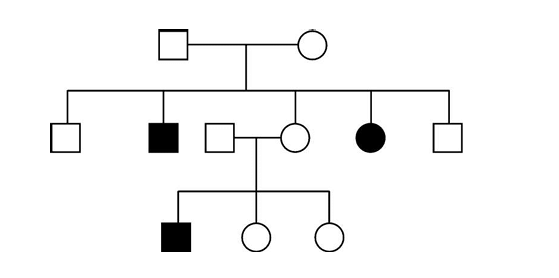
The trait traced in the above pedigree chart is:
Study the given pedigree chart in which neither of the parents shows the trait but the trait is present in both male and female children. 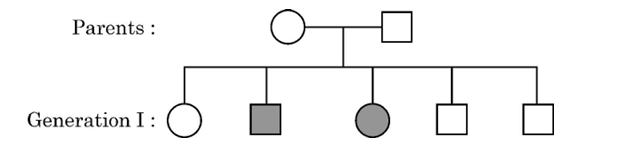
Answer the following questions:
(a) Write the trait, also explain the inheritance of such trait in the progeny on the basis of given pedigree chart.
(b) Give one example of such trait in human beings.
In a pedigree chart  represents :
A pedigree chart is shown below for a disease that is autosomal dominant. The genetic make-up of the first generation is: 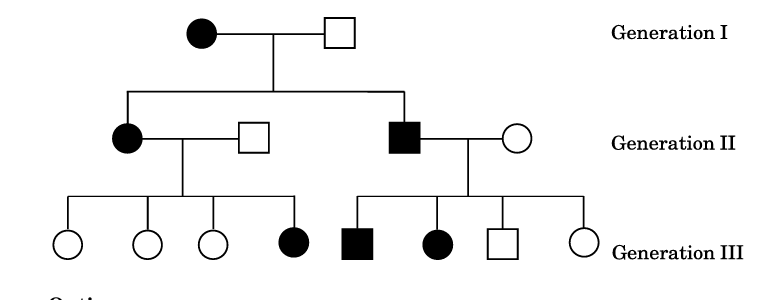
Study the pedigree chart of a family showing the inheritance of myotonic dystrophy: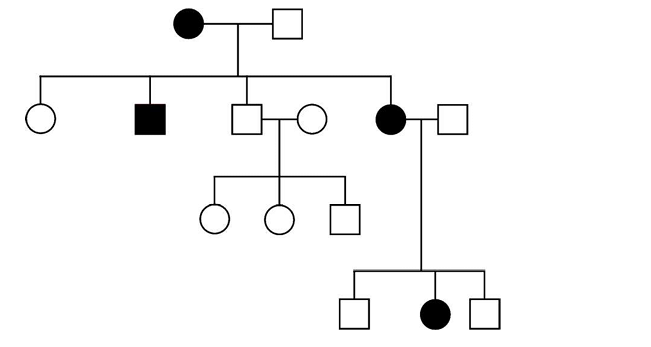
The trait under study is:
Reason (R): The gene for haemophilia lies on X-chromosome.
Reason (R): The gene for haemophilia lies on X-chromosome.
In a certain population, the frequency of three genotypes is as follows:
Genotypes: PP Pp pp
Frequency: 22% 62% 16%
Choose the option that shows the frequency of P and p alleles correctly:
Answer the following questions:
(a)
- What is a test cross? How can we find out the zygosity of a plant by the use of test cross?
- Why are human females rarely haemophilic? Explain with the help of a cross. Under what conditions can a haemophilic female be born? How do haemophilic patients suffer?
OR
(b) Name the two events ‘a’ and ‘c’ shown in the diagram below. 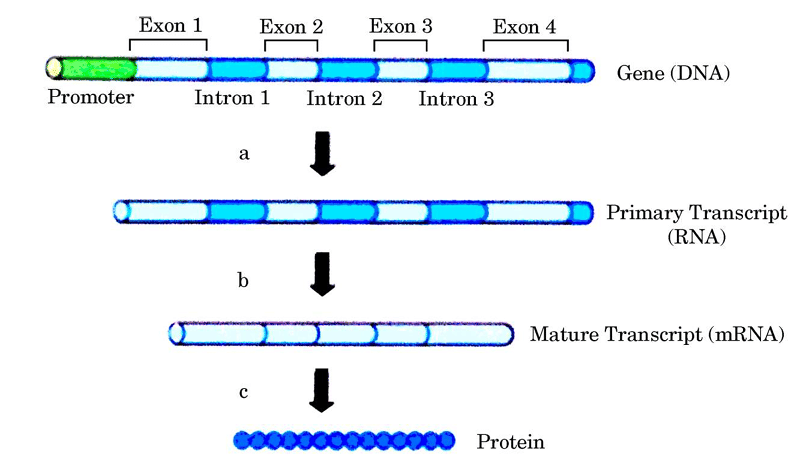
- Mention where in the cell these events take place.
- Explain the changes taking place during event ‘b’ and mention why these are needed.
- Write the scientific name of the fruit fly.
- Why did Morgan prefer to work with fruit flies for his experiments? State two reasons.
Reason (R): The male produces millions of sperms of the same kind.
Answer either option-(A) or (B): (A)
- Name the two genes encoding for the Bt toxin protein used in biotechnology for the control of cotton bollworms.
- How does the expression of Bt toxin gene in Bt cotton plant help in providing resistance to cotton bollworms? Explain.
OR (B)
- Explain the given methods of introducing the alien DNA in the host cells:
- (I) Biolistics
- (II) Microinjection
- How is E. coli made 'competent' to take up a recombinant plasmid or DNA?
Thomas Hunt Morgan carried out several dihybrid crosses in Drosophila melanogaster to study genes that were sex linked.
(a) Give four major reasons for using the tiny fruit flies by Morgan for his experiments.
(b) How did Morgan and his group explain the physical association of the two genes on a chromosome to the frequency of recombination between gene pairs on the same chromosome?
1. Haemophilia and red-green colour-blindness is usually observed in men. Why?
2. Perform a cross (or crosses) where haemophilic daughter(s) and haemophilic son(s) are
produced in the same ratio.
OR
1. Where do transcription and translation occur in bacteria and eukaryotes respectively?
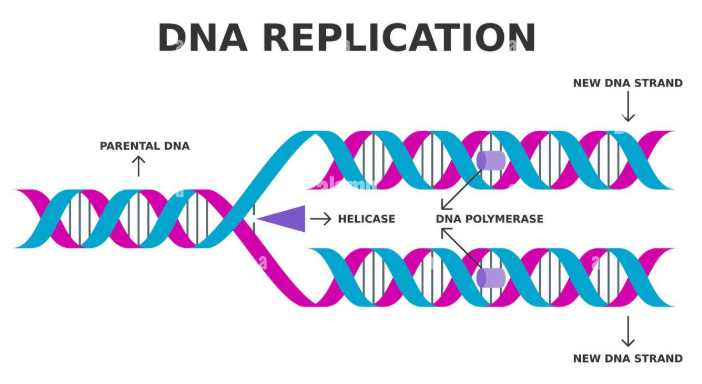
2. Draw a labelled schematic sketch of replication fork of DNA.
3. A DNA segment has a total of 1000 nucleotides, out of which 240 of them are Adenine-containing nucleotides. How many pyrimidine bases does this segment possess?
Which of the following is not an example of aneuploidy?
Klinefelter’s syndrome
Reason (R): Frequency of recombination between gene pairs on different chromosomes as a measure of the distance between genes can be used for ‘mapping’ their position on the chromosomes.
(A) is false, but (R) is true.
Tt × Tt
Why was he successful in his hybridisation experiments? Give two reasons.
State the law of independent assortment as proposed by Mendel after his dihybrid crosses.
Reason (R): More than two genes in a population govern the same character in ABO blood grouping in humans.
Assertion (A): In dihybrid crosses involving sex-linked genes in , generation of non-parental gene combinations are observed
Reason (R): Two genes present on different chromosomes show linkage and recombination in
Explain how the addition of lactose in the medium regulates the switching on of the operon in bacteria.
Assertion (A) : In dihybrid crosses involving sex-linked genes in , generation of non-parental gene combinations are observed.
Reason (R) : Two genes present on different chromosomes show linkage and recombination in
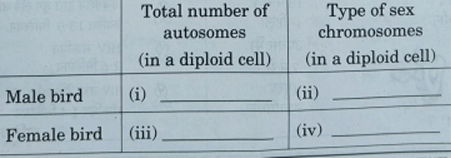
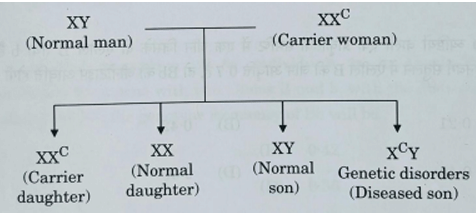
Case I: Males have (XO) sex chromosomes and females have two copies of same sex chromosome (XX).
Case II: Females have two different sex chromosomes (ZW) and males have two copies of same sex chromosome (ZZ).
Identify the type of heterogamety in each case, giving one example of each.
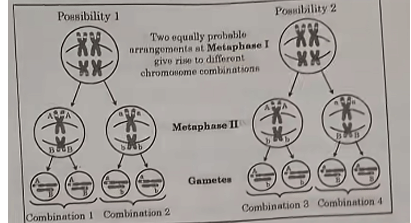
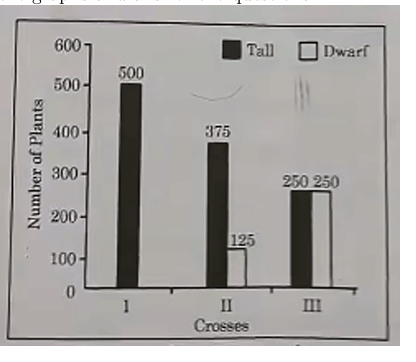
A student performed some crosses in plants and represented the result in the form of bar graphs as shown below. Each graph displays the phenotypic proportion of the progeny. Study the graphs and answer the questions:
About Principles Of Inheritance And Variation - CBSE-CLASS-XII
Principles Of Inheritance And Variation is a vital chapter for CBSE-CLASS-XII aspirants. Mastering the concepts covered in this chapter is essential for securing a top rank.
By rigorously practicing the previous year questions associated with this chapter, you can identify high-yield topics, understand the examiner's perspective, and boost your confidence during the actual exam.
Frequently Asked Questions
Why focus on Principles Of Inheritance And Variation PYQs?
Analyzing PYQs for this specific chapter reveals the most frequently tested concepts and the typical complexity of questions, allowing you to tailor your study plan efficiently.
How to best use this analysis?
Review the topic breakdown to see which sub-topics within Principles Of Inheritance And Variation carry the most weight. Then, tackle the questions iteratively to solidify your understanding.