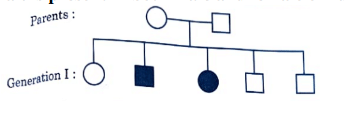
Study the given pedigree chart in which neither of the parents shows the trait but the trait is present in both male and female children.
Give one example of such a trait in human beings.
Official Solution
Correct Option: (1)
Example of a Recessive Trait in Humans
Observation: The given pedigree chart shows that neither of the parents expresses the trait, but both male and female children exhibit it. This pattern suggests the inheritance of a **recessive trait**.
Example of such a trait in humans:
An example of a recessive trait that follows this pattern is **cystic fibrosis**.
Cystic fibrosis is caused by a mutation in the CFTR gene, which leads to the production of thick mucus in the lungs and digestive system.
The condition is inherited in a recessive manner, meaning both parents must be carriers (heterozygous) for the child to inherit the disease.
Even though neither parent shows symptoms, they can pass on the mutated gene to their offspring, who can then express the trait if they inherit the mutated gene from both parents.
02
PYQ 2025
medium
biologyID: cbse-cla
Study the given pedigree chart in which neither of the parents shows the trait but the trait is present in both male and female children.
Write about the trait, also explain the inheritance of such a trait in the progeny on the basis of the given pedigree chart.
Official Solution
Correct Option: (1)
Analyzing the Pedigree Chart and Inheritance Pattern
Step 1: Analyzing the Pedigree Chart
- In the pedigree chart, neither of the parents shows the trait (as both the father and mother are represented without filled circles or squares). - However, both the male and female children (represented by filled circles and squares) show the trait. - This suggests that the trait is recessive in nature. Both parents are carriers of the trait (heterozygous) and pass it on to the offspring.
Step 2: Explanation of the Inheritance Pattern
- The trait is inherited in a recessive manner, and both parents must be carriers of the recessive allele (genotype Aa) for the trait to be expressed in their children. - Since the trait is expressed in both male and female children, this suggests autosomal inheritance.
Step 3: Conclusion
- The parents are carriers of a recessive allele (genotype Aa), and the trait is autosomal recessive. The children inherited the recessive allele from both parents (genotype aa), resulting in the expression of the trait.
03
PYQ 2025
medium
biologyID: cbse-cla
(A)
Perform a cross between two sickle cell carriers. What ratio is obtained between carrier, disease free and diseased individuals in progeny? Name the nitrogenous base substituted, in the haemoglobin molecule in this disease. Explain the difference in inheritance pattern of flower colour in garden pea plant and snap-dragon plant with the help of monohybrid crosses. \begin{center} OR
\end{center} (B) Explain with the help of well-labelled diagrams how lac operon operates in \textit{E. coli} :
In presence of an inducer. In absence of an inducer.
Official Solution
Correct Option: (1)
Step 1 (A):
\begin{itemize} Cross between two sickle cell carriers (Hb Hb × Hb Hb ) results in: \begin{itemize} 1 Normal (Hb Hb ) 2 Carriers (Hb Hb ) 1 Diseased (Hb Hb ) \end{itemize} Ratio = 1:2:1 Substitution: Adenine is replaced by Thymine in the sixth codon of the beta globin gene, leading to substitution of glutamic acid by valine. \end{itemize} \begin{itemize} Garden Pea Plant: Shows complete dominance (e.g., red × white flower yields all red in ). Snap-Dragon Plant: Shows incomplete dominance (e.g., red × white yields pink in ). Monohybrid cross in pea plant gives a phenotypic ratio of 3:1, while in snap-dragon it is 1:2:1. \end{itemize} Step 2 (B):
\begin{itemize} In presence of an inducer (e.g., lactose): \begin{itemize} Inducer binds to repressor. Repressor becomes inactive. RNA polymerase transcribes structural genes (lac Z, Y, A). Enzymes for lactose metabolism produced. \end{itemize} In absence of an inducer: \begin{itemize} Active repressor binds to operator. RNA polymerase is blocked. No transcription. No enzyme production. \end{itemize}
\end{itemize}
04
PYQ 2025
medium
biologyID: cbse-cla
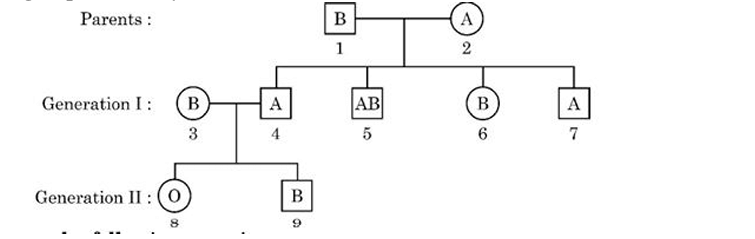
Study the pedigree chart given below, showing the inheritance pattern of blood group in a family: Answer the following questions:
[(a)] Give the possible genotypes of individual 1 and 2. [(b)] Which antigen or antigens will be present on the plasma membranes of the R.B.Cs of individuals ‘5’ and ‘8’?
Official Solution
Correct Option: (1)
Individual 1 (B): Possible genotype =
Individual 2 (A): Possible genotype = (Since their child (individual 8) has blood group O, both parents must carry the allele.)
Individual 5 (AB): Antigens present = A and B antigens
Individual 8 (O): Antigens present = None (no A or B antigen present on RBC membrane)
05
PYQ 2025
medium
biologyID: cbse-cla
The sequence of nitrogenous bases in a segment of a coding strand of DNA is
5' – AATGCTAGGCAC – 3'.
Choose the option that shows the correct sequence of nitrogenous bases in the mRNA transcribed by the DNA.
1
5' – UUACGAACCGAG – 3'
2
5' – AAUGCUAGGCAC – 3'
3
5' – UUAACGAACCGUG – 3'
4
5' – AACGUAGGCAGC – 3'
Official Solution
Correct Option: (2)
Step 1: The coding strand is given. So, the mRNA will be complementary to the template strand and identical to the coding strand (except U replaces T). Step 2: Replace each T with U in the coding strand: AATGCTAGGCAC → AAUGCUAGGCAC.
06
PYQ 2025
medium
biologyID: cbse-cla
A man whose father was colour-blind marries a woman who had a colour-blind mother and normal father. What percentage of male children of this couple will be colour-blind?
1
25%
2
0%
3
50%
4
75%
Official Solution
Correct Option: (3)
Step 1: Colour blindness is an X-linked recessive disorder. A man inherits his X chromosome from his mother and Y chromosome from his father. Step 2: Since the man's father was colour-blind, and the disorder is X-linked, the man himself is not colour-blind (he received the normal X from his mother). But his genotype must be with a normal X. Step 3: The woman had a colour-blind mother and normal father. So, she must be a carrier ( ). Step 4: Cross between man ( ) and woman ( ) gives: \begin{itemize} Male offspring: 50% (normal), 50% (colour-blind)
\end{itemize}
Thus, 50% of male children will be colour-blind.