Human Reproduction
57 previous year questions.
High-Yield Trend
Chapter Questions 57 MCQs
Study the graphs given below for Case 1 and Case 2 showing different levels of certain hormones and answer the question that follows:
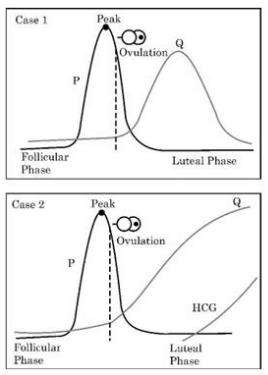
(a) Which hormone is responsible for the peak observed in Case 1 and Case 2? Write one function of that hormone.
(b) Write changes that take place in the ovary and uterus during follicular phase.
Student to attempt either sub-part (c) or (d):
(c) Name the hormone Q of Case 2. Write one function of hormone Q.
OR
(d) Which structure in the ovary will remain functional in Case 2? How is it formed?
(a) Suggest and explain a way of testing if their baby is at risk for any genetic disorders.
(b) In case of presence of one or both of the abnormalities and posing a risk to the mother’s health, mention one possible option for them to consider. Is that option safe for Radha at the current gestational age? Justify.
(c) Under what conditions is the process mentioned in (b) illegal?
Reason (R): It has been developed by National Institute of Immunology, New Delhi.
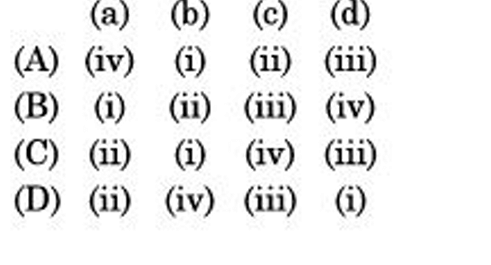
Match the following items of Column-I with that of Column-II: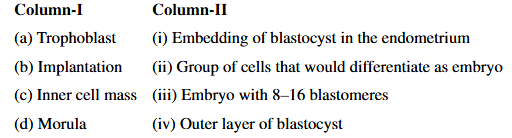
Given below are few statements with reference to the ovaries of the human female reproductive system:
(i) It is 2--4 cm in length and is connected to the pelvic wall by tendons.
(ii) It is covered by a thin epithelium which encloses the ovarian stroma.
(iii) The stroma is divided into a peripheral medulla and an inner cortex.
(iv) The ovaries are the primary female sex organs that produce the female gamete (ovum).
(v) Ovaries are located one on each side of the lower abdomen.
Choose the option with all the true statements from the given options:
Student to attempt either option (A) or (B):
(A)
(i) Draw a diagrammatic sectional view of human seminiferous tubule (enlarged) and label the following:
(a) Cell that undergoes spermiogenesis
(b) Cell that nourish male gametes
(c) Cell which undergoes meiosis I and meiosis II.
(ii) State what is seminal plasma. Mention two constituents of seminal plasma. How is it different from semen?
OR
(B)
(i) Mention the event that induces the completion of the meiotic division of the secondary oocyte in humans.
(ii) Trace the journey of the zygote until its implantation inside the uterus.
(i) ZIFT (ii) ICSI (iii) IUT (iv) GIFT
(b) Why is there a statutory ban on Amniocentesis? Give at least two reasons.
Student to attempt either option (A) or (B):
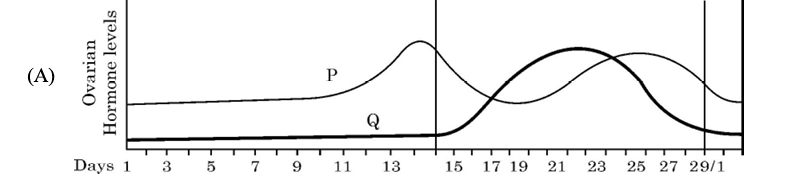
(i) Identify ‘P’ and ‘Q’ labelled in the diagram.
(ii) Specify the source of the hormone ‘P’ and ‘Q’ marked in the diagram.
OR 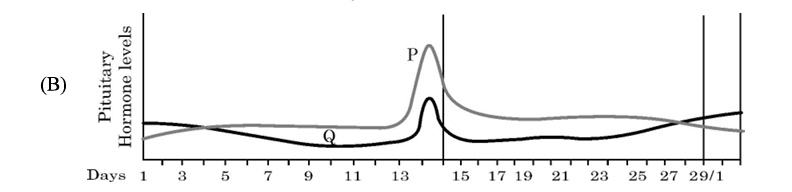
(i) Identify ‘P’ and ‘Q’ labelled in the above diagram.
(ii) Write down the role of hormone ‘P’ in both males and females.
(a) Name and explain the role of inner and middle walls of the human female uterus.
(b) Write the location and function of fimbriae in human female.
(A) (i) Explain why the milk produced by the mother during the initial days of lactation is considered to be very essential for the newborn infant.
(ii) What is the term used for the milk produced during the initial days of lactation?
OR
(B) Many children in the metro cities are suffering from a very common exaggerated response of the immune system to certain weak antigens in air.
(i) What is the term used for the above mentioned disease?
(ii) Name the main type of antibody produced by the immune system in response to this disease.
(iii) Which two main inflammation-causing chemicals are produced by the mast cells in such an immune response?
(i) Sperms are released from the seminiferous tubules by the process of spermiation.
(ii) Spermiogenesis involves the maturation of spermatids into sperms.
(iii) Spermatogonia produce spermatids by the process of spermiogenesis.
(iv) Meiosis II in secondary spermatocytes results in the formation of four equal haploid spermatids.
(v) Primary spermatocyte completes the first meiotic division forming two equal, diploid cells called secondary spermatocytes.
Choose the option with all true statements from the given options:
Reason (R): Hormone Progesterone is essential for maintenance of the endometrium.
Choose the correct option.
(A) Write two features of an ideal contraceptive. Explain any one natural contraceptive method that makes the chances of conception almost nil.
(B) Explain GIFT and ICSI.
Given below are few statements with reference to oogenesis in a human female:
- An unequal division of the primary oocyte forms a large secondary oocyte and a tiny first polar body.
- A couple of thousands of oogonia are formed within each fetal ovary during embryonic development.
- Primary oocytes start meiosis-I but it gets arrested temporarily at prophase-I during fetal development.
- Fertilisation induces the completion of the meiotic division of the secondary oocyte.
- A primary oocyte on meiosis forms an ovum and a polar body.
Choose the option with all true statements from the given options:
Student to attempt either option (A) or (B):
(A) Explain what is meant by the term amniocentesis. How is this technique misused in India?
OR
(B) Name any two VDs which might occur in a human female. State any two complications in a female if it is left untreated.
Reason (R): The effective period of pills is much longer as compared to implants/injectables.
- During the follicular phase, the primary follicles grow to become a Graafian follicle.
- Gonadotropins FSH and progesterone stimulate follicular development during the follicular phase.
- LH surge induces rupture of Graafian follicle thereby releasing the corpus luteum.
- Progesterone released by corpus luteum is essential for maintenance of endometrium.
- Both LH and progesterone attain a peak level in the middle of the cycle.
Student to attempt either option (A) or (B):
(A) Write two features of an ideal contraceptive. Explain any one natural contraceptive method that makes the chances of conception almost nil.
OR
(B) Explain GIFT and ICSI.
Distinguish between the two cells enclosed in a mature male gametophyte of an angiosperm.
Study the diagram given below showing the modes of pollination. Answer the questions that follow.
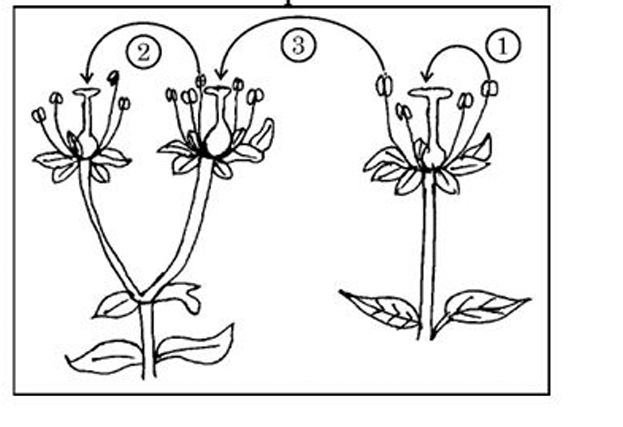
The given diagram shows three methods of pollen transfer in plants. Examine them carefully and write the technical terms used for pollen transfer methods ‘1’, ‘2’ and ‘3’.
How do the following plants achieve pollination successfully?
Water lily
Vallisneria
Write advantages of pollen transfer in method ‘3’. \begin{center} OR \end{center} (B)
Given below is the diagram of human ovum surrounded by a few sperms. Observe the diagram and answer the questions that follow:
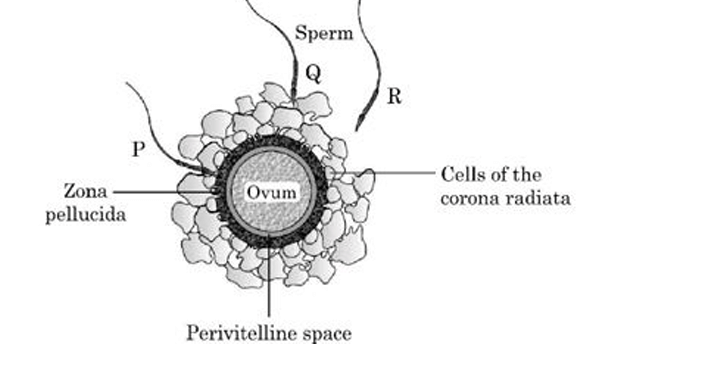
Compare the fate of sperms ‘P’, ‘Q’ and ‘R’ shown in the diagram.
Write the role of Zona pellucida in this process.
Analyse the changes occurring in the ovum after the entry of sperm.
How acrosome and middle piece of a human sperm are able to play an important role in human fertilization?
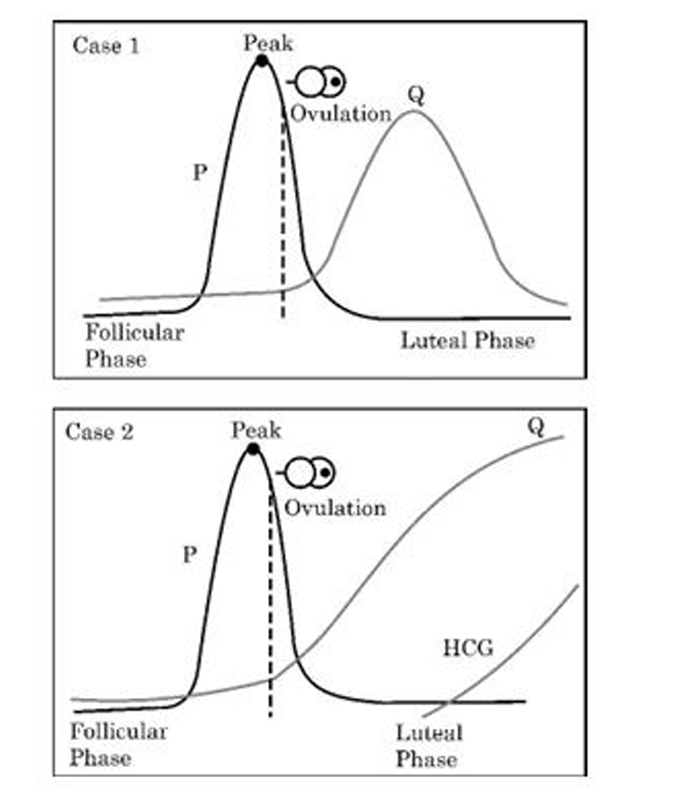
(b) Write changes that take place in the ovary and uterus during follicular phase.
Student to attempt either sub-part (c) or (d):
(c) Name the hormone Q of Case 2. Write one function of hormone Q.
\begin{center} OR
\end{center} (d) Which structure in the ovary will remain functional in Case 2? How is it formed?
(a) Suggest and explain a way of testing if their baby is at risk for any genetic disorders.
(b) In case of presence of one or both of the abnormalities and posing a risk to the mother’s health, mention one possible option for them to consider. Is that option safe for Radha at the current gestational age? Justify.
(c) Under what conditions is the process mentioned in (b) illegal?
Reason (R): It has been developed by National Institute of Immunology, New Delhi.
- [(i)] The seminiferous tubules of the testes open into rete testis then into the vas deferens.
- [(ii)] The vasa efferentia leave the testes and open into the epididymis.
- [(iii)] The epididymis leads to vas deferens that ascends into the abdomen.
- [(iv)] The vas deferens receives a duct from the prostrate gland and opens into the urethra as ejaculatory duct.
- [(v)] The urethra originates from the urinary bladder and extends through the penis to its external opening, urethral meatus.
Reason (R): Cu-ions in IUDs effectively suppress sperm motility and the fertilising capacity of sperms.
(A) is false, but (R) is true.
(i) Each granulosa cell gets surrounded by a primary oocyte to form the primary follicle.
(ii) A couple of million of oogonia are formed within each fetal ovary during the embryonic development.
(iii) Tertiary follicle is characterised by antrum and theca layers.
(iv) Secondary follicles form a zona pellucida layer around it.
(v) Mature graafian follicle ruptures to release the secondary oocyte from the ovary.
Choose the option with all true statements from the given options:
(a) (i) Explain how does double fertilisation take place in a flowering plant.
(ii) Write the fate of the products of double fertilization in these plants.
OR
(b) (i) Explain the structure of testicular lobules in the human male reproductive system. Name the two types of cells present in the seminiferous tubules and state their role.
(ii) Describe the role of hypothalamic hormone GnRH in spermatogenesis.
Reason (R): It is a non-steroidal preparation.
| Column-I | Column-II |
|---|---|
| (a) Trophoblast | (iv) Outer layer of blastocyst |
| (b) Implantation | (i) Embedding of blastocyst in the endometrium |
| (c) Inner cell mass | (ii) Group of cells that would differentiate as embryo |
| (d) Morula | (iii) Embryo with 8–16 blastomeres |
How is the interaction between and its specific bee pollinator one of the best examples of co-evolution? Explain.
1. Sperm head contains a large nucleus and a lot of cytoplasm.
2. Mitochondria in the middle piece of a sperm provides ATP for the sperm motility.
3. Posterior part of the sperm head is covered by acrosome.
4. Spermatids undergo maturation into spermatozoa by the process of spermiogenesis.
5. Acrosomal secretions help in the entry of the sperm into the ovum at the time of fertilization.
Choose the option with all true statements from the given options :
Cow named Rosie
1. Paired seminal vesicles, prostate gland and bulbourethral gland constitute the male accessory glands.
2. Secretions of the male accessory glands constitute the seminal plasma.
3. Secretions of the bulbourethral glands help in the lubrication of the penis.
4. Enlarged end of the the penis is known as foreskin.
5. Seminal plasma is rich in fructose, calcium and certain enzymes.
Choose the option with all true statements from the given options:
(i) Corpus luteum secretes progesterone.
(ii) Only FSH attains a peak level in middle of cycle.
(iii) LH surge induces rupture of graafian follicle.
(iv) Luteal phase of menstrual cycle is also called proliferative phase.
About Human Reproduction - CBSE-CLASS-XII
Human Reproduction is a vital chapter for CBSE-CLASS-XII aspirants. Mastering the concepts covered in this chapter is essential for securing a top rank.
By rigorously practicing the previous year questions associated with this chapter, you can identify high-yield topics, understand the examiner's perspective, and boost your confidence during the actual exam.
Frequently Asked Questions
Why focus on Human Reproduction PYQs?
Analyzing PYQs for this specific chapter reveals the most frequently tested concepts and the typical complexity of questions, allowing you to tailor your study plan efficiently.
How to best use this analysis?
Review the topic breakdown to see which sub-topics within Human Reproduction carry the most weight. Then, tackle the questions iteratively to solidify your understanding.