In which of the following plants are both male and female flowers born on the same plant, and the mode of pollination can be geitonogamy or xenogamy?
1
Papaya
2
Date Palm
3
Maize
4
Spinach
Official Solution
Correct Option: (3)
Plants that bear both male and female flowers on the same plant are called monoecious plants. Maize is an example of a monoecious plant. Geitonogamy refers to the transfer of pollen between flowers on the same plant. Xenogamy refers to the transfer of pollen between flowers of different plants. Maize exhibits both types of pollination.
02
PYQ 2024
medium
biologyID: cbse-cla
An angiosperm embryo sac is located within the:
1
Placenta
2
Megasporangium
3
Nucellus
4
Ovary
Official Solution
Correct Option: (3)
In angiosperms, the embryo sac is located within the nucellus, which is a part of the ovule. The nucellus contains the female gametophyte, the embryo sac, where fertilization takes place.
03
PYQ 2024
medium
biologyID: cbse-cla
Describe co-evolution with the help of this example.
Official Solution
Correct Option: (1)
- Co-evolution is the process where two or more species influence each other’s evolution. In the case of and its specific bee species, the orchid evolved to mimic the female bee, while the bee adapted to the orchid's mimicry.
04
PYQ 2024
medium
biologyID: cbse-cla
Mention what does the dotted line in the graph indicate and state its importance also.
Official Solution
Correct Option: (1)
The dotted line indicates the carrying capacity ( ) of the environment. It represents the maximum population size that the environment can sustain with available resources.
05
PYQ 2024
medium
biologyID: cbse-cla
Name the type of age pyramid shown above for Sweden.
Official Solution
Correct Option: (1)
Stationary age pyramid.
06
PYQ 2024
medium
biologyID: cbse-cla
With reference to flower color, two independent crosses were made, one between true breeding garden pea plants and another between true breeding Antirrhinum plants. Write the phenotypes of their F progeny. Justify your answer giving reasons.
Official Solution
Correct Option: (1)
Garden Pea: F progeny exhibits complete dominance, showing the dominant flower color. Antirrhinum: F progeny exhibits incomplete dominance, resulting in an intermediate flower color (e.g., pink when red and white are crossed).
07
PYQ 2024
medium
biologyID: cbse-cla
Observe the population growth curve and answer the questions given below:
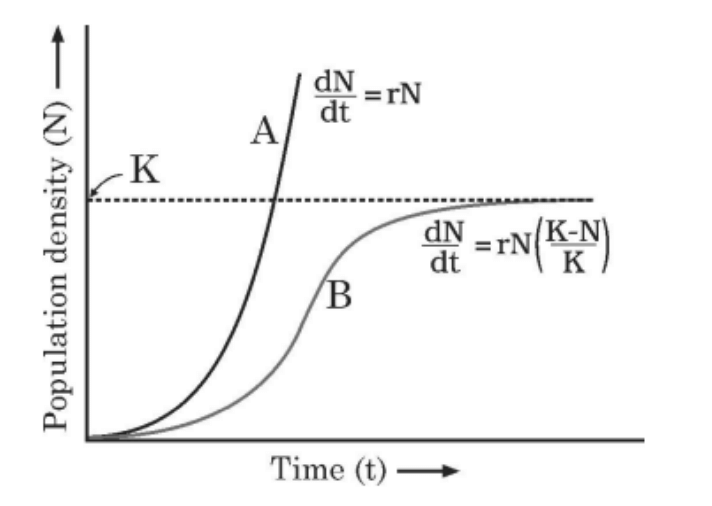
Population growth curves showing exponential growth (A) and logistic growth (B).
Mention what does ‘K’ in the graph represent.
Official Solution
Correct Option: (1)
‘K’ represents the carrying capacity of the environment, which is the maximum population size that the environment can sustain with the available resources.
08
PYQ 2025
medium
biologyID: cbse-cla
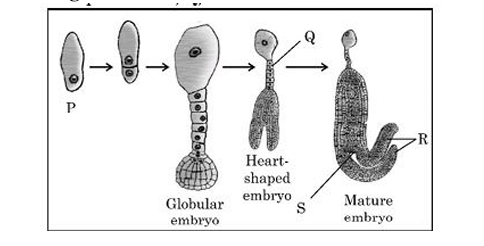
Identify the labelled parts P, Q, R, and S in the stages of a dicot embryo shown in the diagram.
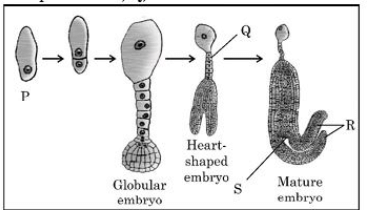
Choose the option that indicates correct labelling of 'P', 'Q', 'R', and 'S' of embryo in different stages of its development.
1
P-Egg, Q-Suspenso, R-Radicle, S-Cotyledons
2
P-Zygote, Q-Suspenso, R-Cotyledons, S-Plumule
3
P-Egg, Q-Radicle, R-Suspenso, S-Cotyledons
4
P-Zygote, Q-Suspenso, R-Cotyledons, S-Radicle
Official Solution
Correct Option: (4)
Step 1: P is the fertilized egg or zygote. Step 2: Q is the suspensor that pushes the embryo into endosperm. Step 3: R represents cotyledons in the heart-shaped embryo. Step 4: S indicates the radicle in the mature embryo.
09
PYQ 2025
medium
biologyID: cbse-cla
Identify the labelled parts P, Q, R, and S in the stages of a dicot embryo shown in the diagram.
Choose the option that indicates correct labelling of 'P', 'Q', 'R', and 'S' of embryo in differenct stages of its development.
1
P
2
Q
3
R
4
S
Official Solution
Correct Option: (4)
Step 1: P is the fertilized egg or zygote. Step 2: Q is the suspensor that pushes the embryo into endosperm. Step 3: R represents cotyledons in the heart-shaped embryo. Step 4: S indicates the radicle in the mature embryo.
10
PYQ 2025
medium
biologyID: cbse-cla
Select the statements that are true for a typical monocotyledonous embryo from the given options. 1. Scutellum is present towards the centre of the embryonal axis. 2. Embryonal axis of the lower end has radicle and root cap covered by coleoptile.
3. The portion of embryonal axis above the level of attachment of scutellum is epicotyl.
4. Shoot apex and few leaf primordia of embryo are enclosed in a hollow foliar structure. Choose the correct answer from the following :
1
2
3
4
Official Solution
Correct Option: (3)
Let's analyze each statement for a typical monocotyledonous embryo:
(A) Scutellum is present towards the centre of the embryonal axis. This statement is incorrect. The scutellum is the cotyledon in monocots and it is lateral to the embryonal axis.
(B) Embryonal axis of the lower end has radicle and root cap covered by coleoptile. This statement is incorrect. In monocots, the radicle and root cap are covered by the coleorhiza, not coleoptile. Coleoptile covers the shoot apex and leaf primordia.
(C) The portion of embryonal axis above the level of attachment of scutellum is epicotyl. This statement is correct. The epicotyl is the part of the embryonal axis above the cotyledon(s). In monocots, it's above the scutellum.
(D) Shoot apex and few leaf primordia of embryo are enclosed in a hollow foliar structure. This statement is correct. The shoot apex and leaf primordia in a monocot embryo are enclosed within a protective sheath called the coleoptile. Therefore, statements (iii) and (iv) are true for a typical monocotyledonous embryo.
11
PYQ 2026
medium
biologyID: cbse-cla
List any three outbreeding devices that flowering plants have developed for cross-pollination and explain how they help to encourage cross-pollination.
Official Solution
Correct Option: (1)
Step 1: Introduction to outbreeding devices.
Outbreeding devices in plants help to promote cross-pollination, which is the transfer of pollen from one plant to another. Cross-pollination enhances genetic diversity, leading to stronger and more adaptable offspring. Step 2: Three outbreeding devices. 1. Dioecious plants: In dioecious plants, male and female reproductive organs are present on separate plants. This ensures that pollen is transferred between different plants, facilitating cross-pollination.
2. Heterostyly: Plants with heterostyly have different types of flowers with different styles (the part of the flower that receives pollen). This encourages cross-pollination by preventing self-pollination.
3. Temporal separation: Some plants release pollen at different times of the day or during different seasons, reducing the chance of self-pollination and encouraging cross-pollination by attracting different pollinators. Step 3: Conclusion.
These outbreeding devices ensure that pollen is transferred between genetically diverse plants, promoting stronger, more resilient generations.
12
PYQ 2026
medium
biologyID: cbse-cla
Mention the functions of each of the following: (i) Tassels of Corn Cob: (ii) Scutellum:
Official Solution
Correct Option: (1)
(i) Tassels of Corn Cob:
The tassels of the corn cob are the male reproductive structures of the plant. They produce pollen, which is carried by the wind to fertilize the female flowers (ears) of the corn plant. (ii) Scutellum:
The scutellum is a single, large cotyledon present in the seeds of monocots (like corn). It plays an important role in the process of seed germination by absorbing nutrients from the endosperm and transferring them to the growing embryo.
13
PYQ 2026
medium
biologyID: cbse-cla
Farmers prefer apomictic seeds over hybrid seeds. Give any two reasons.
Official Solution
Correct Option: (1)
Step 1: No Need for Replanting Every Year.
Apomictic seeds are favored by farmers because they do not require replanting every year, unlike hybrid seeds which require new seeds to be purchased each season. Step 2: Genetic Stability.
Apomictic seeds are genetically stable and produce offspring that are genetically identical to the parent plant. This results in uniformity and predictability, whereas hybrid seeds may exhibit variability in the next generation.