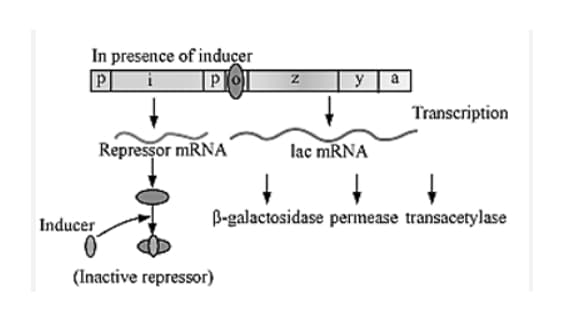
(a) (i) Compare the pattern of inheritance of flower colour in garden pea plant (violet/white) with snapdragon plant (red/white) on the basis of the following: 1. F1 phenotypic expression. 2. Expected phenotypic and genotypic expression of F2 generation. 3. Conclusion you reached at the end of the comparison. (ii) List any two characteristics of pattern of inheritance of human blood group ABO. OR (b) (i) Draw a schematic, self-explanatory labelled diagram of lac operon in a ‘switched on’ condition. (ii) Why is regulation of lac operon referred to as negative regulation?
Official Solution
Correct Option: (1)
(a) (i) 1. F1 phenotypic expression: - Garden pea: All F1 plants are violet (dominant trait). - Snapdragon: All F1 plants are pink (incomplete dominance). 2. F2 generation: - Garden pea: -- Phenotypic ratio: 3:1 (violet: white) -- Genotypic ratio: 1:2:1 (VV:Vv:vv) - Snapdragon: -- Phenotypic ratio: 1:2:1 (red: pink: white) -- Genotypic ratio: 1:2:1 (RR:Rr:rr). 3. Conclusion: - In garden pea, flower colour inheritance follows complete dominance. - In snapdragon, flower colour inheritance follows incomplete dominance.
(ii) 1. The ABO blood group exhibits codominance, where both A and B alleles are expressed equally in the AB blood group. 2. The blood group also shows multiple allelism, as there are three alleles (IA, IB, i) for a single gene.
OR (b) (i)
(ii) The lac operon is referred to as negative regulation because the operon is switched off by the binding of a repressor protein to the operator region in the absence of lactose. Lactose acts as an inducer by removing the repressor.
02
PYQ 2024
medium
biologyID: cbse-cla
(a) (i) Write the karyotype and the genetic disorder of an individual who has developed from a zygote formed from an ‘XX’ egg fertilized by a ‘Y’ sperm. (ii) Mention any two symptoms of this genetic disorder. (iii) Write the possible reason that leads to the formation of this ‘XX’ egg. OR (b) In case of any dispute, a very small sample of tissue or even a drop of blood can help us to determine the paternity of a child. Provide a scientific explanation to substantiate the statement.
Official Solution
Correct Option: (1)
(a) (i) - Karyotype: The karyotype of this individual will be XY, as the egg provides the X chromosome and the sperm provides the Y chromosome. - Genetic Disorder: The individual may have Klinefelter syndrome, a disorder caused by the presence of an extra X chromosome (XXY), leading to male infertility and other physical and developmental features. (ii) Two common symptoms of Klinefelter syndrome are: 1. Infertility: Due to underdeveloped testes and reduced sperm production. 2. Tall stature and long limbs: Affected individuals are typically taller than average, with longer arms and legs. (iii) The formation of an XX egg can occur due to a failure in meiosis, specifically during oogenesis. This error, known as non-disjunction, leads to an egg with two X chromosomes instead of just one. OR (b) The DNA in a small sample of tissue or blood contains unique genetic markers (alleles) inherited from both parents. By comparing the DNA of the child with the DNA of the alleged father, we can identify matching markers that confirm or rule out paternity. This process is called DNA fingerprinting.
03
PYQ 2024
medium
biologyID: cbse-cla
Although Hemophilia and sickle cell anemia are two blood-related Mendelian disorders, yet they differ in their pattern of inheritance. State any two differences.
Official Solution
Correct Option: (1)
The two differences in inheritance patterns between Hemophilia and Sickle Cell Anemia are: 1. Hemophilia is X-linked recessive, meaning it is carried on the X chromosome and primarily affects males, while Sickle Cell Anemia is autosomal recessive, meaning it is inherited through non-sex chromosomes. 2. In Hemophilia, a single X chromosome carrying the defective gene is enough to express the disorder in males, but in Sickle Cell Anemia, both alleles must be defective (homozygous) for the disorder to be expressed in an individual.
04
PYQ 2024
medium
biologyID: cbse-cla
Which one of the following is not a feature of plasmids?
1
Circular
2
Self-replicating
3
Single stranded
4
Extra-chromosomal
Official Solution
Correct Option: (3)
Plasmids are typically circular and extra-chromosomal, meaning they are not part of the chromosome and can replicate independently. They are also usually double-stranded, not single-stranded.
05
PYQ 2024
medium
biologyID: cbse-cla
A woman with normal vision has a colour blind father. She marries a man with normal vision. The percentage chance of their progeny being colour blind is:
1
0.25
2
0.5
3
0.75
4
1
Official Solution
Correct Option: (1)
Since the woman has a colour-blind father, she is a carrier (XNXc). Her husband, having normal vision, has the genotype XNY. Their offspring will have the following probabilities: - Sons (XY) will inherit their father’s Y chromosome and will not be colour-blind. - Daughters (XNXc) will inherit one X chromosome from the mother and will be carriers (not colour-blind). Thus, there is a 25 percent chance that a daughter could inherit the colour-blind allele, making her a carrier.
06
PYQ 2024
medium
biologyID: cbse-cla
A population is in genetic equilibrium/Hardy-Weinberg equilibrium for a gene with 2 alleles (dominant allele is ‘A’ and recessive allele ‘a’). If the frequency of allele ‘A’ is 0.6, then the frequency of genotype ‘Aa’ is:
1
0.21
2
0.42
3
0.48
4
0.32
Official Solution
Correct Option: (3)
According to Hardy-Weinberg equilibrium, the frequency of heterozygotes (Aa) is given by 2pq, where: - p is the frequency of allele A (p = 0.6) - q is the frequency of allele a (q = 1−p=0.4) The frequency of genotype Aa is: 2pq = 2(0.6)(0.4) = 0.48
07
PYQ 2024
medium
biologyID: cbse-cla
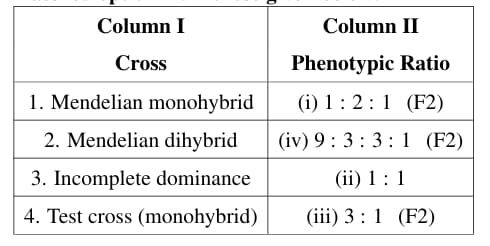
Match the items in Column I with those in Column II and select the correctly matched option from those given below:
1
1-(ii), 2-(iv), 3-(1), 4-(iii)
2
1-(iii), 2-(i), 3-(iv), 4-(ii)
3
1-(iii), 2-(iv), 3-(1), 4-(ii)
4
1-(ii), 2-(1), 3-(iv), 4-(iii)
Official Solution
Correct Option: (3)
Mendelian monohybrid cross (1): This cross results in a phenotypic ratio of 3:1 in the F2 generation. - Mendelian dihybrid cross (2): The phenotypic ratio in the F2 generation is 9:3:3:1. - Incomplete dominance (3): In this case, the phenotypic ratio is 1:2:1 because of the blending of traits in the heterozygote. - Test cross (4): A test cross between a heterozygous and a homozygous recessive plant results in a phenotypic ratio of 1:1 in the F2 generation.
08
PYQ 2024
medium
biologyID: cbse-cla
Although Haemophilia and sickle cell anemia are two blood-related Mendelian disorders, yet, they differ in their pattern of inheritance. State any two differences.
Official Solution
Correct Option: (1)
Analyze the inheritance of Haemophilia. - Haemophilia is a sex-linked recessive disorder, predominantly affecting males who have only one X chromosome. Analyze the inheritance of sickle cell anemia. - Sickle cell anemia is an autosomal recessive disorder, meaning both males and females are equally affected because it is inherited through autosomes, not sex chromosomes. 1. Haemophilia is a sex-linked recessive disorder, while sickle cell anemia is an autosomal recessive disorder. 2. Haemophilia predominantly affects males, whereas sickle cell anemia affects both sexes equally.
09
PYQ 2024
medium
biologyID: cbse-cla
(b) Name the transgenic animal having the largest number amongst all the existing transgenic animals.
Official Solution
Correct Option: (1)
Mice are the transgenic animals with the largest numbers among all existing transgenic animals. They are widely used due to their short generation time and genetic similarity to humans.
10
PYQ 2024
medium
biologyID: cbse-cla
(a) What are transgenic animals?
Official Solution
Correct Option: (1)
Transgenic animals are animals whose genomes have been altered through the insertion of a foreign gene. This enables them to express specific traits, such as producing therapeutic proteins, serving as model organisms for disease research, or improving agricultural products.
11
PYQ 2024
medium
biologyID: cbse-cla
Study the table given below: \begin{center}
\begin{tabular}{|c|l|l|}
\hline
Contraceptive & Mode of Action
\hline
A. The pill & I. Prevent sperm reaching cervix
B. Condom & II. Prevent implantation
C. Vasectomy & III. Inhibits ovulation
D. Copper-T & IV. Semen contains no sperm
\hline
\end{tabular}
\end{center} Select the option where contraceptive/contraceptive method are correctly matched with their mode of action:
1
A – III, B – I, C – I, D – IV
2
A – III, B – I, C – IV, D – II
3
A – III, B – I, C – IV, D – III
4
A – IV, B – III, C – II, D – I
Official Solution
Correct Option: (3)
The contraceptives and their corresponding modes of action are: A. The pill – III. Inhibits ovulation. B. Condom – I. Prevents sperm from reaching the cervix. C. Vasectomy – IV. Semen contains no sperm. D. Copper-T – III. Prevents implantation.
12
PYQ 2024
medium
biologyID: cbse-cla
A patient is suffering from the infection of the alveoli of lungs and is showing the symptoms of fever, chills, cough, headache, and bluish-colored lips and fingernails. The patient was diagnosed to be suffering from the infection of:
1
Epidermophyton
2
Entamoeba histolytica
3
Haemophilus influenzae
4
Salmonella typhi
Official Solution
Correct Option: (3)
- Haemophilus influenzae causes pneumonia, an infection of the alveoli of the lungs. - Symptoms include fever, chills, cough, and cyanosis (bluish lips and nails).
13
PYQ 2025
medium
biologyID: cbse-cla
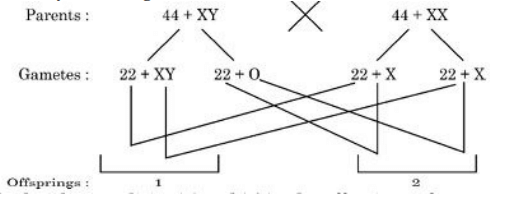
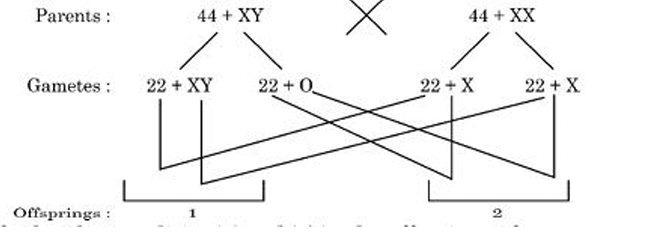
Study the cross given below: Identify the abnormalities ‘1’ and ‘2’ in the offsprings of a cross done between a couple and distinguish between them.
Official Solution
Correct Option: (1)
Offspring 1: Turner’s Syndrome (45, XO) Caused due to absence of one X chromosome (Monosomy). Genotype: 44 + XO (total 45 chromosomes). Phenotype: Female with underdeveloped secondary sexual characters, short stature, and sterility. Offspring 2: Klinefelter’s Syndrome (47, XXY) Caused due to the presence of an extra X chromosome (Trisomy). Genotype: 44 + XXY (total 47 chromosomes). Phenotype: Male with feminine body features, gynecomastia, and sterility.
14
PYQ 2025
medium
biologyID: cbse-cla
Assertion (A): When the two genes in a dihybrid cross are situated on the same chromosome, the proportion of parental gene combinations is much higher than non-parental type. Reason (R): Higher parental gene combinations can be attributed to crossing over between two genes.
1
Both (A) and (R) are true and (R) is the correct explanation of (A).
2
Both (A) and (R) are true, but (R) is not the correct explanation of (A).
3
(A) is true, but (R) is false.
4
(A) is false, but (R) is true.
Official Solution
Correct Option: (3)
Parental combinations dominate when genes are on the same chromosome due to **linkage**. Crossing over promotes new (non-parental) combinations. So, the assertion is true, but the reason is false.
15
PYQ 2025
medium
biologyID: cbse-cla
Assertion (A): A bioreactor provides the optimal conditions for achieving the desired product by providing optimum growth conditions. Reason (R): The most commonly used bioreactors are of stirring type.
1
Both (A) and (R) are true and (R) is the correct explanation of (A).
2
Both (A) and (R) are true, but (R) is not the correct explanation of (A).
3
(A) is true, but (R) is false.
4
(A) is false, but (R) is true.
Official Solution
Correct Option: (2)
While both the assertion and the reason are true, the reason is not a direct explanation for the assertion. Stirring-type bioreactors are common, but they are only one design feature among many for maintaining optimum growth conditions.
16
PYQ 2025
medium
biologyID: cbse-cla
Assertion (A): One of the properties of genetic code is degeneracy. Reason (R): Some amino acids can be coded by more than one codon.
1
Both (A) and (R) are true and (R) is the correct explanation of (A).
2
Both (A) and (R) are true, but (R) is not the correct explanation of (A).
3
(A) is true, but (R) is false.
4
(A) is false, but (R) is true.
Official Solution
Correct Option: (1)
Degeneracy of the genetic code means that more than one codon can code for the same amino acid, which makes both the assertion and reason true, and the reason is the correct explanation.
17
PYQ 2025
medium
biologyID: cbse-cla
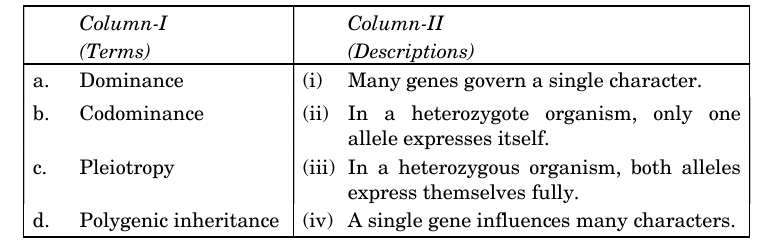
Match the terms in Column-I with their description in Column-II and choose the correct option.
1
a-(ii), b-(iii), c-(iv), d-(i)
2
a-(iv), b-(i), c-(iii), d-(ii)
3
a-(iv), b-(iii), c-(i), d-(ii)
4
a-(ii), b-(i), c-(iv), d-(iii)
Official Solution
Correct Option: (1)
Dominance occurs when one allele masks the other in a heterozygote (a-ii). Codominance is when both alleles are expressed fully in a heterozygote (b-iii). Pleiotropy refers to one gene affecting multiple traits (c-iv). Polygenic inheritance involves multiple genes influencing a single trait (d-i).
18
PYQ 2025
medium
biologyID: cbse-cla
(a) Write two closely linked genes that control -thalassemia.
(b) Differentiate between thalassemia and sickle cell anaemia on the basis of their effect on globin molecule of Haemoglobin.
Official Solution
Correct Option: (1)
(a) The two closely linked genes that control -thalassemia are and , which are present on chromosome 16. (b)
Thalassemia: Caused by deletion or mutation of globin genes, leading to reduced or absent synthesis of one of the globin chains. The structure of the globin molecule is normal, but the quantity is insufficient.
Sickle Cell Anaemia: Caused by a point mutation in the -globin gene, resulting in abnormal hemoglobin (HbS). The globin molecule becomes deformed under low oxygen conditions, causing sickling of RBCs.
19
PYQ 2025
medium
biologyID: cbse-cla
A diploid organism is heterozygous for three loci, how many types of gametes can be produced by that organism?
1
4
2
8
3
16
4
32
Official Solution
Correct Option: (2)
Step 1: For an organism heterozygous at loci, the number of gamete types = . Step 2: Here, , so number of gametes = .
20
PYQ 2025
medium
biologyID: cbse-cla
Study the cross given below: Identify the abnormalities ‘1’ and ‘2’ in the offsprings of a cross done between a couple and distinguish between them.
Official Solution
Correct Option: (1)
Offspring 1: Turner’s Syndrome (45, XO) \begin{itemize} Caused due to absence of one X chromosome (Monosomy). Genotype: 44 + XO (total 45 chromosomes). Phenotype: Female with underdeveloped secondary sexual characters, short stature, and sterility.
\end{itemize} Offspring 2: Klinefelter’s Syndrome (47, XXY) \begin{itemize} Caused due to the presence of an extra X chromosome (Trisomy). Genotype: 44 + XXY (total 47 chromosomes). Phenotype: Male with feminine body features, gynecomastia, and sterility.
\end{itemize}
21
PYQ 2025
medium
biologyID: cbse-cla
Assertion (A): When the two genes in a dihybrid cross are situated on the same chromosome, the proportion of parental gene combinations is much higher than non-parental type. Reason (R): Higher parental gene combinations can be attributed to crossing over between two genes.
1
Both (A) and (R) are true and (R) is the correct explanation of (A).
2
Both (A) and (R) are true, but (R) is not the correct explanation of (A).
3
(A) is true, but (R) is false.
4
(A) is false, but (R) is true.
Official Solution
Correct Option: (3)
Parental combinations dominate when genes are on the same chromosome due to **linkage**. Crossing over promotes new (non-parental) combinations. So, the assertion is true, but the reason is false.
22
PYQ 2025
medium
biologyID: cbse-cla
Assertion (A): One of the properties of genetic code is degeneracy. Reason (R): Some amino acids can be coded by more than one codon.
1
Both (A) and (R) are true and (R) is the correct explanation of (A).
2
Both (A) and (R) are true, but (R) is not the correct explanation of (A).
3
(A) is true, but (R) is false.
4
(A) is false, but (R) is true.
Official Solution
Correct Option: (1)
Degeneracy of the genetic code means that more than one codon can code for the same amino acid, which makes both the assertion and reason true, and the reason is the correct explanation.
23
PYQ 2026
hard
biologyID: cbse-cla
Assertion (A): Repetitive sequences make up a very large portion of human genome. Reason (R): Repetitive sequences do not have direct coding functions in the genome.
1
Both Assertion (A) and Reason (R) are true and Reason (R) is the correct explanation of the Assertion (A).
2
Both Assertion (A) and Reason (R) are true, but Reason (R) is not the correct explanation of the Assertion (A).
3
Assertion (A) is true, but Reason (R) is false.
4
Assertion (A) is false, but Reason (R) is true.
Official Solution
Correct Option: (1)
Step 1: Understanding the assertion. Repetitive sequences make up a significant portion of the human genome. These include satellite DNA, transposons, and other repetitive regions that do not code for proteins.
Step 2: Verifying the reason. The reason is also correct. While repetitive sequences are abundant in the human genome, they do not directly code for proteins. Instead, they often play structural or regulatory roles in the genome.
Step 3: Conclusion. Therefore, both the assertion and reason are true, and the reason correctly explains the assertion. The correct answer is (A). Final Answer: (A) Both Assertion (A) and Reason (R) are true and Reason (R) is the correct explanation of the Assertion (A).
24
PYQ 2026
easy
biologyID: cbse-cla
A DNA molecule is 160 base pairs long. It has 30% Guanine. How many Adenine bases are present in this DNA molecule?
1
48
2
64
3
96
4
192
Official Solution
Correct Option: (2)
Step 1: Understanding the question. This question asks how many adenine bases are present in a DNA molecule given the percentage of guanine. Step 2: Base pair rule. In a DNA molecule, guanine pairs with cytosine (G-C), and adenine pairs with thymine (A-T). If 30% of the bases are guanine, 30% must also be cytosine. This leaves 40% for adenine and thymine combined. Step 3: Calculating adenine bases. Since adenine and thymine pair in equal amounts, half of the remaining 40% will be adenine. Therefore, the percentage of adenine is 20%. To find the number of adenine bases:
Thus, the correct answer is 64 as per the given options. Final Answer: 64.
25
PYQ 2026
medium
biologyID: cbse-cla
In order to force bacteria to take up the recombinant DNA, they must be made competent. Explain how it can be achieved.
Official Solution
Correct Option: (1)
Step 1: Chemical Transformation.
Bacteria can be made competent by treating them with a solution of calcium chloride (CaCl₂), which makes their cell membrane more permeable to DNA. Step 2: Heat Shock Treatment.
After incubation with calcium chloride, the bacteria are subjected to a heat shock at 42°C for a brief period. This creates a temperature gradient that drives the DNA into the bacterial cells. Step 3: Recovery and Selection.
After the heat shock, the bacteria are allowed to recover in a nutrient medium. Then, they can be grown on selective media to isolate those that have successfully taken up the recombinant DNA.
26
PYQ 2026
medium
biologyID: cbse-cla
Draw a labelled diagram of a 'replicating fork' showing the polarity. Why does DNA replication occur within such 'fork'?
Official Solution
Correct Option: (1)
Step 1: Explanation of the replicating fork.
A replicating fork is formed during DNA replication when the double helix is unwound, creating two single-stranded DNA templates. The replication fork is the region where the DNA strands are being separated, and new complementary strands are synthesized. Step 2: Diagram of a replicating fork. (Note: Include a diagram of the replicating fork showing two separated DNA strands, with the leading strand and lagging strand, along with arrows showing the direction of replication.) Step 3: Why replication occurs in the fork.
DNA replication occurs in the fork because the single-stranded DNA templates are exposed, allowing DNA polymerase to synthesize new complementary strands. The direction of replication is influenced by the polarity of the strands. Replication occurs in the 5' to 3' direction on the leading strand, and the lagging strand is synthesized in short segments (Okazaki fragments) due to its opposite polarity.
27
PYQ 2026
medium
biologyID: cbse-cla
Define the term 'amniocentesis'. Why has the government imposed a statutory ban in spite of its importance in the medical field?
Official Solution
Correct Option: (1)
Step 1: Define Amniocentesis.
Amniocentesis is a medical procedure used during pregnancy to obtain a sample of amniotic fluid from the sac surrounding the fetus. This fluid contains fetal cells, which can be analyzed to detect genetic conditions, birth defects, or other health issues. Step 2: Reason for statutory ban.
The government has imposed a statutory ban on amniocentesis due to its misuse for sex determination of the fetus, leading to female foeticide. While amniocentesis is important for detecting genetic disorders, its use for gender selection was deemed unethical and illegal under the Pre-conception and Pre-natal Diagnostic Techniques (PCPNDT) Act, 1994.
28
PYQ 2026
medium
biologyID: cbse-cla
Transgenic animals have their genetic material manipulated. Select the correct option in reference to transgenic animals.
1
Foreign DNA and RNA are present in their cells.
2
Foreign RNA is present in all of their cells.
3
Foreign DNA is present in all of its cells.
4
Foreign RNA is present in some of its cells.
Official Solution
Correct Option: (3)
Step 1: Understanding transgenic animals. Transgenic animals are genetically modified organisms that have foreign DNA introduced into their cells. This foreign genetic material can be integrated into their genome, leading to the expression of new traits.
Step 2: Analysis of the options. - (A) Foreign DNA and RNA are present in their cells: Incorrect. While foreign DNA is integrated into the cells of transgenic animals, the presence of foreign RNA is not guaranteed in all cases, as RNA is typically transcribed from the foreign DNA but not always present in all cells. - (B) Foreign RNA is present in all of their cells: Incorrect. While foreign RNA may be expressed, it is not necessarily present in all cells, as it is usually transcribed from the foreign DNA when required. - (C) Foreign DNA is present in all of its cells: Correct. Transgenic animals typically have foreign DNA integrated into all of their cells, as the foreign DNA is integrated into the genome and inherited by all cells in the organism. - (D) Foreign RNA is present in some of its cells: Incorrect. While foreign RNA might be present in certain cells, it is not a characteristic of all transgenic animals, as foreign RNA is typically present in the cells where the transgene is expressed.
Step 3: Conclusion. Therefore, the correct answer is (C) Foreign DNA is present in all of its cells, as transgenic animals inherit the foreign DNA in all their cells.
Final Answer: Foreign DNA is present in all of its cells.
29
PYQ 2026
medium
biologyID: cbse-cla
Given below is the restriction site of a restriction endonuclease Pst I and the cleavage sites on a DNA molecule.
Choose the option that gives the correct resultant fragments.
1
5' C - T - G - C - A \, C - A - G 3'
3' G - A - C - G - T \, C 5'
2
5' C - T - G - C - A \, G - C - A - G 3'
3' G - A - C - G \, T - C 5'
3
5' C - T - G - C - A \, A - G 3'
3' G - A - C - G \, T - C 5'
4
5' C - T - G - C - A \, G 3'
3' G - A - C - G - T - C 5'
Official Solution
Correct Option: (1)
Step 1: Understanding the restriction site. Pst I is a restriction enzyme that recognizes and cuts DNA at the sequence 5' C - T - G - C - A 3', with a sticky end created at the cleavage site. Step 2: Analyzing the cleavage. The enzyme cuts between the G and C, resulting in two fragments: 1. 5' C - T - G - C - A \, C - A - G 3' 2. 3' G - A - C - G - T \, C 5' Step 3: Conclusion. The correct resultant fragments are option (A) 5' C - T - G - C - A \, C - A - G 3' and 3' G - A - C - G - T \, C 5'. Final Answer: (A) 5' C - T - G - C - A \, C - A - G 3'
3' G - A - C - G - T \, C 5'.
30
PYQ 2026
medium
biologyID: cbse-cla
In Pisum sativum, the flower colour may be violet (V) or white (v). What proportion of the offspring in a cross of "VV × vv" would be expected to be violet?
1
25%
2
50%
3
75%
4
100%
Official Solution
Correct Option: (2)
Step 1: Understanding the genetic cross. In this question, we are dealing with a cross between two plants with genotypes "VV" (homozygous violet) and "vv" (homozygous white). Step 2: Punnett square analysis. The cross between "VV" and "vv" will produce all heterozygous "Vv" offspring, since each parent contributes one allele. The "V" allele (violet) is dominant, so all offspring will have violet flowers. Step 3: Conclusion. Thus, 100% of the offspring from the cross "VV × vv" will have violet flowers. Final Answer: 100%.
31
PYQ 2026
easy
biologyID: cbse-cla
Read the following passage and answer the questions that follow: The process of copying genetic information from template strand of DNA into RNA is called transcription. It is mediated by RNA polymerase. Transcription takes place in the nucleus of eukaryotic cells. In transcription, only a segment of DNA and only one of the strands is copied into RNA.
Official Solution
Correct Option: (1)
32
PYQ 2026
medium
biologyID: cbse-cla
Work out separate monohybrid crosses up to F2 generation between two pea plants and two Antirrhinum plants, both having contrasting traits with respect to the colour of the flower. Comment on the patterns of inheritance in the crosses carried out in such two cases.
Official Solution
Correct Option: (1)
Monohybrid Cross in Pea Plants (Mendel's experiment): For pea plants, let us assume that the contrasting traits are: Purple flower (P) is dominant, and White flower (p) is recessive. - Parental Cross (P generation): - \text{Purple flower} (P) x \text{White flower} (p) - F1 x F1 Cross: - - The offspring (F2 generation) will have the following genotypic and phenotypic ratio: - Genotypic ratio: 1 PP : 2 Pp : 1 pp - Phenotypic ratio: 3 Purple : 1 White
Monohybrid Cross in Antirrhinum Plants (Snapdragon): For Antirrhinum plants, let us assume that the contrasting traits are: Red flower (R) is dominant, and White flower (r) is recessive. - Parental Cross (P generation): - \text{Red flower} (RR) x \text{White flower} (rr) - F1 x F1 Cross: - - The offspring (F2 generation) will have the following genotypic and phenotypic ratio: - Genotypic ratio: 1 RR : 2 Rr : 1 rr - Phenotypic ratio: 3 Red : 1 White
Conclusion: - In both crosses, the dominant trait appears in the F1 generation. - In the F2 generation, both the dominant and recessive traits are visible. - The Mendelian inheritance pattern follows a 3:1 phenotypic ratio and a 1:2:1 genotypic ratio in both cases.
33
PYQ 2026
medium
biologyID: cbse-cla
Name the phenomenon that leads to situations like ‘XO’ abnormality in humans. Also name this genetic disorder. How are individuals with an XO chromosomal abnormality affected? Write its symptoms as well as karyotype.
Official Solution
Correct Option: (1)
Step 1: Phenomenon Leading to XO Abnormality.
The phenomenon that leads to an XO chromosomal abnormality is Turner Syndrome. This occurs when there is a missing or incomplete second sex chromosome (only one X chromosome is present instead of two). Step 2: Symptoms of XO Chromosomal Abnormality.
Individuals with Turner syndrome typically have short stature, infertility, and may experience heart defects, kidney problems, and learning difficulties. They also typically lack the development of secondary sexual characteristics such as breast development. Step 3: Karyotype.
The karyotype of individuals with Turner syndrome is 45,X, which means they have a total of 45 chromosomes instead of the normal 46, with only one X chromosome instead of two sex chromosomes.
34
PYQ 2026
medium
biologyID: cbse-cla
How does a chromosomal disorder differ from a Mendelian disorder? Write one example for each.
Official Solution
Correct Option: (1)
Step 1: Chromosomal Disorder.
Chromosomal disorders are caused by abnormalities in the number or structure of chromosomes. An example is Down syndrome, which occurs due to an extra copy of chromosome 21 (trisomy 21). Step 2: Mendelian Disorder.
Mendelian disorders are caused by mutations in a single gene, following Mendelian inheritance patterns. An example is Cystic Fibrosis, which is caused by a mutation in the CFTR gene and follows autosomal recessive inheritance.