Molecular Basis Of Inheritance
52 previous year questions.
High-Yield Trend
Chapter Questions 52 MCQs
Reason (R): A probe always searches and hybridises with its complementary DNA in a clone of cells.
Student to attempt either option-(A) or (B):
(A) Write the features a molecule should have to act as a genetic material. In the light of the above features, evaluate and justify the suitability of the molecule that is preferred as an ideal genetic material.
OR
(B) Differentiate between the following:
- [(i)] Polygenic Inheritance and Pleiotropy
- [(ii)] Dominance, Codominance and Incomplete dominance
Study the given below single strand of deoxyribonucleic acid depicted in the form of a “stick” diagram with 5′ – 3′ end directionality, sugars as vertical lines and bases as single letter abbreviations and answer the questions that follow.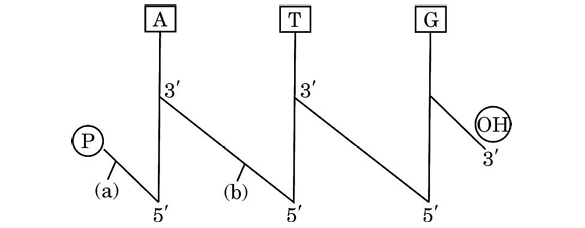
Name the covalent bonds depicted as (a) and (b) in the form of slanting lines in the diagram.
How many purines are present in the given “stick” diagram?
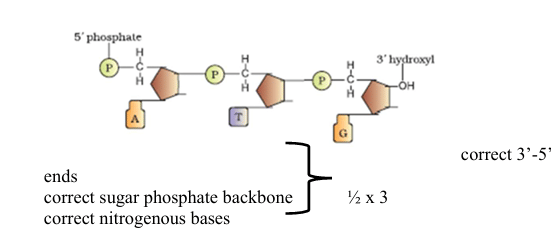
Draw the chemical structure of the given polynucleotide chain of DNA.
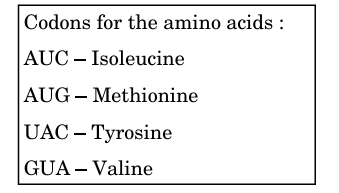
- [(a)] Write the codons in correct sequence for the four amino acids.
- [(b)] If first adenine in DNA is substituted by guanine, what will be the sequence of amino acids in the new oligopeptide?
- [(c)] Write the anticodons for these amino acids.
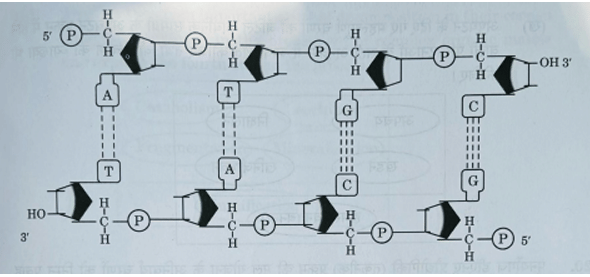
Study the given molecular structure of double-stranded polynucleotide chain of DNA and answer the questions that follow. 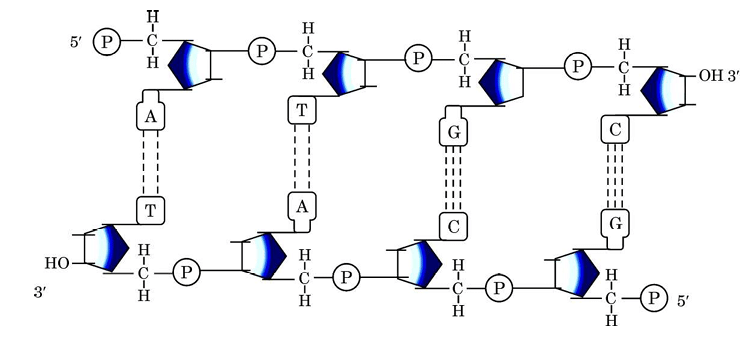
(a) How many phosphodiester bonds are present in the given double-stranded polynucleotide chain?
(b) How many base pairs are there in each helical turn of double helix structure of DNA? Also write the distance between a base pair in a helix.
(c) In addition to H-bonds, what confers additional stability to the helical structure of DNA?
Construct and label a transcription unit from which the RNA segment given below has been transcribed. Write the complete name of the enzyme that transcribed this RNA. 
Explain how the addition of lactose in the medium regulates the switching on of the lac operon in bacteria.
The process of copying the genetic information from one strand of DNA into RNA is termed as transcription. The principle of complementarity of bases governs the process of transcription, also except that uracil comes in place of thymine.
Study the complete transcription unit given below and answer the following questions: 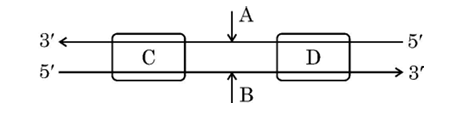
(a) Name the main enzyme involved in the process of transcription.
(b) Identify coding strand and template strand of DNA in the transcription unit.
Attempt either sub-part (c) or (d):
(c) Identify (C) and (D) in the diagram, mention their significance in the process of transcription.
OR
(d) Describe the location of (C) and (D) in the transcription unit.}
Column-I Column-II
(a) RNA polymerase I (i) 18s rRNA
(b) RNA polymerase II (ii) SnRNAs
(c) RNA polymerase III (iii) hnRNA
Choose the option that correctly matches the items of Column-I with those of Column-II:
Given below is a heterogeneous RNA formed during Eukaryotic transcription: 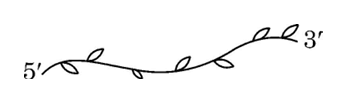
How many introns and exons respectively are present in the hnRNA?
Use the given information to select the amino acid attached to the 3′ end of tRNA during the process of translation, if the coding strand of the structural gene being transcribed has the nucleotide sequence ‘TCC’. 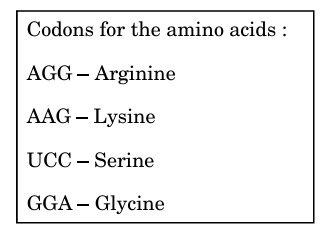
Regulation of lac operon by repressor is referred to as:
Reason (R): Chromosomes have specific sequences called ‘ori’ region, where DNA replication is initiated.
Reason (R): DNA replication and cell division cycle should be highly coordinated.
In which position will an insertion of a thymine nucleotide result in the termination of translation?
DNA strand:
3′ T C C A C C C G A T G C 5′
3′ TCCACCCGATGC 5'
3′ TCCACCCGATGC 5′
3′ TCCACCCGATGC 5′
3′ TCCACCCGATGC 5′
- Give the base sequence of its complementary strand.
- How are these base pairs held together in DNA molecule?
- Explain the base complementarity rule. Name the scientist who framed this rule.
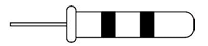
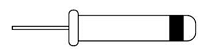
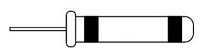
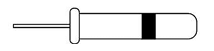
Use the given information to select the amino acid attached to the 3′ end of tRNA during the process of translation, if the coding strand of the structural gene being transcribed has the nucleotide sequence TAC.
28S rRNA
5.8S rRNA
26S rRNA
23S rRNA
5' - ATG ACC GTA TTT TCT GTA GTG CCC GTA CTT CAG GCA TTA 3'
(i) Write the corresponding template strand and m-RNA strand that will be transcribed along with its polarity.
(ii) If GUA of transcribed mRNA is an intron, then depict the sequence involved in formation of mRNA / mature / processed hnRNA strand :
(1) In a bacterium
(2) In humans
(iii) How many amino acids the resulting polypeptide will have after the process of translation in humans?
About Molecular Basis Of Inheritance - CBSE-CLASS-XII
Molecular Basis Of Inheritance is a vital chapter for CBSE-CLASS-XII aspirants. Mastering the concepts covered in this chapter is essential for securing a top rank.
By rigorously practicing the previous year questions associated with this chapter, you can identify high-yield topics, understand the examiner's perspective, and boost your confidence during the actual exam.
Frequently Asked Questions
Why focus on Molecular Basis Of Inheritance PYQs?
Analyzing PYQs for this specific chapter reveals the most frequently tested concepts and the typical complexity of questions, allowing you to tailor your study plan efficiently.
How to best use this analysis?
Review the topic breakdown to see which sub-topics within Molecular Basis Of Inheritance carry the most weight. Then, tackle the questions iteratively to solidify your understanding.