Human Health And Disease
59 previous year questions.
High-Yield Trend
Chapter Questions 59 MCQs
(i) What did the doctor inject and why?
(ii) Name the kind of immunity provided by this injection.
State the role of the following techniques in the detection and diagnosis of cancer:
All normal human cells have genes that may become cancerous under certain conditions. Name them and explain how.
Read the following passage and answer the questions that follow: “Mosquitoes are drastically affecting the human health in almost all the developing tropical countries. Different species of mosquitoes cause very fatal diseases so much so that many humans lose their life and if they survive, are unable to put in productive hours to sustain their life. With the result, the health index of the country goes down.”
Explain the events which occur within a female Anopheles mosquito after it has sucked blood from a malaria patient.
(i) human body
(ii) the female {Anopheles} body.
Student to attempt either option (A) or (B):
(A) Explain how the immunity of a person is affected if there is atrophy (degeneration) of the thymus gland at an early stage of life.
OR
(B) (i) What are interferons? Explain their role in providing immunity to a person.
(ii) Which category of innate immunity defence barrier can interferons be classified into?
Immunity in our body is of two types: (i) Innate immunity and (ii) acquired immunity. Innate immunity is a non-specific defence mechanism, whereas acquired immunity is pathogen-specific; it is called specific immunity too. Acquired immunity is characterised by memory. Antibodies are specific to antigens and there are different types of antibodies produced in our body: they are IgA, IgE, IgG and IgM. It shows primary response when it encounters the pathogen for the first time and secondary response during the subsequent encounters with the same Antigen/Pathogen.
(a) Name the two types of specialised cells which carry out the primary and secondary immune response.
(b) Why is the antibody-mediated immunity also called as humoral immune response?
Attempt either sub-part (c) or (d):
(c) The organ transplants are often rejected if taken from suitable compatible persons.
(i) Mention the characteristic of our immune system that is responsible for the graft rejection.
(ii) Name the type of immune response and the cell involved in it.
OR
(d) How is active immunity different from passive immunity?
Study a part of life cycle of Plasmodium given below: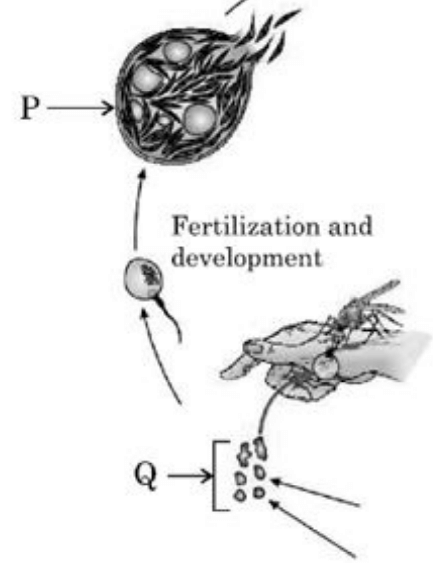
Answer the following questions:
(a) Name the infective stage of Plasmodium that is stored in the female Anopheles mosquito.
(b) Where does fertilization and development of parasite take place?
(c) Identify labels P and Q in the given diagram.
(d) Asexual and sexual phase of the life cycle of the Plasmodium takes place in two different hosts. Write their names.
Read the following passage and answer the questions that follow. Prevention is the frontline response to drug use. Effective interventions address the underlying conditions contributing to drug use, such as a lack of connection to family or community, instability, insecurity, trauma, mental health issues, etc. When addressed, these factors can effectively prevent the initiation of drug use and the progression to drug use disorders. Study the few key figures of drug use given below and answer the questions that follow. 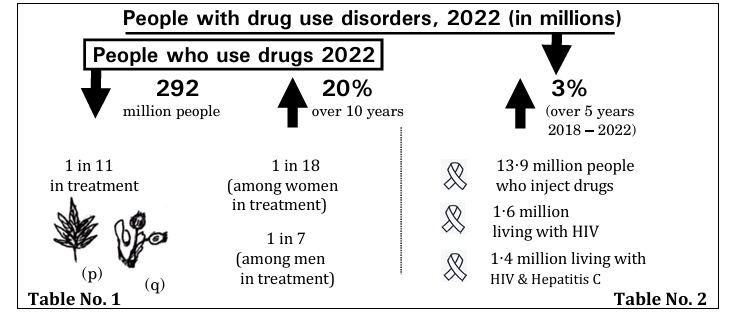
(a) What do you infer from the figures in Table No. 1 about the people with drug use disorders, 2022 (in million)? State any two of your observations.
(b) How are Hepatitis C and HIV related to drug use disorders by people, as shown in Table No. 2? State the correlation between the two.
(c)
- [(i)] Give the scientific name of (p) shown in Table No. 1.
OR - [(ii)] Give the scientific name of (q) shown in Table No. 1.
Reason (R): Filarial worm usually lives in the lymphatic vessels of the lower limbs.
(a) Why there is a need to conduct such tests?
(b) Name the drugs the authorities usually look for.
(c) Write the generic names of two plants from which these drugs are obtained.
Student to attempt either option (A) or (B).
(A) Describe any two situations where a medical doctor would recommend injection of pre-formed antibodies (antitoxins) into the body of a patient.
OR
(B) The symptoms of malaria do not appear immediately after the entry of sporozoites into the human body when bitten by female Anopheles mosquito. Explain why it happens.
Reason (R): A healthy person acquires the infection by inhaling the aerosols released by an infected person.
Student to attempt either option (A) or (B):
(A) Give an account of the generalised structure of an antibody molecule produced by B-lymphocytes in response to the pathogen.
OR
(B) Other than public awareness and counselling, enlist four measures taken up by NACO, WHO and other NGOs to prevent the spread of HIV infection in the society.
(A) How does a human body respond when vaccine is introduced into it? It is said that vaccinations are a must for a healthy society. Justify.
OR
(B) Humans have innate immunity for protection against pathogens that may enter the gut along with food. What are the two barriers in our body that protect it from such pathogens?
Study the items of columns I and II where drugs and their effects are given and match them correctly. 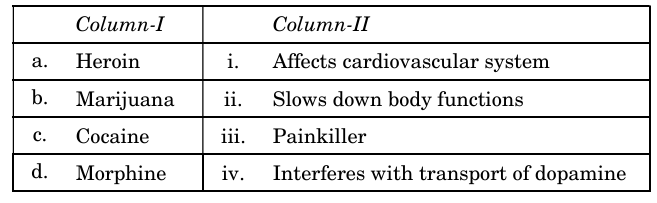
Choose the correct answer from the options given below:
Reason (R): The inhibiting chemical was commercially extracted and its full potential was established by Alexander Fleming.
IgG
Read the following passage and answer the questions that follow.
Deaths related to the use of drugs were estimated at about 5,00,000 in 2019, 17.5 percent more than in 2009. Liver diseases attributed to Hepatitis B are a major cause of drug-related deaths, according to UNODC, accounting for more than half of the total number of deaths attributed to the use of drugs. Drug overdoses account for a quarter of drug-related deaths.
Opioids contribute to account for the most severe drug-related harm, including fatal overdoses, when used non-medically. At the global level, two-thirds of direct drug-related deaths are due to opioids, and in some sub-regions the proportion can be as high as three-quarters of such deaths.
(a) Why are people taking opioids more prone to liver diseases attributed to Hepatitis B?
(b) What is meant by direct drug-related disease?
(c) (i) What is the scientific name of the plant from which the opioids are derived and from which part of the plant is it extracted?
OR
(c) (ii) State two common warning signs of drug abuse among the youth.
(ii) Which category of innate immunity defence barrier can interferons be classified into?
Reason (R): The parasite attacks the RBC resulting in their rupture and release of haemozoin.
Reason (R) : An antibody binds to a specific foreign antigen and neutralizes its odd effects.
Reason (R): Filarial worm usually lives in the lymphatic vessels of the lower limbs.
About Human Health And Disease - CBSE-CLASS-XII
Human Health And Disease is a vital chapter for CBSE-CLASS-XII aspirants. Mastering the concepts covered in this chapter is essential for securing a top rank.
By rigorously practicing the previous year questions associated with this chapter, you can identify high-yield topics, understand the examiner's perspective, and boost your confidence during the actual exam.
Frequently Asked Questions
Why focus on Human Health And Disease PYQs?
Analyzing PYQs for this specific chapter reveals the most frequently tested concepts and the typical complexity of questions, allowing you to tailor your study plan efficiently.
How to best use this analysis?
Review the topic breakdown to see which sub-topics within Human Health And Disease carry the most weight. Then, tackle the questions iteratively to solidify your understanding.