Sexual Reproduction In Flowering Plants
33 previous year questions.
High-Yield Trend
Chapter Questions 33 MCQs
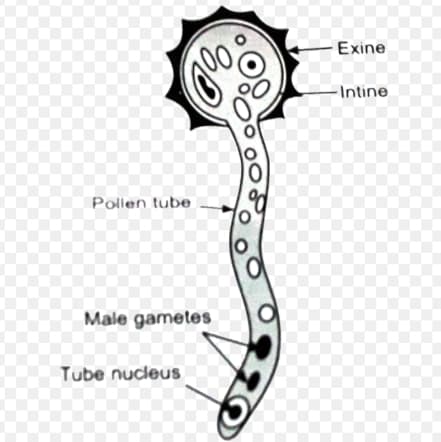
Student to attempt either option (A) or (B):
(A)
(i) Write two crucial changes, the seed undergoes while reaching maturity that enable them to be in a viable state until the onset of favourable conditions.
(ii) Name the oldest viable seed excavated from Arctic Tundra as per the records.
OR (B)
(i) Pea flower produced seed sets. Give reason.
(ii) In case of Polyembryony, an embryo ‘P’ develops from a synergid and the embryo ‘Q’ develops from the nucellus. State the ploidy of embryo ‘P’ and ‘Q’.
(i) Non-albuminous seeds have no residual endosperm.
(ii) Residual, persistent nucellus in wheat is known as perisperm.
(iii) Integuments of ovules harden as tough protective seed coat.
(iv) Metabolic activity of the embryo slows down in dormancy.
Choose the correct option:
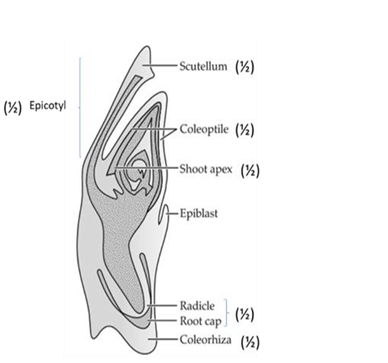
Given below is a diagram of T.S. of a monocot seed with parts I, II & III labelled : 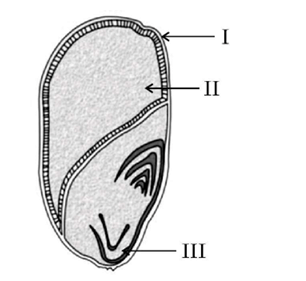
Choose the option where parts I, II and III are identified correctly.
(b) Write the composition of intine and exine layers of a pollen grain.
The following question is based on pollination. Study the figures carefully and answer the questions that follow.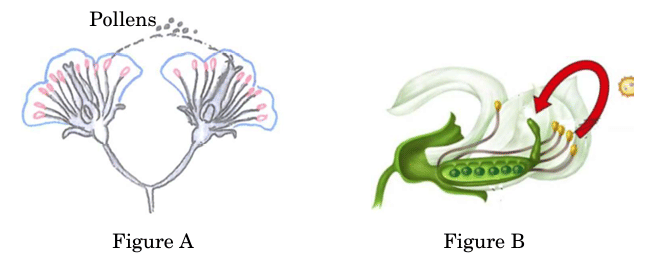
- Give the scientific terms for the processes taking place in Figures A and B respectively.
- Mention two conditions necessary for the process occurring in Figure B.
-
- [(i)] State one advantage and one disadvantage of the process occurring in Figure B.
OR - [(ii)] Name one plant where, in some flowers only, the process in Figure B takes place and give the reason responsible for it.
- [(i)] State one advantage and one disadvantage of the process occurring in Figure B.
OR
(B)
- Give the schematic representation of oogenesis in human females indicating chromosome number at each step.
- In which part of the female reproductive system do the following events take place?
- I. Formation of corpus luteum
- II. Maturation of tertiary follicle
- III. Fertilisation
- IV. Implantation
Flowering plants with hermaphrodite flowers have developed many reproductive strategies to ensure cross-pollination. Study the given outbreeding devices adopted by certain flowering plants and answer the questions that follow. 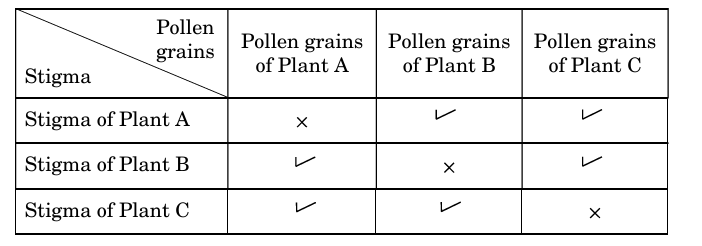
Note : All plants belong to the same species. No pollen tube growth/inhibition of pollen germination on stigma. Pollen germination on stigma.
- [(a)] Name and define the outbreeding device described in the above table.
- [(b)] Explain what would have been the disadvantage to the plant in the absence of the given strategy.
Student to attempt either option (A) or (B).
(A)
(i) Describe the process of megasporogenesis in an angiosperm.
(ii) Draw a diagram of a mature embryo sac of the angiosperm. Label its any four parts.
OR
(B) The reproductive cycle in the female primates is called menstrual cycle. The first menstruation begins at puberty.
Answer the following questions:
(i) Name the four phases of menstrual cycle in a proper sequence.
(ii) How long does the menstrual phase last in a menstrual cycle?
(iii) When and why hormones estrogen and progesterone reach their peak levels respectively, in the menstrual cycle?
(iv) Give the significance of LH surge.
- [(i)]
- They discourage cross-pollination and ensure self-pollination.
- They are advantageous as they lead to inbreeding depression.
- Self-incompatibility prevents self-pollen from fertilising the ovules.
- To prevent self-pollination in some species pollen release and stigma receptivity are not synchronised.
- Majority of these flowers are large, colourful and rich in nectar.
- Nectars and seeds are usual floral rewards to attract insects for pollination.
- Pollen grains of these flowers are generally mucilaginous so as to stick to the body of the insects.
- A foul odour is emitted by some flowers to attract flies and beetles.
Answer the following questions:
[(i)] Explain the structure of a mature embryo sac of a typical flowering plant.
[(ii)] How is triple fusion achieved in these plants?
OR
[(i)] Describe the changes in the ovary and the uterus as induced by the changes in the level of pituitary and ovarian hormones during menstrual cycle in a human female.
- Re-bagging
- Selection of parents
- Bagging
- Dusting the pollens on stigma
- Emasculation
- Collection of pollens from male parent
(i) It is attached to the placenta by hilum.
(ii) It has a chalaza end that represents the basal part of the ovule.
(iii) It has nucellus enclosed by integuments.
(iv) Its micropylar end is known as chalaza.
Choose the correct answer:
Reason (R): Perisperm is the remains of nucellus which surrounds the embryo in certain seeds.
(a) (i) Explain the structure of a typical monocotyledonous embryo of a flowering plant.
(ii) How are multiple embryos formed in a citrus fruit? What is the mechanism known as?
OR
(b) (i) Name and explain the structural organization of the male sex accessory ducts in the human male reproductive system.
(ii) Describe the role of gonadotropin FSH (Follicle-Stimulating Hormone) in the regulation of spermatogenesis.
Pollination by water is quite rare and limited to about 30 genera.
Given below is a flower with its characteristic features specialised for the most common type of abiotic pollination.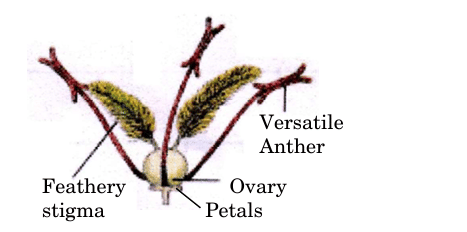
Answer the following questions based on the above diagram:
(a) Name the mode of abiotic pollination that will be adopted by the given plant species in the above picture.
(b) State the need of exposed large feathery stigmas for the flower.
(c) What will be the two important adaptations in the pollen grains of the flowers pollinated by the above mode of pollination?
(d)What could be the probable reason for the petals being small and non-green?
Reason (R): Formation of fruit without fertilization is called parthenocarpy.
1. The zygote forms a proembryo and subsequently heart-shaped, globular and mature embryo.
2. Most zygotes divide to form embryo only after a certain amount of endosperm is formed.
3. The embryo develops at the micropylar end of the embryo sac.
4. A typical dicotyledonous embryo consists of an embryonal axis and a scutellum.
Choose the correct option from the following:
About Sexual Reproduction In Flowering Plants - CBSE-CLASS-XII
Sexual Reproduction In Flowering Plants is a vital chapter for CBSE-CLASS-XII aspirants. Mastering the concepts covered in this chapter is essential for securing a top rank.
By rigorously practicing the previous year questions associated with this chapter, you can identify high-yield topics, understand the examiner's perspective, and boost your confidence during the actual exam.
Frequently Asked Questions
Why focus on Sexual Reproduction In Flowering Plants PYQs?
Analyzing PYQs for this specific chapter reveals the most frequently tested concepts and the typical complexity of questions, allowing you to tailor your study plan efficiently.
How to best use this analysis?
Review the topic breakdown to see which sub-topics within Sexual Reproduction In Flowering Plants carry the most weight. Then, tackle the questions iteratively to solidify your understanding.