Lactobacillus that sets milk into curd is categorised as:
1
Cyanobacteria
2
Archaebacteria
3
Chemosynthetic bacteria
4
Heterotrophic bacteria
Official Solution
Correct Option: (4)
\textit{Lactobacillus} is a heterotrophic bacterium that ferments lactose in milk to produce lactic acid, leading to curd formation. It ferments lactose in milk, producing lactic acid and causing the milk to curdle.
02
PYQ 2025
medium
biologyID: cbse-cla
Answer the following questions: 1. State what do you understand by “MALT”? Where is it located inside our body? 2. Explain cytokine barriers. 3. Name the diagnostic test for AIDS. On what principle does it work? 4. Bone marrow and thymus play an important role in human immune system. Explain how are they able to achieve this.
Official Solution
Correct Option: (1)
Step 1 (A): (A) MALT (Mucosa-Associated Lymphoid Tissue) is a component of the immune system found in mucosal linings such as the respiratory tract, gut, and urogenital tract. It provides localized immunity at the mucosal surfaces. (B) Cytokine barriers refer to proteins like interferons secreted by virus-infected cells that protect non-infected cells from further viral infection. (C) The diagnostic test for AIDS is the ELISA test. It works on the principle of antigen-antibody interaction, detecting HIV antibodies in the blood. (D) Bone marrow produces lymphocytes while the thymus is where T-lymphocytes mature. Together, they generate a functional immune system capable of defending the body.
03
PYQ 2025
medium
biologyID: cbse-cla
Explain how cyanobacteria can be used as bio-fertilizer.
Official Solution
Correct Option: (1)
Step 1: Cyanobacteria like \emph{Anabaena}, \emph{Nostoc}, and \emph{Oscillatoria} are free-living nitrogen-fixing bacteria found in aquatic and terrestrial habitats. Step 2: These microbes fix atmospheric nitrogen into usable forms, enriching the soil. They are used in rice fields to enhance fertility without the use of chemical fertilizers.
04
PYQ 2025
medium
biologyID: cbse-cla
Name an alcoholic drink which is produced with the help of microbes: (1) With distillation (2) Without distillation
Official Solution
Correct Option: (1)
Step 1: (1) With distillation: Whisky or rum (2) Without distillation: Wine or beer
05
PYQ 2025
medium
biologyID: cbse-cla
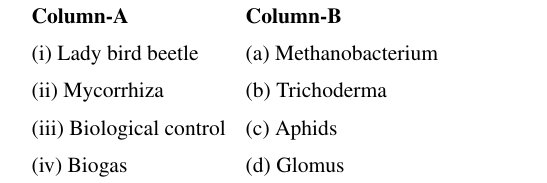
Match the items in Column-A with that of Column-B:
1
(b) (d) (c) (a)
2
(c) (d) (b) (a)
3
(d) (a) (b) (c)
4
(c) (b) (a) (d)
Official Solution
Correct Option: (1)
Step 1: Lady bird beetle is used in biological control of aphids. → (i) → (c) Step 2: Mycorrhiza refers to a symbiotic association of fungi with plant roots; Glomus is a genus of mycorrhizal fungi. → (ii) → (d) Step 3: Trichoderma is a fungal genus used in biological control. → (iii) → (b) Step 4: Methanobacterium is involved in methane (biogas) production. → (iv) → (a)
06
PYQ 2025
medium
biologyID: cbse-cla
Large scale industrial production of citric acid for human welfare is done using the microbe:
1
Streptococcus sp.
2
Aspergillus sp.
3
Clostridium sp.
4
Trichoderma sp.
Official Solution
Correct Option: (2)
Aspergillus sp., particularly Aspergillus niger, is widely used for the industrial production of citric acid due to its efficiency in fermenting sugars into citric acid. Streptococcus, Clostridium, and Trichoderma are not typically used for this purpose.
07
PYQ 2025
medium
biologyID: cbse-cla
Bottled fruit juices are clearer as compared to those made at home, as they are clarified by the use of:
1
Lipases and pectinases
2
Pectinases and proteases
3
Proteases and cellulases
4
Nucleases and lipases
Official Solution
Correct Option: (2)
Pectinases break down pectin, a component of plant cell walls that causes turbidity. Proteases remove proteins that also contribute to cloudiness, resulting in clearer juices.
08
PYQ 2025
medium
biologyID: cbse-cla
Identify the organism whose product has been commercialised as blood cholesterol lowering agent.
1
Trichoderma polysporum
2
Monascus purpureus
3
Saccharomyces cerevisiae
4
Aspergillus niger
Official Solution
Correct Option: (2)
Step 1:Monascus purpureus produces statins, which are used as cholesterol-lowering drugs. Step 2: These compounds inhibit HMG-CoA reductase, an enzyme involved in cholesterol synthesis. Step 3: Hence, the correct organism is Monascus purpureus.
09
PYQ 2025
medium
biologyID: cbse-cla
Large scale industrial production of streptokinase for human welfare is done using the microbe:
1
Streptomyces
2
Streptococcus
3
Streptobacilli
4
Streptopneumoniae
Official Solution
Correct Option: (2)
Streptokinase, used as a clot-buster in myocardial infarction patients, is produced by the bacterium Streptococcus.
10
PYQ 2025
medium
biologyID: cbse-cla
Assertion (A): Swiss cheese is characterized by large holes due to CO2 production. Reason (R): It is ripened by growing a specific fungi.
1
Both Assertion (A) and Reason (R) are true and Reason (R) is the correct explanation of the Assertion (A).
2
Both Assertion (A) and Reason (R) are true, but Reason (R) is not the correct explanation of the Assertion (A).
3
Assertion (A) is true, but Reason (R) is false.
4
Assertion (A) is false, but Reason (R) is true.
Official Solution
Correct Option: (3)
Swiss cheese gets its characteristic holes due to CO2 production by the bacterium Propionibacterium shermanii, not by fungi. Hence, Assertion is true and Reason is false.
11
PYQ 2025
medium
biologyID: cbse-cla
Student to attempt either option (A) or (B):(A) Ravi lives in a village where he suggested to the local farmers to introduce a fungus as biofertilizer into their crop fields. State the benefits provided by the fungus to the crop. OR (B)
[(i)] How do secondary lymphoid organs provide immunity?
[(ii)] Highlight the role of spleen as an organ that provides immunity.
Official Solution
Correct Option: (1)
(A)Step 1: The fungus suggested as a biofertilizer is mycorrhiza. Step 2: Mycorrhizal fungi form a symbiotic association with plant roots. Step 3: They enhance water and nutrient (especially phosphorus) absorption. Step 4: They also offer protection from pathogens and improve plant growth and resistance. OR (B)(i) Secondary lymphoid organs like lymph nodes and spleen are sites where lymphocytes interact with antigens. These organs provide an environment for the activation and proliferation of immune cells. (ii) The spleen filters blood, traps blood-borne antigens, and provides a site for immune responses. It also destroys old RBCs and stores immune cells like lymphocytes.
12
PYQ 2025
medium
biologyID: cbse-cla
Assertion (A): Swiss cheese is characterized by large holes due to CO2 production. Reason (R): It is ripened by growing a specific fungi.
1
Both Assertion (A) and Reason (R) are true and Reason (R) is the correct explanation of the Assertion (A).
2
Both Assertion (A) and Reason (R) are true, but Reason (R) is \textit{not} the correct explanation of the Assertion (A).
3
Assertion (A) is true, but Reason (R) is false.
4
Assertion (A) is false, but Reason (R) is true.
Official Solution
Correct Option: (3)
Swiss cheese contains holes due to carbon dioxide produced by Propionibacterium shermanii, not fungi. Hence, the assertion is correct but the reason is incorrect.
13
PYQ 2025
medium
biologyID: cbse-cla
Large holes in 'Swiss cheese' are formed by the activity of microbes:
1
Streptococcus pneumoniae
2
Monascus purpureus
3
Trichoderma polysporum
4
Propionibacterium shermanii
Official Solution
Correct Option: (4)
Large holes in Swiss cheese are formed by Propionibacterium shermanii, which ferments lactic acid to produce carbon dioxide gas, creating the characteristic 'eyes' or holes. Streptococcus pneumoniae causes pneumonia, Monascus purpureus is used in red yeast rice, and Trichoderma polysporum produces cyclosporin A, none of which are involved in Swiss cheese production.
14
PYQ 2025
medium
biologyID: cbse-cla
(A) Answer the following questions:
State what do you understand by “MALT”? Where is it located inside our body? Explain cytokine barriers. Name the diagnostic test for AIDS. On what principle does it work? Bone marrow and thymus play an important role in human immune system. Explain how are they able to achieve this. \begin{center} OR
\end{center} (B)
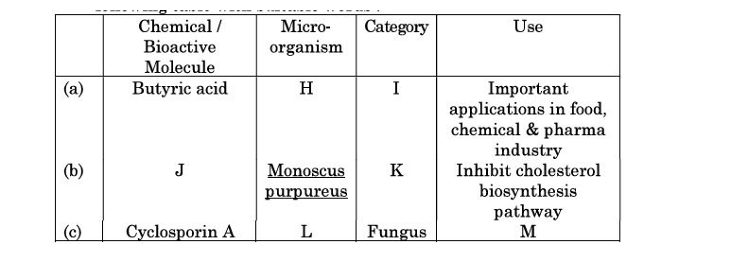
Study the following table \& fill ‘H’, ‘T’, ‘J’, ‘K’, ‘L’ and ‘M’ in the following table with suitable words: Why are baculoviruses used as biological control agents?
Official Solution
Correct Option: (1)
Step 1 (A):
MALT (Mucosa-Associated Lymphoid Tissue) is a component of the immune system found in mucosal linings such as the respiratory tract, gut, and urogenital tract. It provides localized immunity at the mucosal surfaces. Cytokine barriers refer to proteins like interferons secreted by virus-infected cells that protect non-infected cells from further viral infection. The diagnostic test for AIDS is the ELISA test. It works on the principle of antigen-antibody interaction, detecting HIV antibodies in the blood. Bone marrow produces lymphocytes while the thymus is where T-lymphocytes mature. Together, they generate a functional immune system capable of defending the body. Step 2 (B):
See the filled table above in the question section. Baculoviruses are used as biological control agents because they are species-specific, do not harm non-target organisms, and are safe for the environment. They infect only specific insect pests.
15
PYQ 2025
medium
biologyID: cbse-cla
Explain how cyanobacteria can be used as bio-fertilizer.
Official Solution
Correct Option: (1)
Step 1: Cyanobacteria like \emph{Anabaena}, \emph{Nostoc}, and \emph{Oscillatoria} are free-living nitrogen-fixing bacteria found in aquatic and terrestrial habitats. Step 2: These microbes fix atmospheric nitrogen into usable forms, enriching the soil. They are used in rice fields to enhance fertility without the use of chemical fertilizers.
16
PYQ 2025
medium
biologyID: cbse-cla
Name an alcoholic drink which is produced with the help of microbes: (1) With distillation (2) Without distillation
Official Solution
Correct Option: (1)
Step 1: (1) With distillation: Whisky or rum (2) Without distillation: Wine or beer
17
PYQ 2025
medium
biologyID: cbse-cla
Bioactive molecule Cyclosporin A used for human welfare is derived from:
1
Propionibacterium sharmanii
2
Monascus purpureus
3
Trichoderma polysporum
4
Aspergillus niger
Official Solution
Correct Option: (3)
Cyclosporin A is an immunosuppressive drug widely used during organ transplantation to prevent graft rejection. It is obtained from the fungus Trichoderma polysporum. This molecule acts by inhibiting the activity of T-cells, thereby suppressing the immune response.
18
PYQ 2025
medium
biologyID: cbse-cla
Assertion (A): Biogas plants are more often built in rural areas. Reason (R): The excreta or gobar of cattle is rich in Methanobacterium.
1
Both (A) and (R) are true and (R) is the correct explanation of (A).
2
Both (A) and (R) are true, but (R) is not the correct explanation of (A).
3
(A) is true, but (R) is false.
4
(A) is false, but (R) is true.
Official Solution
Correct Option: (1)
Step 1: Biogas plants are indeed more prevalent in rural areas due to easy availability of cattle dung — Assertion is true. Step 2: Cattle dung contains Methanobacterium, which helps in methane production — Reason is true. Step 3: The presence of Methanobacterium in gobar is the reason biogas plants are suitable for rural areas — so Reason explains Assertion.
19
PYQ 2025
medium
biologyID: cbse-cla
Large scale industrial production of Butyric acid for human welfare is done using the microbe:
1
Aspergillus sp.
2
Streptococcus sp.
3
Clostridium sp.
4
Trichoderma sp.
Official Solution
Correct Option: (3)
Clostridium species are anaerobic bacteria known for their role in producing butyric acid as a metabolic by-product in fermentation processes.
20
PYQ 2025
medium
biologyID: cbse-cla
Explain the biological treatment of primary effluent when passed into the large aeration tanks in a sewage treatment plant (STP).
Official Solution
Correct Option: (1)
Step 1: The primary effluent obtained after sedimentation is transferred to large aeration tanks where it is subjected to secondary (biological) treatment. Step 2: In these tanks, air is pumped to facilitate the vigorous growth of aerobic microbes, especially bacteria and protozoa, which form flocs (masses of bacteria and fungal filaments). Step 3: These microbes digest the organic matter in the effluent, significantly reducing the biochemical oxygen demand (BOD), which is an indicator of organic pollution. Step 4: Once the BOD is sufficiently reduced, the effluent is passed into a settling tank where the flocs settle as activated sludge. Step 5: Part of this activated sludge is recycled back to the aeration tank as inoculum, and the rest is sent for anaerobic digestion or dried and used as manure.
21
PYQ 2025
medium
biologyID: cbse-cla
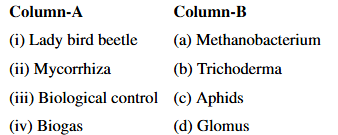
Match the items in Column-A with that of Column-B: Choose the option that matches the items of Column A with that of B correctly:
1
(b) (d) (c) (a)
2
(c) (d) (b) (a)
3
(d) (a) (b) (c)
4
(c) (b) (a) (d)
Official Solution
Correct Option: (1)
Step 1: Lady bird beetle is used in biological control of aphids. → (i) → (c) Step 2: Mycorrhiza refers to a symbiotic association of fungi with plant roots; Glomus is a genus of mycorrhizal fungi. → (ii) → (d) Step 3: Trichoderma is a fungal genus used in biological control. → (iii) → (b) Step 4: Methanobacterium is involved in methane (biogas) production. → (iv) → (a)
22
PYQ 2025
easy
biologyID: cbse-cla
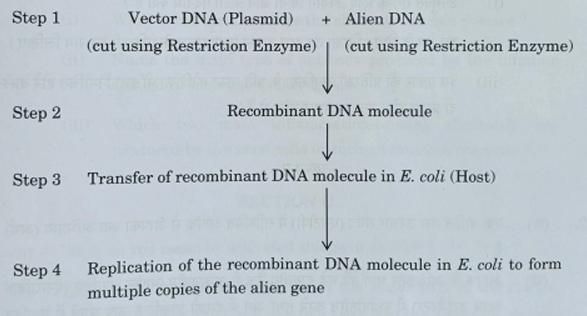
The basic scheme of the essential steps involved in the process of recombinant DNA technology is summarised below in the form of a flow diagram. Study the given flow diagram and answer the questions that follow.
Official Solution
Correct Option: (1)
23
PYQ 2025
easy
biologyID: cbse-cla
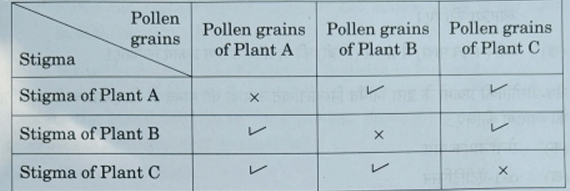
Flowering plants with hermaphrodite flowers have developed many reproductive strategies to ensure cross-pollination. Study the given outbreeding devices adopted by certain flowering plants and answer the questions that follow.Note: All plants belong to the same species.
× - No pollen tube growth/inhibition of pollen germination on stigma.
✓ - Pollen germination on stigma.
Official Solution
Correct Option: (1)
24
PYQ 2025
medium
biologyID: cbse-cla
Bacteria growing anaerobically on cellulosic material produce large amounts of which gases? Select the correct option.
Anaerobic bacteria that decompose cellulosic material (like plant matter) in environments lacking oxygen carry out anaerobic digestion or fermentation. This process typically results in the production of several gases, including carbon dioxide (CO(_2)), methane (CH(_4)), and hydrogen (H(_2)). These gases are the primary components of biogas produced from the anaerobic breakdown of organic matter. Option includes CH(_3) (methyl radical), which is not a stable end product of this process. Option includes NH(_3) (ammonia), which is produced during the breakdown of nitrogen-containing compounds, not primarily from cellulose. Option includes H(_2)O (water), Cl(_2) (chlorine gas, which is not biologically produced in this context), and H(_2)S (hydrogen sulfide), which can be produced under certain anaerobic conditions, but CO(_2) and CH(_4) are more significant products of cellulose breakdown. Option correctly lists the major gaseous products of anaerobic digestion of cellulosic material.
25
PYQ 2026
medium
biologyID: cbse-cla
Write two advantages of using bio-fertilizers over chemical fertilizers.
Official Solution
Correct Option: (1)
Step 1: Understanding the Concept: The shift from chemical to organic farming is driven by the negative environmental impacts of synthetic fertilizers. Step 2: Detailed Explanation: 1. Environmental Safety: Chemical fertilizers often leach into water bodies, causing eutrophication and soil degradation. Bio-fertilizers are non-polluting and eco-friendly. 2. Sustainability and Soil Health: Bio-fertilizers maintain the natural nutrient cycle and improve soil structure and water-holding capacity. They are a low-cost, renewable source of nutrients, whereas chemical fertilizers are expensive and non-renewable. Step 3: Final Answer: Advantages include environmental protection (no pollution) and long-term improvement of soil health and sustainability.
26
PYQ 2026
medium
biologyID: cbse-cla
Name the different types of microorganisms used as bio-fertilizers in organic farming and explain how each contributes to soil fertility.
Official Solution
Correct Option: (1)
Step 1: Understanding the Concept: Different microbes have specialized roles in nutrient cycling within the soil. Step 2: Detailed Explanation: 1. Bacteria: \textit{Rhizobium} forms symbiotic associations with legume roots to fix atmospheric nitrogen. Free-living bacteria like \textit{Azotobacter} and \textit{Azospirillum} also fix nitrogen directly into the soil. 2. Fungi: Fungi form symbiotic associations with plants called Mycorrhiza (e.g., genus \textit{Glomus}). The fungus absorbs phosphorus from the soil and passes it to the plant. It also provides resistance to root-borne pathogens and salinity. 3. Cyanobacteria: Blue-green algae like \textit{Anabaena}, \textit{Nostoc}, and \textit{Oscillatoria} can fix atmospheric nitrogen. In paddy fields, they serve as an important bio-fertilizer and also add organic matter to the soil. Step 3: Final Answer: Microbes include bacteria (fix nitrogen), fungi (absorb phosphorus), and cyanobacteria (fix nitrogen and add organic matter).
27
PYQ 2026
medium
biologyID: cbse-cla
What are bio-fertilizers?
Official Solution
Correct Option: (1)
Step 1: Understanding the Concept: Unlike chemical fertilizers, bio-fertilizers use living microorganisms to provide nutrients to plants. Step 2: Detailed Explanation: Bio-fertilizers are substances containing living microorganisms which, when applied to seeds, plant surfaces, or soil, colonize the rhizosphere or the interior of the plant and promote growth by increasing the supply or availability of primary nutrients to the host plant. They primarily consist of bacteria, fungi, and cyanobacteria. Step 3: Final Answer: Bio-fertilizers are living organisms (like bacteria or fungi) that enhance the fertility of the soil by providing nutrients like nitrogen and phosphorus.
28
PYQ 2026
medium
biologyID: cbse-cla
Assertion (A) : Flocs are masses of bacteria associated with fungal filaments in secondary treatment of sewage. Reason (R) : Flocs help in digestion of solid waste by aerobic respiration.
1
Both Assertion (A) and Reason (R) are true and Reason (R) is the correct explanation of the Assertion (A).
2
Both Assertion (A) and Reason (R) are true, but Reason (R) is not the correct explanation of the Assertion (A).
3
Assertion (A) is true, but Reason (R) is false.
4
Assertion (A) is false, but Reason (R) is true.
Official Solution
Correct Option: (3)
Step 1: Understanding the Concept: Secondary treatment of sewage is a biological process involving the use of microbes to reduce the organic load of wastewater. Step 2: Detailed Explanation: Assertion (A): During secondary treatment, the primary effluent is agitated in large aeration tanks. This allows vigorous growth of useful aerobic microbes into flocs. Flocs are indeed masses of bacteria associated with fungal filaments to form mesh-like structures. This statement is true. Reason (R): While the microbes in flocs do perform aerobic respiration, they consume the organic matter (BOD) dissolved in the effluent. The term "solid waste" generally refers to the grit and debris removed during primary treatment (physical separation). Flocs do not digest the "solid waste" in the context of sewage treatment terminology; they digest dissolved or colloidal organic matter. Thus, the reason is technically false or inaccurate in its description. Step 3: Final Answer: Assertion is true, but the Reason is false regarding the digestion of "solid waste." Option (C) is correct.