Which of the following compounds on boiling with (alk.) and subsequent acidification will not give benzoic acid ?
Official Solution
Correct Option: (1)
02
PYQ 2002
medium
chemistryID: kcet-200
Organic acid without a carboxylic acid group is
1
ascorbic acid
2
vinegar
3
oxalic acid
4
picric acid
Official Solution
Correct Option: (4)
Picric acid is a 2, 4, 6-trinitrophenol.
03
PYQ 2004
medium
chemistryID: kcet-200
Benzoin is :
1
- hydroxy aldehyde
2
- hydroxy ketone
3
compound containing an aldehyde and a ketonic group
4
- unsaturated acid
Official Solution
Correct Option: (2)
Answer (b) - hydroxy ketone
04
PYQ 2004
medium
chemistryID: kcet-200
Select the value of the strongest acid from the following :
1
2
2
4
3
1
4
3
Official Solution
Correct Option: (3)
See chemical properties of acids
05
PYQ 2009
easy
chemistryID: kcet-200
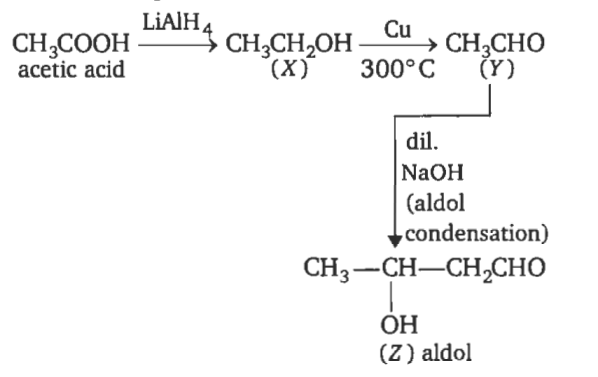
In the above reaction is
1
Ketol
2
Acetal
3
Butanol
4
Aldol
Official Solution
Correct Option: (4)
06
PYQ 2014
medium
chemistryID: kcet-201
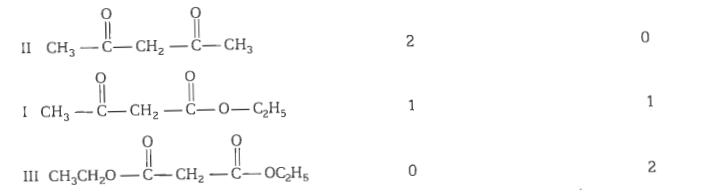
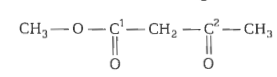
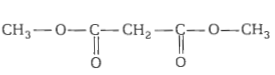
The acid strength of active methylene group in (I) (II) (III) decreases as
1
I > II > III
2
III > I >II
3
III > II > I
4
II > I > III
Official Solution
Correct Option: (4)
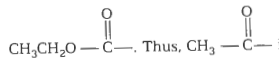
Acid strength in active methylene compounds can be decided by two factors (i) Presence of electron withdrawing group (ii) Stability of enolate anion obtained after removal of . Higher the electron withdrawing ability of substitutents attached to electron withdrawing groups higher will be acidic strength of methylene group. Electron withdrawing ability of is greater than
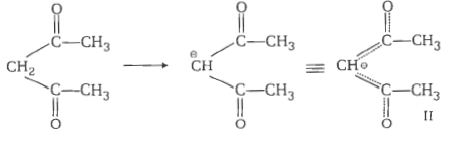
increases acidic strength of active methyl e ne compound to greater extent than Number of groups Number of groups On the other hand stability of enolate anion obtained after the removal of can be explained as keto group stabilises enolate anion to more extent than ester as ketone group stabilise enolate anion by resonance through one side only while ester stabilises by both side of keto group which can be shown as
less tautomerism will be seen due lesser availability of atom for tautomerism (as at this -atom bond is in conjugation with the lone of neighbouring oxygen attached). Further, in
as both the C-atoms of bond have similar situations hence, tautomerism decreases further. That's why correct order of acidity can be arranged as II III and correct choice is (c).
07
PYQ 2016
medium
chemistryID: kcet-201
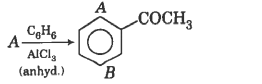
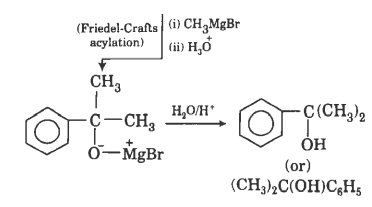
Predict the product in the following series of reactions :
1
2
3
4
Official Solution
Correct Option: (4)
undefined
08
PYQ 2020
medium
chemistryID: kcet-202
A metal exists as an oxide with formula M0.96O. Metal M can exist as M+2 and M+3 in its oxide M0.96O. The percentage of M+3 in the oxide is nearly
1
9.6%
2
8.3%
3
4.6%
4
5%
Official Solution
Correct Option: (2)
The given oxide formula is . Let the amount of metal M present as be and the amount of metal M present as be . The total number of metal atoms in the oxide is , so: The charge balance equation for the oxide is: Now, solve the system of equations: 1. 2. From equation (1), solve for : Substitute this into equation (2): So, the percentage of in the oxide is:
Thus, the correct answer is (B): .
09
PYQ 2020
medium
chemistryID: kcet-202
The oxide of potassium that does not exist is
1
K2O3
2
K2O
3
KO2
4
K2O2
Official Solution
Correct Option: (1)
Potassium (K) forms several oxides, but does not exist due to the instability of such an oxide. The common oxides of potassium are: (Potassium oxide) (Potassium superoxide) (Potassium peroxide) These oxides are stable under normal conditions. , on the other hand, is not stable and does not exist. This is due to the fact that potassium typically forms compounds with an oxidation state of +1 or +2, and an oxide like would require a higher oxidation state, which is not stable for potassium. Thus, the oxide of potassium that does not exist is .
The correct option is (A):
10
PYQ 2020
medium
chemistryID: kcet-202
A Lewis acid 'X' formed by the reaction of BF3 with LiA/H4 in ether medium to gives a highly toxic gas. This gas when heated with NH3 gives a compound commonly known as inorganic benzene. The gas is
1
BF3
2
B2O3
3
B2H6
4
B2N3H6
Official Solution
Correct Option: (3)
The reaction described in the question involves a Lewis acid that reacts with LiAlH_4 to give a highly toxic gas. The gas in question is diborane ( ), which is a highly toxic and volatile compound. When diborane reacts with ammonia ( ), it forms a compound commonly known as inorganic benzene. This compound is known as borazine, , which has a structure similar to benzene, but with alternating boron and nitrogen atoms. Thus, the gas that reacts with NH_3 to form inorganic benzene is .
The correct option is(C):
11
PYQ 2026
medium
chemistryID: kcet-202
The compound that does not answer iodoform test is
1
Ethanal
2
Acetone
3
Ethanoic acid
4
Acetophenone
Official Solution
Correct Option: (3)
Step 1: Understanding the Iodoform Test:
The iodoform test (reaction with I and NaOH) is a qualitative test for the presence of a methyl ketone group (CH -C(=O)-) or an alcohol group (CH -CH(OH)-) which can be oxidized to a methyl ketone under the test conditions. A positive test is indicated by the formation of a yellow precipitate of iodoform (CHI ). Step 2: Analyzing the given compounds: (A) Ethanal (Acetaldehyde, CH CHO): The structure contains a CH -C(=O)- group attached to a hydrogen. It fulfills the condition for the iodoform test and gives a positive result. (B) Acetone (Propanone, CH COCH ): The structure contains a CH -C(=O)- group. It is a methyl ketone and gives a positive iodoform test. (C) Ethanoic acid (Acetic acid, CH COOH): The structure contains a CH -C(=O)- group, but it is part of a carboxylic acid functional group. The acidic proton of the -COOH group reacts with the NaOH base preferentially. This prevents the abstraction of the -hydrogen, which is the first step of the haloform reaction mechanism. Therefore, carboxylic acids do not give a positive iodoform test. (D) Acetophenone (C H COCH ): The structure contains a CH -C(=O)- group attached to a phenyl ring. It is a methyl ketone and gives a positive iodoform test. Step 3: Conclusion:
Among the given options, only ethanoic acid does not have the required structure or reactivity to undergo the iodoform reaction. Step 4: Final Answer:
The compound that does not answer the iodoform test is ethanoic acid.
12
PYQ 2026
medium
chemistryID: kcet-202
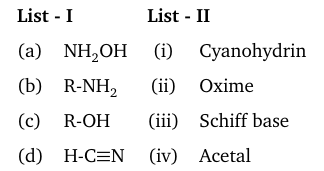
Match the reagents in List - I with products obtained from their carbonyl compounds in List - II.
Codes:
1
a – ii, b – iii, c – iv, d – i
2
a – i, b – ii, c – iii, d – iv
3
a – iii, b – ii, c – i, d – iv
4
a – i, b – iii, c – ii, d – iv
Official Solution
Correct Option: (1)
Step 1: Understanding the Question:
The question requires matching carbonyl reaction reagents (List-I) with their corresponding products (List-II). These are standard named reactions of aldehydes and ketones. Step 2: Matching each reagent with its product: (a) NH OH (Hydroxylamine): Carbonyl compounds (aldehydes and ketones) react with hydroxylamine in a condensation reaction to form oximes.
So, a ii. (b) R-NH (Primary Amine): Carbonyl compounds react with primary amines to form imines, which are also known as Schiff bases.
So, b iii. (c) R-OH (Alcohol): In the presence of an acid catalyst, aldehydes react with two equivalents of alcohol to form acetals. Ketones form ketals.
So, c iv. (d) H-C N (Hydrogen Cyanide): Hydrogen cyanide adds across the carbonyl double bond of aldehydes and ketones in a nucleophilic addition reaction to form cyanohydrins.
So, d i. Step 3: Compiling the final match:
The correct matches are:
- (a) maps to (ii)
- (b) maps to (iii)
- (c) maps to (iv)
- (d) maps to (i)
This corresponds to the code: a – ii, b – iii, c – iv, d – i. Step 4: Final Answer:
The correct code is (A).
13
PYQ 2026
medium
chemistryID: kcet-202
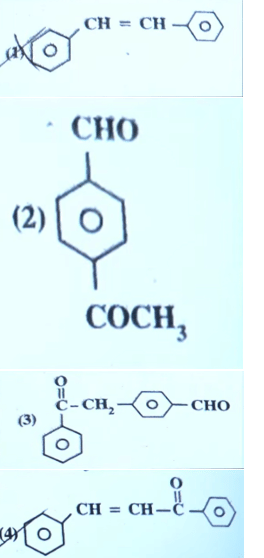
The major product 'A' in the given reaction is
Benzaldehyde + Acetophenone 'A' (Major product)
1
(1)
2
(2)
3
(3)
4
(4)
Official Solution
Correct Option: (4)
Step 1: Understanding the Reaction:
The reaction is between benzaldehyde (C H CHO) and acetophenone (C H COCH ) in the presence of a base (OH ). This is a base-catalyzed condensation reaction.
- Benzaldehyde has no -hydrogens.
- Acetophenone has acidic -hydrogens on its methyl group.
This type of reaction between an aldehyde with no -hydrogens and a ketone with -hydrogens is called a Claisen-Schmidt condensation, which is a type of crossed aldol condensation. Step 2: The Reaction Mechanism:
1. Enolate formation: The base (OH ) abstracts an acidic -hydrogen from acetophenone to form a resonance-stabilized enolate ion.
2. Nucleophilic attack: The enolate ion acts as a nucleophile and attacks the electrophilic carbonyl carbon of benzaldehyde.
3. Protonation: The resulting alkoxide ion is protonated by water to give the -hydroxy ketone (aldol addition product).
4. Dehydration: The aldol product readily dehydrates (loses a molecule of water) upon gentle warming (293K is room temperature, but dehydration is rapid here) to form an , -unsaturated ketone. The dehydration is favorable because the resulting double bond is in conjugation with both the benzene ring and the carbonyl group, leading to a very stable system. Step 3: Identifying the Major Product:
The final major product 'A' is the dehydrated , -unsaturated ketone, which is 1,3-diphenylprop-2-en-1-one, commonly known as chalcone. Its structure is C H -CH=CH-C(=O)-C H . This matches the structure in option (4). Step 4: Final Answer:
The major product of the reaction is benzalacetophenone (chalcone), which is represented by structure (4).