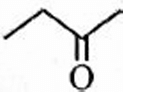
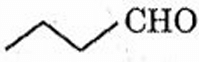
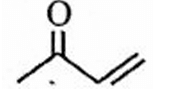
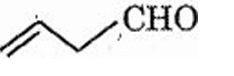
Ethyl chloride on heating with , forms a compound . The functional isomer of is -
1
2
3
4
None of the these
Official Solution
Correct Option:
(3)
Functional isomer of X is
02
PYQ 2006
medium
chemistryID: kcet-200
An organic compound which produces a bluish green coloured flame on heating in presence of copper is
1
chlorobenzene
2
benzaldehyde
3
aniline
4
benzoic acid
Official Solution
Correct Option:
(1)
Halogen containing compounds When placed in a flame, the presence of halogen is revealed by a green to blue flame.
03
PYQ 2007
easy
chemistryID: kcet-200
How many chiral carbon atoms are present in - trichloropentane ?
1
3
2
2
3
1
4
4
Official Solution
Correct Option:
(1)
3 chiral centers are present.
04
PYQ 2009
medium
chemistryID: kcet-200
An organic compound on heating with produces , but no water. The organic compound may be
1
Methane
2
Ethyl iodide
3
Carbon tetrachloride
4
Chloroform
Official Solution
Correct Option:
(3)
Since, the compound on heating with produced , it contains carbon. Again, it does not produce water, hence it does not contain hydrogen. So, the organic compound is carbon tetrachloride
05
PYQ 2011
medium
chemistryID: kcet-201
Following is the substitution reaction in which replaces
To obtain propane nitrile, should be:
1
chloroethane
2
-chloropropane
3
chloromethane
4
-chloropropane
Official Solution
Correct Option:
(1)
Hence, to obtain propanenitrile, should be chloroethane.
06
PYQ 2012
medium
chemistryID: kcet-201
Which of the following is not true for reaction ?
1
Favoured by polar solvents
2
- alkyl halides generally react through reaction
3
The rate of the reaction does not depend upon the molar concentration of the nucleophile
4
- alkyl halides generally react through reaction.
Official Solution
Correct Option:
(4)
In reactions, rate of the reaction depends upon the concentration of the substrate only. It does not depend upon the concentration of the nucleophile.
In this type of reaction, covalent nucleophile reacts/attacks on substrate. alkyl halide generally react by this mechanism, whereas alkyl halide generally follow reactions. reactions are favoured by polar solvents.
07
PYQ 2013
medium
chemistryID: kcet-201
Which of the following pairs are correctly matched? Reactants Products I. RH II. RNC III. RNC IV. R-R
1
Only I
2
and
3
and
4
and
Official Solution
Correct Option:
(4)
(i) (moist)
(ii)
(iii)
(iv)
08
PYQ 2024
medium
chemistryID: kcet-202
But-1-yne on reaction with dilute H2SO4 in the presence of Hg2+ ions at 333K gives:
1
2
3
4
Official Solution
Correct Option:
(1)
The reaction given in the question involves the hydration of but-1-yne using dilute \text{H}_2\text{SO}_4 in the presence of \text{Hg}^{2+} ions at 333K. This is a classic example of the keto-enol tautomerism involved in alkyne hydration, which eventually leads to the formation of a ketone.
But-1-yne is an alkyne with the formula \text{CH}_3\text{C}\equiv\text{CH} .
The hydration of but-1-yne occurs in an acidic medium provided by dilute \text{H}_2\text{SO}_4 with \text{Hg}^{2+} as a catalyst. This usually leads to the addition of water across the triple bond.
Initially, enol is formed as an intermediate. Enol is unstable and usually isomerizes into its corresponding ketone, which is the more stable form.
The enol formed from but-1-yne is butan-1-ol. This immediately tautomerizes to butan-2-one (methyl ethyl ketone).
Therefore, the main product formed by the reaction of but-1-yne with dilute \text{H}_2\text{SO}_4 in the presence of \text{Hg}^{2+} ions is butan-2-one.
The correct answer corresponds to the structural formula of butan-2-one as depicted in the given option:
09
PYQ 2024
easy
chemistryID: kcet-202
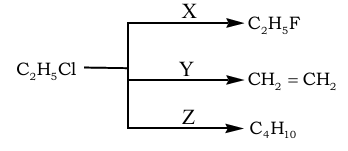
In the following scheme of reaction. X, Y and Z respectively are:
1
AgF, alcoholic KOH, benzene
2
HF, aqueous KOH, Na in dry ether
3
, alcoholic KOH, Na in dry ether
4
, aqueous KOH, benzene
Official Solution
Correct Option:
(3)
To solve this question, we need to identify the reagents (X, Y, Z) used in the transformation of into different compounds. Let's analyze each part of the reaction scheme:
X: Transformation to
The conversion of to can be carried out using a fluoride source. The most suitable reagent from the options provided is , which facilitates the halogen exchange reaction.
Y: Transformation to
This step involves dehydrohalogenation of to form ethylene . Alcoholic KOH is commonly used for such elimination reactions.
Z: Transformation to
The conversion of to butane can occur via the Wurtz reaction, involving the coupling of alkyl halides. This reaction uses sodium in dry ether as the reagent.
Based on the above analysis, the correct choice of reagents for X, Y, and Z are , alcoholic KOH, and Na in dry ether, respectively.
Conclusion: The correct answer is , alcoholic KOH, Na in dry ether.
10
PYQ 2024
medium
chemistryID: kcet-202
A haloalkane undergoes or reaction depending on:
1
Solvent used in the reaction
2
Low temperature
3
The type of halogen atom
4
Stability of the haloalkane
Official Solution
Correct Option:
(1)
The question asks which factors determine if a haloalkane undergoes an or reaction. Here's a step-by-step explanation of the relevant concepts:
Understanding and Reactions:
(Substitution Nucleophilic Bimolecular) reaction is a single-step process where the nucleophile attacks the substrate and the leaving group departs simultaneously. This type of reaction involves a transition state where the carbon atom is simultaneously bonded to the nucleophile and the leaving group.
(Substitution Nucleophilic Unimolecular) reaction, on the other hand, is a two-step process. First, the leaving group departs to form a carbocation intermediate, followed by the attack of the nucleophile.
Influence of Solvent on Reaction Type:
reactions are favored in polar aprotic solvents because these solvents do not form strong interactions with the nucleophile, thus making it more nucleophilic.
reactions are favored in polar protic solvents which stabilize the carbocation intermediate and the leaving group through hydrogen bonding.
Analyzing Other Options:
Low temperature: While temperature can influence reaction rates, it does not directly determine whether an or mechanism is preferred.
The type of halogen atom: The leaving ability of a halogen atom can affect the rate but does not decide the type of nucleophilic substitution (though better leaving groups favor both types).
Stability of the haloalkane: While more stable carbocations (tertiary) favor , stability alone does not determine the mechanism without considering solvent effects.
Conclusion: The most influential factor determining whether a haloalkane undergoes an or reaction is the solvent used in the reaction, as it directly influences the mechanisms described above.
11
PYQ 2024
medium
chemistryID: kcet-202
2-Methylpropane can be prepared by Wurtz reaction. The haloalkanes taken along with metallic sodium and dry ether are:
1
Chloromethane and 2-chloropropane
2
Chloroethane and chloromethane
3
Chloroethane and 1-chloropropane
4
Chloromethane and 1-chloropropane
Official Solution
Correct Option:
(1)
The question requires us to determine which pair of haloalkanes, when used in the Wurtz reaction with metallic sodium and dry ether, produces 2-methylpropane. The Wurtz reaction involves coupling two alkyl halides in the presence of sodium metal to form a higher alkane.
2-Methylpropane has the molecular formula of . To achieve this via the Wurtz reaction, the two haloalkanes chosen must form the correct structure upon coupling. Let's analyze the options:
Chloromethane and 2-chloropropane: - Chloromethane and 2-chloropropane couple to form 2-methylpropane .
Chloroethane and chloromethane: - Chloroethane and chloromethane will not correctly form 2-methylpropane.
Chloroethane and 1-chloropropane: - This option will yield alkanes different from 2-methylpropane.
Chloromethane and 1-chloropropane: - Combination of these would form isomers but not specifically 2-methylpropane.
The correct pair is therefore Chloromethane and 2-chloropropane. When these are reacted with sodium in dry ether, they successfully couple to form 2-methylpropane due to the favorable position of the functional groups facilitating this particular isomer formation.
Thus, the correct answer is:
Chloromethane and 2-chloropropane
12
PYQ 2024
medium
chemistryID: kcet-202
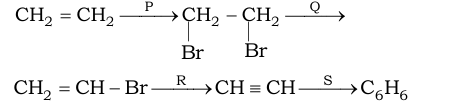
In the given sequence of reactions, identify ‘P’, ‘Q’ and ‘S’ respectively:
1
Br2, Alc, KOH, NaOH, Al2O3
2
HBr, Alc, KOH, CaC2, KMnO4
3
HBr, Alc, KOH, NaNH2, Red hot iron tube
4
Br2, Alc, KOH, NaNH2, Red hot iron tube
Official Solution
Correct Option:
(4)
Given the sequence of reactions, we need to identify the reagents 'P', 'Q', and 'S'. The reaction sequence is:
The first step involves converting an alkene to a dibromo compound. This reaction is typically performed using bromine in the presence of an inert solvent. Hence, P is .
The second step involves dehydrohalogenation to form a terminal alkyne. This requires a strong base. Thus, Q involves , which is used for elimination to form an alkyne from a dibromo compound.
The alkyne reacts further to form the aromatic compound benzene. This step (S) generally requires a strong base followed by a red-hot iron tube for the conversion of alkynes to benzene; hence, S is and a red-hot iron tube.
Therefore, the correct sequence of reagents is: Br2, Alc, KOH, NaNH2, Red hot iron tube.
This matches with the correct answer choice provided: Br2, Alc, KOH, NaNH2, Red hot iron tube.
13
PYQ 2026
medium
chemistryID: kcet-202
C-Cl bond in methyl chloride compared to C-Cl bond in chlorobenzene is
1
Longer and stronger
2
Shorter and stronger
3
Shorter and weaker
4
Longer and weaker
Official Solution
Correct Option:
(4)
Step 1: Analyze the bonding in methyl chloride (CH Cl).
In methyl chloride, the chlorine atom is bonded to a carbon atom that is sp hybridized. The C-Cl bond is a pure single ( ) bond. Step 2: Analyze the bonding in chlorobenzene (C H Cl).
In chlorobenzene, the chlorine atom is bonded to a carbon atom that is part of the benzene ring. This carbon atom is sp hybridized. Furthermore, the lone pairs of electrons on the chlorine atom can participate in resonance with the -electron system of the benzene ring.
This resonance delocalization gives the C-Cl bond a partial double bond character. Step 3: Compare the bond length and bond strength. Bond Length:
A single bond is longer than a double bond.
The C(sp )-Cl bond in chlorobenzene has partial double bond character, making it shorter than the C(sp )-Cl single bond in methyl chloride.
Also, an sp hybrid orbital has more s-character (33.3%) than an sp hybrid orbital (25%). More s-character leads to shorter and stronger bonds.
Therefore, the C-Cl bond in methyl chloride is longer. Bond Strength:
A double bond is stronger than a single bond.
Because the C-Cl bond in chlorobenzene has partial double bond character, it is stronger than the pure single C-Cl bond in methyl chloride.
Therefore, the C-Cl bond in methyl chloride is weaker. Step 4: Final Answer.
Combining the two comparisons, the C-Cl bond in methyl chloride is longer and weaker than the C-Cl bond in chlorobenzene.
14
PYQ 2026
medium
chemistryID: kcet-202
The number of chain isomers possible for the hydrocarbon with molecular formula is
1
4
2
3
3
2
4
1
Official Solution
Correct Option:
(2)
Step 1: Understanding the Question:
The question asks for the number of chain isomers for the alkane with the molecular formula , which is pentane. Chain isomers are structural isomers that differ in the arrangement of their carbon skeleton. Step 2: Detailed Explanation:
To find all chain isomers, we systematically vary the carbon chain length and add branches:
1. n-Pentane: The five carbon atoms are arranged in a single continuous straight chain. Structure:
2. Isopentane (2-Methylbutane): The parent chain consists of four carbon atoms, with one methyl ( ) group branched off the second carbon. Structure:
3. Neopentane (2,2-Dimethylpropane): The parent chain consists of three carbon atoms, with two methyl groups branched off the central carbon atom. Structure:
Further branching is not possible for five carbon atoms without repeating one of these structures or violating valency rules. Step 3: Final Answer:
Thus, there are exactly three chain isomers for the molecular formula , which corresponds to option (B).
15
PYQ 2026
medium
chemistryID: kcet-202
The compound with molecular formula C H is
1
Decane
2
Dodecane
3
Eicosane
4
Hicosane
Official Solution
Correct Option:
(3)
Step 1: Identify the type of hydrocarbon.
The molecular formula is C H . This fits the general formula for alkanes, C H .
For n=20, 2n+2 = 2(20) + 2 = 40 + 2 = 42.
So, the compound is a 20-carbon alkane. Step 2: Recall the IUPAC nomenclature for alkanes.
The root name of an alkane indicates the number of carbon atoms in its longest chain. We need to identify the root name for a 20-carbon chain.
(A) Decane: "Deca-" means 10. So, C H .
(B) Dodecane: "Do-" (2) + "deca-" (10) means 12. So, C H .
(C) Eicosane: "Eicosa-" is the Greek prefix for 20. So, C H .
(D) Hicosane: This is a common misspelling of Eicosane.
Step 3: Final Answer.
The correct name for the alkane with the molecular formula C H is Eicosane.
About Haloalkanes And Haloarenes - KCET
Haloalkanes And Haloarenes is a vital chapter for KCET aspirants. Mastering the concepts covered in this chapter is essential for securing a top rank.
By rigorously practicing the previous year questions associated with this chapter, you can identify high-yield topics, understand the examiner's perspective, and boost your confidence during the actual exam.
Frequently Asked Questions
Why focus on Haloalkanes And Haloarenes PYQs?
Analyzing PYQs for this specific chapter reveals the most frequently tested concepts and the typical complexity of questions, allowing you to tailor your study plan efficiently.
How to best use this analysis?
Review the topic breakdown to see which sub-topics within Haloalkanes And Haloarenes carry the most weight. Then, tackle the questions iteratively to solidify your understanding.