Homoleptic complexes among the following are (A) K3[Al(C2O4)3], (B) [CoCl2(en)2]+, (C) K2[Zn(OH)4]
1
A only
2
(A) and (B) only
3
(A) and (C) only
4
(C) only
Official Solution
Correct Option:
(3)
To solve the problem, we need to identify which of the given complexes are homoleptic. A homoleptic complex is defined as a coordination compound in which all the ligands are identical.
1. Understanding Homoleptic Complexes: A homoleptic complex has only one type of ligand coordinated to the central metal ion. For example: - is homoleptic because all ligands are . - is not homoleptic because it has two different ligands: and .
2. Analyzing Each Option:
(A) : - The central metal ion is . - The ligand is (oxalate ion). - All three ligands are identical ( ). - Therefore, this is a homoleptic complex.
(B) : - The central metal ion is . - The ligands are and (ethylenediamine, ). - There are two different types of ligands: and . - Therefore, this is not a homoleptic complex.
(C) : - The central metal ion is . - The ligand is . - All four ligands are identical ( ). - Therefore, this is a homoleptic complex.
3. Identifying the Correct Answer: - From the analysis: - Option (A) is homoleptic. - Option (B) is not homoleptic. - Option (C) is homoleptic. - The correct answer includes options (A) and (C).
Final Answer: The correct answer is .
02
PYQ 2021
medium
chemistryID: kcet-202
For the crystal field splitting in octahedral complexes,
1
the energy of the eg orbitals will decrease by (3/5)Δ0 and that of the t2g will increase by (2/5)Δ0
2
the energy of the eg orbitals will increase by (3/5)Δ0 and that of the t2g will decrease by (2/5)Δ0
3
the energy of the eg orbitals will increase by (3/5)Δ0 and that of the t2g will increase by (2/5)Δ0
4
the energy of the eg orbitals will decrease by (3/5)Δ0 and that of the t2g will decrease by (2/5)Δ0
Official Solution
Correct Option:
(2)
To solve this problem, we need to understand the crystal field splitting in octahedral complexes and how the energy levels of the and orbitals are affected by the ligand field.
1. Crystal Field Theory (CFT) and Octahedral Complexes: In an octahedral crystal field, the metal ion is surrounded by six ligands placed at the vertices of an octahedron. The d-orbitals of the central metal ion split into two sets due to the ligand field:
The set, which consists of the , , and orbitals.
The set, which consists of the and orbitals.
2. Splitting of the Orbitals: In an octahedral field, the ligands cause the orbitals to be raised in energy and the orbitals to be lowered in energy. The amount of splitting is quantified by , the octahedral crystal field splitting energy. The energy difference between the two sets of orbitals is . The orbitals experience more repulsion from the ligands and hence are raised by , while the orbitals experience less repulsion and are lowered by .
3. Analyzing the Options: - Option (A) "The energy of the orbitals will decrease by and that of the will increase by ": This is incorrect because the orbitals are raised in energy, not decreased, and the orbitals are lowered, not increased.
- Option (B) "The energy of the orbitals will increase by and that of the will decrease by ": This is correct. The orbitals are raised by , and the orbitals are lowered by .
- Option (C) "The energy of the orbitals will increase by and that of the will increase by ": This is incorrect because the orbitals are lowered in energy, not raised.
- Option (D) "The energy of the orbitals will decrease by and that of the will decrease by ": This is incorrect because both sets of orbitals do not decrease in energy; the orbitals are raised in energy, not decreased.
Final Answer: The correct answer is (B) "The energy of the orbitals will increase by and that of the will decrease by ."
03
PYQ 2026
medium
chemistryID: kcet-202
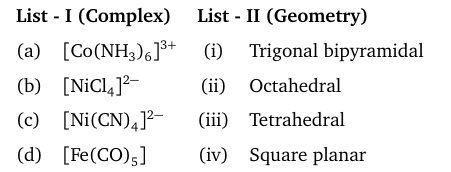
Match List - I with List - II
Choose the correct answer from the options given below.
1
a - ii, b – iii, c – iv, d - i
2
a - ii, b - i, c - iii, d – iv
3
a – iii, b – ii, c – iv, d – i
4
a – i, b – iii, c – iv, d – ii
Official Solution
Correct Option:
(1)
Step 1: Determine the geometry of each complex. (a) [Co(NH ) ] :
Co atomic number = 27. Co configuration: [Ar] 3d .
NH is a strong field ligand, so it will cause pairing of electrons. The 6 electrons will occupy three d-orbitals.
Hybridization involves two empty 3d orbitals, one 4s, and three 4p orbitals, leading to d sp hybridization.
The geometry for coordination number 6 is Octahedral.
So, a ii.
(b) [NiCl ] :
Ni atomic number = 28. Ni configuration: [Ar] 3d .
Cl is a weak field ligand. No pairing of electrons will occur.
Hybridization involves one 4s and three 4p orbitals, as the 3d orbitals are not empty. This leads to sp hybridization.
The geometry for sp hybridization is Tetrahedral.
So, b iii.
(c) [Ni(CN) ] :
Ni configuration: [Ar] 3d .
CN is a strong field ligand. It will force the two unpaired electrons in the 3d orbitals to pair up, leaving one 3d orbital empty.
Hybridization involves the one empty 3d orbital, one 4s, and two 4p orbitals, leading to dsp hybridization.
The geometry for dsp hybridization is Square planar.
So, c iv.
(d) [Fe(CO) ]:
Fe atomic number = 26. Fe(0) configuration: [Ar] 3d 4s .
CO is a strong field ligand. In the complex, the 8 valence electrons of Fe rearrange and pair up in the 3d orbitals.
The complex has coordination number 5. The hybridization is dsp .
The geometry for coordination number 5 (dsp ) is Trigonal bipyramidal.
So, d i.
Step 2: Compile the matches.
The correct matches are: a ii, b iii, c iv, d i. Step 3: Final Answer.
This combination corresponds to option (A).
04
PYQ 2026
medium
chemistryID: kcet-202
Given below are two statements:
Statement I: The M – C bond is formed by the donation of lone pair of electrons on the carbonyl carbon into a vacant d-orbital of the metal
Statement II: The M – C bond is formed by the donation of a pair of electrons from a filled d-orbital of metal into the vacant antibonding * orbital of carbon monoxide.
In the light of the above statements, choose the correct answer from the options given below:
1
Both Statement I and Statement II are correct
2
Both Statement I and Statement II are incorrect
3
Statement I is correct but Statement II is incorrect
4
Statement I is incorrect but Statement II is correct
Official Solution
Correct Option:
(1)
Step 1: Understanding Synergic Bonding in Metal Carbonyls.
The bonding between a metal atom and a carbon monoxide (carbonyl) ligand is a special type of bonding called synergic bonding. It consists of two components: a sigma ( ) bond and a pi ( ) bond. Step 2: Analyzing Statement I.
This statement describes the formation of the sigma bond. The carbon atom in the CO molecule has a lone pair of electrons. This lone pair is donated into a suitable vacant orbital of the metal atom (which can be a d-orbital, or a hybrid orbital). This forms a standard coordinate covalent bond, which is a bond. The direction of electron donation is from the ligand (CO) to the metal (M). So, M CO. Statement I accurately describes this process. Thus, Statement I is correct. Step 3: Analyzing Statement II.
This statement describes the formation of the pi bond, also known as back-bonding. The metal atom has filled d-orbitals. The CO ligand has vacant antibonding pi-star ( *) orbitals. A pair of electrons from a filled d-orbital of the metal is donated back into a vacant * orbital of the CO ligand. This creates a bond. The direction of electron donation is from the metal (M) to the ligand (CO). So, M CO. Statement II accurately describes this back-donation. Thus, Statement II is correct. Step 4: Conclusion.
Both statements correctly describe the two components of synergic bonding in metal carbonyls. The sigma bond strengthens the pi bond and vice-versa, leading to a strong overall M-C bond. Step 5: Final Answer.
Both Statement I and Statement II are correct.
05
PYQ 2026
medium
chemistryID: kcet-202
Which of the following is the most stable complex?
1
[Fe(CO) ]
2
[Fe(CN) ]
3
[Fe(C O ) ]
4
[Fe(H O) ]
Official Solution
Correct Option:
(2)
Step 1: Understanding Complex Stability.
The stability of a coordination complex is described by its stability constant (K) or formation constant ( ). A higher value of the stability constant indicates a more stable complex. Several factors influence stability, including the nature of the metal ion, the nature of the ligand, and the chelate effect. Step 2: Analyzing the Ligands and the Chelate Effect.
(A) [Fe(CO) ]: The ligand is Carbonyl (CO), a strong field ligand that forms strong and bonds (synergic bonding). The complex is stable, but the oxidation state of Fe is 0.
(B) [Fe(CN) ] : The ligand is Cyanide (CN ), a very strong field ligand. The oxidation state of Fe is +2. Cyanide complexes are known to have very high stability constants.
(C) [Fe(C O ) ] : The ligand is Oxalate (C O ), which is a bidentate ligand. Bidentate or polydentate ligands form rings with the central metal ion, a phenomenon known as the chelate effect. Chelation significantly increases the stability of a complex compared to complexes with analogous monodentate ligands. The oxidation state of Fe is +3.
(D) [Fe(H O) ] : The ligand is Aqua (H O), which is a weak field ligand. The oxidation state of Fe is +3. Aqua complexes are generally less stable compared to those with strong field ligands or chelating ligands.
Step 3: Comparing the Stability.
We need to compare the stability of these complexes.
Comparing (C) and (D): The oxalate complex (C) is a chelate and will be much more stable than the aqua complex (D) due to the chelate effect.
Comparing (B) and (C): We are comparing a complex with a very strong monodentate ligand (CN ) and a complex with a chelating ligand (C O ). While the chelate effect is powerful, the cyanide ligand is exceptionally strong and forms extremely stable complexes. The stability constant for [Fe(CN) ] is extremely large (log 35). The stability constant for [Fe(C O ) ] is also high due to chelation (log 20), but significantly lower than that of the cyanide complex.
Comparing (A) and (B): Metal carbonyls are stable due to synergic bonding. However, hexacyanoferrate(II) is renowned for its exceptional thermodynamic stability in aqueous solution.
Overall, the complex [Fe(CN) ] is known to be one of the most stable iron complexes due to the strong ligand field and high charge density of the CN ligand. Step 4: Final Answer.
The most stable complex among the given options is [Fe(CN) ] .
06
PYQ 2026
medium
chemistryID: kcet-202
How many ions per molecule are produced from the complex [Co(NH ) ]Cl in solution?
1
6
2
4
3
3
4
2
Official Solution
Correct Option:
(2)
Step 1: Understanding the Dissociation of Coordination Compounds.
When a coordination compound is dissolved in a solvent like water, it dissociates into its constituent ions. The coordination sphere (the part in the square brackets) remains as a single, intact complex ion, while the counter ions outside the brackets dissociate. Step 2: Analyzing the given complex.
The complex is [Co(NH ) ]Cl .
The coordination sphere is [Co(NH ) ] . This is one complex cation.
The counter ions are the three chloride ions, Cl .
Step 3: Writing the dissociation equation.
When one formula unit of the complex dissolves in water, it dissociates as follows:
Step 4: Counting the total number of ions produced.
From the dissociation equation, we can see that one formula unit produces:
1 complex cation: [Co(NH ) ]
3 simple anions: Cl
Total number of ions = 1 + 3 = 4 ions. Step 5: Final Answer.
A total of 4 ions are produced per molecule of the complex in solution.
About Coordination Complexes - KCET
Coordination Complexes is a vital chapter for KCET aspirants. Mastering the concepts covered in this chapter is essential for securing a top rank.
By rigorously practicing the previous year questions associated with this chapter, you can identify high-yield topics, understand the examiner's perspective, and boost your confidence during the actual exam.
Frequently Asked Questions
Why focus on Coordination Complexes PYQs?
Analyzing PYQs for this specific chapter reveals the most frequently tested concepts and the typical complexity of questions, allowing you to tailor your study plan efficiently.
How to best use this analysis?
Review the topic breakdown to see which sub-topics within Coordination Complexes carry the most weight. Then, tackle the questions iteratively to solidify your understanding.