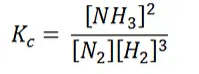
Step 1: Understanding Le Chatelier's Principle.
Le Chatelier's principle states that if a change of condition (like temperature, pressure, or concentration) is applied to a system in equilibrium, the system will shift in a direction that counteracts the change. We need to see how temperature and pressure changes will affect the equilibrium position.
Step 2: Effect of Temperature.
The reaction is given as exothermic (
H = -q kJ, meaning heat is released).
According to Le Chatelier's principle:
- Increasing the temperature will favor the endothermic (reverse) reaction to absorb the added heat. The equilibrium will shift to the left, decreasing the amount of product A B.
- Decreasing the temperature will favor the exothermic (forward) reaction to release heat. The equilibrium will shift to the right, increasing the amount of product A B.
Since temperature changes the equilibrium position, the amount of product is affected by temperature.
Step 3: Effect of Pressure.
The effect of pressure depends on the change in the number of moles of gas (
).
Since
, pressure will affect the equilibrium.
According to Le Chatelier's principle:
- Increasing the pressure will favor the side with fewer moles of gas to relieve the pressure. The equilibrium will shift to the right, increasing the amount of product A B.
- Decreasing the pressure will favor the side with more moles of gas. The equilibrium will shift to the left, decreasing the amount of product A B.
Since pressure changes the equilibrium position, the amount of product is affected by pressure.
Step 4: Effect of a Catalyst.
A catalyst increases the rate of both the forward and reverse reactions equally. It helps the system reach equilibrium faster but
does not change the position of the equilibrium. Therefore, a catalyst does not affect the amount of product at equilibrium.
Step 5: Final Answer.
The amount of product is affected by both temperature and pressure, but not by a catalyst. Therefore, option (C) is the best answer.