Heat liberated' when 100 mL of 1 N NaOH isneutralised by 300 mL of 1 N HCl
1
22 92 kJ
2
17.19 kJ
3
11.46 kJ
4
5.73 kJ
Official Solution
Correct Option:
(4)
100 mL of 1 N NaOH will be exactly neutralised with 100 mL of 1 NHC1. 1000 mL of 1 N NaOH react with 1000 mL of HC1 to give 57.3 kJ of heat 100 mL of 1 N NaOH will react with 100 mL of 1 N HCI to give = 5.73 kJ of heat
02
PYQ 2003
medium
chemistryID: kcet-200
Hesss law states that
1
the standard enthalpy of an overall reactionis the sum of the enthalpy changes in individual reactions
2
enthalpy of formation of a compound is same as the enthalpy of decomposition of but with opposite sign
3
at constant temperature the pressure of agas is inversely proportional to its volume
4
the mass of a gas dissolved per litre of asolvent is'proportional to the pressure of the gas in equilibrium with the solution.'
Official Solution
Correct Option:
(1)
See Comprehensive Review.
03
PYQ 2004
medium
chemistryID: kcet-200
When of is mixed with of , the heat liberated is :
1
573 kJ
2
573 J
3
11.46 kJ
4
57.3 kJ
Official Solution
Correct Option:
(2)
Answer (b) 573 J
04
PYQ 2005
medium
chemistryID: kcet-200
A mixture of two moles of carbon monoxide and one mole of oxygen, in a closed vessel is ignited to convert the carbon monoxide to carbon dioxide.If is the enthalpy change and is the change in internal energy, then,
1
2
3
4
the relationship depends on the capacity of the vessel
Official Solution
Correct Option:
(2)
No. of moles of gaseous product - No. of moles of gaseous reactant $\therefore\, \Delta H
05
PYQ 2010
medium
chemistryID: kcet-201
Molecules of a noble gas do not possess vibrational energy because a noble gas _________
1
is chemically inert
2
is monoatomic
3
is diamagnetic
4
has completely filled shells
Official Solution
Correct Option:
(2)
Since, noble gases are monoatomic, these do not possess vibrational energy as monoatomic molecules do not vibrate.
06
PYQ 2011
medium
chemistryID: kcet-201
The amount of heat evolved when of is mixed with of is
1
2
3
4
Official Solution
Correct Option:
(2)
No. of equivalents of reacting
07
PYQ 2017
medium
chemistryID: kcet-201
A reaction has both and - ve The rate of reaction
1
increases with increase in temperature
2
increases with decrease in temperature
3
remains unaffected by change in temperature
4
cannot be predicted for change in temperature
Official Solution
Correct Option:
(2)
ve Given =- ve =- ve To get =- ve must be less then i.e. Thus the reaction is exotherms and favours and increases with the decrease in temperature
08
PYQ 2019
medium
chemistryID: kcet-201
One mole of gas is heated at constant pressure starting at C. How much energy must be added to the gas as heat to double its volume?
1
750 R
2
Zero
3
1050 R
4
450 R
Official Solution
Correct Option:
(3)
At constant pressure it volume is doubled, temperate gets doubled,
09
PYQ 2022
medium
chemistryID: kcet-202
The work done when 2 moles of an ideal gas expands reversibly and isothermally from a volume of 1L to 10L at 300 K is (R = 0.0083 kJK mol-1)
1
0.115 kJ
2
11.5 kJ
3
58.5 kJ
4
5.8 kJ
Official Solution
Correct Option:
(2)
Correct Answer: 11.5 kJ
Explanation: For isothermal, reversible expansion of an ideal gas, the work done is given by: W = -nRT ln(Vf/Vi)
Where: • n = 2 mol • R = 0.0083 kJ·K⁻¹·mol⁻¹ • T = 300 K • Vi = 1 L • Vf = 10 L
Substituting the values:
Since ,
Work done by the system is positive in expansion: So, work done = 11.5 kJ.
10
PYQ 2023
easy
chemistryID: kcet-202
Lattice enthalpy for NaCl is +788 kJ mol-1 and ΔH°hyd= -784 kJ mol-1. Enthaply of solution of NaCl is
1
+572 kJ mol-1
2
+4 kJ mol-1
3
-572 kJ mol-1
4
-4 kJ mol-1
Official Solution
Correct Option:
(2)
Enthalpy of Solution for NaCl
Given:
Lattice enthalpy for NaCl,
Enthalpy of solution for NaCl,
Objective: Find the enthalpy of hydration ( ).
The relationship between lattice enthalpy, enthalpy of hydration, and enthalpy of solution is given by:
Rearranging to solve for :
Substituting the given values:
Conclusion: The enthalpy of hydration is , which corresponds to option D. +4 kJ/mol.
11
PYQ 2023
easy
chemistryID: kcet-202
For the formation of which compound in Ellingham diagram ΔG° becomes more and more negative with increase in temperature ?
1
CO
2
FeO
3
ZnO
4
Cu2O
Official Solution
Correct Option:
(1)
The question asks which compound in the Ellingham diagram has a negative change in Gibbs free energy ( ) that becomes more and more negative with increasing temperature.
Ellingham Diagram Explanation:
The Ellingham diagram plots the change in Gibbs free energy ( ) for various reactions as a function of temperature. The slope of the line represents how the favorability of the reaction changes with temperature. - If the slope is negative, the reaction becomes more favorable (more negative ) at higher temperatures. - If the slope is positive, the reaction becomes less favorable as the temperature increases.
Analysis of Options:
-(A) CO: Carbon monoxide is formed by reducing carbon dioxide. In the Ellingham diagram, the formation of CO has a **negative slope**, meaning its formation becomes more favorable as the temperature increases, and becomes more negative at higher temperatures. - (B) FeO: The formation of iron oxide (FeO) typically has a **positive slope**, meaning its formation becomes less favorable with increasing temperature. - (C) ZnO: Zinc oxide formation also has a **positive slope**, so it becomes less favorable as the temperature increases. - (D) Cu₂O: Copper(I) oxide formation similarly shows a **positive slope**, meaning it becomes less favorable at higher temperatures.
Conclusion:
The compound whose formation in the Ellingham diagram becomes more negative with increasing temperature is CO, as it has a negative slope.
Correct Answer: Option (A): CO
12
PYQ 2024
medium
chemistryID: kcet-202
For the reaction, A ⇌ B, Ea = 50 kJ mol−1 and ΔH = −20 kJ mol−1. When a catalyst is added, Ea decreases by 10 kJ mol−1. What is the Ea for the backward reaction in the presence of catalyst?
1
60 kJ mol−1
2
40 kJ mol−1
3
70 kJ mol−1
4
20 kJ mol−1
Official Solution
Correct Option:
(1)
To solve the problem of determining the activation energy for the backward reaction in the presence of a catalyst, let's follow these steps:
Initially, we have the activation energy ( ) for the forward reaction, which is 50 kJ mol−1. The enthalpy change ( ) for the reaction is -20 kJ mol−1.
From the relationship between , , and the activation energy for the backward reaction ( ), we use the equation:
Since is negative, we take its absolute value.
Substituting the given values:
When a catalyst is added, it reduces the activation energy of both the forward and backward reactions by the same amount. Here, the reduction is 10 kJ mol−1.
Therefore, the activation energy for the backward reaction in the presence of the catalyst is:
Hence, the correct answer is 60 kJ mol−1. This means that when the catalyst is added, it decreases the activation energy for the backward reaction to 60 kJ mol−1. This is the correct option among the given choices.
13
PYQ 2024
medium
chemistryID: kcet-202
Which one of the following does not represent the Arrhenius equation?
1
2
3
4
Official Solution
Correct Option:
(4)
The Arrhenius equation is fundamental in chemical kinetics and is used to express the temperature dependence of reaction rates. It is defined as:
Where:
= Rate constant
= Pre-exponential factor (frequency factor)
= Activation energy
= Universal gas constant
= Temperature in Kelvin
Each of the given options is analyzed below:
This is a logarithmic form of the Arrhenius equation, expressed in base 10 logarithms.
This is the standard form of the Arrhenius equation, showing the dependency of the rate constant on temperature.
This is another logarithmic form of the Arrhenius equation, expressed in natural logarithms.
This equation suggests that as the activation energy increases, the rate constant would absurdly increase exponentially, which contradicts the phenomena described by Arrhenius' theory. Hence, it does not represent the Arrhenius equation.
Conclusively, the equation does not represent the Arrhenius equation correctly. In the Arrhenius equation, the exponential part of the expression should have a negative exponent to match the physical observation that higher activation energies lead to lower reaction rates at a given temperature.
14
PYQ 2024
medium
chemistryID: kcet-202
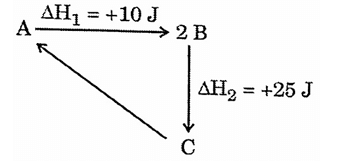
From the diagram for the reaction C → A is:
1
35 j
2
−15J
3
−35J
4
15 J
Official Solution
Correct Option:
(3)
The problem involves determining the enthalpy change ( ) for the reaction from C to A using the given reaction diagram.
The diagram shows:
with
with
Using Hess's Law, the total enthalpy change for the series of reactions is the sum of the enthalpy changes for each step.
Reversing the reactions to find :
For , reverse of , the will be .
For , reverse of , the will be .
Add the reversed enthalpy changes together:
Thus, the enthalpy change for the reaction is -35 J.
15
PYQ 2025
medium
chemistryID: kcet-202
Given below are two statements.
1
Statement-I is true but Statement-II is false.
2
Statement-I is false but Statement-II is true.
3
Both Statement-I and Statement-II are true.
4
Both Statement-I and Statement-II are false.
Official Solution
Correct Option:
(3)
Statement-I: In adiabatic processes, no heat is exchanged ( ). Work done on the system ( ) can change the internal energy ( ). If work is done on the system, the internal energy increases, which aligns with Statement-I. Hence, Statement-I is true. Statement-II: During free expansion of an ideal gas (no external pressure), the system does not perform any work ( ), as the gas does not push against any external pressure. Hence, Statement-II is true.
16
PYQ 2025
hard
chemistryID: kcet-202
Identify the incorrect statements among the following:
1
All enthalpies of fusion are positive.
2
The magnitude of enthalpy change does not depend on the strength of the intermolecular interactions in the substance undergoing phase transformations.
3
When a chemical reaction is reversed, the value of is reversed in sign.
4
The change in enthalpy is dependent on the path between initial state (reactants) and final state (products).
Official Solution
Correct Option:
(4)
Statement (a) is true: All enthalpies of fusion are positive because energy is required to overcome intermolecular forces during fusion.
Statement (b) is false: The magnitude of enthalpy change indeed depends on the strength of intermolecular interactions, especially during phase transitions.
Statement (c) is true: When a chemical reaction is reversed, the sign of is indeed reversed.
Statement (d) is false: Enthalpy change ( ) is a state function, which means it only depends on the initial and final states, not the path taken. Thus, the change in enthalpy is not dependent on the path.
17
PYQ 2026
medium
chemistryID: kcet-202
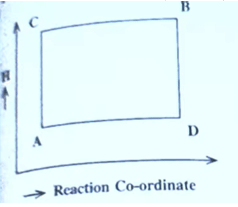
A gas can be taken from A to B via two different paths ACB and ADB.
When path ACB is used, 60J of heat flows into the system and 30J of work is done by the system. If path ADB is used, work done by the system is 10J. The heat flow into the system in path ADB is}
1
80J
2
20J
3
100J
4
40J
Official Solution
Correct Option:
(4)
Step 1: Understanding the First Law of Thermodynamics and State Functions.
The first law of thermodynamics states that the change in internal energy ( U) of a system is equal to the heat (q) added to the system minus the work (w) done by the system.
(Note: The sign convention w = work done *by* the system is used here).
Internal energy (U) is a state function. This means that the change in internal energy ( U) between two states (A and B) is independent of the path taken. Therefore, . Step 2: Calculate the change in internal energy for path ACB.
For path ACB:
Heat flow into the system, q = +60 J
Work done by the system, w = +30 J
Using the first law:
Step 3: Use the property of state functions to find the heat flow for path ADB.
Since internal energy is a state function, the change in internal energy from A to B is the same for both paths.
For path ADB:
Work done by the system, w = +10 J
Heat flow, q = ?
Using the first law for path ADB:
Step 4: Final Answer.
The heat flow into the system in path ADB is 40 J.
18
PYQ 2026
medium
chemistryID: kcet-202
Which of the following is a correct statement for a thermodynamic system?
1
The internal energy changes in all processes
2
Internal energy and entropy are state functions
3
Work is a state function
4
The work done in an adiabatic process is always zero
Official Solution
Correct Option:
(2)
Step 1: Understanding State Functions and Path Functions.
State Function: A property of a system that depends only on the current state of the system (e.g., temperature, pressure, volume, internal energy, entropy), not on the path taken to reach that state. The change in a state function depends only on the initial and final states.
Path Function: A property that depends on the path taken between two states (e.g., heat, work).
Step 2: Evaluating each statement. (A) The internal energy changes in all processes: This is incorrect. For example, in an isothermal process involving an ideal gas, the internal energy (which depends only on temperature for an ideal gas) remains constant ( U = 0). Also, in a cyclic process, the system returns to its initial state, so the change in any state function, including internal energy, is zero. (B) Internal energy and entropy are state functions: This is correct. Both internal energy (U) and entropy (S) are properties that depend only on the state of the system, not on how the system arrived at that state. Their changes ( U and S) are determined solely by the initial and final states. (C) Work is a state function: This is incorrect. Work (w) is a classic example of a path function. The amount of work done to get from state A to state B depends on the specific path followed. (D) The work done in an adiabatic process is always zero: This is incorrect. An adiabatic process is one in which no heat is exchanged with the surroundings (q=0). According to the first law of thermodynamics, U = q + w. For an adiabatic process, this becomes U = w. Since the internal energy can change (e.g., by changing temperature), the work done is generally not zero. Work is only zero in a free expansion into a vacuum. Step 3: Final Answer.
The correct statement is that internal energy and entropy are state functions.
19
PYQ 2026
medium
chemistryID: kcet-202
A: Entropy of a perfect crystalline solid at absolute zero approaches zero.
B: For spontaneity of a reaction, T S> H.
Among the two statements given above, identify the correct answer from the options given below.
1
Both 'A' and 'B' are true
2
'A' is true but 'B' is false
3
Both 'A' and 'B' are false
4
'A' is false but 'B' is true
Official Solution
Correct Option:
(1)
Step 1: Analyzing Statement A.
Statement A says, "Entropy of a perfect crystalline solid at absolute zero approaches zero." This is a direct statement of the Third Law of Thermodynamics. The law states that as the temperature of a system approaches absolute zero (0 K), the entropy of the system approaches a minimum value. For a perfect crystalline substance, this minimum entropy is zero, as there is only one possible arrangement of atoms (one microstate, W=1, and S = k ln W = 0). Therefore, Statement A is true. Step 2: Analyzing Statement B.
Statement B gives a condition for the spontaneity of a reaction: T S> H.
The spontaneity of a process at constant temperature and pressure is determined by the change in Gibbs free energy ( G). The relationship is:
For a process to be spontaneous, the change in Gibbs free energy must be negative ( G<0).
So, for spontaneity:
Rearranging this inequality:
or
This exactly matches the condition given in Statement B. Therefore, Statement B is true. Step 3: Final Answer.
Both statements A and B are true.
About Thermodynamics - KCET
Thermodynamics is a vital chapter for KCET aspirants. Mastering the concepts covered in this chapter is essential for securing a top rank.
By rigorously practicing the previous year questions associated with this chapter, you can identify high-yield topics, understand the examiner's perspective, and boost your confidence during the actual exam.
Frequently Asked Questions
Why focus on Thermodynamics PYQs?
Analyzing PYQs for this specific chapter reveals the most frequently tested concepts and the typical complexity of questions, allowing you to tailor your study plan efficiently.
How to best use this analysis?
Review the topic breakdown to see which sub-topics within Thermodynamics carry the most weight. Then, tackle the questions iteratively to solidify your understanding.