Classification Of Elements And Periodicity In Properties
6 previous year questions.
Volume: 6 Ques
Yield: Medium
High-Yield Trend
1
2026
3
2024
1
2017
1
2008
Chapter Questions
6 MCQs
01
PYQ 2008
medium
chemistryID: kcet-200
An element with atomic number is a
1
halogen
2
representative element
3
transition element
4
alkali metal
Official Solution
Correct Option: (3)
The electronic configuration of element with atomic number is Since this element contains partly filled orbital, so it is a -block element. -block elements are also known as transition elements.
02
PYQ 2017
medium
chemistryID: kcet-201
The electronegativities of and are in the order of
1
2
3
4
Official Solution
Correct Option: (3)
Electronegativity increases as we more left to right in a period and decreases as we move down in the group. (i) and belong to the same period. Hence has more electronegativity than carbon (C). (ii) In the same way is more electronegative than Si (iii) As Si is below the carbon is 14th group the electronegativity of carbons is more than of Si.
03
PYQ 2024
medium
chemistryID: kcet-202
Which of the following statements related to lanthanoids is incorrect?
1
Lanthanoids are silvery white metals.
2
Samarium shows +2 oxidation state.
3
Ce⁴⁺ solutions are oxidizing agents.
4
Colour of lanthanoids is due to d-d transitions.
Official Solution
Correct Option: (4)
To determine which statement about lanthanoids is incorrect, let's analyze each option:
Lanthanoids are silvery white metals: This statement is correct. Lanthanoids, or lanthanides, are generally shiny and have a silvery-white metallic appearance.
Samarium shows +2 oxidation state: This statement is correct. Samarium does exhibit a +2 oxidation state, though it more commonly forms a +3 state.
Ce⁴⁺ solutions are oxidizing agents: This statement is correct. Cerium in the +4 oxidation state (Ce⁴⁺) is a well-known oxidizing agent due to its ability to be reduced to the more stable Ce³⁺ state.
Colour of lanthanoids is due to d-d transitions: This statement is incorrect. The color in lanthanoids arises due to f-f transitions, not d-d transitions, as lanthanoids have electrons filling their 4f orbitals. This is the incorrect statement as lanthanoids do not primarily involve d orbital electron transitions in their coloration.
Hence, the incorrect statement is: Colour of lanthanoids is due to d-d transitions.
04
PYQ 2024
medium
chemistryID: kcet-202
A metalloid is:
1
Bi
2
Sb
3
P
4
Se
Official Solution
Correct Option: (2)
In this question, we are tasked with identifying which of the given elements are metalloids. Let's first understand the characteristics and classification of metalloids in the periodic table.
Definition of Metalloids: Metalloids are elements that have properties intermediate between those of metals and non-metals. They are typically semiconductors, meaning they can conduct electricity better than non-metals but not as well as metals. This property is particularly useful in electronic devices.
Commonly Recognized Metalloids: Typically, the elements recognized as metalloids include Boron (B), Silicon (Si), Germanium (Ge), Arsenic (As), Antimony (Sb), Tellurium (Te), and sometimes Selenium (Se), depending on the classification.
Now, let's analyze the options provided:
Bi (Bismuth): Bismuth is a post-transition metal and is not classified as a metalloid.
Sb (Antimony): Antimony is a well-known metalloid. It exhibits properties that are intermediate between metals and non-metals. Thus, this is a correct choice.
P (Phosphorus): Phosphorus is a non-metal, not considered a metalloid.
Se (Selenium): Selenium is sometimes considered a metalloid, particularly in some scientific classifications, due to its properties, which include semiconductor behavior. Thus, this is also a correct choice.
Conclusion: Based on the above analysis, the elements given in the options that are classified as metalloids are:
Correct Answer: Antimony (Sb) and Selenium (Se).
05
PYQ 2024
medium
chemistryID: kcet-202
A pair of isoelectronic species having a bond order of one is:
1
N2, CO
2
N2, NO+
3
O22−, F2
4
CO, NO+
Official Solution
Correct Option: (3)
To solve the problem of identifying a pair of isoelectronic species with a bond order of one, we need to understand the concepts of isoelectronic species and bond order.
Isoelectronic Species:
Isoelectronic species are molecules or ions that have the same number of electrons. For example, if two species have the same total number of electrons, they are considered isoelectronic.
Bond Order Calculation:
The bond order is a measure of the number of bonds between a pair of atoms. It can be calculated using the Molecular Orbital Theory:
Solution:
O22− (Peroxide ion): The electronic configuration is the same as O2 but with 2 extra electrons, making it isoelectronic with F2.
F2 (Fluorine molecule): Has 18 electrons (9 per fluorine atom) which matches the total number of electrons in O22−.
For both O22− and F2:
Number of bonding electrons (σ2s, σ2s*, π2px, π2py): 10
Number of antibonding electrons (σ*2s, σ2p, σ*2p, π*2px, π*2py): 8
Thus, both O22− and F2 have a bond order of one and are isoelectronic, making O22−, F2 the correct answer.
Conclusion:
The correct pair of isoelectronic species with a bond order of one is O22− and F2. The other options are eliminated because either they are not isoelectronic, or their bond orders do not satisfy the condition.
06
PYQ 2026
medium
chemistryID: kcet-202
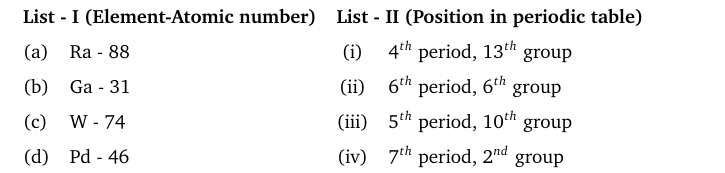
Match List – I with List – II:
Choose the correct answer from the options given below.
1
a – iv, b – i, c – ii, d – iii
2
a – i, b - ii, c - iii, d – iv
3
a – iv, b – ii, c – iii, d – i
4
a – iii, b – iv, c – i, d – ii
Official Solution
Correct Option: (1)
Step 1: Determine the position of each element. (a) Ra (Z = 88):
The noble gas preceding Radium is Radon (Rn, Z=86).
Electronic configuration: [Rn] 7s .
The principal quantum number of the valence shell is n=7, so it is in the 7 period.
It is an s-block element with 2 valence electrons, so it is in Group 2.
This matches with (iv). So, a iv. (b) Ga (Z = 31):
The noble gas preceding Gallium is Argon (Ar, Z=18).
Electronic configuration: [Ar] 3d 4s 4p .
The principal quantum number of the valence shell is n=4, so it is in the 4 period.
It is a p-block element. For p-block, Group number = 10 + (valence s-electrons + valence p-electrons) = 10 + 2 + 1 = 13.
This matches with (i). So, b i. (c) W (Z = 74):
The noble gas preceding Tungsten is Xenon (Xe, Z=54).
Electronic configuration: [Xe] 4f 5d 6s .
The principal quantum number of the valence shell is n=6, so it is in the 6 period.
It is a d-block element. Group number = number of ns + (n-1)d electrons = 2 + 4 = 6.
This matches with (ii). So, c ii. (d) Pd (Z = 46):
The noble gas preceding Palladium is Krypton (Kr, Z=36).
Electronic configuration is exceptional: [Kr] 4d 5s .
The highest principal quantum number is n=5, so it is in the 5 period.
It is a d-block element. Group number = number of ns + (n-1)d electrons = 0 + 10 = 10.
This matches with (iii). So, d iii. Step 2: Compile the matches.
The correct matches are: a iv, b i, c ii, d iii. Step 3: Final Answer:
This combination corresponds to option (A).