A signature written with carbon pencil weighs 1 mg. What is the number of carbon atoms present in the signature ?
1
2
3
4
Official Solution
Correct Option: (2)
carbon contain =
02
PYQ 2007
easy
chemistryID: kcet-200
Gram molecular volume of oxygen at is
1
2
3
4
Official Solution
Correct Option: (3)
Gram Molecular volume is the volume occupied by 1 mole of molecules and 1 mole of any gas at STP occupies liters volume.
03
PYQ 2007
easy
chemistryID: kcet-200
Which one of the following has maximum number of atoms of oxygen ?
1
2 g of water
2
2 g of sulphur dioxide
3
2 g of carbon dioxide
4
2 g of carbon monoxide
Official Solution
Correct Option: (1)
Number of oxygen atom in 2 g of
Number of oxygen atom in of
Hence, 2 g of has maximum number of atoms of oxygen.
04
PYQ 2007
easy
chemistryID: kcet-200
Angle strain in cyclopropane is
1
2
3
44'
4
Official Solution
Correct Option: (1)
Angle strain in cyclopropane is
Angle strain
05
PYQ 2008
medium
chemistryID: kcet-200
of oxygen contains as many atoms as in
1
of hydrogen
2
of hydrogen
3
of hydrogen
4
of hydrogen
Official Solution
Correct Option: (4)
Number of moles of oxygen
Number of atoms of oxygen
Number of moles of of hydrogen
Number of atoms in of hydrogen
Hence, the number of atoms in of oxygen is equal to the number of atoms in of hydrogen.
06
PYQ 2008
medium
chemistryID: kcet-200
Mass of of methane is
1
2
3
4
Official Solution
Correct Option: (3)
Mass of one mole of methane Mass of mole of methane =
07
PYQ 2008
medium
chemistryID: kcet-200
For the reaction the volume of carbon monoxide required to reduce one mole of ferric oxide is
1
2
3
4
Official Solution
Correct Option: (3)
The correct option is(C): 67.2dm3.
Volume of carbon monoxide
(at STP)
mole of ferric oxide is reduced by moles of of of
08
PYQ 2009
easy
chemistryID: kcet-200
Excess of carbon dioxide is passed through of calcium hydroxide solution. After the completion of the reaction, the solution was evaporated to dryness. The solid calcium carbonate was completely neutralised with Hydrochloric acid. The volume of Hydrochloric acid required is (At. mass of calcium = )
1
2
3
4
Official Solution
Correct Option: (1)
No. of millimoles of
No. of milliequivalents of Volume of
09
PYQ 2009
medium
chemistryID: kcet-200
A bivalent metal has an equivalent mass of . The molecular mass of the metal nitrate is
1
192
2
188
3
182
4
168
Official Solution
Correct Option: (2)
Atomic mass of the metal
Formula of metal nitrate Molecular mass
10
PYQ 2010
medium
chemistryID: kcet-201
A mixture of and weighing is treated with sodium carbonate solution to precipitate all the calcium ions as calcium carbonate. The calcium carbonate so obtained is heated strongly to get of . The percentage of in the mixture is (Atomic mass of
1
30.6
2
75
3
69.4
4
25
Official Solution
Correct Option: (2)
Thus, in the mixture, weight of
Percentage of
11
PYQ 2010
medium
chemistryID: kcet-201
is titrated against solution. The titration is discontinued after adding . The remaining titration is completed by adding . The volume of required for completing the titration is
1
2
3
4
Official Solution
Correct Option: (1)
When is used,
When is used,
12
PYQ 2012
medium
chemistryID: kcet-201
The volume of oxalic acid that can be completely oxidized by of solution is
1
2
3
4
Official Solution
Correct Option: (3)
13
PYQ 2012
easy
chemistryID: kcet-201
The total number of electrons in of water (density ) is
1
2
3
4
Official Solution
Correct Option: (3)
In , number of moles of Number of moles of in and number of in molecule of Number of in of
14
PYQ 2013
medium
chemistryID: kcet-201
The number of water molecules present in a drop of water weighing is
1
2
3
4
Official Solution
Correct Option: (4)
of of molecules
of of molecules
molecules
15
PYQ 2014
medium
chemistryID: kcet-201
of oxalic acid completely neutralised of sodium hydroxide. Molarity of the oxalic acid solution is
1
0.045
2
0.032
3
0.064
4
0.015
Official Solution
Correct Option: (2)
Moles of oxalic acid = Moles of
Molarity of oxalic acid Basicity Normality
16
PYQ 2014
easy
chemistryID: kcet-201
of an optically active L-amino acid is treated with at . of nitrogen was at is evolved. A sample of protein has of this amino acid by mass. The molar mass of the protein is
1
2
3
4
Official Solution
Correct Option: (4)
From van-Siyke method for estimation of amino acids
Molar mass of L-amino acid
Protein has of amino acid by mass
Molar mass of protein
17
PYQ 2014
easy
chemistryID: kcet-201
of in acidic medium oxidizes a sample of gas to sulphur. Volume of required to oxidize the same amount of gas to sulphur, in acidic medium is
1
2
3
4
Official Solution
Correct Option: (1)
For
For
Now, from normality equation
18
PYQ 2014
easy
chemistryID: kcet-201
of a mixture of and requires of to react completely. The percentage of calcium oxide in the mixture is approximately (Given : molar mass of )
1
55.1
2
47.4
3
52.6
4
44.9
Official Solution
Correct Option: (3)
Let, mass of Mass of
Again, equivalent mass of BaO
Number of moles of
and equivalent mass of Number of moles of
From molarity
Moles of solute
or
or
or
or of
19
PYQ 2016
medium
chemistryID: kcet-201
The hottest region of Bunsen flame shown in the figure below is :
1
region 1
2
region 2
3
region 3
4
region 4
Official Solution
Correct Option: (2)
Region blue flame
20
PYQ 2017
easy
chemistryID: kcet-201
If molecules are removed from of , then number of moles of left are
1
2
3
4
Official Solution
Correct Option: (2)
The correct answer is B: of Number of left
21
PYQ 2018
medium
chemistryID: kcet-201
of Mg is burnt with 0.28 g of in a closed vessel. Which reactant is left in excess and how much ?
1
Mg, 5.8 g
2
Mg, 0.58 g
3
4
Official Solution
Correct Option: (2)
48 g of Mg requires 32 g of ?
requires 0.28 g of
Mass of magnesium required = But 1 g of Mg is available. Thus, Mg is the excess reagent. Excess of Mg left behind
22
PYQ 2019
medium
chemistryID: kcet-201
The mass of AgCl precipitated when a solution containing 11.70 g of NaCl is added to a solution containing 3.4 g of AgNO3 is [Atomic mass of Ag = 108, Atomic mass of Na = 23]
1
2.87 g
2
6.8 g
3
5.74 g
4
1.17 g
Official Solution
Correct Option: (1)
23
PYQ 2020
easy
chemistryID: kcet-202
of dihydrogen is made to react with of dichlorine to form hydrogen chloride. The volume of hydrogen formed at and bar pressure is
1
9.08L
2
4.54L
3
90.8L
4
45.4L
Official Solution
Correct Option: (2)
The corresponding balanced reaction is:
Again,
So, is the limiting reagent here.
Hence moles of will be formed.
Again, we need to find out the volume of formed in the STP condition.
1 mol of gas in STP occupies
Thus, mol of will occupy
24
PYQ 2024
medium
chemistryID: kcet-202
In the analysis of III group basic radicals of salts, the purpose of adding NH₄Cl (solid) to NH₄OH is:
1
to increase the concentration of OH⁻ ions
2
to precipitate the radicals of group IV and V
3
to suppress the dissociation of NH₄OH
4
to introduce Cl⁻ ions
Official Solution
Correct Option: (3)
In the context of analyzing III group basic radicals of salts, it is essential to understand the role of each component added during the process. Here, we will explore why NH₄Cl is added to NH₄OH in this specific procedure.
The primary reason for adding solid NH₄Cl to NH₄OH is to suppress the dissociation of NH₄OH. This can be explained through the concept of common ion effect and equilibrium dynamics:
**Dissociation of NH₄OH**:
NH₄OH is a weak base that partially dissociates in water to produce NH₄⁺ and OH⁻ ions:
**Addition of NH₄Cl**:
NH₄Cl dissociates completely to NH₄⁺ and Cl⁻ ions in solution:
**Common Ion Effect**:
The presence of a common ion, NH₄⁺ in this case, from NH₄Cl increases the concentration of NH₄⁺ ions in solution.
This results in the suppression of NH₄OH dissociation due to Le Chatelier's principle (shifting the equilibrium towards the reactant side), reducing the production of OH⁻ ions.
This suppression of dissociation prevented by the common ion effect helps maintain a controlled concentration of OH⁻ ions, essential for selective precipitation in qualitative inorganic analysis, particularly to avoid premature precipitation of III group radicals.
Now, let’s evaluate the given options:
To increase the concentration of OH⁻ ions: This option is incorrect because the addition of NH₄Cl actually leads to a decrease in the dissociation of NH₄OH, therefore reducing the OH⁻ ion concentration due to the common ion effect.
To precipitate the radicals of group IV and V: This option is also incorrect as the purpose of adding NH₄Cl is not to precipitate later group radicals, but specifically to control the environment for III group radicals.
To introduce Cl⁻ ions: While Cl⁻ ions are introduced, it is not the primary purpose. The introduction of NH₄⁺ ions is more pertinent to controlling the dissociation of NH₄OH.
To suppress the dissociation of NH₄OH: This is the correct answer, as explained above.
Thus, the correct answer is: To suppress the dissociation of NH₄OH.
25
PYQ 2024
easy
chemistryID: kcet-202
The energy associated with the first orbit of He+ is:
1
0J
2
-8.72 × 10⁻¹⁸ J
3
-4.58 × 10⁻¹⁸ J
4
-0.545 × 10⁻¹⁸ J
Official Solution
Correct Option: (2)
To find the energy associated with the first orbit of , we can use the formula for the energy levels of the hydrogen-like ion, given by:
where:
is the atomic number of the ion.
is the principal quantum number, which denotes the orbit (here, ).
The constant value is the ionization energy for hydrogen.
For , , since helium has an atomic number of 2. Substituting these values into the formula gives:
To convert this energy from electron volts to joules, we use the conversion factor .
Therefore,
Rounding this value, we find:
Thus, the energy associated with the first orbit of is -8.72 × 10⁻¹⁸ J, making this the correct answer.
26
PYQ 2024
medium
chemistryID: kcet-202
0.48 g of an organic compound on complete combustion produced 0.22 g of CO₂. The percentage of C in the given organic compound is:
1
25
2
50
3
12.5
4
87.5
Official Solution
Correct Option: (3)
To determine the percentage of carbon in the given organic compound, we need to first use the data provided from the combustion reaction.
Given:
Mass of the organic compound = 0.48 g
Mass of CO₂ produced = 0.22 g
We know that during combustion, the carbon in the organic compound is converted into carbon dioxide (CO₂). Therefore, we start by calculating the mass of carbon in the 0.22 g of CO₂ produced.
The molar mass of CO₂ is 44 g/mol, which consists of 12 g/mol of carbon and 32 g/mol of oxygen. Thus, the mass fraction of carbon in CO₂ can be expressed as:
.
Calculate the amount of carbon in 0.22 g of CO₂:
.
Simplifying the equation:
.
Now, we calculate the percentage of carbon in the organic compound:
.
Calculating the percentage:
.
Thus, the percentage of carbon in the organic compound is 12.5%, which corresponds to the correct option given.
27
PYQ 2024
medium
chemistryID: kcet-202
For the reaction PCl5→PCl3+Cl2, the rate and rate constant are 1.02×10⁻⁴mol L−1s−1 and 3.4×10⁻⁵s−1, respectively, at a given instant. The molar concentration of PCl5 at that instant is:
1
8.0mol/L
2
3.0mol/L
3
0.2mol/L
4
2.0mol/L
Official Solution
Correct Option: (2)
To determine the molar concentration of at the given instant, we need to understand the relationship between the rate of the reaction and the concentration, which for a first-order reaction is given by the formula:
Where:
is the rate of the reaction.
is the rate constant.
is the molar concentration of .
Given in the problem:
Substitute the given values into the formula:
To find , rearrange the equation:
Calculating the above expression:
Therefore, the molar concentration of at that instant is 3.0 mol/L, which matches the correct option among the given choices.
28
PYQ 2024
medium
chemistryID: kcet-202
Identify the wrong relation for real gases:
1
2
3
4
Official Solution
Correct Option: (1)
To determine the wrong relation for real gases among the given options, let's analyze each equation based on the principles of real gases and the Van der Waals equation.
: This equation appears incorrect because the compressibility factor is defined as the ratio of the volume of a real gas to the volume of an ideal gas under the same conditions, i.e., . Therefore, this relation is incorrect.
: This equation reflects the correction applied to the pressure of a real gas. Due to intermolecular forces, the actual pressure is higher than the ideal pressure. Hence, this relation represents how the actual pressure of a real gas is augmented over the ideal pressure.
: This is a part of the volume correction in the Van der Waals equation, where is the volume occupied by the gas particles. This equation correctly depicts how the volume is adjusted for the finite size of gas molecules.
: This is the Van der Waals equation, which accounts for the pressure and volume corrections for real gases. It represents how real gases deviate from ideal gas behavior.
Based on the above analysis, the relation is incorrect, as it contradicts the standard definition of the compressibility factor. The compressibility factor should be , reflecting that real gases occupy more volume than predicted by the ideal gas law.
Hence, the correct answer is: .
29
PYQ 2024
medium
chemistryID: kcet-202
For which one of the following mixtures is composition uniform throughout?
1
Sand and water
2
Grains and pulses with stone
3
Mixture of oil and water
4
Dilute aqueous solution of sugar
Official Solution
Correct Option: (4)
To determine which mixture has a uniform composition throughout, we need to understand the concept of homogeneous and heterogeneous mixtures in chemistry.
A homogeneous mixture is a mixture in which the composition is uniform throughout the mixture. The different components of the mixture are not distinguishable. On the other hand, a heterogeneous mixture has a non-uniform composition, and its constituent components are distinguishable.
Let's analyze each option to identify the correct answer:
Sand and water: This is a heterogeneous mixture because sand particles do not dissolve in water and can be seen separately. The composition is not uniform throughout.
Grains and pulses with stone: This mixture is heterogeneous because stones can be distinguished from grains and pulses. The composition is visibly non-uniform.
Mixture of oil and water: Oil does not dissolve in water, leading to two distinct layers. This is a heterogeneous mixture because of the clearly visible separation of components.
Dilute aqueous solution of sugar: Once sugar dissolves in water, the mixture is homogeneous. The sugar molecules are evenly distributed throughout the water, making the composition uniform throughout the solution.
Based on the above explanations, the correct answer is the dilute aqueous solution of sugar, as it is the only homogeneous mixture among the options provided.
30
PYQ 2025
medium
chemistryID: kcet-202
Select the INCORRECT statement/s from the following:
1
22 books have infinite significant figures.
2
In the answer of calculation has four significant figures.
3
Zero's preceding to first non-zero digit are significant.
4
In the answer of calculation has three significant figures.
Official Solution
Correct Option: (1)
The correct interpretations are: - (a) The statement is true: Numbers like 22 (which are exact countable numbers) have infinite significant figures. - (b) The statement is incorrect: When multiplying, the result should have the same number of significant figures as the number with the least significant figures, which is 2.5 (2 significant figures). Hence, the product will have 2 significant figures, not 4. - (c) The statement is incorrect: Zeros before the first non-zero digit are not significant (e.g., in 0.0023, the leading zeros are not significant). - (d) The statement is correct: The result of the addition should be rounded to the least number of decimal places, so the result will have three significant figures.
31
PYQ 2026
medium
chemistryID: kcet-202
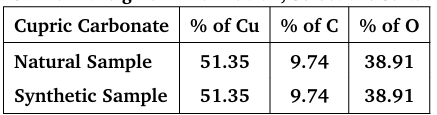
From the given information, select the suitable law of chemical combination:
1
Law of Multiple Proportions
2
Gay Lussac's Law of Gaseous Volumes
3
Law of Definite Proportions
4
Law of Conservation of Mass
Official Solution
Correct Option: (3)
Step 1: Analyzing the given data.
The table shows the percentage composition by mass of copper (Cu), carbon (C), and oxygen (O) in two different samples of cupric carbonate. One sample is obtained from a natural source, and the other is synthesized in a laboratory. The data shows that both samples have the exact same percentage composition: 51.35% Cu, 9.74% C, and 38.91% O. Step 2: Defining the Laws of Chemical Combination.
Law of Multiple Proportions: If two elements form more than one compound, the masses of one element that combine with a fixed mass of the other element are in a ratio of small whole numbers.
Gay Lussac's Law: When gases react, they do so in volumes which bear a simple whole number ratio to one another and to the volume of the products, if gaseous.
Law of Definite Proportions (or Constant Composition): A given chemical compound always contains its component elements in a fixed ratio by mass, regardless of its source or method of preparation.
Law of Conservation of Mass: Mass can neither be created nor destroyed in a chemical reaction.
Step 3: Applying the correct law.
The observation that cupric carbonate has the same composition whether it is natural or synthetic directly illustrates the Law of Definite Proportions. The chemical identity of a compound is defined by its fixed elemental composition by mass. Step 4: Final Answer:
The given information illustrates the Law of Definite Proportions.