The volume of water to be added to N/2 HCl to prepare of N/10 solution is
1
45
2
400
3
450
4
100
Official Solution
Correct Option: (2)
=100 Vol. of N/10 solution = 500 Vol. of N/2 solution = 100 Water to be added = (500 - 100) = 400
02
PYQ 2007
medium
chemistryID: kcet-200
The volume of and required to make litre of are
1
litre of and litre of
2
litre of and litre of
3
litre of and litre of
4
litre of and litre of
Official Solution
Correct Option: (4)
Let litre of be mixed with litre of 4
to give of
Volume of
Volume of
03
PYQ 2008
medium
chemistryID: kcet-200
of monobasic acid requires of sodium hydroxide solution whose normality is
1
2
3
4
Official Solution
Correct Option: (3)
Volume of monobasic acid
Normality of monobasic acid
Volume of solution
Normality of solution
(for monobasic acid ) (for )
04
PYQ 2008
medium
chemistryID: kcet-200
Which of the following can be measured by the Ostwald-Walker dynamic method ?
1
Relative lowering of vapour pressure
2
Lowering of vapour pressure
3
Vapour pressure of the solvent
4
all of these
Official Solution
Correct Option: (1)
By Ostwald-Walker dynamic method, the relative lowering of vapour pressure, lowering of vapour pressure and vapour pressure of the solvent, all can be measured. In this method, the apparatus used, contains two bulbs : bulb A contains solution and bulb contains solvent. The loss of weight in bulb gives the lowering of vapour pressure and total loss of weight in both the tubes gives the vapour pressure of the solvent and
Relative lowering of vapour pressure
05
PYQ 2009
easy
chemistryID: kcet-200
A 6% solution of urea is isotonic with
1
6% solution of Glucose
2
25% solution of Glucose
3
1 M solution of Glucose
4
0.05 M solution of Glucose
Official Solution
Correct Option: (3)
Molarity of urea
Hence, solution of glucose is isotonic with urea solution.
06
PYQ 2011
medium
chemistryID: kcet-201
A solution of two liquids boils at a temperature more than the boiling point of either of them. Hence, the binary solution shows
1
negative deviation from Raoult's law
2
positive deviation from Raoult's law
3
no deviation from Raoult's law
4
positive or negative deviation from Raoult's law depending upon the composition
Official Solution
Correct Option: (1)
Solutions boils at relatively higher temperature, vapour pressure of solution is less. Hence, it shows negative deviation from Raoult's law.
07
PYQ 2012
medium
chemistryID: kcet-201
The vapour pressure of due to
1
Dipole moment
2
Dipole- dipole interaction
3
H- bonding
4
Lattice structure
Official Solution
Correct Option: (3)
Ortho-nitrophenol has intramolecular -bonding and paranitro phenol has intermolecular -bonding. Hence former is more volatile than latter.
08
PYQ 2012
medium
chemistryID: kcet-201
The vapour pressures of two liquids and in their pure states are in the ratio of . A binary solution of and contains and in the mole proportion of . The mole fraction of in the vapour phase of the solution will be
1
2
3
4
Official Solution
Correct Option: (2)
Given,
Similarly and
Total pressure,
Mole fraction in vapour phase
09
PYQ 2013
medium
chemistryID: kcet-201
Which of the following is not a colligative property ?
1
Elevation in boiling point
2
Depression in freezing point
3
Osmotic pressure
4
Lowering of vapour pressure
Official Solution
Correct Option: (4)
Those properties of ideal solutions which depend only on the number of particles of the solute (molecules or ions) dissolved in a definite amount of the solvent and do not depend on the nature of solute are called colligative properties. Tho important colligative properties are
(i) Relative lowering of vapour pressure.
(ii) Osmotic pressure
(iii) Elevation in boiling point
(iv) Depression in freezing point
10
PYQ 2013
medium
chemistryID: kcet-201
Which of the following aqueous solutions will exhibit highest boiling point ?
1
urea
2
3
4
Official Solution
Correct Option: (3)
no dissociation
no dissociation
As gives naximum particles, i.e., on dissociation boiling point is maximum for .
11
PYQ 2014
medium
chemistryID: kcet-201
For an ideal binary liquid mixture
1
2
3
4
Official Solution
Correct Option: (2)
For an ideal binary mixture,
12
PYQ 2015
easy
chemistryID: kcet-201
aqueous solution of urea is isotonic with
1
glucose solution
2
glucose solution
3
glucose solution
4
glucose solution
Official Solution
Correct Option: (3)
aqueous solution of urea
This means that of urea is present in of solution.
Molecular mass of urea
Molarity of urea solution
glucose solution is isotonic with (w/V) solution of urea.
13
PYQ 2016
easy
chemistryID: kcet-201
When an electrolyte is dissociated in solution, the van't Hoff factor is,
1
> 1
2
< 1
3
0
4
1
Official Solution
Correct Option: (1)
When an electrolyte dissociates in a solution, number of particles increases and
van't Hoff factor (i)
for dissociation
14
PYQ 2016
easy
chemistryID: kcet-201
Osmotic pressure can be increased by
1
increasing the temperature of the solution.
2
decreasing the temperature of the solution.
3
increasing the volume of the vessel.
4
diluting the solution.
Official Solution
Correct Option: (1)
Osmotic pressure is directly proportional to the temperature where,
Which of the following aqueous solution has highest freezing point ?
1
molal
2
molal
3
molal
4
molal
Official Solution
Correct Option: (4)
Colligative property number of particles after dissociation or association means less be the number of particles, more lower be the freezing point and more be the number of particle more lower be the freezing p?int.
Hence for
which is gives least number of particle hence show highest freezing point.
16
PYQ 2018
medium
chemistryID: kcet-201
Which of the following aqueous solutions should have the highest boiling point ?
1
2
3
4
Official Solution
Correct Option: (2)
number of particles of solute.
particles
17
PYQ 2018
easy
chemistryID: kcet-201
Isotonic solutions are solutions having the same
1
Surface tension
2
Vapour pressure
3
Osmotic pressure
4
Viscosity
Official Solution
Correct Option: (3)
When two solutions have same osmotic pressure, they are said to be the isotonic solutions.
18
PYQ 2019
easy
chemistryID: kcet-201
Relative lowering of vapour pressure of a dilute solution of glucose dissolved in 1 kg of water is 0.002. The molality of the solution is
1
0.11
2
0.021
3
0.004
4
0.222
Official Solution
Correct Option: (1)
19
PYQ 2019
easy
chemistryID: kcet-201
A non-volatile solute, ?A? tetramerises in water to the extent of 80%. 2.5 g of ?A? in 100 g of water, lowers the freezing point by 0.3 ?C. the molar mass of ? in mol L-1 is (Kf for water = 1.86 K kg mol-1)
1
155
2
354
3
62
4
221
Official Solution
Correct Option: (3)
20
PYQ 2020
medium
chemistryID: kcet-202
How many moles of acidified K2 Cr2 O7 is required to liberate 6 moles of I2 from an aqueous solution of I− ?
1
0.5
2
2
3
1
4
0.25
Official Solution
Correct Option: (2)
The reaction between acidified potassium dichromate ( ) and iodide ions ( ) in acidic solution involves the reduction of to , while is oxidized to iodine ( ). The balanced equation for the reaction is: From the equation, it is clear that 1 mole of liberates 3 moles of . To liberate 6 moles of , we need: Thus, 2 moles of are required to liberate 6 moles of .
The correct option is (B) : 2
21
PYQ 2021
medium
chemistryID: kcet-202
Choose the correct statement
1
value is same for a gas in any solvent
2
Higher the value more the solubility of gas
3
value increases on increasing the temperature of the solution
4
none of the above
Official Solution
Correct Option: (4)
The question asks us to choose the correct statement regarding Henry's Law constant, denoted as . Let's evaluate each of the statements given in the options:
Statement 1: value is same for a gas in any solvent.
This statement is incorrect. The Henry's Law constant is specific to the gas-solvent combination. It depends on the nature of the gas, the solvent, and the temperature. Hence, can vary with different solvents.
Statement 2: Higher the value more the solubility of gas.
This statement is also incorrect. Solubility of a gas in a liquid is inversely proportional to Henry's Law constant . This means, if is high, the solubility of the gas is low, and vice versa. Therefore, higher value implies lower solubility of the gas.
Statement 3: value increases on increasing the temperature of the solution.
This statement is correct. According to Henry's Law, as the temperature of a solution increases, the solubility of gases decreases, and consequently, the value of increases. This statement correctly describes the relationship between temperature and Henry's Law constant.
Now, we need to determine why "none of the above" is marked as the correct answer. On reviewing the statements, Statement 3 is actually correct. Therefore, there seems to be a discrepancy in the problem, as it indicates "none of the above" as the correct answer. Based on the scientific understanding of Henry's Law, Statement 3 should be the correct one.
22
PYQ 2022
medium
chemistryID: kcet-202
If 3 g of glucose (Molar mass = 180) is dissolved in 60 g of water at 15 degree, the osmotic pressure of the solution will be
1
6.57 atm
2
0.34 atm
3
5.57 atm
4
0.65 atm
Official Solution
Correct Option: (1)
To calculate the osmotic pressure of a solution, we can use the formula:
First, let's calculate the number of moles of glucose:
Next, we need to convert the mass of water to volume:
Now, we can calculate the osmotic pressure:
Therefore, the osmotic pressure of the solution will be approximately (A) 6.57 atm.
23
PYQ 2022
medium
chemistryID: kcet-202
The rise in boiling point of a solution containing 1.8 g of glucose in 100 g of solvent is 0.1 degree C. The molal elevation constant of the liquid is
1
2 K kg/mol
2
0.1 K kg/mol
3
10 K kg/mol
4
1 K kg/mol
Official Solution
Correct Option: (4)
To calculate the molal elevation constant (Kb) of the liquid, we can use the formula:
where is the elevation in boiling point and m is the molality of the solution. Given that the rise in boiling point ( ) is 0.1 degree Celsius and the mass of the solvent is 100 g, we need to determine the molality of the solution. The molality (m) can be calculated using the formula:
To find the moles of solute, we need to convert the mass of glucose to moles using its molar mass. The molar mass of glucose is 180 g/mol.
=
Now we can calculate the molality (m):
= = 0.1 mol/kg
Now we can substitute the values into the equation to find Kb:
Dividing both sides by 0.1:
Therefore, the molal elevation constant (Kb) of the liquid is (D) 1 K kg/mol.
24
PYQ 2022
easy
chemistryID: kcet-202
Which of the following colligative properties can provide molar mass of Proteins, Polymers and colloids with greater precision?
1
Depression in Freezing Point
2
Relative lowering of vapour pressure
3
Osmotic Pressure
4
Elevation in boiling point
Official Solution
Correct Option: (3)
Osmotic pressure is a colligative property that depends on the number of solute particles present in a solution, regardless of their nature. In the case of proteins, polymers, and colloids, these substances are often too large to accurately determine their molar mass using other colligative properties such as depression in freezing point or elevation in boiling point. These properties are more suitable for smaller molecules and non-volatile solutes. However, osmotic pressure is not affected by the size or nature of the solute particles. It depends solely on the concentration of solute particles in the solution. By measuring the osmotic pressure and using the ideal gas law equation, the molar mass of proteins, polymers, and colloids can be determined with greater precision. Therefore, the correct answer is (C) Osmotic Pressure.
25
PYQ 2022
medium
chemistryID: kcet-202
An Aqueous solution of Alcohol contains 18 g of water and 414 g of ethyl alcohol .The mole fraction of water is
1
0.7
2
0.1
3
0.9
4
0.4
Official Solution
Correct Option: (2)
Correct Answer: 0.1
Explanation: To find the mole fraction of water, we use the formula: Mole fraction of water (χwater) = moles of water / (moles of water + moles of alcohol)
Given: • Mass of water = 18 g • Molar mass of water (H2O) = 18 g/mol → Moles of water = 18 / 18 = 1 mol
• Mass of ethyl alcohol (C2H5OH) = 414 g • Molar mass of ethyl alcohol = 46 g/mol → Moles of alcohol = 414 / 46 ≈ 9 mol
Now, mole fraction of water:
Therefore, the mole fraction of water is 0.1.
26
PYQ 2023
medium
chemistryID: kcet-202
The swelling in feet and ankles of an aged person due to sitting continuously for long hours during travel, is reduced by soaking the feet in warm salt water. This is because of:
1
Reverse Osmosis
2
Osmosis
3
Edema
4
Diffusion
Official Solution
Correct Option: (2)
Oedema, or swelling, occurs when fluid accumulates in the body's tissues. This can happen due to various reasons, including prolonged sitting, which can reduce blood and lymph flow, leading to fluid buildup.
Soaking the feet in warm salt water can help reduce this swelling. The warmth of the water increases blood flow, while the salt (sodium chloride) in the water helps draw fluid out of the tissues.
Analyzing the Options
(A) Reverse Osmosis Reverse osmosis is a process where water is forced through a semipermeable membrane to remove contaminants. This is not the mechanism by which salt water reduces swelling.
(B) Osmosis Osmosis is the movement of water across a semipermeable membrane from an area of lower solute concentration to an area of higher solute concentration. The salt in the water increases the solute concentration outside the cells, drawing water out of the cells and reducing swelling.
(C) Edema Edema is the condition of swelling, not the process by which it is reduced.
(D) Diffusion Diffusion is the movement of particles from an area of higher concentration to an area of lower concentration. While diffusion plays a role in many biological processes, it is not the primary mechanism by which soaking in salt water reduces swelling.
Conclusion
The correct answer is (B) Osmosis. Soaking the feet in warm salt water reduces swelling by increasing the solute concentration outside the cells, which draws water out of the cells through osmosis.
27
PYQ 2023
medium
chemistryID: kcet-202
When FeCl3 is added to excess of hot water gives a sol ‘X’. When FeCl3 is added to NaOH(aq) solution, gives sol ‘Y’. X and Y formed in the above processes respectively are
1
Fe2O3 . xH2O / OH- and Fe2O3 . xH2O/Fe3+
2
Fe2O3 . xH2O / H+ and Fe2O3 . xH2O/Na+
3
Fe2O3 . xH2O / Cl- and Fe2O3 . xH2O/OH-
4
Fe2O3 . xH2O / Fe3+ and Fe2O3 . xH2O/OH-
Official Solution
Correct Option: (4)
When FeCl₃ (ferric chloride) is added to hot water and NaOH, two different solutions are formed. Let's analyze both reactions:
Step 1: FeCl₃ added to hot water (giving sol X)
When FeCl₃ is added to hot water, it undergoes hydrolysis and forms a colloidal solution of ferric hydroxide (Fe(OH)₃) with a reddish-brown color. The reaction can be written as:
The colloidal particles of Fe(OH)₃ are surrounded by water molecules and hydroxide ions. Therefore, sol X is represented as:
Step 2: FeCl₃ added to NaOH solution (giving sol Y)
When FeCl₃ is added to NaOH solution, the iron ions react with hydroxide ions to form ferric hydroxide (Fe(OH)₃), which dissolves in excess NaOH, forming a soluble complex ion. The reaction is:
In excess NaOH, Fe(OH)₃ dissolves to form the soluble ferrate complex, and sol Y is represented as:
Conclusion:
The correct matching of sol X and sol Y is: - Sol X: - Sol Y: Therefore, the correct answer is Option (D).
Correct Answer: Option (D)
28
PYQ 2023
easy
chemistryID: kcet-202
Dimerisation of solute molecules in low dielectric constant solvent is due to :
1
Hydrogen bond
2
Covalent bond
3
Co-ordinate bond
4
Ionic bond
Official Solution
Correct Option: (1)
Dimerisation of solute molecules in solvents with a low dielectric constant occurs predominantly due to hydrogen bonding.
Detailed Explanation:
(A) Hydrogen bond:Correct Answer. In solvents with low dielectric constants, intermolecular hydrogen bonds become stronger due to the reduced solvent polarity, leading to the formation of stable dimers. This phenomenon is typical in carboxylic acids (e.g., acetic acid dimerisation in benzene).
(B) Covalent bond: Incorrect. Covalent bonds involve electron sharing within molecules, not between distinct molecules in solution under these conditions.
(C) Co-ordinate bond: Incorrect. Coordinate bonds involve electron donation from one species to another, usually seen in complex formation, not typical for dimerisation in low dielectric solvents.
(D) Ionic bond: Incorrect. Ionic bonds generally require solvents with high dielectric constants (like water) for ion stabilization and dissociation. They are not favored in solvents with low dielectric constants.
Conclusion:
The correct answer is Option (A): Hydrogen bond.
29
PYQ 2024
hard
chemistryID: kcet-202
Solubility product of CaC₂O₄ at a given temperature in pure water is 4 × 10⁻⁹ mol²/L². Solubility of CaC₂O₄ at the same temperature is:
1
6.3×10⁻⁵mol/L
2
2×10⁻⁵mol/L
3
2×10⁻⁴mol/L
4
6.3×10⁻⁴mol/L
Official Solution
Correct Option: (1)
To solve this problem, we need to determine the solubility of calcium oxalate ( ) in pure water given its solubility product, , at a certain temperature.
The solubility product expression for in water is given by:
Since dissociates as follows:
Let be the solubility of in mol/L. Then, at equilibrium:
Therefore, the expression for the solubility product becomes:
Given that , we find:
Solving for :
Upon reviewing the options provided, I realized there's a discrepancy with the given correct answer. The calculated solubility is , which matches the second option.
Therefore, the solubility of at this temperature is . The provided correct answer might need to be reviewed, as the calculated result is different.
30
PYQ 2024
medium
chemistryID: kcet-202
Vapour pressure of a solution containing 18 g of glucose and 178.2 g of water at 100°C is: (Vapour pressure of pure water at 100°C = 760 torr)
1
76.0 torr
2
752.0 torr
3
7.6 torr
4
3207.6 torr
Official Solution
Correct Option: (2)
To determine the vapour pressure of the solution containing glucose and water at 100°C, we can use Raoult's Law. According to Raoult's Law, the vapour pressure of a solution is the product of the mole fraction of the solvent and the vapour pressure of the pure solvent. Mathematically, it is given by:
Where:
is the vapour pressure of the solution.
is the mole fraction of the solvent (water).
is the vapour pressure of pure water at 100°C, given as 760 torr.
First, we need to calculate the moles of glucose and water:
Molar mass of glucose (C6H12O6): 180 g/mol
Moles of glucose:
Molar mass of water (H2O): 18 g/mol
Moles of water:
Now, calculate the mole fraction of water:
Using Raoult's Law, calculate the vapour pressure of the solution:
Considering significant figures and rounding, the vapour pressure of the solution is approximately 752.0 torr.
Hence, the correct answer is: 752.0 torr.
31
PYQ 2024
medium
chemistryID: kcet-202
A mixture of phenol and aniline shows negative deviation from Raoult's law. This is due to the formation of:
1
Polar covalent bond
2
Non-polar covalent bond
3
Intermolecular Hydrogen bond
4
Intramolecular Hydrogen bond
Official Solution
Correct Option: (3)
The given question concerns the behavior of a mixture composed of phenol and aniline, specifically observing its deviation from Raoult's law. Let us explore the reasoning that leads to selecting the correct answer:
Understanding the Concepts:
Raoult's law states that the partial vapor pressure of each component in an ideal mixture is proportional to its mole fraction. An ideal solution shows neither positive nor negative deviation from Raoult's law.
Negative deviation occurs when the interactions between the different components are stronger than those between the same components. This results in a lower total vapor pressure than what would be expected from an ideal solution.
Analyzing the Mixture:
Phenol ( ) has an –OH group capable of hydrogen bonding.
Aniline ( ) contains an –NH2 group, which is also capable of hydrogen bonding.
When these two substances are mixed, intermolecular hydrogen bonds form between the –OH group of phenol and the –NH2 group of aniline. This interaction is stronger than the interactions present in the pure substances individually.
Conclusion:
Due to the formation of these intermolecular hydrogen bonds, the mixture exhibits a negative deviation from Raoult’s law as the new interactions are more robust than the original interactions within pure phenol or pure aniline.
Based on the above reasoning, the correct answer is Intermolecular Hydrogen bond.
32
PYQ 2024
medium
chemistryID: kcet-202
Which one of the following pairs will show positive deviation from Raoult's Law?
1
Water - HCl
2
Benzene - Methanol
3
Water -
4
Acetone - Chloroform
Official Solution
Correct Option: (2)
To determine which pair will show positive deviation from Raoult's Law, we need to understand what Raoult's Law is and what positive deviation implies.
Raoult's Law states that the vapor pressure of an ideal solution is directly proportional to the mole fraction of the solvent present in the solution. In a solution showing positive deviation from Raoult's Law, the observed vapor pressure is higher than predicted by Raoult's Law. This occurs when the interactions between unlike molecules are weaker than those among like molecules, leading to greater tendency for evaporation.
Let's analyze each pair:
Water - HCl: This is a strong acid solution where hydrogen bonding occurs significantly between the components. Typically, this pair would show negative deviation due to strong intermolecular attractions.
Benzene - Methanol: Methanol can hydrogen bond, while benzene is non-polar and cannot hydrogen bond. The interaction between methanol and benzene is weaker than the hydrogen bonding between methanol molecules, leading to positive deviation.
Water - : Like water and HCl, water and nitric acid form a strong acid solution with significant hydrogen bonding, generally resulting in negative deviation.
Acetone - Chloroform: This pair commonly shows negative deviation from Raoult’s Law due to the presence of hydrogen bonding between chloroform and acetone, which is stronger than within the pure components.
Therefore, the correct answer is Benzene - Methanol, as the intermolecular forces between methanol and benzene are weaker than the forces within pure methanol, leading to positive deviation from Raoult's Law.
33
PYQ 2024
medium
chemistryID: kcet-202
The value of 'A' in the equation is same for the pair
1
NaCl and CaCl2
2
CaCl2 and MgSO4
3
NaCl and KBr
4
MgCl2 and NaCl
Official Solution
Correct Option: (3)
To solve the question of identifying the value of 'A' in the given equation , we need to understand the Kohlrausch's Law of Independent Migration of Ions.
This law states that the molar conductivity of an electrolyte at infinite dilution (i.e., when the concentration approaches zero) is equal to the sum of the ionic conductivities of the cations and anions. In this context, the equation can be interpreted for comparing the molar conductivity at infinite dilution for different ionic compounds, denoted as , and its relationship with concentration .
In the given options:
NaCl and CaCl2 - These are different types of ions with different charges, and their constant 'A' would differ due to ionic size and interaction differences.
CaCl2 and MgSO4 - Again, these have different cationic compositions and charge differences.
NaCl and KBr - Both are halide salts with the same type of anions, similar ionic radii, and similar cationic charge (+1), hence they are expected to have the same 'A' value due to comparable ionic mobility.
MgCl2 and NaCl - Different charge states and ionic interactions.
The constant 'A' is the ion-specific parameter that reflects the ion's effect on molar conductivity. When comparing NaCl and KBr, both have monovalent cations (Na+ and K+) and monovalent anions (Cl- and Br-), which leads to the same influence on the molar conductivity in the equation, making 'A' the same for them.
Considering these explanations, the correct answer is NaCl and KBr because they both have similar ionic characteristics and behavior in a solution that affects the parameter 'A' equally.
34
PYQ 2026
medium
chemistryID: kcet-202
Which of the following is CORRECT with respect to the property mentioned against it?
1
Osmotic pressure at 298K : 0.1M NaCl solution<0.1M Urea solution
2
Concentration of NaCl in the solution : 2ppm>2M
3
T : 0.02M Urea solution>0.02M NaCl solution
4
Vapour pressure at 298K : Salt water
Official Solution
Correct Option: (4)
Step 1: Understanding Colligative Properties and Van't Hoff Factor (i).
Colligative properties (osmotic pressure, elevation in boiling point, depression in freezing point, relative lowering of vapour pressure) depend on the number of solute particles in a solution. For electrolytes like NaCl, we must consider their dissociation using the Van't Hoff factor (i).
For NaCl, which dissociates into Na and Cl , the theoretical Van't Hoff factor is i=2.
For Urea, a non-electrolyte, i=1.
The effective concentration for colligative properties is i Molarity. Step 2: Evaluating each statement. (A) Osmotic pressure ( ) = iCRT:
For 0.1M NaCl: effective concentration = i 0.1 M = 2 0.1 M = 0.2 M.
For 0.1M Urea: effective concentration = i 0.1 M = 1 0.1 M = 0.1 M.
Since osmotic pressure is proportional to the effective concentration, the osmotic pressure of 0.1M NaCl solution should be greater than that of 0.1M Urea solution. The statement says the opposite, so it is incorrect. (B) Concentration of NaCl in the solution: 2ppm>2M:
2 ppm (parts per million) is a very dilute concentration (e.g., 2 mg of solute per 1 kg of solution).
2M (2 Molar) means 2 moles of solute per 1 litre of solution. Molar mass of NaCl 58.5 g/mol. So, 2M NaCl is 2 58.5 = 117 g of NaCl per litre.
Clearly, 2M is a much, much higher concentration than 2ppm. The statement is incorrect. (C) Elevation in boiling point ( T ) = iK m:
For 0.02M Urea: effective concentration 1 0.02 M = 0.02 M.
For 0.02M NaCl: effective concentration 2 0.02 M = 0.04 M.
Since T is proportional to the effective concentration, the boiling point elevation for NaCl solution will be greater than for Urea solution. The statement says the opposite, so it is incorrect. (D) Vapour pressure at 298K: Salt water
This refers to the lowering of vapour pressure, a colligative property. According to Raoult's law, when a non-volatile solute (like salt) is dissolved in a solvent (like water), the vapour pressure of the solution is lower than that of the pure solvent. This is because the solute particles occupy some of the surface area, reducing the rate of evaporation of the solvent molecules. This statement is correct. Step 3: Final Answer.
The correct statement is (D).
35
PYQ 2026
medium
chemistryID: kcet-202
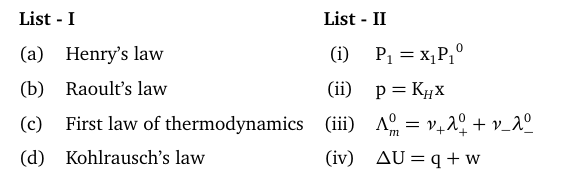
Match List - I (Laws) with the List - II (Mathematical expressions):
Codes:
1
a - i, b – ii, c - iii, d - iv
2
a - ii, b – i, c - iii, d - iv
3
a - ii, b – i, c – iv, d – iii
4
a – i, b – ii, c – iv, d - iii
Official Solution
Correct Option: (3)
Step 1: Match each law with its mathematical expression. (a) Henry's law: This law relates the partial pressure of a gas above a liquid to the concentration of the gas dissolved in the liquid. The mathematical form is , where p is the partial pressure of the gas, x is its mole fraction in the solution, and K is Henry's law constant. This matches with (ii). So, a ii. (b) Raoult's law: This law states that for a solution of volatile liquids, the partial vapour pressure of each component in the solution is directly proportional to its mole fraction. The expression is , where P is the partial pressure of component 1, x is its mole fraction, and P is the vapour pressure of the pure component. This matches with (i). So, b i. (c) First law of thermodynamics: This law is a statement of the conservation of energy. It states that the change in internal energy of a system ( U) is equal to the heat supplied to the system (q) plus the work done on the system (w). The equation is . This matches with (iv). So, c iv. (d) Kohlrausch's law: This law of independent migration of ions states that the limiting molar conductivity of an electrolyte ( ) can be represented as the sum of the individual contributions of the anion and cation of the electrolyte. The expression is , where and are the number of cations and anions per formula unit, and and are their limiting molar conductivities. This matches with (iii). So, d iii. Step 2: Compile the matches.
The correct matches are: a ii, b i, c iv, d iii. Step 3: Final Answer.
This combination corresponds to option (C).