KCET SERIES
Chemistry

Chemical Kinetics

38 previous year questions.

Volume: 38 Ques
Yield: High

High-Yield Trend

8
2026
3
2025
2
2023
4
2022
3
2021
2
2020
1
2019
1
2018
1
2017
1
2016
2
2015
1
2012
1
2011
1
2009
1
2007

Chapter Questions
38 MCQs

01
PYQ 2001
medium
chemistry ID: kcet-200
For certain first order reaction m, 75% of the reaction complete in 30 min. How much time it require to complete 99.9% of the reaction?
1
2
3
4
02
PYQ 2003
medium
chemistry ID: kcet-200
Temperature coefficient of a reaction is 2. When temperature is increased from 30 C to 100 C, rate of the reaction increases by
1
500 times
2
250 times
3
128 times
4
100 times
03
PYQ 2004
easy
chemistry ID: kcet-200
The reaction, is carried out in a vessel and vessel separately. The ratio of the reaction velocities will be :
1
4:01
2
8:01
3
1:08
4
1:04
04
PYQ 2005
medium
chemistry ID: kcet-200
The rate at which a substance reacts depends on its
1
atomic weight
2
atomic number
3
molecular weight
4
active mass
05
PYQ 2005
medium
chemistry ID: kcet-200
Which of these does not influence the rate of reaction?
1
Molecularity of the reaction
2
Temperature of the reaction
3
Concentration of the reactants
4
Nature of reactant
06
PYQ 2005
medium
chemistry ID: kcet-200
A radioactive isotope has a half life of days. If today mg is left over, what was its original weight days earlier ?
1
2 g
2
600 mg
3
1 g
4
1.5 g
07
PYQ 2007
medium
chemistry ID: kcet-200
Which one of the following is a second order reaction ?
1
2
3
4
08
PYQ 2009
medium
chemistry ID: kcet-200
The rate equation for a reaction : is . If the initial concentration of the reactant is a mol , the half life period of the reaction is
1
2
3
4
09
PYQ 2011
medium
chemistry ID: kcet-201
The following data is obtained during the first order thermal decomposition of , at constant volume and temperature The rate constant in is
1
2
3
4
10
PYQ 2012
medium
chemistry ID: kcet-201
A first order reaction is complete in minutes. How long will the reaction take to be complete ?
1
54 mins
2
68 mins
3
40 mins
4
76 mins
11
PYQ 2015
medium
chemistry ID: kcet-201
Half-life period of a first order reaction is . Starting with initial concentration , the rate after is
1
2
3
4
12
PYQ 2015
easy
chemistry ID: kcet-201
In a first order reaction, the concentration of the reactant is reduced to in one hour. When was it half completed ?
1
3 hr
2
20 min
3
30 min
4
15 min
13
PYQ 2016
easy
chemistry ID: kcet-201
The half-life period of a order reaction is 60 minutes What percentage will be left over after 240 minutes ?
1
2
3
4
14
PYQ 2017
medium
chemistry ID: kcet-201
For a reaction rate of disappearance of is related to rate of appearance of by the expression
1
2
3
4
15
PYQ 2018
medium
chemistry ID: kcet-201
For the reaction, the rate of disappearance of is . The rate of of appearance of is
1
2
3
4
16
PYQ 2019
medium
chemistry ID: kcet-201
1 L of 2 M CH3COOH is mixed with 1 L of 3M C2H5OH to form an ester. The rate of the reaction with respect to the initial rate when each solution is diluted with an equal volume of water will be
1
0.5 times
2
4 times
3
0.25 times
4
2 times
17
PYQ 2020
easy
chemistry ID: kcet-202
The rate constant of a reaction is given by under standard notation. In order to speed up the reaction, which of the following factors has to be decreased ?
1
Z
2
Both Z and T
3
4
T
18
PYQ 2020
medium
chemistry ID: kcet-202
The time required for completion of a first order reaction is min. The time required for completion of the same reaction will be
1
100 min
2
83.8 min
3
50 min
4
150 min
19
PYQ 2021
medium
chemistry ID: kcet-202
The rate of a gaseous reaction is given by the expression k[A][B]2. If the volume of vessel is reduced to one half of the initial volume, the reaction rate as compared to original rate is
1
2
3
8
4
16
20
PYQ 2021
medium
chemistry ID: kcet-202
If the rate constant for a first order reaction is k, the time(t) required for the completion of 99% of the reaction is given by
1
2
3
4
21
PYQ 2021
hard
chemistry ID: kcet-202
For a reaction A + 2B → Products, when concentration of B alone is increased half life remains the same. If concentration of A alone is doubled, rate remains the same. The unit of rate constant for the reaction is
1
S-1
2
L mol-1 S-1
3
mol L-1 S-1
4
atm-1
22
PYQ 2022
medium
chemistry ID: kcet-202
Half- life of a reaction is found to the inversely proportional to the fifth power of its initial concentration, the order of reaction is
1
5
2
3
3
6
4
4
23
PYQ 2022
medium
chemistry ID: kcet-202
For nth order of reaction, Half-life period is directly proportional to
1
2
3
4
24
PYQ 2022
medium
chemistry ID: kcet-202
The rate of reaction:

is given by the equation. Rate . If concentration is expressed in . The unit of K is
1
L mole-1 s-1
2
S-1
3
mol-2 L2 s-1
4
mol L-1 s-1
25
PYQ 2022
medium
chemistry ID: kcet-202
A first order reaction is half completed in 45 min. How long does it need 99.9% of the reaction to be completed?
1
10 Hours
2
5 Hours
3
20 Hours
4
7.5 Hours
26
PYQ 2023
hard
chemistry ID: kcet-202
For a reaction, the value of rate constant at 300 K is 6.0 ×10⁵ s-1. The value of Arrhenius factor A at infinitely high temperature is :
1
6 × 10⁵ × e-Ea/300R
2
e-Ea/300R
3
4
6 × 10⁵
27
PYQ 2023
easy
chemistry ID: kcet-202
The rate constants k1 and k2 for two different reactions are 1016 × e-2000/T and 1015 × e-1000/T respectively. The temperature at which k1 = k2 is :
1
2
2000 K
3
4
1000 K
28
PYQ 2025
medium
chemistry ID: kcet-202
Half-life of a first order reaction is 20 seconds and initial concentration of reactant is 0.2M. The concentration of reactant left after 80 seconds is
1
0.5 M
2
0.0125 M
3
0.2 M
4
0.1 M
29
PYQ 2025
easy
chemistry ID: kcet-202

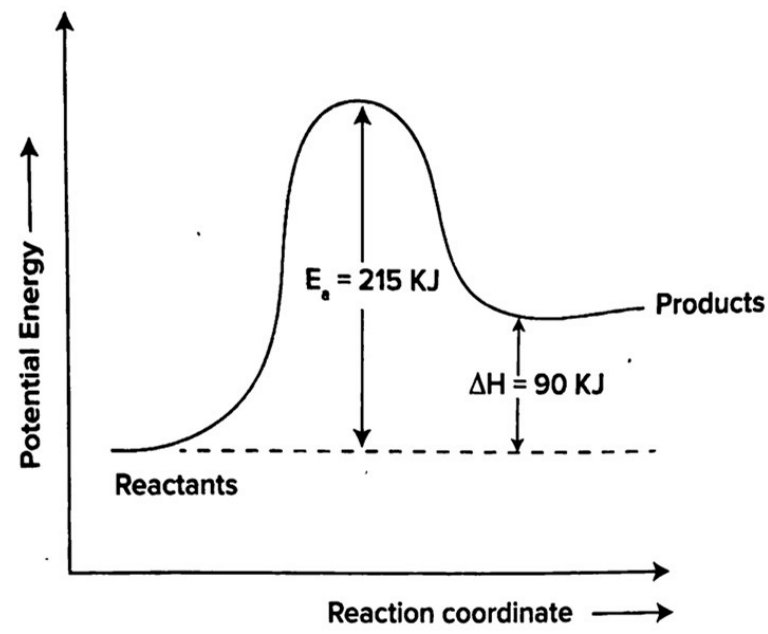
In the given graph, for the reverse reaction will be
1
215 KJ
2
90 KJ
3
305 KJ
4
125 KJ
30
PYQ 2025
medium
chemistry ID: kcet-202
For the reaction , the initial concentration of is 2.0 mol L , and after 300 minutes, it is reduced to 1.4 mol L . The rate of production of (in mol L min ) is
1

2

3

4

31
PYQ 2026
medium
chemistry ID: kcet-202
Given below are the half-cell reactions:
Mn + 2e Mn (E = -1.18 V)
Mn + e Mn (E = +1.51 V)
The E for 3 Mn Mn + 2Mn will be \rule{2cm{0.1mm}}
1
- 2.69 V, the reaction will not occur (Non-Spontaneous)
2
2.69 V, the reaction will occur (Spontaneous)
3
- 0.33 V, the reaction will not occur (Non-Spontaneous)
4
- 0.33 V, the reaction will occur (Spontaneous)
32
PYQ 2026
medium
chemistry ID: kcet-202
The conductivity of centimolar solution of KCl at 298 K is 0.021 Ohm cm and the resistance of the cell containing the solution at 298 K is 60 . The value of cell constant (G*) is
1
3.28 cm
2
1.26 cm
3
3.34 cm
4
1.34 cm
33
PYQ 2026
hard
chemistry ID: kcet-202

For a reaction having three steps, the overall rate constant is . The values of , , and (activation energies stepwise) are 40, 50, and 60 kJ mol respectively.
Then the overall (activation energy) of the reaction is
.
1
30 kJ mol
2
40 kJ mol
3
50 kJ mol
4
60 kJ mol
34
PYQ 2026
hard
chemistry ID: kcet-202
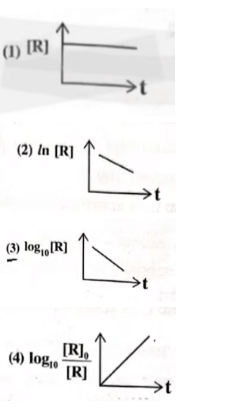
Which one of the following graph is not applicable for a 1st order reaction (R P)?
1
A graph of [R] vs t with a downward sloping curve.
2
A graph of ln[R] vs t with a downward sloping straight line.
3
A graph of log [R] vs t with an upward sloping straight line.
4
A graph of log ([R] /[R]) vs t with an upward sloping straight line through the origin.
35
PYQ 2026
medium
chemistry ID: kcet-202
The activation energy for the reaction X Y is 150 kJ mol . The change in enthalpy for the above reaction is -135 kJ mol . Then the activation energy for Y X is _________.
1
280 kJ mol
2
285 kJ mol
3
270 kJ mol
4
15 kJ mol
36
PYQ 2026
medium
chemistry ID: kcet-202
Which one of the following graph is not applicable for a 1st order reaction (R P)?
1
Graph 1
2
Graph 2
3
Graph 3
4
Graph 4
37
PYQ 2026
medium
chemistry ID: kcet-202
For a 1st order change R P, the concentration of Reactant R changes from 0.1 M to 0.025 M in 40 minutes. The rate of reaction when the concentration of R is 0.01 M is________.
1
1.73 10 M min
2
3.47 10 M min
3
3.47 10 M min
4
1.73 10 M min
38
PYQ 2026
medium
chemistry ID: kcet-202
For a reaction having three steps, the overall rate constant is . The values E , E and E (activation energies stepwise) are 40, 50 and 60 kJ mol respectively. Then the overall E (activation energy) of the reaction is ______
1
30 kJ mol
2
40 kJ mol
3
50 kJ mol
4
60 kJ mol