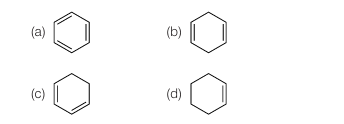
The maximum heat of hydrogenation among the following is
1
a
2
b
3
c
4
d
Official Solution
Correct Option:
(2)
Step 1: Understanding the Concept:
Heat of hydrogenation is inversely related to the stability of the alkene. More stable alkenes have lower heats of hydrogenation. Step 2: Detailed Explanation:
The stability of alkenes increases with greater substitution. A more substituted alkene (more alkyl groups attached to the double bond) is more stable. Therefore, the least substituted alkene will have the highest heat of hydrogenation. Without the images, if the options include an alkene like 1-butene (terminal) and 2-butene (internal), the terminal alkene is less stable and has a higher heat of hydrogenation. Step 3: Final Answer:
The least substituted alkene (likely a terminal alkene) has the maximum heat of hydrogenation, which corresponds to option (B) based on typical patterns.
02
PYQ 2016
medium
chemistryID: met-2016
Anti-Markownikoff's rule addition reaction is not observed in the following compound.
1
propene
2
1-butene
3
but-2-ene
4
pent-2-ene
Official Solution
Correct Option:
(3)
Step 1: Understanding the Concept:
Anti-Markovnikov addition (e.g., using HBr in the presence of peroxides) occurs with unsymmetrical alkenes where the addition of HBr gives the product with Br at the less substituted carbon. For symmetrical alkenes, both addition modes give the same product. Step 2: Detailed Explanation:
Anti-Markovnikov addition is observed with unsymmetrical alkenes. If the alkene is symmetrical (like but-2-ene or pent-2-ene), the two possible addition products are identical. Therefore, one cannot say that "Anti-Markovnikov rule" is observed or not, as it yields the same product as Markovnikov addition. However, the question likely tests that for symmetrical alkenes, the distinction between Markovnikov and anti-Markovnikov addition is not apparent. More specifically, the peroxide effect is not observed for symmetrical alkenes like but-2-ene. Propene and 1-butene are unsymmetrical and show the effect. Step 3: Final Answer:
Anti-Markovnikov addition is not observed in but-2-ene, which corresponds to option (C).
About Alkenes - MET
Alkenes is a vital chapter for MET aspirants. Mastering the concepts covered in this chapter is essential for securing a top rank.
By rigorously practicing the previous year questions associated with this chapter, you can identify high-yield topics, understand the examiner's perspective, and boost your confidence during the actual exam.
Frequently Asked Questions
Why focus on Alkenes PYQs?
Analyzing PYQs for this specific chapter reveals the most frequently tested concepts and the typical complexity of questions, allowing you to tailor your study plan efficiently.
How to best use this analysis?
Review the topic breakdown to see which sub-topics within Alkenes carry the most weight. Then, tackle the questions iteratively to solidify your understanding.