Which cycloalkane has the lowest heat of combustion per group?
1
Cyclopropane
2
Cyclobutane
3
Cyclopentane
4
Cyclohexane
Official Solution
Correct Option:
(4)
Step 1: Concept
Heat of combustion per group is a measure of the chemical stability of cycloalkanes. Step 2: Analysis
Stability increases as angle strain decreases. Cyclohexane is virtually strain-free. Step 3: Conclusion
Because it is the most stable, cyclohexane has the lowest heat of combustion per group. Final Answer: (D)
02
PYQ 2008
medium
chemistryID: met-2008
2, 2-dichloro propane on hydrolysis yields:
1
acetone
2
2, 2-propane diol
3
iso-propyl alcohol
4
acetaldehyde
Official Solution
Correct Option:
(1)
Step 1: Concept
Hydrolysis of gem-dihalides initially produces an unstable gem-diol. Step 2: Analysis
Hydrolysis replaces two Cl atoms with two OH groups. The resulting 2,2-propane diol is unstable and loses a water molecule. Step 3: Conclusion
The dehydration of the gem-diol results in the formation of acetone. Final Answer: (A)
03
PYQ 2009
medium
chemistryID: met-2009
For a chemical reaction the rate of the reaction is mol dm s when the initial concentration is 0.05 mol dm . The rate of the same reaction is mol dm s when the initial concentration is 0.1 mol dm . The order of the reaction is
1
2
2
0
3
3
4
1
Official Solution
Correct Option:
(3)
Step 1: Set up Rate Equations
. . Step 2: Compare Rates
. Step 3: Solve for n
. Thus, . Final Answer: (c)
04
PYQ 2009
medium
chemistryID: met-2009
For the constructive interference the path difference between the two interfering waves must be equal to
1
2
3
4
Official Solution
Correct Option:
(3)
Step 1: Formula
Phase difference is related to path difference by the formula: . Step 2: Condition
For constructive interference, the phase difference must be an even multiple of , i.e., (where ). Step 3: Calculation
Substituting this into the formula: . Final Answer: (c)
05
PYQ 2010
medium
chemistryID: met-2010
Angle strain in cyclopropane is ________.
1
2
3
4
Official Solution
Correct Option:
(1)
Step 1: Formula
Angle strain ( ) is calculated using the formula: , where is the bond angle. Step 2: Analysis
In cyclopropane, the molecule is an equilateral triangle, so the bond angle . Step 3: Calculation
. . Final Answer: (A)
06
PYQ 2011
medium
chemistryID: met-2011
Which of the following alkenes will react fastest with under catalytic hydrogenation conditions? • [(1)]
• [(2)]
• [(3)]
• [(4)]
1
A
2
B
3
C
4
D
Official Solution
Correct Option:
(2)
Step 1: Analyze the structure of the alkenes. The reactivity of alkenes towards hydrogenation is affected by the structure and substituents on the carbon-carbon double bond. Alkenes with more substituted carbons typically react faster because the electronic density on the double bond is higher, making it more susceptible to attack by the catalyst. Step 2: Analyze the options. - Option (1): This alkene has only simple hydrogens on both sides of the double bond and will react slower.
- Option (2): This alkene has more substituted groups, making it react faster with hydrogen.
- Option (3): This alkene has a different arrangement, and its reactivity is somewhat lower.
- Option (4): This alkene is similarly substituted as option (3) and will react slower. Step 3: Conclusion. The correct answer is (2), as this alkene is more substituted and will react faster under catalytic hydrogenation conditions.
07
PYQ 2011
medium
chemistryID: met-2011
Complete hydrolysis of cellulose gives:
1
D-fructose
2
D-ribose
3
D-glucose
4
L-glucose
Official Solution
Correct Option:
(3)
Step 1: Understand the structure of cellulose. Cellulose is a polymer of glucose, where glucose molecules are linked by -1,4-glycosidic bonds. When cellulose undergoes complete hydrolysis, the -glycosidic bonds are broken, and the resulting product is D-glucose. Step 2: Analyze the options. - (1) D-fructose: This is a monosaccharide that does not result from the hydrolysis of cellulose.
- (2) D-ribose: This is a pentose sugar and is not a product of cellulose hydrolysis.
- (3) D-glucose: This is the correct product, as cellulose is made up of glucose units, and hydrolysis breaks it down into D-glucose.
- (4) L-glucose: This is the enantiomer of D-glucose and would not be produced by hydrolysis of cellulose. Step 3: Conclusion. The correct answer is (3), D-glucose, as it is the product of complete hydrolysis of cellulose.
08
PYQ 2011
medium
chemistryID: met-2011
Which of the following reaction doesnât support the acidic nature of alkyne?
1
Reaction with HBr
2
Reaction with Grignard reagent
3
Reaction with ammoniacal silver salt
4
None of the above
Official Solution
Correct Option:
(1)
Step 1: Understand the acidic nature of alkynes. Alkynes are weakly acidic because the hydrogen attached to the carbon-carbon triple bond can be donated in a reaction. This is typically observed in their reactions with strong bases or nucleophiles. Step 2: Analyze the reactions. - Reaction with HBr: Alkynes undergo electrophilic addition reactions with HBr, but this does not indicate an acidic behavior. Alkynes do not typically show strong acidity in this reaction.
- Reaction with Grignard reagent: Alkynes react with Grignard reagents to form alkylated products, which shows their acidic behavior.
- Reaction with ammoniacal silver salt: This is a typical reaction for alkynes, forming silver salts, which further confirms their acidic nature. Step 3: Conclusion. The correct answer is (1), reaction with HBr, as it does not support the acidic nature of alkynes.
09
PYQ 2013
medium
chemistryID: met-2013
1 g of fuming H SO (oleum: mixture of H SO and SO having formula H S O ) is diluted with H O. This solution is completely neutralised by 26.7 mL of 0.8 N NaOH. Find the percentage of free SO in the oleum.
1
20.73%
2
43.80%
3
79.27%
4
60.74%
Official Solution
Correct Option:
(1)
Step 1: Understanding the Concept:
Oleum contains H SO and SO . SO reacts with water to form H SO . Total acidity = from both. Equivalent weight of SO = 40 (M/2). Step 2: Detailed Explanation:
Let H SO = x g, SO = (1 - x) g.
Eq. of H SO = x/49, Eq. of SO = (1-x)/40.
Total Eq. = x/49 + (1-x)/40.
NaOH used = 26.7 0.8 / 1000 = 0.02136 eq.
x/49 + (1-x)/40 = 0.02136
Multiply by 1960: 40x + 49(1-x) = 41.8656 40x + 49 - 49x = 41.8656 -9x = -7.1344 x = 0.7927 g H SO .
SO = 1 - 0.7927 = 0.2073 g 20.73%. Step 3: Final Answer:
Thus, percentage of free SO = 20.73%.
10
PYQ 2013
medium
chemistryID: met-2013
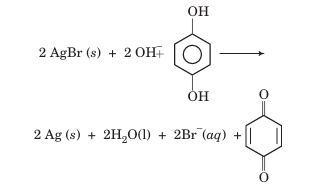
Photographic paper is developed with alkaline hydroquinone. Select correct statement.
1
Hydroquinone is the oxidant
2
Ag is the oxidant
3
Br is the oxidant
4
Ag is the reductant
Official Solution
Correct Option:
(2)
Step 1: Understanding the Concept:
In photographic development, exposed AgBr is reduced to Ag metal. Hydroquinone is the reducing agent. Step 2: Detailed Explanation:
Ag (in AgBr) + e Ag(s) (reduction). Ag accepts electrons oxidant.
Hydroquinone is oxidised to quinone, donates electrons reductant. Step 3: Final Answer:
Thus, Ag is the oxidant.
11
PYQ 2013
medium
chemistryID: met-2013
Which one of the following statements about NO is wrong?
1
NO is an odd electron molecule
2
It is a free radical and highly reactive
3
It readily forms complexes with transition metal ions
4
It can be prepared by heating NH NO at 250 C
Official Solution
Correct Option:
(4)
Step 1: Understanding the Concept:
NO has 11 valence electrons (odd electron molecule). Step 2: Detailed Explanation:
(A) Correct - NO has 15 electrons total, 11 valence electrons.
(B) Correct - Odd electron makes it a free radical.
(C) Correct - NO acts as a ligand (nitrosyl complex).
(D) Incorrect - NH NO on heating gives N O, not NO.
NO is prepared by: 3Cu + 8HNO 3Cu(NO ) + 2NO + 4H O. Step 3: Final Answer:
Thus, wrong statement is (D).
12
PYQ 2014
medium
chemistryID: met-2014
Which pair is usually required for a nucleophilic aromatic substitution reaction?
1
An –NO substitution and a strong electrophile
2
A ring bearing a strong activating group and a strong acid
3
An aryl halide with an –NO and a strong nucleophile
4
An unsubstituted benzene ring and a strong electrophile
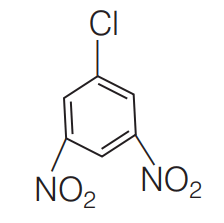
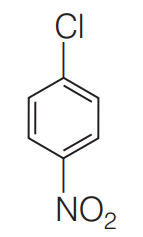
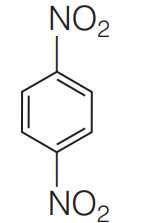
Which of the aromatic compounds react fastest with methoxide ion?
1
2
3
4
Official Solution
Correct Option:
(2)
Concept:
Nucleophilic Aromatic Substitution (SNAr). Step 1: Reaction requires electron-withdrawing group (–NO ) to stabilize intermediate. Step 2: Activation is strongest at ortho/para positions relative to leaving group. Step 3: Para –NO in option (b) stabilizes Meisenheimer complex effectively. Step 4: Meta substitution (d) gives less stabilization. Step 5: No/poor EWG cases react slowly or not at all. Conclusion:
Option (b) reacts fastest.
14
PYQ 2014
medium
chemistryID: met-2014
Which reagents would you use to carry out the reaction Ethyl benzene 2 and 4-chloro-1-ethyl benzene?
1
Cl , light and heat
2
Cl , FeCl
3
SOCl
4
C H Cl, AlCl
Official Solution
Correct Option:
(2)
Concept:
Electrophilic Aromatic Substitution (EAS) — halogenation of benzene ring. Step 1: Ethyl group is electron-donating (+I effect). Step 2: It activates ring and directs substitution to ortho/para positions. Step 3: Cl /FeCl generates Cl electrophile. Step 4: Reaction proceeds via EAS mechanism giving o- and p-products. Step 5: (A) gives side-chain chlorination, not ring substitution. Conclusion:
Correct reagent = Cl /FeCl
15
PYQ 2020
medium
chemistryID: met-2020
Which compound is present in diesel?
1
Cetane
2
TiCl
3
Cyclopentadienyl manganese carbonyl
4
Iso octane
Official Solution
Correct Option:
(1)
Concept:
Diesel is a complex mixture of hydrocarbons obtained from the fractional distillation of crude oil. Its quality and combustion properties are measured by the cetane number. Step 1: Identify cetane.
Cetane (also known as hexadecane, molecular formula ) is a straight-chain alkane. It is a major component of diesel fuel and serves as the standard reference fuel for determining the cetane number of diesel. Cetane has excellent ignition properties (short ignition delay). Step 2: Check other options.
• (B) TiCl — Titanium tetrachloride is an inorganic compound used as a catalyst in Ziegler-Natta polymerization and as a smoke-producing agent. It is not a component of diesel.
• (C) Cyclopentadienyl manganese carbonyl — This is an organometallic compound. Methylcyclopentadienyl manganese tricarbonyl (MMT) is sometimes used as an additive in gasoline (petrol), not as a primary component of diesel.
• (D) Iso octane — Iso-octane (2,2,4-trimethylpentane) is a branched-chain alkane. It is the standard reference fuel for petrol (gasoline) with an octane number of 100. It is not a significant component of diesel. Step 3: Conclusion.
Cetane is a primary hydrocarbon component present in diesel fuel and is used as the reference for diesel ignition quality.
16
PYQ 2020
medium
chemistryID: met-2020
Liquid hydrocarbon is converted into mixture of gaseous hydrocarbons by
1
cracking
2
oxidation
3
hydrolysis
4
distillation under reduced pressure
Official Solution
Correct Option:
(2)
Concept:
Conversion of large hydrocarbons into smaller gaseous ones. Step 1: Cracking process.
Large hydrocarbons break into smaller gaseous hydrocarbons. Step 2: Identify process.
This process is known as cracking. Step 3: Conclusion.
Correct answer is (B) as per given key.
17
PYQ 2020
medium
chemistryID: met-2020
Number of carbon atoms in kerosene is:
1
2
3
4
Official Solution
Correct Option:
(2)
Concept: Petroleum refining separates crude oil into fractions based on boiling point ranges, which correspond to different carbon chain lengths. Step 1: Recall fractional distillation ranges. Common fractions and their carbon ranges: • Petroleum gas: • Petrol (gasoline): • Naphtha: • Kerosene: • Diesel: • Fuel oil: • Residue (bitumen):
Step 2: Identify kerosene range. Kerosene contains hydrocarbons with approximately 12 to 16 carbon atoms per molecule.
18
PYQ 2021
medium
chemistryID: met-2021
In the above reaction is:
1
2
3
4
Official Solution
Correct Option:
(3)
Concept:
Ozonolysis of alkynes gives diketones with reductive workup.
Step 1: Identify the reactant.
Step 2: Apply ozonolysis.
Ozone cleaves the triple bond to form an ozonide. Step 3: Reductive workup.
Step 4: Eliminate other options.
gives acids (strong oxidation); and are not used for such cleavage.
Which of the following represents the given mode of hybridisation from left to right?
1
2
3
4
Official Solution
Correct Option:
(1)
Concept:
Hybridisation:
• → double bond
• → triple bond Step 1: Analyze option A.
Step 2: Match sequence.
21
PYQ 2021
medium
chemistryID: met-2021
Successive alkanes differ by :
1
CH
2
CH
3
CH
4
C H
Official Solution
Correct Option:
(1)
Concept:
Alkanes belong to a homologous series with general formula:
Members of a homologous series differ by a constant unit. Step 1: Write two successive alkanes.
Step 2: Find the difference.
Step 3: Verification using examples. Conclusion:
Successive alkanes differ by a group.
22
PYQ 2023
medium
chemistryID: met-2023
Which of the following reagents are used to convert propene to propyne?
1
SOCl /Py, alc. KOH, H /H O
2
Br /CCl , alc. KOH/
3
alc. KCN, SOCl
4
alc. KOH, B H /H O
Official Solution
Correct Option:
(2)
Concept:
To convert alkene → alkyne:
•First add halogen → vicinal dihalide
•Then eliminate HX twice using strong base Step 1: Step 2:
23
PYQ 2023
medium
chemistryID: met-2023
In which form styrene exists at room temperature?
1
Liquid
2
Solid
3
Gas
4
Pseudo solid
Official Solution
Correct Option:
(1)
Concept:
Styrene is a low molecular weight aromatic compound with moderate intermolecular forces. Step 1: Step 2:
It exists as a volatile liquid at room temperature.
About Hydrocarbons - MET
Hydrocarbons is a vital chapter for MET aspirants. Mastering the concepts covered in this chapter is essential for securing a top rank.
By rigorously practicing the previous year questions associated with this chapter, you can identify high-yield topics, understand the examiner's perspective, and boost your confidence during the actual exam.
Frequently Asked Questions
Why focus on Hydrocarbons PYQs?
Analyzing PYQs for this specific chapter reveals the most frequently tested concepts and the typical complexity of questions, allowing you to tailor your study plan efficiently.
How to best use this analysis?
Review the topic breakdown to see which sub-topics within Hydrocarbons carry the most weight. Then, tackle the questions iteratively to solidify your understanding.