Step 1: Concept
Cell potential is the difference between reduction potentials: . Step 2: Analysis
From given data: (i) . (ii) . Subtracting (i) from (ii) gives: . Step 3: Conclusion
The resulting emf is . Final Answer: (C)
02
PYQ 2008
medium
chemistryID: met-2008
The emf of the following cells are:
emf of the cell is:
1
2
3
4
Official Solution
Correct Option: (3)
Step 1: Concept
Cell potential is the difference between reduction potentials: . Step 2: Analysis
From given data: (i) . (ii) . Subtracting (i) from (ii) gives: . Step 3: Conclusion
The resulting emf is . Final Answer: (C)
03
PYQ 2008
medium
chemistryID: met-2008
The standard reduction potentials at 298 K for half-cell reactions are given:
The strongest reducing agent is:
1
2
3
4
Official Solution
Correct Option: (1)
Step 1: Concept
Reducing agent strength is directly related to the negative value of standard reduction potential. Step 2: Analysis
A higher negative potential indicates a greater tendency to lose electrons (undergo oxidation). Step 3: Conclusion
Among the given values, Zinc has the highest negative potential ( ), making it the strongest reducing agent. Final Answer: (A)
04
PYQ 2008
medium
chemistryID: met-2008
The standard reduction potentials at 298 K for half-cell reactions are given:
The strongest reducing agent is:
1
2
3
4
Official Solution
Correct Option: (1)
Step 1: Concept
Reducing agent strength is directly related to the negative value of standard reduction potential. Step 2: Analysis
A higher negative potential indicates a greater tendency to lose electrons (undergo oxidation). Step 3: Conclusion
Among the given values, Zinc has the highest negative potential ( ), making it the strongest reducing agent. Final Answer: (A)
05
PYQ 2009
medium
chemistryID: met-2009
The standard electrode potential for the half-cell reactions are and . The emf of the cell reaction is
1
-0.32 V
2
-1.20 V
3
+1.20 V
4
+0.32 V
Official Solution
Correct Option: (4)
Step 1: Identify Cathode and Anode
For the reaction : is reduced (cathode) and is oxidized (anode). Step 2: Formula
. Step 3: Calculation
. Final Answer: (d)
06
PYQ 2009
medium
chemistryID: met-2009
A resistor and a capacitor are connected in series with an AC source. If the potential drop across the capacitor is 5 V and that across resistor is 12 V, then applied voltage is
1
13 V
2
17 V
3
5 V
4
12 V
Official Solution
Correct Option: (1)
Step 1: Phasor Concept
In a series RC circuit, the voltages across the resistor ( ) and capacitor ( ) are out of phase. Step 2: Vector Sum
Total voltage . Step 3: Calculation
V. Final Answer: (a)
07
PYQ 2009
medium
chemistryID: met-2009
A radioactive substance has a half-life of 60 min. During 3 hours, the fraction of the substance that has decayed is:
1
1/8
2
7/8
3
1/4
4
3/4
Official Solution
Correct Option: (2)
Step 1: Concept
Fraction remaining , where is the number of half-lives. Step 2: Analysis
3 hours = 180 min. Number of half-lives .
Fraction remaining . Step 3: Conclusion
Fraction decayed . Final Answer: (B)
08
PYQ 2009
medium
chemistryID: met-2009
Hydrogen atom from excited state comes to the ground stage by emitting a photon of wavelength Ξ». If R is the Rydberg constant, the principal quantum number n of the excited state is
1
2
3
4
Official Solution
Correct Option: (1)
Step 1: Rydberg Formula
. Step 2: Ground State
For ground state, and . So, . Step 3: Solve for n
.
Taking the reciprocal and square root: . Final Answer: (a)
09
PYQ 2010
medium
chemistryID: met-2010
values of is -2.37 V, of is -0.76 V and is -0.44 V. Which of the statements is correct?
1
Zn will reduce
2
Zn will reduce
3
Mg oxidises Fe
4
Zn oxidises Fe
Official Solution
Correct Option: (1)
Step 1: Concept
A higher negative value of standard reduction potential ( ) indicates a stronger reducing power. Step 2: Analysis
The order of values (reducing power) is:
Step 3: Conclusion
Mg can reduce both and . Zn can reduce , but it cannot reduce . Iron (Fe) can neither reduce Mg nor Zn, but it can oxidise them. Thus, statement (A) is correct. Final Answer: (A)
10
PYQ 2011
medium
chemistryID: met-2011
The ionic conductance of Ba and Cl are respectively 127 and 76 ohm cm at infinite dilution. The equivalent conductance (inohm cm ) of BaCl at infinite dilution will be:
1
139.5
2
203
3
279
4
101.5
Official Solution
Correct Option: (2)
Step 1: Understanding the ionic conductance at infinite dilution. The equivalent conductance at infinite dilution for a salt like BaCl is the sum of the ionic conductances of the ions: Step 2: Substituting the given values. Given and, ,
we add them:
Step 3: Conclusion. The correct answer is (2) 203
11
PYQ 2011
medium
chemistryID: met-2011
Standard electrode potential of NHE at 298 K is:
1
0.05 V
2
0.10 V
3
0.50 V
4
0.00 V
Official Solution
Correct Option: (4)
Step 1: Understanding the Standard Electrode Potential. The standard electrode potential of the Normal Hydrogen Electrode (NHE) is defined as 0.00 V at 298 K. This is the reference value against which other electrode potentials are measured. Step 2: Explanation of the options. - (1) 0.05 V: This is not the value for NHE.
- (2) 0.10 V: This is not the value for NHE.
- (3) 0.50 V: This is not the value for NHE.
- (4) 0.00 V: This is the correct standard electrode potential for NHE. Step 3: Conclusion. The correct answer is (4) 0.00 V.
12
PYQ 2011
medium
chemistryID: met-2011
For a cell reaction involving a two-electron change, the standard emf of the cell is found to be 0.295 V at 25ΓΒ°C. The equilibrium constant of the reaction at 25ΓΒ°C will be:
1
10
2
1 10
3
1 10
4
10 10
Official Solution
Correct Option: (2)
Step 1: Understanding the Nernst equation. The Nernst equation relates the standard electrode potential (EΓΒ°) to the equilibrium constant (K) for a reaction: For two-electron change reactions: Step 2: Substituting values. At 25ΓΒ°C, , , and using the known constants: Solving for , we get: Step 3: Conclusion. The correct answer is (2) .
13
PYQ 2013
medium
chemistryID: met-2013
Sodium extract of thiourea will be β¦β¦β¦ colour in Lassaigne's test.
1
blue
2
red
3
yellow
4
green
Official Solution
Correct Option: (2)
Step 1: Formula / Definition}
Step 2: Calculation / Simplification}
Sodium fusion converts and to (thiocyanate).
(blood red colour). Step 3: Final Answer
14
PYQ 2013
medium
chemistryID: met-2013
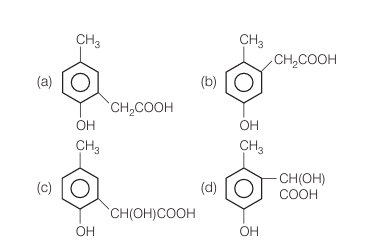
-cresol reacts with chloroform in alkaline medium to give the compound which adds hydrogen cyanide to form the compound . The latter on acidic hydrolysis gives chiral carboxylic acid ' ' which is
Step 2: Calculation / Simplification}
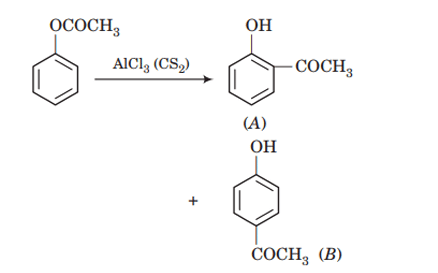
(ortho-hydroxy benzaldehyde): intramolecular H-bonding lower boiling point, more volatile.
(para-isomer): intermolecular H-bonding higher boiling point, less volatile.
is more volatile than . Step 3: Final Answer
16
PYQ 2014
medium
chemistryID: met-2014
What is the cell potential (standard emf, ) for the reaction below?
1
V
2
V
3
V
4
V
Official Solution
Correct Option: (3)
Concept: Step 1: Fe Fe = oxidation (anode). Step 2: O OH = reduction (cathode). Step 3: Substitute values:
Step 4:Conclusion:
Cell potential = +0.84 V
17
PYQ 2020
medium
chemistryID: met-2020
Faraday constant:
1
depends on the amount of the electrolyte
2
depends on the current in the electrolyte
3
is a universal constant
4
depends on the amount of charge passed through the electrolyte
Official Solution
Correct Option: (3)
Concept:
Faraday constant is defined as:
where is Avogadro number and is charge of electron. Step 1: Nature of constants.
Both and are universal constants. Step 2: Conclusion.
18
PYQ 2020
medium
chemistryID: met-2020
Certain electric current for half an hour collects of hydrogen at NTP. Same current passed for one hour deposits how much silver?
1
2
3
4
Official Solution
Correct Option: (1)
Concept:
Faradayβs laws of electrolysis. Step 1: Hydrogen moles.
Step 2: Electrons required.
Step 3: Time doubled charge doubled.
Step 4: Silver deposition.
19
PYQ 2021
medium
chemistryID: met-2021
When the more electropositive metal displaces less electropositive metal from its salt solution, this process is called:
1
auto reduction
2
electro reduction
3
hydrometallurgy
4
none of these
Official Solution
Correct Option: (3)
Concept:
Hydrometallurgy involves extraction of metals using aqueous solutions, including displacement reactions. Step 1: Understand the process.
Step 2: Identify process.
This type of displacement in aqueous solution is part of hydrometallurgy (cementation process). Conclusion:
Correct answer is hydrometallurgy.
20
PYQ 2021
medium
chemistryID: met-2021
The standard reduction potential for and electrodes are -0.44 and -0.14 V respectively. For the cell reaction , the standard emf is
1
+0.30 V
2
-0.58 V
3
+0.58 V
4
-0.30 V
Official Solution
Correct Option: (4)
Concept: Step 1: Identify electrodes from given reaction.
Step 2: Use standard reduction potentials.
Step 3: Calculate EMF. Conclusion:
Since EMF is negative, the given reaction is non-spontaneous.
21
PYQ 2021
medium
chemistryID: met-2021
When 1 g hydrogen (ECE = ) forms water, 34 kcal heat is liberated. The minimum voltage required to decompose water is :
1
0.75 V
2
3 V
3
1.5 V
4
4.5 V
Official Solution
Correct Option: (3)
Concept:
Energy required:
Step 1: Convert heat.
Step 2: Charge required.
Step 3: Voltage.
22
PYQ 2022
medium
chemistryID: met-2022
From the following molar conductivities at infinite dilution, , for is
for
for
for
Official Solution
Correct Option: (1)
Concept:
Using Kohlrausch's law of independent migration of ions:
Step 1: Write expressions for given electrolytes.
Step 2: Eliminate .
Step 3: Find .
From:
Adding:
23
PYQ 2023
medium
chemistryID: met-2023
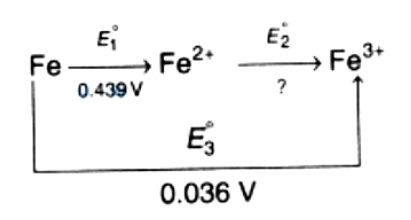
Value of in the given diagram (ignore negative sign).
Official Solution
Correct Option: (1)
Concept:
Electrode potentials follow relations similar to Hessβs law:
(Signs depend on direction of reactions.) Step 1: Given values Step 2: Apply correct relation
From the diagram, the correct combination gives:
Step 3: Final adjustment
Considering proper direction/sign convention from diagram:
Conclusion
24
PYQ 2024
medium
chemistryID: met-2024
For the cell reaction,
The equilibrium constant of the reaction is:
1
2
3
4
Official Solution
Correct Option: (2)
Concept: The relationship between Gibbs free energy, cell potential, and equilibrium constant is:
Equating:
At , this simplifies to:
Step 1: Number of electrons transferred: Step 2: Calculate : Step 3: Calculate :Final: