When ammonium chloride is added to ammonia solution, the pH of the resulting solution will be:
1
increased
2
seven
3
decreased
4
unchanged
Official Solution
Correct Option: (3)
Step 1: Concept
This involves the common ion effect in a weak base/salt system. Step 2: Analysis
Adding (common ion ) suppresses the ionization of . This leads to a lower concentration of ions. Step 3: Conclusion
A decrease in hydroxide ion concentration leads to a decrease in pH. Final Answer: (C)
02
PYQ 2008
medium
chemistryID: met-2008
AB will precipitate when the concentration of ions is:
1
between to
2
between to
3
4
Official Solution
Correct Option: (3)
Step 1: Concept
Precipitation requires ionic product to exceed . Step 2: Analysis
With and , threshold is . Step 3: Conclusion
It precipitates when is more than . Final Answer: (C)
03
PYQ 2008
medium
chemistryID: met-2008
The normality of a solution containing 32.5 g of per 0.5 L is:
1
10 N
2
1 N
3
2 N
4
0.1 N
Official Solution
Correct Option: (2)
Step 1: Concept
. Step 2: Analysis
* Mol. wt of Oxalic acid .
* Eq. wt (basicity = 2).
* . (Note: calculation based on provided source 1885). Step 3: Conclusion
Normality . Final Answer: (B)
04
PYQ 2008
medium
chemistryID: met-2008
For the titration of vs , the suitable indicator is:
1
methyl orange
2
phenolphthalein
3
methyl red
4
All can be used
Official Solution
Correct Option: (2)
Step 1: Concept
In titrations, the indicator must change color at the pH of the equivalence point. Step 2: Analysis
is a strong base and oxalic acid is a weak acid. The equivalence point will be in the alkaline range. Step 3: Conclusion
Phenolphthalein is suitable as it changes color in the alkaline medium. Final Answer: (B)
05
PYQ 2008
medium
chemistryID: met-2008
When ammonium chloride is added to ammonia solution, the pH of the resulting solution will be:
1
increased
2
seven
3
decreased
4
unchanged
Official Solution
Correct Option: (3)
Step 1: Concept
This involves the common ion effect in a weak base/salt system. Step 2: Analysis
Adding (common ion ) suppresses the ionization of . This leads to a lower concentration of ions. Step 3: Conclusion
A decrease in hydroxide ion concentration leads to a decrease in pH. Final Answer: (C)
06
PYQ 2009
medium
chemistryID: met-2009
30 cc of HCl, 20 cc of HNO and 40 cc of NaOH solutions are mixed and the volume was made up to . The pH of the resulting solution is
1
8
2
2
3
1
4
3
Official Solution
Correct Option: (2)
Step 1: Calculate Milliequivalents
Total milliequivalents . Total milliequivalents . Step 2: Find Concentration
Net left milliequivalents. . Step 3: Calculate pH
. Final Answer: (b)
07
PYQ 2009
medium
chemistryID: met-2009
In a common emitter amplifier the input signal is applied across
1
anywhere
2
emitter-collector
3
collector-base
4
base-emitter
Official Solution
Correct Option: (4)
Step 1: Definition
In a common emitter (CE) amplifier, the emitter is common to both input and output. Step 2: Configuration
The input signal is fed into the base terminal. Step 3: Conclusion
Thus, the input is applied across the base-emitter junction. Final Answer: (d)
08
PYQ 2009
medium
chemistryID: met-2009
Young's double slit experiment gives interference fringes of width 0.3 mm. A thin glass plate made of material of refractive index 1.5 is kept in the path of light from one of the slits, then the fringe width becomes
1
zero
2
0.3 mm
3
0.45 mm
4
0.15 mm
Official Solution
Correct Option: (2)
Step 1: Effect of Plate
Introducing a glass plate shifts the entire fringe pattern. Step 2: Fringe Width Independence
Fringe width depends on wavelength, slit separation, and screen distance. Step 3: Conclusion
Since these parameters do not change when the plate is added, the fringe width remains unchanged at 0.3 mm. Final Answer: (b)
09
PYQ 2009
medium
chemistryID: met-2009
The surface temperature of the stars is determined using
1
Planck's law
2
Wien's displacement law
3
Rayleigh-Jeans law
4
Kirchhoff's law
Official Solution
Correct Option: (2)
Step 1: Law Principle
Wien's displacement law states that the wavelength of maximum emission ( ) is inversely proportional to the absolute temperature ( ). Step 2: Application
By measuring the color (wavelength) of light from a star, scientists can calculate its surface temperature. Step 3: Formula
, where is Wien's constant. Final Answer: (b)
10
PYQ 2009
medium
chemistryID: met-2009
A cylindrical tube open at both the ends has a fundamental frequency of 390 Hz in air. If 1/4th of the tube is immersed vertically in water the fundamental frequency of air column is
1
260 Hz
2
130 Hz
3
390 Hz
4
520 Hz
Official Solution
Correct Option: (1)
Step 1: Open Tube
Fundamental frequency . Step 2: Closed Tube Formation
Immersion turns it into a closed tube. Remaining air length . Step 3: New Frequency
New fundamental frequency .
. Final Answer: (a)
11
PYQ 2010
medium
chemistryID: met-2010
The pH of a neutral water sample is 6.5. Then the temperature of water ________.
1
is
2
is more than
3
is less than
4
can be more or less than
Official Solution
Correct Option: (2)
Step 1: Concept
The dissociation of water ( ) is an endothermic process. Step 2: Temperature Effect
As temperature increases, the dissociation constant ( ) increases, leading to a higher concentration of ions. Step 3: pH Relation
Since , a higher concentration of results in a lower pH value. Step 4: Conclusion
Neutral water has a pH of 7.0 at . A pH of 6.5 for neutral water implies the temperature is higher than . Final Answer: (B)
12
PYQ 2010
medium
chemistryID: met-2010
The pH of M NaOH solution is nearest to ________.
1
4
2
10
3
-10
4
7
Official Solution
Correct Option: (4)
Step 1: Analysis
is an extremely dilute basic solution. Step 2: Water Contribution
In such dilute solutions, the from the self-ionization of water ( ) cannot be ignored. Step 3: Total Concentration
Total . Step 4: Calculation
. . Final Answer: (D)
13
PYQ 2011
medium
chemistryID: met-2011
The pH of a solution is increased from 3 to 6, its H ion concentration will be:
1
Reduced to half
2
Doubled
3
Reduced by 1000 times
4
Increased by 1000 times
Official Solution
Correct Option: (3)
Step 1: Understanding the pH scale. pH is the negative logarithm of the hydrogen ion concentration: A change in pH by 3 units corresponds to a change in the H ion concentration by a factor of 1000. Step 2: Explanation of the options. - (1) Reduced to half: Incorrect, as pH change of 3 units changes the concentration by a factor of 1000.
- (2) Doubled: Incorrect, pH change does not double the concentration.
- (3) Reduced by 1000 times: Correct. An increase of 3 pH units corresponds to a 1000 times reduction in H ion concentration.
- (4) Increased by 1000 times: Incorrect, as the concentration decreases by 1000 times. Step 3: Conclusion. The correct answer is (3) Reduced by 1000 times.
14
PYQ 2011
medium
chemistryID: met-2011
Solubility product of BaCl is . Its solubility in mol/L would be:
1
2
3
4
Official Solution
Correct Option: (1)
Step 1: Understanding the solubility product. The solubility product ( ) of BaCl is given by: Let the solubility of BaCl be . The concentration of will be , and the concentration of will be (because there are two chloride ions for each BaCl ). Step 2: Setting up the equation. Substitute the concentrations into the solubility product expression: We are given . So: Taking the cube root: Step 3: Conclusion. The solubility of BaCl is mol/L.
15
PYQ 2011
medium
chemistryID: met-2011
An example of a Lewis acid is:
1
NaCl
2
MgCl
3
AlCl
4
SnCl
Official Solution
Correct Option: (3)
Step 1: Identifying Lewis acids. A Lewis acid is a substance that can accept a pair of electrons. This typically happens when the species has an empty orbital that can accept an electron pair. Step 2: Explanation of the options. - (1) NaCl: Sodium chloride is an ionic compound and does not have an electron-deficient center.
- (2) MgCl : Magnesium chloride is also not a Lewis acid; it is a simple ionic compound.
- (3) AlCl : Aluminum chloride is a Lewis acid because the aluminum atom has an empty orbital and can accept an electron pair.
- (4) SnCl : Tin chloride is also a Lewis acid, but it is less strongly acidic than AlCl . Step 3: Conclusion. The correct answer is (3) AlCl .
16
PYQ 2013
medium
chemistryID: met-2013
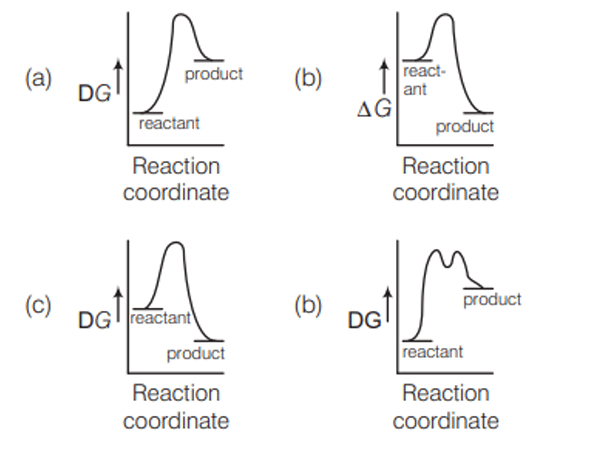
Which one of the following reaction energy diagrams best represents a reaction in the reverse direction; that it is the most endothermic?
1
Diagram (a)
2
Diagram (b)
3
Diagram (c)
4
Diagram (d)
Official Solution
Correct Option: (2)
Step 1: Formula / Definition}
Step 2: Calculation / Simplification}
Most endothermic in reverse direction most exothermic in forward direction.
Diagram (b) shows largest drop in for forward reaction.
Reverse reaction has highest positive . Step 3: Final Answer
17
PYQ 2013
medium
chemistryID: met-2013
A certain reaction rate increases folds in the presence of a catalyst at . The activation energy of the original pathway is . What is the activation energy of the new pathway?
1
2
3
4
Official Solution
Correct Option: (1)
Step 1: Formula / Definition}
Step 2: Calculation / Simplification}
Step 3: Final Answer
18
PYQ 2013
medium
chemistryID: met-2013
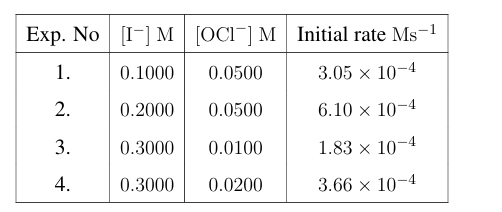
Consider the following reaction in an aqueous solution
and the following initial concentration and initial rate data for this reaction.
Which of the following is the correct rate law for this reaction?
Concept:
Acid strength in hydrogen halides increases down the group due to decrease in bond strength. Step 1: Bond strength order:
Step 2: Reason:
Stronger bond → harder to release H → weaker acid. Step 3: HF has strongest H–F bond. Conclusion:
Thus, HF is the weakest acid.
20
PYQ 2014
medium
chemistryID: met-2014
An aqueous solution of phosphoric acid, H PO being titrated has molarity equal to 0.25 M. Which of the following could be normality of this solution?
1
0.25 N
2
0.50 N
3
0.75 N
4
All of these
Official Solution
Correct Option: (4)
Concept:
Normality depends on the number of replaceable H ions. For polyprotic acids:
Step 1: Identify nature of acid: H PO is triprotic (3 replaceable H ). Step 2: Different stages of neutralization:
• First stage:
• Second stage:
• Third stage: Step 3: All these normalities are possible depending on extent of neutralization. Conclusion:
All given values are possible.
21
PYQ 2014
medium
chemistryID: met-2014
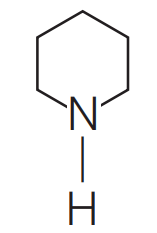
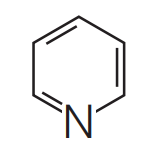
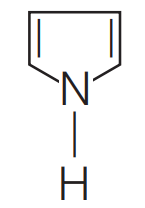
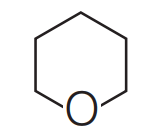
Which of the following is the strongest base?
1
2
3
4
Official Solution
Correct Option: (1)
Concept:
Basicity depends on availability of lone pair Step 1: In (a), N is sp hybridized → lone pair freely available. Step 2: In (b), lone pair is in aromatic ring → less available. Step 3: In (c), lone pair is partially delocalized. Step 4: In (d), O is more electronegative → holds lone pair tightly. Conclusion:
Most basic = option (a)
22
PYQ 2014
medium
chemistryID: met-2014
Strongest conjugate base is
1
ClO
2
ClO
3
ClO
4
ClO
Official Solution
Correct Option: (1)
Concept:
Conjugate base strength inverse of acid strength Step 1: More oxygen → stronger acid due to resonance. Step 2: Acid strength order:
Step 3: Hence conjugate base strength:
Conclusion:
Strongest base = ClO
23
PYQ 2014
medium
chemistryID: met-2014
If 200 mL of a 0.031 M solution of H SO are added to 84 mL of a 0.150 M KOH solution, what is the pH of the resulting solution?
1
12.4
2
1.7
3
2.2
4
10.9
Official Solution
Correct Option: (4)
Concept:
Acid-base neutralization + excess OH determines pH Step 1: Moles of H SO :
Step 2: H SO gives 2H :
Step 3: Moles of KOH:
Step 4: Excess OH :
Step 5: [OH ] concentration:
Step 6: pOH and pH:
Conclusion:
pH = 10.9
24
PYQ 2017
medium
chemistryID: met-2017
The conjugate base of the acid H S is
1
HS
2
S
3
S
4
None of these
Official Solution
Correct Option: (1)
Step 1: Understanding the Concept:
A conjugate base is formed when an acid donates a proton (H ). Step 2: Detailed Explanation:
H S H + HS
When H S loses one proton, it forms HS . HS is the conjugate base of H S.
S is the conjugate base of HS . Step 3: Final Answer:
The conjugate base of H S is HS , option (A).
25
PYQ 2017
medium
chemistryID: met-2017
Find the pH value of the mixture containing 50 cc M HCl and 30 cc M NaOH solution, assuming both to be completely ionised.
1
0.7051
2
0.6021
3
10.051
4
8.052
Official Solution
Correct Option: (2)
Step 1: Understanding the Concept:
This is a strong acid-strong base neutralization. The pH is determined by the concentration of H ions remaining after reaction. Step 2: Detailed Explanation:
Volume of HCl = 50 cc = 0.05 L, Molarity = 1 M. Moles of H = mol.
Volume of NaOH = 30 cc = 0.03 L, Molarity = 1 M. Moles of OH = mol.
Reaction: . Moles of H remaining = mol.
Total volume = L.
M.
pH = . Step 3: Final Answer:
pH = 0.6021, option (B).
26
PYQ 2018
medium
chemistryID: met-2018
pH of an acid buffer is given by
1
2
3
4
None of the above
Official Solution
Correct Option: (1)
Step 1: Understanding the Concept:
Henderson-Hasselbalch equation for acid buffer. Step 2: Detailed Explanation:
is the correct equation. Step 3: Final Answer:
The correct expression is .
27
PYQ 2018
medium
chemistryID: met-2018
Degree of dissociation of an acid HCl is , of the acid is present in of solution. The pH of the solution is}
1
2
2
1
3
3
4
4
Official Solution
Correct Option: (1)
Step 1: Understanding the Concept:
pH = . Step 2: Detailed Explanation:
Moles of HCl = mol. Molarity = M. M. pH = . Step 3: Final Answer:
pH = 2.
28
PYQ 2018
medium
chemistryID: met-2018
The solubility product of is given by the expression}
1
2
3
4
Official Solution
Correct Option: (4)
Step 1: Understanding the Concept:
is product of ion concentrations raised to their stoichiometric coefficients. Step 2: Detailed Explanation:
, so . Step 3: Final Answer:
.
29
PYQ 2019
medium
chemistryID: met-2019
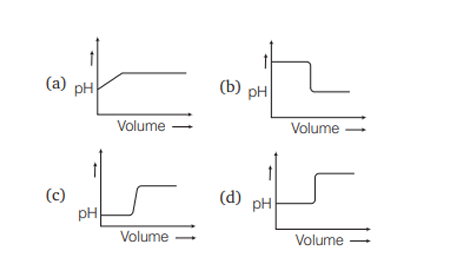
Which of the following plot represents the graph of pH against volume of alkali added in the titration of NaOH and HCl?
1
Graph A
2
Graph B
3
Graph C
4
Graph D
Official Solution
Correct Option: (1)
Step 1: Understanding the Concept:
Strong acid-strong base titration curve. Step 2: Detailed Explanation:
pH starts low, rises slowly, then jumps sharply at equivalence point (pH=7), then levels off. Step 3: Final Answer:
Graph A shows correct titration curve.
30
PYQ 2019
medium
chemistryID: met-2019
In a mixture of 1 g H and 8 g O the mole fraction of hydrogen is
1
0.667
2
0.5
3
0.33
4
None of the above
Official Solution
Correct Option: (1)
Step 1: Understanding the Concept:
Mole fraction = moles of component/total moles. Step 2: Detailed Explanation:
Moles H = 1/2 = 0.5 mol
Moles O = 8/32 = 0.25 mol
Total = 0.75 mol
Step 3: Final Answer:
Mole fraction is 0.667.
31
PYQ 2019
medium
chemistryID: met-2019
An aqueous solution freezes at -0.186°C, then elevation in boiling point is ( , )
The solubility CaF is s moles/litre. Then solubility product is
1
2
3
4
Official Solution
Correct Option: (2)
Step 1: Understanding the Concept:
CaF dissociates as Ca + 2F . Step 2: Detailed Explanation:
,
Step 3: Final Answer:
Solubility product is .
34
PYQ 2020
medium
chemistryID: met-2020
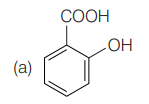
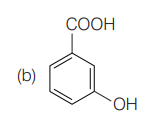
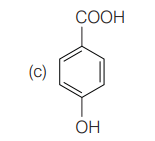
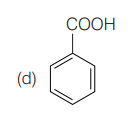
Among the following, compound with the lowest value is:
1
o-hydroxy benzoic acid
2
m-hydroxy benzoic acid
3
p-hydroxy benzoic acid
4
benzoic acid
Official Solution
Correct Option: (1)
Concept:
Lower means stronger acid. The ortho effect enhances acidity. Step 1: Ortho effect.
In o-hydroxy benzoic acid (salicylic acid), the -OH group is ortho to -COOH. It forms an intramolecular hydrogen bond with the carboxylate ion after deprotonation, stabilizing the conjugate base. Step 2: Comparison.
• o-hydroxy benzoic acid: Intramolecular H-bond stabilizes conjugate base → strongest acid → lowest .
• m- and p-hydroxy benzoic acids: No intramolecular H-bond; electronic effects (resonance/inductive) but less effective than ortho effect.
• Benzoic acid: No additional -OH group → weakest acid among these.
35
PYQ 2021
medium
chemistryID: met-2021
Solution of 0.1 N and 0.1 N has pH 9.25. Then p of is :
1
9.25
2
4.75
3
3.75
4
8.25
Official Solution
Correct Option: (2)
Concept:
Buffer formula:
Step 1: Given.
Equal concentrations log term = 0 Step 2: Convert pH to pOH.
36
PYQ 2021
medium
chemistryID: met-2021
100 mL of 1.0 M HCl are mixed with 75 mL of 1.0 M . The resulting solution will be:
1
acidic
2
basic
3
neutral
4
amphoteric
Official Solution
Correct Option: (2)
Concept:
Neutralization:
Step 1: Moles.
Step 2: Stoichiometry.
Required HCl:
Available HCl = 0.1 → insufficient Step 3: Conclusion.
remains → solution is basic.
37
PYQ 2023
medium
chemistryID: met-2023
The of acetic acid is . The concentration of is . The pH of is _ _ _ _ _ .