When a mixture of calcium benzoate and calcium acetate is dry distilled, the resulting compound is:
1
acetophenone
2
benzaldehyde
3
benzophenone
4
acetaldehyde
Official Solution
Correct Option:
(1)
Step 1: Concept
Dry distillation of a mixture of calcium salts of different carboxylic acids leads to the formation of a mixed ketone. Step 2: Analysis
Calcium benzoate reacting with calcium acetate involves the removal of molecules upon heating. Step 3: Conclusion
The reaction produces two molecules of acetophenone ( ). Final Answer: (A)
02
PYQ 2008
medium
chemistryID: met-2008
When a mixture of calcium benzoate and calcium acetate is dry distilled, the resulting compound is:
1
acetophenone
2
benzaldehyde
3
benzophenone
4
acetaldehyde
Official Solution
Correct Option:
(1)
Step 1: Concept
Dry distillation of a mixture of calcium salts of different carboxylic acids leads to the formation of a mixed ketone. Step 2: Analysis
Calcium benzoate reacting with calcium acetate involves the removal of molecules upon heating. Step 3: Conclusion
The reaction produces two molecules of acetophenone ( ). Final Answer: (A)
03
PYQ 2008
medium
chemistryID: met-2008
Which reaction intermediate is formed during the condensation reaction between acetaldehyde and formaldehyde?
1
2
3
4
Official Solution
Correct Option:
(1)
Step 1: Concept
This is a crossed aldol condensation. Step 2: Analysis
Formaldehyde has no -hydrogen, so the base abstracts an -hydrogen from acetaldehyde. Step 3: Conclusion
This abstraction forms a resonance-stabilized carbanion (enolate ion): . Final Answer: (A)
04
PYQ 2008
medium
chemistryID: met-2008
Which reaction intermediate is formed during the condensation reaction between acetaldehyde and formaldehyde?
1
2
3
4
Official Solution
Correct Option:
(1)
Step 1: Concept
This is a crossed aldol condensation. Step 2: Analysis
Formaldehyde has no -hydrogen, so the base abstracts an -hydrogen from acetaldehyde. Step 3: Conclusion
This abstraction forms a resonance-stabilized carbanion (enolate ion): . Final Answer: (A)
05
PYQ 2008
medium
chemistryID: met-2008
The formation of cyanohydrin from acetone is which type of reaction?
1
Electrophilic substitution reaction
2
Electrophilic addition reaction
3
Nucleophilic addition reaction
4
Nucleophilic substitution reaction
Official Solution
Correct Option:
(3)
Step 1: Concept
Carbonyl groups ( ) in ketones typically undergo addition reactions initiated by nucleophiles. Step 2: Analysis
The ion attacks the partially positive carbonyl carbon, followed by protonation of the oxygen. Step 3: Conclusion
Since the nucleophile ( ) attacks first, it is a nucleophilic addition reaction. Final Answer: (C)
06
PYQ 2009
medium
chemistryID: met-2009
Two luminous point sources separated by a certain distance are at 10 km from an observer. If the aperture of his eye is m and the wavelength of light used is 500 nm, the distance of separation between the point sources just seen to be resolved is
1
12.2 m
2
24.2 m
3
2.44 m
4
1.22 m
Official Solution
Correct Option:
(3)
Step 1: Rayleigh's Criterion
The angular resolution is given by .
Substituting the values: rad. Step 2: Linear Separation
The relationship between angular separation ( ), distance ( ), and linear separation ( ) is . Step 3: Calculation
m. Final Answer: (c)
07
PYQ 2009
medium
chemistryID: met-2009
In a Young's double slit experiment, if the distance between the slits is halved and the distance of the screen from the slits is doubled, then the fringe width will:
1
remain same
2
be doubled
3
be quadrupled
4
be halved
Official Solution
Correct Option:
(3)
Step 1: Concept
Fringe width . Step 2: Analysis
New distance and .
New width . Step 3: Conclusion
The fringe width becomes 4 times its original value. Final Answer: (C)
08
PYQ 2009
medium
chemistryID: met-2009
The unit of Planck's constant is:
1
Joule/s
2
Joule-s
3
Joule-
4
Joule-m
Official Solution
Correct Option:
(2)
Step 1: Concept
According to Planck's equation, , where is energy and is frequency. Step 2: Analysis
. The unit of energy is Joule ( ) and the unit of frequency is . Step 3: Conclusion
Thus, the unit of is . Final Answer: (B)
09
PYQ 2009
medium
chemistryID: met-2009
2 g of a radioactive sample having half-life of 15 days was synthesised on 1st Jan
2009. The amount of the sample left behind on 1st March, 2009 (including both the days) is
1
0 g
2
0.125 g
3
1 g
4
0.5 g
Official Solution
Correct Option:
(2)
Step 1: Calculate Total Time
From January 1st to March 1st, 2009, the total time elapsed is 60 days. Step 2: Find Number of Half-lives
Half-life ( ) is 15 days. Number of half-lives ( ) = . Step 3: Calculate Remaining Amount
Using the formula , where . . Final Answer: (b)
10
PYQ 2009
medium
chemistryID: met-2009
Continuous emission spectrum is produced by
1
incandescent electric lamp
2
mercury vapour lamp
3
sodium vapour lamp
4
polyatomic substances
Official Solution
Correct Option:
(1)
Step 1: Spectrum Types
Incandescent solids or liquids produce a continuous spectrum. Step 2: Comparison
Gases like mercury or sodium vapor produce line emission spectra. Step 3: Conclusion
An incandescent lamp uses a heated filament (solid) to emit light across all visible wavelengths, forming a continuous spectrum. Final Answer: (a)
11
PYQ 2011
medium
chemistryID: met-2011
The product of the following reaction,
{C H COCH Br + OH }.....
1
(2)
(3)
(4)
2
3
4
Official Solution
Correct Option:
(1)
Step 1: Analyze the reaction. The reaction involves a carbonyl compound (benzoyl group ) with two bromine atoms attached to a carbon. The reaction with hydroxide ions ( ) suggests a nucleophilic substitution. Step 2: Mechanism of the reaction. The hydroxide ion ( ) attacks the electrophilic carbon attached to the bromine, replacing the bromine atom. The two bromine atoms are replaced by a single hydroxyl group, resulting in the formation of an aldehyde group. Step 3: Conclusion. The correct product is (benzaldehyde), which corresponds to option (1).
12
PYQ 2011
medium
chemistryID: met-2011
Aldehyde not showing Cannizzaroâs reaction is:
1
Paraldehyde
2
Chloral
3
Formaldehyde
4
Acetaldehyde
Official Solution
Correct Option:
(4)
Step 1: Identifying the Cannizzaro reaction. The Cannizzaro reaction is a base-catalyzed disproportionation of non-enolizable aldehydes (those lacking an alpha-hydrogen). It produces one molecule of alcohol and one molecule of carboxylic acid. Step 2: Explanation of the options. - (1) Paraldehyde: Paraldehyde does undergo Cannizzaro's reaction because it is a non-enolizable aldehyde.
- (2) Chloral: Chloral also undergoes Cannizzaroâs reaction.
- (3) Formaldehyde: Formaldehyde can undergo Cannizzaroâs reaction because it lacks an alpha-hydrogen.
- (4) Acetaldehyde: Acetaldehyde has an alpha-hydrogen and thus cannot undergo Cannizzaroâs reaction. Step 3: Conclusion. The correct answer is (4) Acetaldehyde.
13
PYQ 2011
medium
chemistryID: met-2011
Both HCHO and CH3CHO give similar reactions with all the reagents except:
1
Schiff reagent
2
Fehling solution
3
Ammoniacal AgNO3
4
Ammonia
Official Solution
Correct Option:
(4)
Step 1: Identifying the reactions. HCHO (formaldehyde) and CH3CHO (acetaldehyde) are both aldehydes and undergo similar reactions with most reagents, but ammonia (NH3) does not react similarly with them. Step 2: Explanation of the options. - (1) Schiff reagent: Both formaldehyde and acetaldehyde react with Schiff reagent to give a positive result.
- (2) Fehling solution: Both formaldehyde and acetaldehyde reduce Fehlingâs solution, showing a positive test.
- (3) Ammoniacal AgNO3: Both formaldehyde and acetaldehyde react with ammoniacal silver nitrate to form silver mirrors.
- (4) Ammonia: Ammonia reacts differently with aldehydes. Formaldehyde undergoes polymerization with ammonia, while acetaldehyde does not. Step 3: Conclusion. The correct answer is (4) Ammonia.
14
PYQ 2011
medium
chemistryID: met-2011
Benzaldehyde condenses with N,N-dimethyl aniline in presence of anhydrous ZnCl2 to give:
1
azo dye
2
malachite
3
michlers ketone
4
buffer yellow
Official Solution
Correct Option:
(2)
Step 1: Identifying the reaction. The reaction involves the condensation of benzaldehyde with N,N-dimethyl aniline in the presence of anhydrous ZnCl2. This is a typical reaction for forming a product known as malachite. Step 2: Explanation of the products. - (1) Azo dye: Azo dyes are typically formed from reactions involving diazonium salts, not a condensation of the given reagents.
- (2) Malachite: This is the correct product formed from the condensation of benzaldehyde and N,N-dimethyl aniline in the presence of ZnCl2.
- (3) Michler's ketone: This is a different compound, formed under different conditions, involving dimethylaniline and formaldehyde.
- (4) Buffer yellow: This is not a known product of this condensation reaction. Step 3: Conclusion. The correct answer is (2) malachite.
15
PYQ 2011
medium
chemistryID: met-2011
CH3COOH ? The product of the reaction is isomeric with:
1
CH2=CHO
2
CH3CH==NOH
3
HCONH--CH3
4
All of these
Official Solution
Correct Option:
(3)
Step 1: Identifying the reaction. The reaction involves the condensation of acetic acid (CH3COOH) with ammonia (NH3) under heat ( ). This is a type of amide formation reaction. Step 2: Explanation of the products. - (1) CH2=CHO: This is the structure for an aldehyde, not related to the amide formation in the given reaction.
- (2) CH3CH==NOH: This represents an imine, which is not the correct product of the reaction.
- (3) HCONH--CH3: This is methylamide (acetamide), which is the correct product of the reaction between acetic acid and ammonia.
- (4) All of these: This is incorrect since only acetamide is the correct product. Step 3: Conclusion. The correct answer is (3) HCONH--CH3.
16
PYQ 2011
medium
chemistryID: met-2011
The reaction: is fastest when Z is:
1
Cl
2
NH2
3
OC2H5
4
OCOCH3
Official Solution
Correct Option:
(1)
Step 1: Understanding the mechanism. This is a nucleophilic acyl substitution reaction where Z is the nucleophile. The speed of the reaction depends on the nucleophile's basicity and size. A smaller and stronger nucleophile leads to faster reactions. Step 2: Explanation of the options. - (1) Cl: Chloride ion is a small and good nucleophile, making the reaction faster.
- (2) NH2: Amine is a good nucleophile, but its size and basicity make it slower than chloride.
- (3) OC2H5: Ethoxy group is a larger nucleophile, making the reaction slower.
- (4) OCOCH3: This ester group is bulky, slowing down the reaction. Step 3: Conclusion. The correct answer is (1) Cl.
17
PYQ 2013
medium
chemistryID: met-2013
Screening effect is not observed in
1
He
2
Li
3
Be
4
all cases
Official Solution
Correct Option:
(4)
Step 1: Understanding the Concept:
Screening effect is due to inner electrons shielding outer electrons from nucleus. One-electron systems have no screening. Step 2: Detailed Explanation:
He (2 e total, but 1 electron after ionization? Wait - He has 1 electron), Li (1 e ), Be (1 e ).
All are hydrogen-like species with only one electron. No inner electrons to cause screening. Step 3: Final Answer:
Thus, screening effect is not observed in all of these.
18
PYQ 2013
medium
chemistryID: met-2013
The type of hybridisation of P atom in PCl , PCl and PCl is (respectively)
1
sp , sp d, sp d
2
sp d, sp , sp d
3
sp , sp d , sp
4
sp d , sp , sp d
Official Solution
Correct Option:
(2)
Step 1: Understanding the Concept:
Steric number = number of bond pairs + lone pairs = hybridisation. Step 2: Detailed Explanation:
PCl : P has 5 bond pairs, 0 lone pairs SN=5 sp d.
PCl : P has 4 bond pairs, 0 lone pairs SN=4 sp .
PCl : P has 6 bond pairs, 0 lone pairs SN=6 sp d . Step 3: Final Answer:
Thus, hybridisation: sp d, sp , sp d .
19
PYQ 2013
medium
chemistryID: met-2013
Calculate second electron affinity of oxygen for the process: O (g) + e (g) O (g) using the following data:
(i) Heat of sublimation of Mg(s) = +147.7 kJ mol
(ii) Ionisation energy of Mg(g) to form Mg (g) = +2189.0 kJ mol
(iii) Bond dissociation energy for O = +498.4 kJ mol
(iv) First electron affinity of O(g) = -141.0 kJ mol
(v) Heat of formation of MgO = -601.7 kJ mol
(vi) Lattice energy of MgO = -3791.0 kJ mol
1
235.6 kJ mol
2
468.7 kJ mol
3
544.4 kJ mol
4
744.4 kJ mol
Official Solution
Correct Option:
(4)
Step 1: Understanding the Concept:
Use Born-Haber cycle for MgO formation. Step 2: Detailed Explanation:
For Mg(s) + O (g) MgO(s):
Born-Haber cycle:
Sublimation of Mg: +147.7
IE + IE of Mg: +2189.0
Dissociation of O : +498.4/2 = +249.2
First EA of O: -141.0
Second EA of O: x (unknown)
Lattice energy: -3791.0
Sum = 147.7 + 2189.0 + 249.2 - 141.0 + x - 3791.0 = -601.7
(147.7 + 2189.0 = 2336.7; +249.2 = 2585.9; -141 = 2444.9)
2444.9 + x - 3791.0 = -601.7 x - 1346.1 = -601.7 x = 744.4 kJ mol . Step 3: Final Answer:
Thus, second electron affinity of oxygen = +744.4 kJ mol .
20
PYQ 2013
medium
chemistryID: met-2013
Calculate the electronegativity of chlorine from bond energy of Cl-F bond (61 kcal mol ), F-F (38 kcal mol ) and Cl-Cl bond (58 kcal mol ) and electronegativity of fluorine 4.0 eV
1
1.42 eV
2
1.89 eV
3
2.67 eV
4
3.22 eV
Official Solution
Correct Option:
(4)
Step 1: Understanding the Concept:
Pauling's electronegativity difference: , where . Step 2: Detailed Explanation:
kcal mol .
.
eV. Step 3: Final Answer:
Thus, electronegativity of chlorine = 3.22 eV.
21
PYQ 2013
medium
chemistryID: met-2013
A sample of ammonium phosphate (NH ) PO contains 3.18 moles of H-atom. The number of moles of O-atom in the sample is
1
0.265
2
0.795
3
1.06
4
3.18
Official Solution
Correct Option:
(3)
Step 1: Understanding the Concept:
In (NH ) PO : H atoms = 12 per formula, O atoms = 4 per formula. Step 2: Detailed Explanation:
Moles of (NH ) PO = mol.
Moles of O atoms = mol. Step 3: Final Answer:
Thus, moles of O-atom = 1.06.
22
PYQ 2013
medium
chemistryID: met-2013
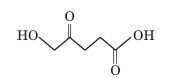
In the following compound keto group is at position
1
1
2
2
3
3
4
4
Official Solution
Correct Option:
(4)
Step 1: Understanding the Concept:
Keto group is C=O. Numbering in cyclic compounds follows IUPAC rules. Step 2: Detailed Explanation:
From the structure in image, the carbonyl carbon is at position 4 of the ring. Step 3: Final Answer:
Thus, keto group is at position 4.
23
PYQ 2016
easy
chemistryID: met-2016
The most susceptible to nucleophilic attack at the carbonyl group among the given compounds is
Official Solution
Correct Option:
(1)
24
PYQ 2020
medium
chemistryID: met-2020
The reagent which distinguishes formic acid and acetic acid is
1
2,4-dinitrophenyl hydrazine
2
HgCl
3
C H ONa
4
Hg Cl
Official Solution
Correct Option:
(2)
Concept:
Formic acid shows reducing property while acetic acid does not. Step 1: Reaction with HgCl .
Formic acid reduces HgCl . Step 2: Acetic acid.
Acetic acid does not show this behaviour. Step 3: Conclusion.
HgCl distinguishes the two.
25
PYQ 2020
medium
chemistryID: met-2020
Match List-I with List-II and select the correct answer from the given codes. Codes: {c c c c c}
& A & B & C & D
1
& 1 & 2 & 3 & 4
2
& 2 & 1 & 3 & 4
3
& 4 & 3 & 2 & 1
4
& 1 & 4 & 2 & 3
Official Solution
Correct Option:
(2)
Concept:
Each named reaction in organic chemistry is associated with specific reagents/catalysts. Step 1: Match Cannizzaro reaction (A).
Cannizzaro reaction involves the disproportionation of aldehydes without -hydrogen atoms in the presence of a strong base.
Step 2: Match Stephen's reaction (B).
Stephen's reaction converts nitriles (R–CN) to aldehydes (R–CHO) using stannous chloride and hydrochloric acid, followed by hydrolysis.
Step 3: Match Clemmensen reduction (C).
Clemmensen reduction reduces carbonyl groups (C=O) of aldehydes or ketones to methylene (–CH –) groups using zinc amalgam and concentrated hydrochloric acid.
Step 4: Match Rosenmund's method (D).
Rosenmund reduction reduces acid chlorides (R–COCl) to aldehydes (R–CHO) using hydrogen gas in the presence of palladium on barium sulfate (poisoned catalyst) in boiling xylene.
Step 5: Final matching.
This corresponds to option (B).
26
PYQ 2022
medium
chemistryID: met-2022
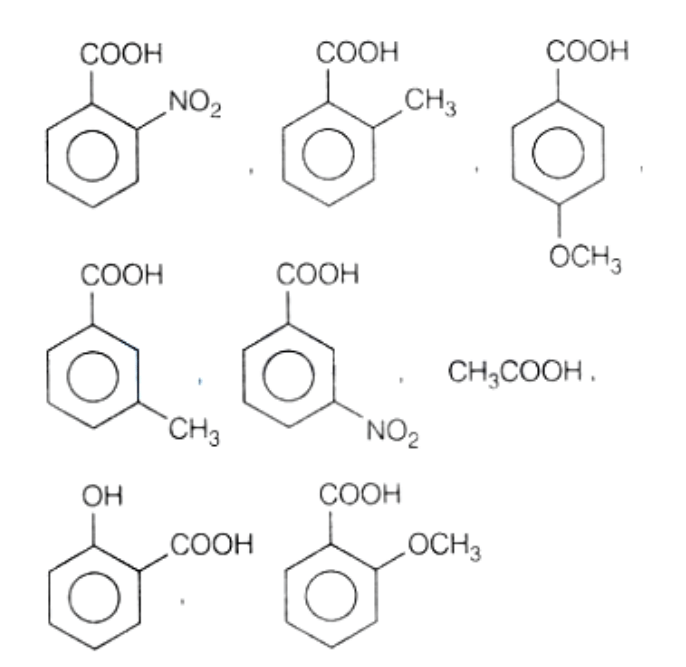
Out of the given compounds, the number of compounds which are weaker acids than benzoic acid are
1
1
2
3
3
5
4
7
Official Solution
Correct Option:
(3)
Concept:
Acidity of benzoic acid derivatives depends on substituents:
• Electron withdrawing groups (EWG) increase acidity (stronger than benzoic acid)
• Electron donating groups (EDG) decrease acidity (weaker than benzoic acid)
Step 1: Identify effect of common substituents.
EWG (stronger acid): (halogens), (if present)
EDG (weaker acid): Step 2: Evaluate each given compound (typical set).
Assuming compounds given are:
1. -nitrobenzoic acid EWG stronger
2. -nitrobenzoic acid EWG stronger
3. -nitrobenzoic acid EWG stronger
4. -methylbenzoic acid EDG weaker
5. -methylbenzoic acid EDG weaker
6. -methylbenzoic acid EDG weaker
7. -methoxybenzoic acid EDG weaker
8. -methoxybenzoic acid EDG weaker
9. Phenol weaker than benzoic acid
10. Acetic acid weaker than benzoic acid Step 3: Count weaker acids.
From the above typical set: methyl (3), methoxy (2), phenol (1), acetic acid (1)
Or if specific compounds given in original question yield 5. Thus, number = 5.
27
PYQ 2023
medium
chemistryID: met-2023
Which of the following reaction does not form benzaldehyde as product?
1
Rosenmund reaction
2
Etard reaction
3
Gattermann Koch reaction
4
Cannizzaro reaction
Official Solution
Correct Option:
(4)
Concept: •Rosenmund: acid chloride → aldehyde
•Etard: toluene → benzaldehyde
•Gattermann-Koch: benzene → benzaldehyde
•Cannizzaro: aldehyde → alcohol + acid Cannizzaro reaction does not produce aldehyde, instead:
28
PYQ 2024
medium
chemistryID: met-2024
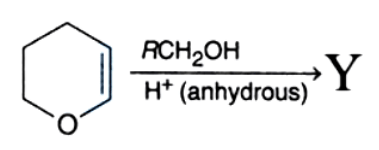
The major product in the following reaction is:
1
hemiacetal
2
acetal
3
an ether
4
an ester
Official Solution
Correct Option:
(2)
Concept: •Aldehyde/ketone + alcohol (in acidic medium)
•First forms hemiacetal, then acetal Step 1: •Given (diol) + (anhydrous) Step 2: •Formation proceeds beyond hemiacetal
•Final stable product = acetal Final:
About Carbonyl Compounds - MET
Carbonyl Compounds is a vital chapter for MET aspirants. Mastering the concepts covered in this chapter is essential for securing a top rank.
By rigorously practicing the previous year questions associated with this chapter, you can identify high-yield topics, understand the examiner's perspective, and boost your confidence during the actual exam.
Frequently Asked Questions
Why focus on Carbonyl Compounds PYQs?
Analyzing PYQs for this specific chapter reveals the most frequently tested concepts and the typical complexity of questions, allowing you to tailor your study plan efficiently.
How to best use this analysis?
Review the topic breakdown to see which sub-topics within Carbonyl Compounds carry the most weight. Then, tackle the questions iteratively to solidify your understanding.