An important product in the ozone depletion by chlorofluorocarbons is
1
Cl
2
OCl
3
OF
4
O F
Official Solution
Correct Option:
(2)
Step 1: Understanding the Concept:
CFCs release chlorine atoms that catalyse ozone depletion.
Step 2: Detailed Explanation:
CFCs (e.g., CCl F ) in the stratosphere undergo photodissociation to release Cl atoms. Cl reacts with O to form ClO and O . ClO is an important intermediate. So OCl (ClO) is produced.
Step 3: Final Answer:
OCl
02
PYQ 2016
medium
chemistryID: met-2016
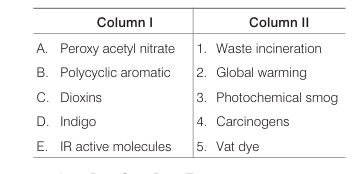
Match the Column I and Column II and pick the correct matching from the codes given below.
1
A-3, B-4, C-1, D-5, E-2
2
A-1, B-2, C-3, D-4, E-5
3
A-3, B-5, C-1, D-2, E-4
4
A-5, B-3, C-1, D-2, E-4
Official Solution
Correct Option:
(1)
Step 1: Understanding the Concept:
This question tests knowledge of environmental chemistry and industrial applications of compounds. Step 2: Detailed Explanation: A. Peroxy acetyl nitrate (PAN): A major component of photochemical smog. B. Polycyclic aromatic hydrocarbons (PAHs): Known to be carcinogens. C. Dioxins: Produced during waste incineration. D. Indigo: A natural dye used in the process of vat dyeing. E. IR active molecules: Absorb infrared radiation, contributing to global warming. Step 3: Final Answer:
The correct matches are A-3, B-4, C-1, D-5, E-2, which corresponds to option (A).
About Environmental Chemistry - MET
Environmental Chemistry is a vital chapter for MET aspirants. Mastering the concepts covered in this chapter is essential for securing a top rank.
By rigorously practicing the previous year questions associated with this chapter, you can identify high-yield topics, understand the examiner's perspective, and boost your confidence during the actual exam.
Frequently Asked Questions
Why focus on Environmental Chemistry PYQs?
Analyzing PYQs for this specific chapter reveals the most frequently tested concepts and the typical complexity of questions, allowing you to tailor your study plan efficiently.
How to best use this analysis?
Review the topic breakdown to see which sub-topics within Environmental Chemistry carry the most weight. Then, tackle the questions iteratively to solidify your understanding.