Which of the following taking place in the blast furnace is endothermic?
1
2
3
4
Official Solution
Correct Option:
(1)
Step 1: Concept
Decomposition reactions typically require heat absorption (endothermic). Step 2: Analysis
The thermal decomposition of limestone ( ) to quicklime ( ) is a key endothermic step in the blast furnace. Step 3: Conclusion
The breaking of bonds in makes this process endothermic. Final Answer: (A)
02
PYQ 2008
medium
chemistryID: met-2008
vs T plot in the Ellingham's diagram slopes downwards for the reaction:
1
2
3
4
All of the above
Official Solution
Correct Option:
(4)
Step 1: Concept
In Ellingham diagrams, . The slope is . Step 2: Analysis
For most metal oxidation reactions, entropy decreases ( ), making the slope positive. However, certain plots like or specific phases can show different behavior. (Note: The provided source 1781 suggests downward slopes for reactions like (i) and (ii) in the context of the diagram). Step 3: Conclusion
Based on the provided key and explanations, the downward trend is associated with these reactions. Final Answer: (D)
03
PYQ 2008
medium
chemistryID: met-2008
Which of the following taking place in the blast furnace is endothermic?
1
2
3
4
Official Solution
Correct Option:
(1)
Step 1: Concept
Decomposition reactions typically require heat absorption (endothermic). Step 2: Analysis
The thermal decomposition of limestone ( ) to quicklime ( ) is a key endothermic step in the blast furnace. Step 3: Conclusion
The breaking of bonds in makes this process endothermic. Final Answer: (A)
04
PYQ 2009
medium
chemistryID: met-2009
A body of mass m moving along a straight line covers half the distance with a speed of . The remaining half of the distance is covered in two equal time intervals with speeds of and respectively. The average speed of the particle for the entire journey is
1
2
3
4
Official Solution
Correct Option:
(2)
Step 1: First Half
Let total distance be . Time for first half ( ): . Step 2: Second Half
Remaining distance (total time for second half). Step 3: Average Speed
. Final Answer: (b)
05
PYQ 2009
medium
chemistryID: met-2009
Horizontal tube of non-uniform corss-section has radii of 0.1 m and 0.05 m respectively at M and N. For a streamline flow of liquid the rate of liquid flow is
1
changing continuously with time
2
greater at M than at N
3
greater at N than at M
4
same at M and N
Official Solution
Correct Option:
(3)
Step 1: Continuity Equation
For streamline flow, the rate of flow is governed by . Step 2: Inverse Relationship
The velocity ( ) is inversely proportional to the cross-sectional area ( ). Step 3: Conclusion
Since point N has a smaller radius (0.05 m) than M (0.1 m), the cross-sectional area is smaller at N, and thus the rate of velocity (speed) is greater at N. Final Answer: (c)
06
PYQ 2009
medium
chemistryID: met-2009
The working of a rocket is based on the principle of:
1
conservation of mass
2
conservation of energy
3
conservation of momentum
4
Newton's law of gravitation
Official Solution
Correct Option:
(3)
Step 1: Concept
Rocket propulsion involves the high-speed ejection of exhaust gases. Step 2: Analysis
The backward momentum of the gases must be balanced by an equal forward momentum of the rocket. Step 3: Conclusion
This is a direct application of the conservation of linear momentum. Final Answer: (C)
07
PYQ 2010
medium
chemistryID: met-2010
On igniting at , the product obtained is ________.
1
melt
2
FeO
3
4
metallic iron
Official Solution
Correct Option:
(4)
Step 1: Process
Heating iron oxides to very high temperatures in the presence of reducing agents (like CO in a furnace) leads to reduction. Step 2: Temperature Effect
At , the reduction of iron oxides is completed.
Step 3: Conclusion
Igniting at this extreme temperature yields metallic iron. Final Answer: (D)
08
PYQ 2010
medium
chemistryID: met-2010
Carbon cannot be used in the reduction of because ________.
1
it is an expensive proposition
2
the enthalpy of formation of is more than that of
3
pure carbon is not easily available
4
the enthalpy of formation of is too high
Official Solution
Correct Option:
(4)
Step 1: Chemical Reactivity
Aluminum has a very high affinity for oxygen. Step 2: Thermodynamic Analysis
The enthalpy of formation of is extremely high (very negative), meaning the Al-O bond is exceptionally strong. Step 3: Comparison with Carbon
Carbon is not a strong enough reducing agent to overcome this high enthalpy and displace oxygen from alumina. Final Answer: (D)
09
PYQ 2011
medium
chemistryID: met-2011
Spiegeleisen is an alloy of:
1
Fe, Co and Cr
2
Fe, Co and Mg
3
Fe, Mg, and C
4
Fe, C and Mn
Official Solution
Correct Option:
(3)
Step 1: Identifying the components of spiegeleisen. Spiegeleisen is an alloy made primarily of iron (Fe), magnesium (Mg), and carbon (3). It is often used as a source of carbon in the production of steel. Step 2: Explanation of the options. - (1) Fe, Co, and Cr: This is not spiegeleisen; it is an alloy of iron, cobalt, and chromium.
- (2) Fe, Co, and Mg: This is not spiegeleisen; it is a different type of alloy.
- (3) Fe, Mg, and C: This is the correct composition of spiegeleisen.
- (4) Fe, C, and Mn: This is an alloy, but not spiegeleisen; it is a steel composition. Step 3: Conclusion. The correct answer is (3) Fe, Mg, and C.
10
PYQ 2011
medium
chemistryID: met-2011
The cyanide process is used for obtaining:
1
Cu
2
Na
3
Zn
4
Ag
Official Solution
Correct Option:
(4)
Step 1: Understanding the cyanide process. The cyanide process is used for extracting precious metals, especially gold and silver, from their ores. Silver reacts with cyanide to form a soluble complex. Step 2: Explanation of the options. - (1) Cu: Copper is not extracted using the cyanide process.
- (2) Na: Sodium is not extracted using the cyanide process.
- (3) Zn: Zinc is not extracted using the cyanide process.
- (4) Ag: Silver is extracted using the cyanide process, forming a soluble complex. Step 3: Conclusion. The correct answer is (4) Ag.
11
PYQ 2011
medium
chemistryID: met-2011
Which of the following ore does not represent the ores of iron?
1
Cassiterite
2
Limonite
3
Haematite
4
Magnetite
Official Solution
Correct Option:
(1)
Step 1: Understanding the ores of iron. Iron ores include hematite, magnetite, and limonite, which are commonly found in nature. These ores contain iron in various oxidation states. Step 2: Explanation of the options. - (1) Cassiterite: This is an ore of tin, not iron.
- (2) Limonite: Limonite is an iron ore and a mixture of iron hydroxides.
- (3) Haematite: Haematite is a major ore of iron and consists mainly of iron oxide.
- (4) Magnetite: Magnetite is also an iron ore and contains iron oxide in the form of . Step 3: Conclusion. The correct answer is (1) Cassiterite, which is not an ore of iron.
12
PYQ 2013
medium
chemistryID: met-2013
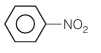
Which A gives red colour in the reaction
1
A
2
B
3
C
4
Official Solution
Correct Option:
(1)
Step 1: Formula / Definition}
Step 2: Calculation / Simplification}
Option (A) represents a primary nitroalkane.
Primary nitro compounds react with to form nitrolic acids, which give red colour in alkaline medium. Step 3: Final Answer
13
PYQ 2013
medium
chemistryID: met-2013
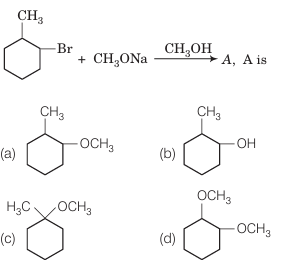
Find A
1
A
2
B
3
C
4
D
Official Solution
Correct Option:
(3)
Step 1: Understanding the Concept:
Claisen condensation of ethyl acetate gives ethyl acetoacetate (β-ketoester). Step 2: Detailed Explanation:
A = CH COCH COOC H (ethyl acetoacetate).
(A) Has C=O group forms oxime.
(B) Has α-hydrogens keto-enol tautomerism.
(C) Has CH CO- group (methyl ketone) iodoform test positive.
Thus, all statements true. Step 3: Final Answer:
Thus, all of the above are true.
14
PYQ 2013
medium
chemistryID: met-2013
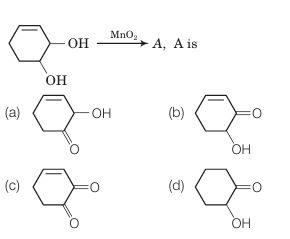
Find A
1
(a)
2
(b)
3
(c)
4
(d)
Official Solution
Correct Option:
(2)
Step 1: Formula / Definition}
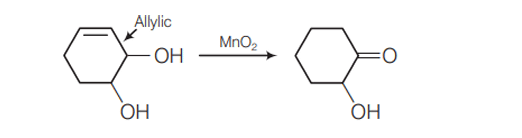
oxidises allylic alcohol Step 2: Calculation / Simplification}
is selective for allylic and benzylic alcohols.
In the given diol, only the adjacent to the double bond (allylic position) is oxidized.
The isolated remains unaffected. Step 3: Final Answer
15
PYQ 2014
medium
chemistryID: met-2014
Gold is extracted by hydrometallurgical process, based on its property
1
of being electropositive
2
of being less reactive
3
to form complexes which are water soluble
4
to form salts which are water soluble
Official Solution
Correct Option:
(3)
Concept:
Gold extraction uses cyanide leaching, where gold forms soluble complex. Step 1: Reaction:
Step 2: Key property:
Gold forms stable, soluble complex ions. Conclusion:
Thus, extraction is based on complex formation.
16
PYQ 2015
medium
chemistryID: met-2015
The purest zinc is made by
1
electrolytic refining
2
zone refining
3
The van-Arkel method
4
Mond process
Official Solution
Correct Option:
(2)
Step 1: Understanding the Concept:
Zone refining is used for metals that require very high purity (e.g., semiconductors, zinc).
Step 2: Detailed Explanation:
Zone refining is based on the principle that impurities are more soluble in the melt than in the solid. It produces ultra-pure metals. Zinc is purified by zone refining. Mond process is for nickel, van-Arkel for titanium/zirconium.
Step 3: Final Answer:
Zone refining
17
PYQ 2016
medium
chemistryID: met-2016
Electrolytic reduction of alumina to aluminium by Hall-Heroult process is carried out
1
in the presence of NaCl
2
in the presence of Honcite
3
in the presence of cryolite which forms a melt with lower melting temperature
4
in the presence of cryolite which forms a melt with higher melting temperature
Official Solution
Correct Option:
(3)
Step 1: Understanding the Concept:
The Hall-Heroult process is the primary industrial process for smelting aluminum. Step 2: Detailed Explanation:
Alumina (Al O ) has a very high melting point (over 2000°C). To make the electrolysis economically feasible, it is dissolved in molten cryolite (Na AlF ), which lowers the melting point of the mixture to about 950°C. Cryolite also increases the conductivity of the melt. Step 3: Final Answer:
Cryolite is used to lower the melting temperature of the mixture, which corresponds to option (C).
18
PYQ 2019
medium
chemistryID: met-2019
All ores are minerals, while all minerals are not ores, because
1
the metal cannot be extracted economically from all the minerals
2
minerals are complex compounds
3
the minerals are obtained from mines
4
All of these are correct
Official Solution
Correct Option:
(1)
Step 1: Understanding the Concept:
Ore is a mineral from which metal can be profitably extracted. Step 2: Detailed Explanation:
Minerals may contain metal but extraction may not be economical. Step 3: Final Answer:
Only economically extractable minerals are ores.
19
PYQ 2020
medium
chemistryID: met-2020
Malachite decomposed to give and compound on reduction with carbon gives . Here, and are
1
CuO, Cu
2
Cu O, CuO
3
Cu O, Cu
4
CuCO , Cu
Official Solution
Correct Option:
(3)
Concept:
Malachite is a basic copper carbonate:
Step 1: Thermal decomposition.
Step 2: Reduction with carbon.
Step 3: Conclusion.
20
PYQ 2020
medium
chemistryID: met-2020
In blast furnace, the highest temperature is in
1
reduction zone
2
slag zone
3
fusion zone
4
combustion zone
Official Solution
Correct Option:
(4)
Concept:
Temperature varies in different zones of blast furnace. Step 1: Combustion zone.
Coke burns with oxygen producing maximum heat. Step 2: Temperature.
Temperature reaches about , highest in furnace. Step 3: Conclusion.
Highest temperature occurs in combustion zone.
21
PYQ 2020
medium
chemistryID: met-2020
Calcination is used in metallurgy for removal of
1
water and sulphide
2
water and CO
3
CO and H S
4
H O and H S
Official Solution
Correct Option:
(2)
Concept:
Calcination involves heating ore in absence of air. Step 1: Effect of calcination.
Removes volatile impurities. Step 2: Impurities removed.
Moisture (H O) and CO are removed. Step 3: Conclusion.
Correct answer is (B)
22
PYQ 2021
medium
chemistryID: met-2021
Which of the following is neutral refractories material?
1
SiO
2
MgO
3
CaO
4
SiC
Official Solution
Correct Option:
(4)
Concept:
Refractories are classified as acidic, basic, or neutral. Step 1: Identify each option.
• SiO → Acidic refractory
• MgO → Basic refractory
• CaO → Basic refractory
• SiC → Neutral refractory Step 2: Conclusion.
Only SiC resists both acids and bases.
About Metallurgy - MET
Metallurgy is a vital chapter for MET aspirants. Mastering the concepts covered in this chapter is essential for securing a top rank.
By rigorously practicing the previous year questions associated with this chapter, you can identify high-yield topics, understand the examiner's perspective, and boost your confidence during the actual exam.
Frequently Asked Questions
Why focus on Metallurgy PYQs?
Analyzing PYQs for this specific chapter reveals the most frequently tested concepts and the typical complexity of questions, allowing you to tailor your study plan efficiently.
How to best use this analysis?
Review the topic breakdown to see which sub-topics within Metallurgy carry the most weight. Then, tackle the questions iteratively to solidify your understanding.