Step 1: Concept
Amino acids exist as Zwitterions at their isoelectric point, but change form in acidic or basic media. Step 2: Analysis
At (acidic medium), the carboxylate group ( ) of the Zwitterion accepts a proton. Step 3: Conclusion
The structure becomes a cation: . Final Answer: (B)
02
PYQ 2008
medium
chemistryID: met-2008
Phenolphthalein is obtained by heating phthalic anhydride with conc. and:
1
benzyl alcohol
2
benzene
3
phenol
4
benzoic acid
Official Solution
Correct Option: (3)
Step 1: Concept
Phenolphthalein is a phthalein dye synthesized via a condensation reaction. Step 2: Analysis
Heating phthalic anhydride with phenol in the presence of concentrated (as a dehydrating agent) yields phenolphthalein. Step 3: Conclusion
The required reagent is phenol. Final Answer: (C)
03
PYQ 2008
medium
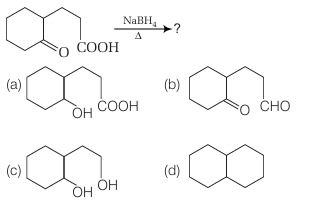
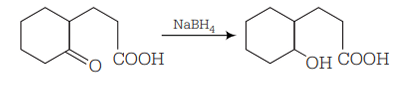
chemistryID: met-2008
is an example of:
1
elimination reaction
2
free radical substitution
3
nucleophilic substitution
4
electrophilic substitution
Official Solution
Correct Option: (3)
Step 1: Concept
Identify the attacking species and the leaving group. Step 2: Analysis
The Bromine atom (leaving group) is replaced by the hydroxyl group ( ), which acts as a nucleophile. Step 3: Conclusion
This is a unimolecular nucleophilic substitution ( ) reaction. Final Answer: (C)
04
PYQ 2008
medium
chemistryID: met-2008
is an example of:
1
elimination reaction
2
free radical substitution
3
nucleophilic substitution
4
electrophilic substitution
Official Solution
Correct Option: (3)
Step 1: Concept
Identify the attacking species and the leaving group. Step 2: Analysis
The Bromine atom (leaving group) is replaced by the hydroxyl group ( ), which acts as a nucleophile. Step 3: Conclusion
This is a unimolecular nucleophilic substitution ( ) reaction. Final Answer: (C)
05
PYQ 2008
medium
chemistryID: met-2008
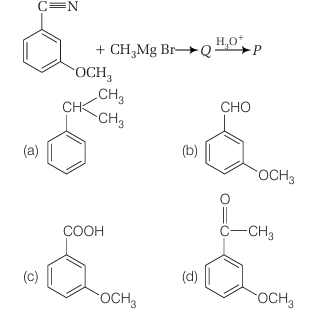
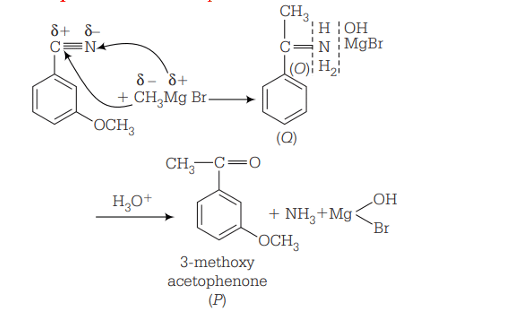
2, 2-dichloro propane on hydrolysis yields:
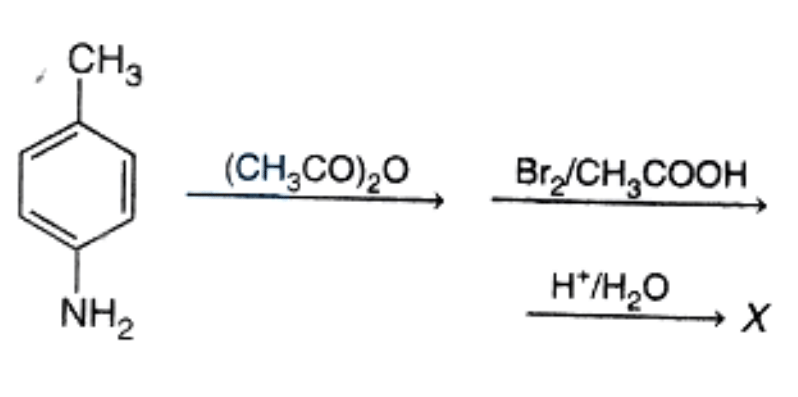
1
acetone
2
2, 2-propane diol
3
iso-propyl alcohol
4
acetaldehyde
Official Solution
Correct Option: (1)
Step 1: Concept
Hydrolysis of gem-dihalides initially produces an unstable gem-diol. Step 2: Analysis
Hydrolysis replaces two Cl atoms with two OH groups. The resulting 2,2-propane diol is unstable and loses a water molecule. Step 3: Conclusion
The dehydration of the gem-diol results in the formation of acetone. Final Answer: (A)
06
PYQ 2008
medium
chemistryID: met-2008
The formation of cyanohydrin from acetone is which type of reaction?
1
Electrophilic substitution reaction
2
Electrophilic addition reaction
3
Nucleophilic addition reaction
4
Nucleophilic substitution reaction
Official Solution
Correct Option: (3)
Step 1: Concept
Carbonyl groups ( ) in ketones typically undergo addition reactions initiated by nucleophiles. Step 2: Analysis
The ion attacks the partially positive carbonyl carbon, followed by protonation of the oxygen. Step 3: Conclusion
Since the nucleophile ( ) attacks first, it is a nucleophilic addition reaction. Final Answer: (C)
07
PYQ 2008
medium
chemistryID: met-2008
Name the end product in the following series of reactions:
1
2
3
4
Official Solution
Correct Option: (4)
Step 1: Concept
Carboxylic acids react with ammonia to form salts, which dehydrate to amides and then to nitriles. Step 2: Analysis
* (A: Ammonium acetate).
* (B: Acetamide).
* (C: Acetonitrile). Step 3: Conclusion
The end product C is methyl cyanide (acetonitrile). Final Answer: (D)
08
PYQ 2009
medium
chemistryID: met-2009
M NaOH is diluted 100 times. The pH of the diluted base is
1
between 7 and 8
2
between 5 and 6
3
between 6 and 7
4
between 10 and 11
Official Solution
Correct Option: (1)
Step 1: Find Concentration
Initial . Diluted 100 times, . Step 2: Account for Water dissociation
Total . Step 3: Find pOH and pH
. . This value is between 7 and 8. Final Answer: (a)
09
PYQ 2009
medium
chemistryID: met-2009
The amount of heat energy radiated by a metal at temperature T is E. When the temperature is increased to 3T, energy radiated is
1
81E
2
9E
3
3E
4
27E
Official Solution
Correct Option: (1)
Step 1: Stefan's Law
Energy radiated ( ) is proportional to the fourth power of absolute temperature ( ): . Step 2: Substitution
New energy . Step 3: Calculation
. Final Answer: (a)
10
PYQ 2009
medium
chemistryID: met-2009
The angle of minimum deviation for an incident light ray on an equilateral prism is equal to its refracting angle. The refractive index of its material is
1
2
3
4
Official Solution
Correct Option: (2)
Step 1: Given Data
For an equilateral prism, the angle of prism . The problem states the angle of minimum deviation . Step 2: Formula
The refractive index is given by . Step 3: Calculation
. Final Answer: (b)
11
PYQ 2009
medium
chemistryID: met-2009
The electric potential at a point on the axial line of an electric dipole is:
1
maximum
2
minimum
3
zero
4
none of these
Official Solution
Correct Option: (1)
Step 1: Concept
Potential . Step 2: Analysis
On the axial line, or , so . Step 3: Conclusion
This yields the maximum magnitude of potential for a given distance. Final Answer: (A)
12
PYQ 2009
medium
chemistryID: met-2009
The magnetic dipole moment of a current loop is independent of
1
magnetic field in which it is lying
2
number of turns
3
area of the loop
4
current in the loop
Official Solution
Correct Option: (1)
Step 1: Formula
Magnetic dipole moment . Step 2: Variables
From the formula, depends on the number of turns ( ), current ( ), and area ( ). Step 3: Conclusion
The external magnetic field does not appear in the definition of the dipole moment itself; it only determines the torque acting on that moment. Final Answer: (a)
13
PYQ 2009
medium
chemistryID: met-2009
A coil of n number of turns is wound tightly in the form of a spiral with inner and outer radii a and b respectively. When a current of strength I is passed through the coil, the magnetic field at its centre is
1
2
3
4
Official Solution
Correct Option: (4)
Step 1: Setup
Consider a small element at distance . Turns per unit length . Step 2: Field Element
Field due to element : . Step 3: Integration
. Final Answer: (d)
14
PYQ 2009
medium
chemistryID: met-2009
represents an equation of a progressive wave, where t is in second and x is in metre. The distance travelled by the wave in 5 s is
1
8 m
2
10 m
3
5 m
4
32 m
Official Solution
Correct Option: (2)
Step 1: Compare Equations
Standard wave equation: . The given equation is . Step 2: Find Velocity
From comparison, and . Wave velocity . Step 3: Distance
Distance . Final Answer: (b)
15
PYQ 2010
medium
chemistryID: met-2010
The product of reaction between alcoholic silver nitrite with ethyl bromide is ________.
1
ethene
2
ethane
3
ethyl nitrile
4
nitro ethane
Official Solution
Correct Option: (4)
Step 1: Reaction
Ethyl bromide ( ) reacts with alcoholic silver nitrite ( ). Step 2: Analysis
is a covalent compound. The nucleophilic attack occurs through the Nitrogen atom rather than the Oxygen atom. Step 3: Equation
Step 4: Conclusion
The major product formed is nitro ethane. Final Answer: (D)
16
PYQ 2010
medium
chemistryID: met-2010
Iso-propyl chloride undergoes hydrolysis by ________.
1
mechanism
2
mechanisms
3
and mechanisms
4
Neither nor mechanism
Official Solution
Correct Option: (3)
Step 1: Concept
Iso-propyl chloride is a secondary ( ) alkyl halide. Step 2: Analysis
Secondary halides are at the border of nucleophilic substitution mechanisms. Step 3: Conclusion
They can undergo hydrolysis via either or pathways, depending on factors like the nature of the solvent and the strength of the nucleophile. Final Answer: (C)
17
PYQ 2010
medium
chemistryID: met-2010
Which one of the following undergoes reaction with 50% sodium hydroxide solution to give the corresponding alcohol and acid?
1
Phenol
2
Benzaldehyde
3
Butanal
4
Benzoic acid
Official Solution
Correct Option: (2)
Step 1: Concept
Aldehydes that do not contain an -hydrogen atom undergo the Cannizzaro reaction when treated with concentrated alkali (50% NaOH). Step 2: Analysis
Benzaldehyde ( ) lacks an -hydrogen atom. Step 3: Reaction
In this disproportionation reaction, one molecule of benzaldehyde is reduced to benzyl alcohol and another is oxidized to sodium benzoate. $ $ Step 4: Conclusion
Thus, benzaldehyde provides the corresponding alcohol and acid salt. Final Answer: (B)
18
PYQ 2010
medium
chemistryID: met-2010
Reduction of nitrobenzene in the presence of gives ________.
1
azobenzene
2
hydrazobenzene
3
N-phenyl hydroxyl amine
4
aniline
Official Solution
Correct Option: (3)
Step 1: Reaction
The reduction of nitrobenzene by and is a neutral reduction. Step 2: Calculation
. Step 3: Conclusion
The product formed is N-phenyl hydroxylamine. Final Answer: (C)
19
PYQ 2011
medium
chemistryID: met-2011
Which of the following has the highest nucleophilicity?
1
2
3
4
Official Solution
Correct Option: (3)
Step 1: Understanding nucleophilicity. Nucleophilicity refers to the ability of a species to donate a pair of electrons to form a bond with an electrophile. It depends on the species' electron density and size. More negatively charged and less electronegative species are generally better nucleophiles. Step 2: Analyze the options. - : Fluoride ion is highly electronegative and its electron density is tightly held, making it a weaker nucleophile.
- : Hydroxide ion is a good nucleophile, but not the strongest among the given options.
- : The methyl anion ( ) is a very strong nucleophile because the negative charge is localized on a small, less electronegative carbon atom.
- : The amide anion ( ) is a good nucleophile, but not as good as the methyl anion. Step 3: Conclusion. The correct answer is (3), , as it is the most nucleophilic species among the options.
20
PYQ 2011
medium
chemistryID: met-2011
The action of chloral on chlorobenzene gives:
1
BHC
2
DDT
3
Gammexene
4
Lindane
Official Solution
Correct Option: (2)
Step 1: Understanding the chloral-chlorobenzene reaction. Chloral (trichloroacetaldehyde) reacts with chlorobenzene to produce DDT (dichlorodiphenyltrichloroethane), which is an insecticide. Step 2: Explanation of the options. - (1) BHC: BHC (benzene hexachloride) is another insecticide, but it is not the product of chloral and chlorobenzene.
- (2) DDT: DDT is the correct product. The reaction between chloral and chlorobenzene results in DDT.
- (3) Gammexene: This is another name for BHC, so it is not the correct answer.
- (4) Lindane: Lindane is a specific isomer of BHC, but not the result of this reaction. Step 3: Conclusion. The correct answer is (2) DDT.
21
PYQ 2011
medium
chemistryID: met-2011
By Wurtz reaction, a mixture of methyl iodide and ethyl iodide gives:
1
Butane
2
Ethane
3
Propane
4
A mixture of above three
Official Solution
Correct Option: (4)
Step 1: Understanding the Wurtz reaction. The Wurtz reaction involves the coupling of alkyl halides in the presence of sodium metal to form alkanes. When two different alkyl iodides react, multiple products can be formed. Step 2: Explanation of the options. - (1) Butane: Butane is formed when two ethyl radicals combine.
- (2) Ethane: Ethane is formed when two methyl radicals combine.
- (3) Propane: Propane is formed when one methyl and one ethyl radical combine.
- (4) A mixture of above three: Since different combinations of methyl and ethyl groups are possible, the reaction gives a mixture of butane, ethane, and propane. Step 3: Conclusion. The correct answer is (4) A mixture of above three.
22
PYQ 2013
medium
chemistryID: met-2013
ClO is an/a
1
anhydride of HClO
2
anhydride of HClO
3
mixed anhydride of HClO and HClO
4
mixed anhydride of HClO and HClO
Official Solution
Correct Option: (3)
Step 1: Understanding the Concept:
Anhydride = compound that reacts with water to form an acid. Mixed anhydride gives two different acids. Step 2: Detailed Explanation:
ClO + H O HClO + HClO (disproportionation).
2ClO + H O HClO + HClO .
Thus, ClO is mixed anhydride of chlorous (HClO ) and chloric (HClO ) acids. Step 3: Final Answer:
Thus, ClO is mixed anhydride of HClO and HClO .
23
PYQ 2013
medium
chemistryID: met-2013
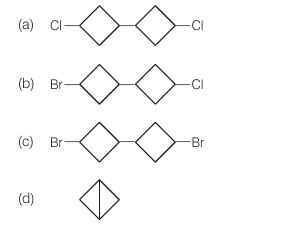
The reaction of 1-bromo-3-chlorocyclobutane with metallic sodium in dioxane gives
1
A
2
B
3
C
4
D
Official Solution
Correct Option: (1)
Step 1: Understanding the Concept:}
Wurtz reaction with dihalide gives cyclic product via intramolecular coupling. Step 2: Detailed Explanation:
1-bromo-3-chlorocyclobutane has halogens on carbons 1 and 3. Reaction with Na (Wurtz-type) causes elimination of NaBr and NaCl, forming a bond between C1 and C3, giving bicyclo[1.1.0]butane. Step 3: Final Answer:
Thus, product is bicyclobutane.
24
PYQ 2013
medium
chemistryID: met-2013
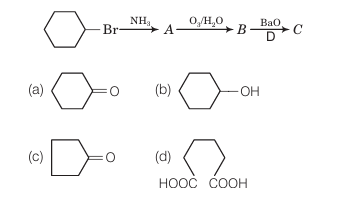
End product of following sequence of reaction is
1
A
2
B
3
C
4
D
Official Solution
Correct Option: (3)
Step 1: Understanding the Concept:
Sequence involves substitution, followed by oxidative cleavage and further reaction leading to ring contraction. Step 2: Detailed Explanation:
Cyclohexyl bromide reacts with NH to form amine (A).
On treatment with O /H O, oxidative cleavage occurs forming a diketone or dialdehyde (B).
Further reaction with BaO leads to rearrangement and ring contraction forming a smaller ring ketone. Step 3: Final Answer:
Thus, the final product corresponds to option (C).
25
PYQ 2015
medium
chemistryID: met-2015
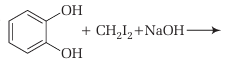
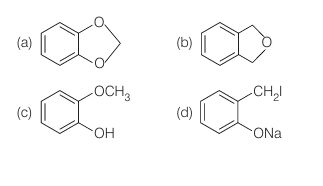
The product of the reaction is:
1
a
2
b
3
c
4
d
Official Solution
Correct Option: (1)
Step 1: Understanding the Concept:
This reaction involves phenol treated with and , leading to formation of a methylene-bridged cyclic ether.
Step 2: Detailed Explanation:
In basic medium, phenol forms phenoxide ion. The acts as a methylene donor.
Since two groups are present in ortho-position, intramolecular cyclization occurs forming a five-membered ring with linkage.
This results in a benzodioxole structure (cyclic acetal type).
Step 3: Final Answer:
Option (a)
26
PYQ 2015
medium
chemistryID: met-2015
The reaction sequence given in the figure produces product .
1
(a)
2
(b)
3
(c)
4
(d)
Official Solution
Correct Option: (1)
Step 1: Understanding the Concept:
Based on the reaction sequence shown.
Step 2: Detailed Explanation:
Step 3: Final Answer:
As per the figure. reduced to 1st order alcohol
27
PYQ 2015
medium
chemistryID: met-2015
The product P in the reaction is
1
(a)
2
(b)
3
(c)
4
(d)
Official Solution
Correct Option: (4)
Step 1: Understanding the Concept:
Based on the reaction shown.
Step 2: Detailed Explanation:
Step 3: Final Answer:
As per the figure.
28
PYQ 2015
medium
chemistryID: met-2015
C H A B C
Here the compound C is
1
3-bromo-2,4,5,6-trichloro toluene
2
o-bromo toluene
3
p-bromo toluene
4
m-bromo toluene
Official Solution
Correct Option: (4)
Step 1: Understanding the Concept:
C H is toluene. Side-chain chlorination, then ring bromination, then reduction of Cl to H.
Step 2: Detailed Explanation: 1. Toluene + 3Cl , heat → side-chain chlorination: C H CCl (benzotrichloride, A). 2. A + Fe/Br → ring bromination (meta-directing due to -CCl group): 3-bromo-benzotrichloride (B). 3. B + Zn/HCl → reduction of -CCl to -CH : m-bromo toluene (C).
Step 3: Final Answer:
m-bromo toluene
29
PYQ 2015
medium
chemistryID: met-2015
Given the following sequence of reactions:
The major product is:
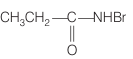
1
2
3
4
Official Solution
Correct Option: (1)
Step 1: Concept:
Identify each reaction type:
→ Nucleophilic substitution (chain extension)
Partial hydrolysis of nitrile → Amide
→ Hofmann bromamide reaction (gives amine with one less carbon)
Step 2: Detailed Explanation: First Reaction:
Product is Propanenitrile.
Second Reaction (Partial Hydrolysis):
Product is Propanamide.
Third Reaction (Hofmann Bromamide Reaction):
In Hofmann bromamide reaction:
- Amide loses one carbon
- Forms a primary amine So, product is Ethylamine.
Step 3: Final Answer:
30
PYQ 2016
easy
chemistryID: met-2016
For the following,
(i) I
(ii) Cl
(iii) Br
the increasing order of nucleophilicity would be
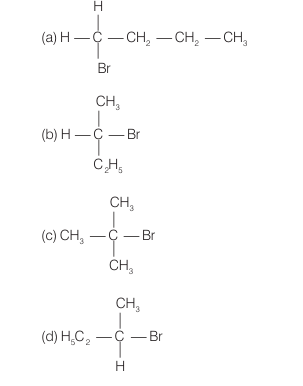
Official Solution
Correct Option: (1)
31
PYQ 2016
easy
chemistryID: met-2016
Which will undergo fastest S 2 substitution reaction when treated with NaOH?
Official Solution
Correct Option: (1)
32
PYQ 2017
medium
chemistryID: met-2017
HCHO A B C D. 'D' is
1
acetic acid
2
ethylamine
3
acetamide
4
None of these
Official Solution
Correct Option: (1)
Step 1: Understanding the Concept:
This is a reaction sequence starting from formaldehyde. Step 2: Detailed Explanation:
\begin{enumerate} \item HCHO A: Reduction of formaldehyde gives methanol (CH OH). A = CH OH. \item CH OH B: P + I produces PI , which converts alcohol to alkyl iodide. B = CH I (methyl iodide). \item CH I C: Nucleophilic substitution gives methyl cyanide (acetonitrile). C = CH CN. \item CH CN D: Hydrolysis of nitrile gives carboxylic acid. D = CH COOH (acetic acid).
\end{enumerate} Step 3: Final Answer:
D is acetic acid, option (A).
33
PYQ 2017
medium
chemistryID: met-2017
Carbylamine test is performed in alcoholic KOH by heating a mixture of
1
chloroform and silver powder
2
trihalogenated methane and a primary amine
3
an alkyl halide and a primary amine
4
an alkyl cyanide and a primary amine
Official Solution
Correct Option: (2)
Step 1: Understanding the Concept:
Carbylamine reaction is a specific test for primary amines. Step 2: Detailed Explanation:
In the carbylamine test, a primary amine is heated with chloroform (trihalogenated methane) and alcoholic KOH. The reaction produces an isocyanide (carbylamine) which has a foul smell.
Step 3: Final Answer:
The mixture is trihalogenated methane and a primary amine, option (B).
34
PYQ 2017
medium
chemistryID: met-2017
Relative acidity of the following is in the order
1
RCOOH>H CO >C H OH>H O>ROH
2
RCOOH>ROH>H CO >C H OH>H O
3
ROH>RCOOH>H CO >C H OH>H O
4
RCOOH>C H OH>ROH>H CO >H O
Official Solution
Correct Option: (1)
Step 1: Understanding the Concept:
Acidity depends on the stability of the conjugate base formed after losing a proton. Step 2: Detailed Explanation:
\begin{itemize} \item RCOOH (Carboxylic acids): Strongest among these due to resonance stabilization of carboxylate ion. pKa ≈ 4-5. \item H CO (Carbonic acid): Weak acid, pKa ≈ 6.4. \item C H OH (Phenol): Weak acid, pKa ≈ 10. \item H O (Water): Very weak acid, pKa ≈ 15.7. \item ROH (Alcohols): Very weak acid, pKa ≈ 16-18.
\end{itemize} Step 3: Final Answer:
The correct order is RCOOH>H CO >C H OH>H O>ROH, option (A).
35
PYQ 2017
medium
chemistryID: met-2017
The compound which reacts fastest with Lucas reagent at room temperature is
1
butan-1-ol
2
butan-2-ol
3
2-methyl propan-1-ol
4
2-methyl propan-2-ol
Official Solution
Correct Option: (4)
Step 1: Understanding the Concept:
Lucas reagent (ZnCl /HCl) reacts with alcohols to form alkyl chlorides. The rate depends on the stability of the carbocation intermediate. Step 2: Detailed Explanation:}}
\begin{itemize} \item (A) butan-1-ol: Primary alcohol, forms primary carbocation (least stable), no reaction at room temperature. \item (B) butan-2-ol: Secondary alcohol, forms secondary carbocation, reacts slowly (turbidity in 5-10 min). \item (C) 2-methyl propan-1-ol: Primary alcohol (neopentyl type), forms primary carbocation, no reaction at room temperature. \item (D) 2-methyl propan-2-ol: Tertiary alcohol, forms tertiary carbocation (most stable), reacts immediately (turbidity instantly).
\end{itemize} Step 3: Final Answer:
2-methyl propan-2-ol (tert-butyl alcohol) reacts fastest, option (D).
36
PYQ 2017
medium
chemistryID: met-2017
Which of the following is most basic?
1
2
3
4
Official Solution
Correct Option: (1)
Step 1: Understanding the Concept:
Basicity depends on the availability of the lone pair on nitrogen. Electron-donating groups increase basicity, while electron-withdrawing groups decrease basicity. Step 2: Detailed Explanation:
\begin{itemize} \item (A) (ethylamine): Aliphatic amine with electron-donating ethyl group, strong base. \item (B) (acetamide): The carbonyl group is electron-withdrawing, delocalizing the lone pair on nitrogen through resonance, reducing basicity. \item (C) (benzamide): Similar to acetamide, but the phenyl ring further reduces basicity due to conjugation. \item (D) (hydrazine): Less basic than ethylamine due to the electron-withdrawing effect of the additional group.
\end{itemize} Step 3: Final Answer:
Ethylamine is the most basic, option (A).
37
PYQ 2017
medium
chemistryID: met-2017
Decarboxylation of sodium propionate leads to the formation of
1
methane
2
ethene
3
propanoic acid
4
ethane
Official Solution
Correct Option: (4)
Step 1: Understanding the Concept:
Decarboxylation is the removal of CO from a carboxylic acid or its salt. Sodium salts of carboxylic acids on decarboxylation with soda lime (NaOH + CaO) yield alkanes. Step 2: Detailed Explanation:
Sodium propionate is . Upon heating with soda lime, it undergoes decarboxylation:
The product is ethane. Step 3: Final Answer:
Decarboxylation of sodium propionate gives ethane, option (D).
38
PYQ 2017
medium
chemistryID: met-2017
Formic acid reacts with to form
1
methyl chloride
2
acetyl chloride
3
formyl chloride
4
carbon monoxide and hydrogen chloride
Official Solution
Correct Option: (4)
Step 1: Understanding the Concept:
Formic acid (HCOOH) is unique because it has a hydrogen atom directly attached to the carboxyl group. Step 2: Detailed Explanation:
When reacts with carboxylic acids, it generally replaces the -OH group with -Cl to form an acyl chloride ( ). However, formic acid, being the simplest carboxylic acid, behaves differently. The initial product, formyl chloride (HCOCl), is unstable and decomposes immediately at room temperature to carbon monoxide (CO) and hydrogen chloride (HCl). The overall reaction is:
Step 3: Final Answer:
Formic acid reacts with to give CO and HCl, option (D).
39
PYQ 2017
medium
chemistryID: met-2017
Vinegar is dilute aqueous solution of
1
ethanoic acid
2
benzoic acid
3
citric acid
4
oxalic acid
Official Solution
Correct Option: (1)
Step 1: Understanding the Concept:
Vinegar is a common household product used for cooking and preservation. It is derived from the fermentation of ethanol. Step 2: Detailed Explanation:
Vinegar typically contains 5-8% of acetic acid by volume. Acetic acid's IUPAC name is ethanoic acid (CH COOH). Other acids like citric acid (in citrus fruits) and oxalic acid (in tomatoes, spinach) are not the primary component of vinegar. Step 3: Final Answer:
Vinegar is a dilute solution of ethanoic acid, option (A).
40
PYQ 2017
medium
chemistryID: met-2017
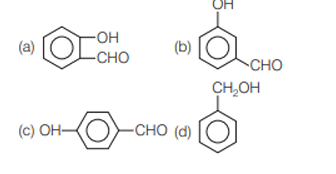
Which of the following is most acidic?}
1
A
2
B
3
C
4
D
Official Solution
Correct Option: (1)
Step 1: Understanding the Concept:
Acidity of phenols is enhanced by electron-withdrawing groups, especially when they are ortho or para to the OH group. This is because these groups stabilize the conjugate base (phenoxide ion) through resonance and inductive effects. Step 2: Detailed Explanation:
The aldehyde group ( ) is a strong electron-withdrawing group. When it is ortho or para to the OH group, it can participate in resonance with the phenoxide ion, delocalizing the negative charge further onto the oxygen of the aldehyde group, thus stabilizing it. Meta-substitution does not allow this resonance stabilization. A simple alcohol ( ) is not acidic. Step 3: Final Answer:
Therefore, the ortho- or para-hydroxybenzaldehyde is the most acidic among the options.
41
PYQ 2017
medium
chemistryID: met-2017
Wurtz reaction involves the reduction of alkyl halide with
1
Zn/HCl
2
HI
3
Zn/Cu Couple
4
Na in ether
Official Solution
Correct Option: (4)
Step 1: Understanding the Concept:
The Wurtz reaction is a coupling reaction used to form alkanes from alkyl halides. Step 2: Detailed Explanation:
In the Wurtz reaction, two molecules of an alkyl halide (usually primary) react with sodium metal in the presence of dry ether to form a higher alkane.
.
Sodium acts as a reducing agent, and the reaction proceeds via a free radical mechanism. Step 3: Final Answer:
Thus, the correct reagent is sodium in dry ether, option (D).
42
PYQ 2017
medium
chemistryID: met-2017
Dry distillation of calcium benzoate gives
1
benzaldehyde
2
acetophenone
3
benzoic acid
4
benzophenone
Official Solution
Correct Option: (4)
Step 1: Understanding the Concept:
Dry distillation or heating of calcium salts of carboxylic acids yields ketones. This is a general method for ketone synthesis. Step 2: Detailed Explanation:
Calcium benzoate is the calcium salt of benzoic acid . Upon dry distillation, it undergoes decomposition to form a ketone.
The product is diphenylmethanone, commonly known as benzophenone. Step 3: Final Answer:
Thus, the correct option is (D) benzophenone.
43
PYQ 2017
medium
chemistryID: met-2017
Which one of the following reacts with Grignard reagent to form an addition product which can be hydrolysed to a carboxylic acid?
1
2
3
4
None of these
Official Solution
Correct Option: (2)
Step 1: Understanding the Concept:
Grignard reagents ( ) act as strong nucleophiles. They react with various electrophiles to form new carbon-carbon bonds. Step 2: Detailed Explanation:
When a Grignard reagent reacts with carbon dioxide ( ), it forms a carboxylate salt. This salt upon acid hydrolysis yields a carboxylic acid.
Other options like or give different products like alcohols or sulfinic acids. Step 3: Final Answer:
Thus, the correct answer is (B) .
44
PYQ 2017
medium
chemistryID: met-2017
CH = CH + CH N Intermediate in the above reaction is
1
C H C H
2
CH CH C H
3
CH CH C H
4
:CH
Official Solution
Correct Option: (4)
Step 1: Understanding the Concept:
Diazomethane (CH N ) decomposes upon heating to produce a carbene (:CH ). Step 2: Detailed Explanation:}}
The reaction of ethene with diazomethane in the presence of heat or light is a carbene addition reaction. Diazomethane decomposes to form methylene carbene (:CH ) which then adds to the double bond of ethene to form cyclopropane.
The intermediate is the methylene carbene. Step 3: Final Answer:
The intermediate is :CH (methylene carbene), option (D).
45
PYQ 2017
medium
chemistryID: met-2017
The rate of S 2 reaction is maximum when the solvent is
1
CH OH
2
H O
3
DMSO
4
benzene
Official Solution
Correct Option: (3)
Step 1: Understanding the Concept:
S 2 reactions are favored by polar aprotic solvents. These solvents solvate the cation but not the anion, leaving the nucleophile highly reactive. Step 2: Detailed Explanation:
\begin{itemize} \item CH OH and H O are polar protic solvents. They solvate the nucleophile through hydrogen bonding, reducing its nucleophilicity and thus slowing the S 2 reaction. \item DMSO (dimethyl sulfoxide) is a polar aprotic solvent. It solvates the cation but not the anion, leaving the nucleophile "naked" and highly reactive, maximizing the S 2 rate. \item Benzene is non-polar and does not stabilize the charged transition state, so the reaction is very slow.
\end{itemize} Step 3: Final Answer:
The rate of S 2 reaction is maximum in DMSO, option (C).
46
PYQ 2019
medium
chemistryID: met-2019
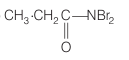
The main product of the reaction of CH CONH with Br in aqueous potassium hydroxide medium is
1
CH -CH -NH
2
CH Br
3
CH CONHBr
4
CH NH
Official Solution
Correct Option: (4)
Step 1: Understanding the Concept:
Hoffmann bromamide degradation. Step 2: Detailed Explanation:
R-CONH + Br + 4KOH R-NH + 2KBr + K CO + 2H O
CH CONH CH NH Step 3: Final Answer:
Product is CH NH (methylamine).
47
PYQ 2019
medium
chemistryID: met-2019
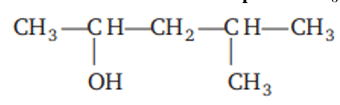
IUPAC name of the compound CH -CH(OH)-CH -CH(CH )-CH is
1
4-methyl pentene-2-ol
2
2-methyl pentanol-4
3
4,4-dimethyl-butane-2-ol
4
4-methyl pentane-2-ol
Official Solution
Correct Option: (4)
Step 1: Understanding the Concept:
Find longest chain containing -OH group. Step 2: Detailed Explanation:
Longest chain: 5 carbons (pentane)
-OH at C2, methyl at C4
Name: 4-methylpentan-2-ol Step 3: Final Answer:
4-methyl pentane-2-ol.
48
PYQ 2019
medium
chemistryID: met-2019
Alkyl halide on heating with alc.NH in a sealed tube results ....
1
1° amine
2
2° amine
3
3° amine
4
all of these
Official Solution
Correct Option: (4)
Step 1: Understanding the Concept:
Reaction with NH gives mixture of amines. Step 2: Detailed Explanation:
R-X + NH R-NH (1°), then R NH (2°), then R N (3°) Step 3: Final Answer:
All types of amines are formed.
49
PYQ 2019
medium
chemistryID: met-2019
For the reaction, CH -CH=CH + HOCl A. The product A is
1
CH -CHCl-CH OH
2
CH -CH(OH)-CH Cl
3
CH -CH -CH -COCl
4
CH -C(Cl)(OH)-CH
Official Solution
Correct Option: (2)
Step 1: Understanding the Concept:
Addition follows Markovnikov's rule. Step 2: Detailed Explanation:
HOCl adds such that OH goes to more substituted carbon, Cl to less substituted.
CH -CH=CH + HOCl CH -CH(OH)-CH Cl Step 3: Final Answer:
Product is CH -CH(OH)-CH Cl.
50
PYQ 2019
medium
chemistryID: met-2019
Ethyl iodide when heated with sodium in dry ether gives pure
1
C H
2
C H
3
C H
4
C H OH
Official Solution
Correct Option: (1)
Step 1: Understanding the Concept:
This is Wurtz reaction. Step 2: Detailed Explanation:
2C H I + 2Na C H + 2NaI Step 3: Final Answer:
Product is butane (C H ).
51
PYQ 2019
medium
chemistryID: met-2019
In the oxidation of C H -CH -CH by KMnO the product formed is
1
C H -CH -CHO
2
C H -CH -COOH
3
C H -COOH
4
C H -CH -OH
Official Solution
Correct Option: (3)
Step 1: Understanding the Concept:
KMnO oxidizes alkyl side chain to carboxylic acid. Step 2: Detailed Explanation:
C H -CH -CH C H -COOH (benzoic acid)
Complete oxidation of side chain. Step 3: Final Answer:
Product is benzoic acid.
52
PYQ 2019
medium
chemistryID: met-2019
Among H—CHO, CH CHO and C H CHO, which will undergo Cannizzaro's reaction?
1
HCHO and CH CHO
2
CH CHO and C H CHO
3
C H CHO and HCHO
4
All of the above
Official Solution
Correct Option: (3)
Step 1: Understanding the Concept:
Cannizzaro reaction occurs for aldehydes without -H. Step 2: Detailed Explanation:
HCHO and C H CHO have no -H, undergo Cannizzaro.
CH CHO has -H, undergoes aldol condensation. Step 3: Final Answer:
C H CHO and HCHO.
53
PYQ 2019
medium
chemistryID: met-2019
Acetylation of a secondary amine in alkaline medium yields
1
N,N-dialkyl acetamide
2
N,N-dialkyl amine
3
N,N-dialkyl amide
4
acetyl dialkyl amine
Official Solution
Correct Option: (1)
Step 1: Understanding the Concept:
Acetylation replaces H with acetyl group. Step 2: Detailed Explanation:
R NH + CH COCl R NCOCH + HCl
Product is N,N-dialkyl acetamide. Step 3: Final Answer:
N,N-dialkyl acetamide.
54
PYQ 2019
medium
chemistryID: met-2019
In acid medium nitrobenzene is reduced to aniline as shown in the reaction C H -NO + 6[H] C H -NH + 2H O. The reducing agent used in this reaction is
1
LiAlH
2
Sn/HCl
3
Na/Alcohol
4
H /Ni
Official Solution
Correct Option: (2)
Step 1: Understanding the Concept:
Nitrobenzene reduction to aniline. Step 2: Detailed Explanation:
Sn/HCl is commonly used for reduction of nitro group to amine in acidic medium. Step 3: Final Answer:
Reducing agent is Sn/HCl.
55
PYQ 2019
medium
chemistryID: met-2019
The product of reaction between alcoholic silver nitrite with ethyl bromide is
1
ethene
2
ethane
3
ethyl nitrile
4
nitro ethane
Official Solution
Correct Option: (4)
Step 1: Understanding the Concept:
AgNO gives nitroalkanes. Step 2: Detailed Explanation:
C H Br + AgNO C H NO + AgBr Step 3: Final Answer:
Product is nitro ethane.
56
PYQ 2019
medium
chemistryID: met-2019
The electrophile involved in the sulphonation of benzene is
1
SO
2
SO
3
H O
4
SO
Official Solution
Correct Option: (4)
Step 1: Understanding the Concept:
Sulphonation uses SO as electrophile. Step 2: Detailed Explanation:
2H SO SO + H O + HSO
SO attacks benzene ring. Step 3: Final Answer:
Electrophile is SO .
57
PYQ 2020
medium
chemistryID: met-2020
A new carbon-carbon bond formation is possible in:
I. Cannizzaro reaction II. Friedel-Crafts reaction III. Clemmensen reduction IV. Reimer-Tiemann reaction
1
I, II and III
2
II, III and IV
3
I and III
4
II and IV
Official Solution
Correct Option: (4)
Concept: Carbon–carbon bond formation occurs in reactions where the carbon chain is extended. Check each reaction: • Cannizzaro reaction → No C–C bond formation
• Friedel-Crafts reaction → Alkylation/acylation C–C bond formation
• Clemmensen reduction → Reduction only (no C–C bond)
• Reimer-Tiemann reaction → Formylation introduces group C–C bond formation Final Answer:
58
PYQ 2020
medium
chemistryID: met-2020
Which of the following compound is formed during Perkin's reaction?
1
Resorcinol
2
Cinnamic acid
3
Benzaldehyde
4
Benzoin
Official Solution
Correct Option: (2)
Concept:
The Perkin reaction is a condensation reaction between an aromatic aldehyde and an acid anhydride (containing at least two -hydrogen atoms) in the presence of a sodium salt of the corresponding acid (e.g., sodium acetate). It produces an -unsaturated aromatic acid. Step 1: General reaction.
Typically, benzaldehyde ( ) reacts with acetic anhydride ( ) in the presence of sodium acetate to form cinnamic acid ( ) and acetic acid. Step 2: Product identification.
The product is an -unsaturated aromatic carboxylic acid. In the classic Perkin reaction:
Step 3: Why not other options?
• (A) Resorcinol — is a dihydroxybenzene ( ), formed by other reactions (e.g., fusion of benzene disulfonic acid with alkali), not by Perkin reaction.
• (B) Cinnamic acid — correct product of Perkin reaction.
• (C) Benzaldehyde — is a starting material (reactant), not a product.
• (D) Benzoin — is formed by benzoin condensation (two molecules of benzaldehyde with cyanide catalyst), not by Perkin reaction.
59
PYQ 2020
medium
chemistryID: met-2020
In the given reaction sequence involving , the end product is used as:
1
explosive
2
hypnotic
3
tear gas
4
analgesic
Official Solution
Correct Option: (2)
Concept:
The reaction sequence (presumably ) ultimately forms chloral hydrate. Step 1: Reaction pathway.
(chloroform) reacts with a base (like ) to form dichlorocarbene ( ), which can undergo further reactions. A common sequence is:
Step 2: Identify the end product .
The end product is chloral hydrate (trichloroacetaldehyde hydrate). Step 3: Use of chloral hydrate.
Chloral hydrate is a sedative and hypnotic drug. It was historically used as a sleeping aid (hypnotic) and to relieve anxiety. Step 4: Why not other options?
• (A) Explosive — chloral hydrate is not an explosive.
• (C) Tear gas — tear gases are compounds like chloroacetophenone (CN) or CS gas, not chloral hydrate.
• (D) Analgesic — analgesics are pain relievers (e.g., aspirin, paracetamol); chloral hydrate is a sedative/hypnotic, not primarily an analgesic.
60
PYQ 2020
medium
chemistryID: met-2020
In the Cannizzaro reaction, the slowest step is:
1
attack of on carbonyl
2
hydride ion transfer
3
proton abstraction from acid
4
deprotonation of alcohol
Official Solution
Correct Option: (2)
Concept:
The Cannizzaro reaction is a disproportionation reaction of aldehydes without -hydrogen atoms (e.g., formaldehyde, benzaldehyde) in the presence of concentrated alkali. One molecule of aldehyde is reduced to alcohol, and another is oxidized to carboxylic acid. Step 1: Mechanism overview.
The reaction proceeds through the following steps:
• Nucleophilic attack of on the carbonyl carbon, forming a tetrahedral intermediate (hemiacetal anion).
• Hydride ion ( ) transfer from this intermediate to another aldehyde molecule.
• Proton abstraction from the carboxylic acid by the alkoxide to form carboxylate salt. Step 2: Identify the rate-determining step.
The rate-determining step (slowest step) is the hydride ion transfer. This step involves breaking the C-H bond and transferring the hydride to another aldehyde. It has a high activation energy because hydride is a poor leaving group and the transfer requires proper orbital alignment. Step 3: Why not the other steps?
• (A) Attack of on carbonyl — fast, as is a strong nucleophile.
• (C) Proton abstraction from acid — occurs after the slow step, typically fast.
• (D) Deprotonation of alcohol — occurs after the slow step, fast. Step 4: Conclusion.
Since hydride transfer has the highest activation energy, it is the slowest step and determines the overall reaction rate.
61
PYQ 2020
medium
chemistryID: met-2020
Which of the following is not a basic amino acid?
1
Leucine
2
Lysine
3
Arginine
4
Histidine
Official Solution
Correct Option: (1)
Concept:
Amino acids are classified based on the nature of their side chain (R-group). Basic amino acids have an additional amino group ( ) or nitrogen-containing group in their side chain that can accept a proton, making them positively charged at physiological pH. Step 1: Identify basic amino acids.
The three standard basic amino acids are:
• Lysine — contains an extra -amino group ( )
• Arginine — contains a guanidino group ( )
• Histidine — contains an imidazole ring (can accept a proton)
All three are positively charged at physiological pH. Step 2: Check Leucine.
Leucine has a nonpolar, aliphatic side chain ( ). It contains no additional amino or basic group. It is a neutral (nonpolar) amino acid. Step 3: Conclusion.
Since Leucine lacks a basic side chain and is not positively charged at physiological pH, it is not a basic amino acid.
62
PYQ 2021
medium
chemistryID: met-2021
An ester (A) with molecular formula was treated with excess and the compound so formed was treated with conc. to form olefin (B). Ozonolysis of B gave ketone with formula which shows positive iodoform test. The structure of A is :
1
2
3
4
Official Solution
Correct Option: (2)
Concept: • Ester + excess Grignard reagent → tertiary alcohol
• Dehydration → alkene
• Ozonolysis → carbonyl compounds
• Iodoform test → presence of group Step 1: Identify final product.
Ketone gives iodoform test → must be acetophenone ( ). Step 2: Work backward (ozonolysis).
Ozonolysis of alkene (B) gives acetophenone → alkene must contain or . Step 3: From Grignard reaction.
Ester + excess gives tertiary alcohol:
Step 4: Dehydration.
This alkene on ozonolysis gives (iodoform positive). Step 5: Conclusion.
Original ester is ethyl benzoate ( ).
63
PYQ 2021
medium
chemistryID: met-2021
A set of compounds in which the reactivity of halogen atom is in ascending order is:
1
chlorobenzene, vinyl chloride, chloroethane
2
chloroethane, chlorobenzene, vinyl chloride
3
vinyl chloride, chlorobenzene, chloroethane
4
vinyl chloride, chloroethane, chlorobenzene
Official Solution
Correct Option: (1)
Concept:
Reactivity of halogen in substitution depends on:
• Bond strength (C–Cl)
• Hybridization of carbon
• Resonance stabilization Step 1: Chlorobenzene (least reactive).
Strong resonance gives partial double bond character → very stable → least reactive. Step 2: Vinyl chloride.
Attached to carbon → stronger bond than alkyl halide → low reactivity. Step 3: Chloroethane (most reactive).
carbon, no resonance → weakest bond → most reactive. Step 4: Ascending order.
64
PYQ 2021
medium
chemistryID: met-2021
Which one of the following is most reactive towards nucleophilic substitution reaction?
1
CH = CH – Cl
2
C H Cl
3
CH CH = CH – Cl
4
ClCH – CH = CH
Official Solution
Correct Option: (4)
Concept:
Reactivity in nucleophilic substitution depends on carbocation/transition state stability and resonance. Step 1: Analyze each option.
• (A) CH =CH–Cl → Vinyl halide (very less reactive, strong C–Cl bond)
• (B) C H Cl → Aryl halide (very less reactive, partial double bond character)
• (C) CH CH=CH–Cl → Vinyl halide (very less reactive)
• (D) ClCH -CH=CH → Allyl halide (highly reactive due to resonance stabilization) Step 2: Reason for high reactivity of allyl halide.
Allylic carbocation is resonance stabilized:
Step 3: Conclusion.
Allyl halide undergoes nucleophilic substitution most easily.
65
PYQ 2021
medium
chemistryID: met-2021
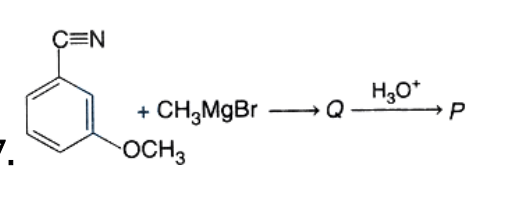
The product 'P' in the above reaction is :
1
undefined
2
undefined
3
4
Official Solution
Correct Option: (2)
Concept:
Grignard reagent reacts with nitrile to form a ketone after hydrolysis. Step 1: Reaction with nitrile.
Step 2: Hydrolysis.
Step 3: Key point.
If only one equivalent of Grignard reagent is used, reaction stops at ketone stage. Step 4: Conclusion.
Thus product is ketone, which matches option (B).
66
PYQ 2021
medium
chemistryID: met-2021
The product X is :
1
2
undefined
3
4
Official Solution
Correct Option: (2)
Concept: • Acetylation (protection of )
• Electrophilic substitution (bromination)
• Deprotection (hydrolysis) Step 1: Acetylation.
Reduces strong activating effect of , prevents multiple substitutions. Step 2: Bromination.
→ is ortho/para directing. Para position is preferred due to less steric hindrance. Step 3: Deprotection.
Step 4: Final product.
Bromine at para position, group restored → p-bromoaniline.
67
PYQ 2022
medium
chemistryID: met-2022
What is the first step and the final product formed in the reaction of HBr with ?
1
Protonation at more substituted carbon;
2
Protonation at less substituted carbon;
3
Radical initiation;
4
Protonation followed by hydride shift;
Official Solution
Correct Option: (4)
Concept:
Addition of HBr to alkene follows Markovnikov's rule (in absence of peroxide).
Formation of most stable carbocation occurs first. Step 1: Protonation of alkene. adds to the terminal carbon (less substituted) secondary carbocation forms at . Step 2: Carbocation rearrangement.
Hydride shift from C2 to C3 occurs to form a more stable tertiary carbocation:
Step 3: Attack of nucleophile.
Step 4: Final product.
Product formed is:
(2-bromo-2-methylbutane, a tertiary bromo compound)
68
PYQ 2022
medium
chemistryID: met-2022
In the following sequence of reactions, the compound formed would be