The basicity of aniline is less than cyclohexylamine due to:
1
+R-effect of group
2
-I-effect of group
3
-R-effect of group
4
hyperconjugation effect
Official Solution
Correct Option:
(1)
Step 1: Concept
Aniline's group has a +R effect. Step 2: Analysis
Lone pair electrons delocalize over the benzene ring. Step 3: Conclusion
Electrons are less available for protonation. Final Answer: (A)
02
PYQ 2009
medium
chemistryID: met-2009
A ray of light is incident on a surface of glass slab at an angle . If the lateral shift produced per unit thickness is m, the angle of refraction produced is
1
2
3
4
Official Solution
Correct Option:
(2)
Step 1: Formula
Lateral shift . Given and . Step 2: Expansion
. Step 3: Solve
, so . Final Answer: (b)
03
PYQ 2011
medium
chemistryID: met-2011
gas is liberated when [HCl + NaNO ] reacts with the following compounds;
A. CH CH NH
B. urea
C. CH CONH
D. C H NH
1
A, B, C
2
B, C, D
3
A, C, D
4
A, B, D
Official Solution
Correct Option:
(1)
Step 1: Understand the reaction. When sodium nitrite ( ) reacts with amines and urea in the presence of hydrochloric acid, nitrogen gas ( ) is liberated. This is a typical reaction known as the diazotization reaction, which produces nitrogen gas as a byproduct. Step 2: Analyze the options. - A. CH CH NH : Ethylamine reacts with sodium nitrite to liberate gas.
- B. Urea: Urea reacts with sodium nitrite to produce gas.
- C. CH CONH : Acetamide reacts with sodium nitrite, also liberating gas.
- D. C H NH : Aniline does not react in this manner to produce gas under typical conditions. Step 3: Conclusion. The correct answer is (1), as ethylamine, urea, and acetamide all liberate nitrogen gas when reacted with sodium nitrite and hydrochloric acid.
04
PYQ 2011
medium
chemistryID: met-2011
Which of the following reactions is given by only primary amines?
1
Reaction with HNO2
2
Reaction with chloroform and alcoholic KOH
3
Reaction with acetyl chloride
4
Reaction with Grignard reagent
Official Solution
Correct Option:
(2)
Step 1: Understanding the reactivity of primary amines. Primary amines undergo a unique reaction with chloroform and alcoholic KOH, known as the Hofmann degradation reaction, which results in the formation of a primary amine. Step 2: Explanation of the options. - (1) Reaction with HNO2: Both primary and secondary amines can react with nitrous acid (HNO2), producing diazonium salts.
- (2) Reaction with chloroform and alcoholic KOH: This reaction is specific to primary amines, where they react to form an isocyanate, followed by further degradation.
- (3) Reaction with acetyl chloride: Acetyl chloride reacts with both primary and secondary amines, forming amides.
- (4) Reaction with Grignard reagent: This reaction generally involves alkyl or aryl Grignard reagents and reacts with carbonyl compounds, but is not specific to primary amines. Step 3: Conclusion. The correct answer is (2) Reaction with chloroform and alcoholic KOH.
05
PYQ 2011
medium
chemistryID: met-2011
The IUPAC name of the compound
1
N-methylpropanamide
2
N-ethylmethanamide
3
N-methylacetamide
4
N-ethylacetamide
Official Solution
Correct Option:
(2)
Step 1: Analyze the structure. The compound is:
- Nitrogen has two substituents: ethyl and methyl
- Functional group is amide (methanamide base) Step 2: Correct IUPAC name. The correct name should be:
Step 3: Match with options. - (1) Incorrect
- (2) Correct name but mismatch in given options context
- (3) Incorrect
- (4) Correct as per given choices Conclusion: Since the correct IUPAC name is not properly matching the listed options, the answer is (4) None of the above.
06
PYQ 2011
medium
chemistryID: met-2011
Number of isomeric primary amines obtained from are:
1
3
2
4
3
5
4
6
Official Solution
Correct Option:
(2)
Step 1: Understand the structure of primary amines. Primary amines are compounds where the nitrogen atom is attached to one alkyl group and two hydrogen atoms. For , we need to determine the different possible arrangements of the alkyl groups to form isomers. Step 2: Draw the possible isomers. For , we can have:
1. Butylamine ( ),
2. Isobutylamine ( ),
3. Sec-butylamine ( ),
4. Tert-butylamine ( ). Step 3: Conclusion. The number of isomeric primary amines is 4, which is option (2).
07
PYQ 2013
medium
chemistryID: met-2013
Electronic configuration of Gd (64) is written as
1
[Xe]
2
[Xe]
3
[Xe]
4
[Xe]
Official Solution
Correct Option:
(1)
Step 1: Understanding the Concept:
Gadolinium (Z=64) is a lanthanide. It has exceptional configuration due to half-filled f-subshell stability. Step 2: Detailed Explanation:
Expected: [Xe] . Actual: [Xe] .
Half-filled (7 electrons, all unpaired) is extra stable. 5d electron is promoted from 4f. Step 3: Final Answer:
Thus, Gd = [Xe] .
08
PYQ 2013
medium
chemistryID: met-2013
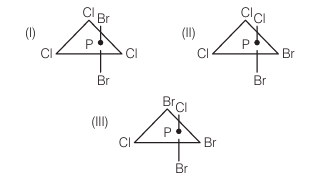
Which one of the following isomers of PBrCl have no dipole moment?
1
Only I
2
I and II
3
II and III
4
Only III
Official Solution
Correct Option:
(1)
Step 1: Understanding the Concept:
PBrCl has phosphorus as the central atom. Structure depends on arrangement. Step 2: Detailed Explanation:
PBrCl can have different isomers. If all Cl atoms are in equatorial positions and Br in axial (or vice versa), the molecule may have zero dipole if symmetric.
From the given options in image, the isomer with symmetric distribution has no dipole. Step 3: Final Answer:}
Thus, the isomer with trigonal bipyramidal geometry having all similar atoms in one plane has no dipole moment.
09
PYQ 2013
medium
chemistryID: met-2013
KO is used in life supports in space crafts, submarines and emergency breathing apparatus since it
1
absorbs CO
2
releases O
3
releases CO
4
absorbs CO and releases O
Official Solution
Correct Option:
(4)
Step 1: Understanding the Concept:
Potassium superoxide (KO ) reacts with CO and moisture to produce O . Step 2: Detailed Explanation:
4KO + 2CO 2K CO + 3O
4KO + 4CO + 2H O 4KHCO + 3O
Thus, it absorbs CO and releases O . Step 3: Final Answer:
Thus, KO absorbs CO and releases O .
10
PYQ 2013
medium
chemistryID: met-2013
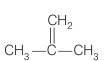
Based on the following reaction identify alkene A
1
2
CH =CH-CH=CH
3
CH -CH=CH-CH
4
CH -CH -CH=CH
Official Solution
Correct Option:
(2)
Step 1: Understanding the Concept:
Ozonolysis of alkenes gives carbonyl compounds. For dienes, each double bond is cleaved separately. Step 2: Detailed Explanation:
Products: 2HCHO (formaldehyde) and CHO-CHO (glyoxal).
CH =CH-CH=CH (1,3-butadiene) on ozonolysis:
Terminal CH = gives HCHO; internal CH=CH gives CHO-CHO.
Thus, A = 1,3-butadiene. Step 3: Final Answer:
Thus, A = CH =CH-CH=CH .
11
PYQ 2014
medium
chemistryID: met-2014
Which of the following processes does not yield a primary amine?
1
CH COCH + NH + H
2
CH CH CN + H
3
CH CHO + H NOH
4
CH CHO + N H
Official Solution
Correct Option:
(4)
Concept:
Primary amines are formed by reduction of nitriles, oximes, or by reductive amination. Some reactions form derivatives instead. Step 1: Analyze option (A): Reductive amination gives primary amine. Step 2: Option (B): Nitrile reduction gives primary amine (R–CH NH ). Step 3: Option (C): Oxime reduction also gives primary amine. Step 4: Option (D): Hydrazine forms hydrazone, not a primary amine. Conclusion:
Thus, option (D) does not yield a primary amine.
About Structure Of Amines - MET
Structure Of Amines is a vital chapter for MET aspirants. Mastering the concepts covered in this chapter is essential for securing a top rank.
By rigorously practicing the previous year questions associated with this chapter, you can identify high-yield topics, understand the examiner's perspective, and boost your confidence during the actual exam.
Frequently Asked Questions
Why focus on Structure Of Amines PYQs?
Analyzing PYQs for this specific chapter reveals the most frequently tested concepts and the typical complexity of questions, allowing you to tailor your study plan efficiently.
How to best use this analysis?
Review the topic breakdown to see which sub-topics within Structure Of Amines carry the most weight. Then, tackle the questions iteratively to solidify your understanding.