as an oxidising agent to oxidise ferrous ions into ferric ions
4
as an insecticide
Official Solution
Correct Option: (3)
Step 1: Concept
Potassium dichromate ( ) is a powerful oxidising agent in acidic media. Step 2: Analysis
It accepts electrons: . It oxidises to . Step 3: Conclusion
Its primary chemical use listed is as an oxidising agent. Final Answer: (C)
02
PYQ 2009
medium
chemistryID: met-2009
The kinetic energy of an electron gets tripled, then the de-Broglie wavelength associated with it changes by a factor
1
2
3
4
3
Official Solution
Correct Option: (3)
Step 1: Relation
The de-Broglie wavelength is related to kinetic energy by: . This implies . Step 2: Substitution
If the new kinetic energy , then the new wavelength . Step 3: Ratio
. Final Answer: (c)
03
PYQ 2011
medium
chemistryID: met-2011
Transition metal with low oxidation number will act as:
1
An oxidising agent
2
A base
3
An acid
4
None of these
Official Solution
Correct Option: (1)
Step 1: Identifying the behavior of low oxidation states in transition metals. Transition metals with low oxidation states, such as or , tend to act as oxidizing agents. This is because they have the ability to easily donate electrons and thus oxidize other substances. Step 2: Explanation of the options. - (1) An oxidising agent: This is the correct answer. Low oxidation states in transition metals often serve as oxidizing agents.
- (2) A base: Transition metals with low oxidation states are less likely to act as bases.
- (3) An acid: Transition metals with low oxidation states are more commonly seen as oxidizing agents rather than acids.
- (4) None of these: This is incorrect because low oxidation states of transition metals indeed act as oxidizing agents. Step 3: Conclusion. The correct answer is (1) An oxidising agent.
04
PYQ 2011
medium
chemistryID: met-2011
Chloride of which of the following element is coloured?
1
Hg
2
Ag
3
Co
4
Zn
Official Solution
Correct Option: (3)
Step 1: Identifying colored chlorides. Among the given elements, cobalt forms a colored chloride due to the presence of unpaired electrons in its orbitals, which can absorb certain wavelengths of light. Step 2: Explanation of the options. - (1) Hg: Mercury chloride is not typically colored.
- (2) Ag: Silver chloride is a white solid, not colored.
- (3) Co: Cobalt chloride forms a blue color in its hydrated form, and a pink color in anhydrous form, due to the presence of unpaired electrons in the orbitals.
- (4) Zn: Zinc chloride is colorless and does not exhibit any color. Step 3: Conclusion. The correct answer is (3) Co.
05
PYQ 2013
medium
chemistryID: met-2013
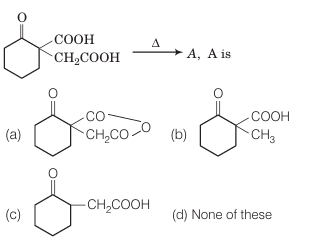
Find A
1
(a)
2
(b)
3
(c)
4
None of these
Official Solution
Correct Option: (3)
Step 1: Formula / Definition}
Step 2: Calculation / Simplification}
The directly on the ring is to the ring ketone.
Heating eliminates this specific carboxyl group as .
The side chain remains intact. Step 3: Final Answer
Concept:
Some metals form metal-metal bonds resulting in dimeric ions. Step 1: Mercury behavior
Mercury forms Hg ion (dimeric ion). Step 2: Structure
Two Hg atoms are bonded together:
Conclusion:
Thus, mercury forms dimeric ions.
08
PYQ 2020
medium
chemistryID: met-2020
Acidic dichromate ion reacts with hydrogen peroxide to the formation of deep blue colour. This is due to the formation of
1
CrO
2
CrO
3
Both (a) and (b)
4
None of (a) and (b)
Official Solution
Correct Option: (2)
Concept:
Hydrogen peroxide forms peroxo complexes with transition metals. Step 1: Reaction.
Dichromate reacts with H O in acidic medium. Step 2: Product formed.
Blue coloured compound is peroxo complex CrO . Step 3: Conclusion.
Correct answer is (B)
09
PYQ 2020
medium
chemistryID: met-2020
Which of the following ions has the highest magnetic moment?
1
Zn
2
Ti
3
Sc
4
Mn
Official Solution
Correct Option: (4)
Concept:
Magnetic moment ( ) depends on the number of unpaired electrons ( ):
Higher the number of unpaired electrons, higher the magnetic moment. Step 1: Determine electronic configurations and unpaired electrons.
• Zn : Atomic number 30. Zn: . Zn loses two 4s electrons → . Unpaired electrons = 0.
• Ti : Atomic number 22. Ti: . Ti loses two 4s electrons and one 3d electron → . Unpaired electrons = 1.
• Sc : Atomic number 21. Sc: . Sc loses two 4s electrons and one 3d electron → . Unpaired electrons = 0.
• Mn : Atomic number 25. Mn: . Mn loses two 4s electrons → . Unpaired electrons = 5 (half-filled d-subshell, highly stable). Step 2: Compare magnetic moments.
Mn has 5 unpaired electrons → highest magnetic moment.
10
PYQ 2021
medium
chemistryID: met-2021
What is the characteristic valence shell configuration of coinage metals?
1
2
3
4
Official Solution
Correct Option: (4)
Concept:
Coinage metals (Cu, Ag, Au) belong to Group 11. Step 1: Electronic configurations.
Step 2: General configuration.
Step 3: Reason.
Filled subshell provides extra stability; one -electron available for bonding.
11
PYQ 2022
medium
chemistryID: met-2022
The number of oxygen atoms that are directly attached to one chromium in dichromate ion are ___.
Official Solution
Correct Option: (1)
Concept:
Structure of dichromate ion :
- Each Cr atom is surrounded by 4 oxygen atoms in a tetrahedral arrangement
- One oxygen atom acts as a bridge between the two Cr atoms
- The other three oxygen atoms are terminal Step 1: Analyze structure.
Each Cr is bonded to:
- 3 terminal oxygen atoms (double bonded)
- 1 bridging oxygen atom (single bonded) Step 2: Count for one chromium.
Step 3: Conclusion.
Each Cr atom is directly attached to 4 oxygen atoms.
12
PYQ 2023
medium
chemistryID: met-2023
Among and ions, the number of ions that impart colour is _ _ _ _ _ _ _
Official Solution
Correct Option: (1)
Concept:
Colour in transition metal ions arises due to transitions, which occur only when the -orbital is partially filled (not or ). Step 1: Electronic configurations:
Step 2:
Number of coloured ions =