The physical states of dispersing phase and dispersion medium in colloid like pesticide spray respectively, are:
1
gas, liquid
2
solid, gas
3
liquid, solid
4
liquid, gas
Official Solution
Correct Option:
(4)
Step 1: Concept
Pesticide spray is an aerosol. Step 2: Analysis
In a spray, liquid droplets are dispersed in a gaseous medium. Step 3: Conclusion
Dispersing phase is liquid and dispersion medium is gas. Final Answer: (D)
02
PYQ 2008
medium
chemistryID: met-2008
Which of the following electrolyte will have maximum flocculation value for sol?
1
2
3
4
Official Solution
Correct Option:
(1)
Step 1: Concept
Flocculation value is inversely proportional to coagulating power. Step 2: Analysis
is a positively charged sol. According to Hardy-Schulze rule, the ion with the lowest negative charge ( in ) has the lowest coagulating power. Step 3: Conclusion
Lower coagulating power results in the maximum flocculation value. Final Answer: (A)
03
PYQ 2008
medium
chemistryID: met-2008
Which of the following electrolyte will have maximum flocculation value for sol?
1
2
3
4
Official Solution
Correct Option:
(1)
Step 1: Concept
Flocculation value is inversely proportional to coagulating power. Step 2: Analysis
is a positively charged sol. According to Hardy-Schulze rule, the ion with the lowest negative charge ( in ) has the lowest coagulating power. Step 3: Conclusion
Lower coagulating power results in the maximum flocculation value. Final Answer: (A)
04
PYQ 2009
medium
chemistryID: met-2009
A graph of pressure versus volume for an ideal gas for different processes is as shown. In the graph curve OC represents
1
isochoric process
2
isothermal process
3
isobaric process
4
adiabatic process
Official Solution
Correct Option:
(4)
Step 1: Identifying Curves
Curve OA: Pressure is constant (Isobaric).
Curve OD: Volume is constant (Isochoric). Step 2: Slope Comparison
Both Isothermal (OB) and Adiabatic (OC) curves are curves, but the adiabatic slope is steeper. Step 3: Conclusion
Since OC is steeper than OB, it represents the Adiabatic process. Final Answer: (d)
05
PYQ 2009
medium
chemistryID: met-2009
In an L-C-R series circuit, at resonance, the phase difference between current and voltage is:
1
2
3
zero
4
Official Solution
Correct Option:
(3)
Step 1: Concept
Resonance occurs when inductive reactance ( ) equals capacitive reactance ( ). Step 2: Analysis
At resonance, the net reactance is zero, making the circuit purely resistive. Step 3: Conclusion
In a purely resistive circuit, current and voltage are in phase, so the phase difference is zero. Final Answer: (C)
06
PYQ 2009
medium
chemistryID: met-2009
The accurate measurement of emf can be obtained using
1
multimeter
2
voltmeter
3
voltameter
4
potentiometer
Official Solution
Correct Option:
(4)
Step 1: Mechanism
A voltmeter always draws some current from the cell during measurement, which leads to a potential drop across the internal resistance. Step 2: Null Method
A potentiometer works on the "null deflection" method, meaning it draws no current from the cell when balanced. Step 3: Conclusion
Because no current is drawn, the potentiometer measures the true electromotive force (emf) accurately. Final Answer: (d)
07
PYQ 2011
medium
chemistryID: met-2011
Multimolecular colloids are present in:
1
Soap solution
2
Sol of proteins
3
Sol of gold
4
All of these
Official Solution
Correct Option:
(3)
Step 1: Understanding multimolecular colloids. Multimolecular colloids consist of aggregates of molecules that are small enough to remain in suspension, and their size is typically between 1 nm and 1000 nm. Step 2: Explanation of the options. - (1) Soap solution: Soap solutions contain micelles, which are not multimolecular colloids.
- (2) Sol of proteins: Proteins are macromolecules and generally form macromolecular colloids, not multimolecular.
- (3) Sol of gold: Gold nanoparticles in sol are an example of multimolecular colloids, where gold atoms aggregate.
- (4) All of these: This is incorrect because soap solutions and sol of proteins are not multimolecular colloids. Step 3: Conclusion. The correct answer is (3) Sol of gold.
08
PYQ 2011
medium
chemistryID: met-2011
In physical adsorption, the gas molecules are held by solid surfaces through:
1
Strong chemical forces
2
Van der waalsâ forces
3
Metallic bonds
4
Gravitational forces
Official Solution
Correct Option:
(2)
Step 1: Identifying the types of forces in adsorption. In physical adsorption, the gas molecules are held by weak forces, mainly van der waals' forces, which are temporary dipole interactions between molecules. Step 2: Explanation of the options. - (1) Strong chemical forces: Chemical forces are involved in chemisorption, not in physical adsorption.
- (2) Van der waalsâ forces: This is the correct option. In physical adsorption, van der waalsâ forces are responsible for holding the gas molecules to the surface.
- (3) Metallic bonds: Metallic bonds are not involved in adsorption.
- (4) Gravitational forces: Gravitational forces are too weak to play a significant role in adsorption. Step 3: Conclusion. The correct answer is (2) Van der waalsâ forces.
09
PYQ 2013
medium
chemistryID: met-2013
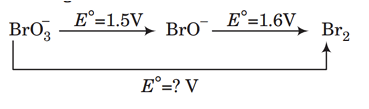
Consider the following redox reaction occurring in acidic medium
The unknown standard reduction potential is
The spontaneous reaction that takes place in this cell is
1
2
3
4
Official Solution
Correct Option:
(2)
Step 1: Formula / Definition}
Step 2: Calculation / Simplification}
is more easily oxidized (lower reduction potential).
Spontaneous: (anode)
(cathode)
Overall: Step 3: Final Answer
11
PYQ 2014
medium
chemistryID: met-2014
In physical adsorption, the adsorbent and adsorbate are held together by the
1
ionic forces
2
covalent forces
3
van der Waals’ forces
4
H-bonding
Official Solution
Correct Option:
(3)
Concept:
Types of adsorption. Step 1: Physical adsorption involves weak intermolecular forces. Step 2: These are van der Waals’ forces. Step 3: Chemical adsorption involves strong covalent/ionic bonds. Conclusion:
Physical adsorption uses van der Waals’ forces.
12
PYQ 2016
medium
chemistryID: met-2016
During the adsorption of krypton on activated charcoal at low temperature.
1
and
2
and
3
and
4
and
Official Solution
Correct Option:
(3)
Step 1: Understanding the Concept:
Adsorption is an exothermic process that results in a decrease in entropy. Step 2: Detailed Explanation:
Adsorption is spontaneous at low temperatures. It is an exothermic process because energy is released when gas molecules bind to the surface ( ). Additionally, when gas molecules become confined to a surface, their freedom of movement decreases, leading to a decrease in entropy ( ). Step 3: Final Answer:
During adsorption, and , which corresponds to option (C).
13
PYQ 2017
medium
chemistryID: met-2017
Fog is a colloidal solution of
1
gas in gas
2
solid in gas
3
liquid in gas
4
None of these
Official Solution
Correct Option:
(3)
Step 1: Understanding the Concept:
Colloidal solutions are classified based on the dispersed phase and the dispersion medium. Step 2: Detailed Explanation:
\begin{itemize} \item Fog: Tiny liquid water droplets dispersed in air (gas). So, dispersed phase is liquid, dispersion medium is gas. \item Smoke: Solid in gas. \item Foam: Gas in liquid. \item Cloud: Liquid in gas.
\end{itemize} Step 3: Final Answer:
Fog is a colloidal solution of liquid in gas, option (C).
14
PYQ 2017
medium
chemistryID: met-2017
Which of the following statements is correct regarding the slag obtained during the extraction of iron?
1
The slag is lighter and has lower melting point than the metal.
2
The slag is lighter and has higher melting point than the metal.
3
The slag is heavier and has lower melting point than metal.
4
The slag is heavier and has higher melting point than the metal.
Official Solution
Correct Option:
(1)
Step 1: Understanding the Concept:
In the blast furnace extraction of iron, slag is formed by the reaction of flux (limestone) with impurities (silica). Step 2: Detailed Explanation:
The slag formed is calcium silicate ( ). It has a lower density than molten iron, so it floats on top of the molten iron, allowing easy separation. It also has a lower melting point than iron, ensuring it remains molten and can be tapped off separately. Step 3: Final Answer:
The correct statement is that the slag is lighter and has a lower melting point than the metal, option (A).
15
PYQ 2017
medium
chemistryID: met-2017
What is the kinetic energy of 1 g of at 47°C?
1
2
3
4
None of these
Official Solution
Correct Option:
(3)
Step 1: Understanding the Concept:
The average kinetic energy for a gas is given by , where n is the number of moles. This is the total translational kinetic energy. Step 2: Detailed Explanation:
Given: mass of = 1 g, Molar mass of = 32 g/mol.
Number of moles, mol.
Temperature, K.
.
Total kinetic energy =
=
= J ≈ J. Step 3: Final Answer:
The kinetic energy is J, option (C).
16
PYQ 2017
medium
chemistryID: met-2017
If ionic radius of and are 1.69 Å and 1.81 Å respectively, the edge length of unit cell is
1
4.04 Å
2
3.50 Å
3
7.00 Å
4
None of these
Official Solution
Correct Option:
(1)
Step 1: Understanding the Concept:
CsCl has a body-centered cubic (BCC) structure. In the CsCl structure, the Cl ions form a simple cubic lattice, and the Cs ion occupies the body center. The ions touch along the body diagonal. Step 2: Detailed Explanation:
In the CsCl structure, the relationship between the edge length (a) and the sum of the ionic radii (r + r ) is given by:
Given: Å, Å.
Sum of radii = Å.
Thus, Å.
So, Å. Step 3: Final Answer:
The edge length of the unit cell is 4.04 Å, option (A).
17
PYQ 2018
medium
chemistryID: met-2018
Lyophilic sols are more stable than lyophobic sols because
1
the colloidal particles have negative charge
2
the colloidal particles have positive charge
3
the colloidal particles are solvated
4
None of the above
Official Solution
Correct Option:
(3)
Step 1: Understanding the Concept:
Lyophilic sols are solvent-loving. Step 2: Detailed Explanation:
Lyophilic sols are stable due to strong solvation (interaction between dispersed phase and dispersion medium). Step 3: Final Answer:
Lyophilic sols are stable because the colloidal particles are solvated.
18
PYQ 2018
medium
chemistryID: met-2018
Coordination number of Zn in ZnS is
1
4
2
6
3
2
4
None of these
Official Solution
Correct Option:
(1)
Step 1: Understanding the Concept:
ZnS has zinc blende structure. Step 2: Detailed Explanation:
In ZnS (zinc blende structure), each Zn is surrounded by 4 S ions. Coordination number is 4. Step 3: Final Answer:
Coordination number is 4.
19
PYQ 2018
medium
chemistryID: met-2018
A certain amount of a metal whose equivalent mass is 28 displaces of at STP from an acid. Hence, mass of the element is
1
2
3
4
Official Solution
Correct Option:
(1)
Step 1: Understanding the Concept:
Equivalent mass = . Step 2: Detailed Explanation:
At STP, L of mol . Mass of g. Equivalent mass of metal = g. Step 3: Final Answer:
The mass of the element is g.
20
PYQ 2018
medium
chemistryID: met-2018
Deviation from the ideal gas behaviour of a gas can be expressed as
1
2
3
4
Official Solution
Correct Option:
(2)
Step 1: Understanding the Concept:
Compressibility factor measures deviation from ideal gas behaviour. Step 2: Detailed Explanation:
; for ideal gas, . Step 3: Final Answer:
.
About Surface Chemistry - MET
Surface Chemistry is a vital chapter for MET aspirants. Mastering the concepts covered in this chapter is essential for securing a top rank.
By rigorously practicing the previous year questions associated with this chapter, you can identify high-yield topics, understand the examiner's perspective, and boost your confidence during the actual exam.
Frequently Asked Questions
Why focus on Surface Chemistry PYQs?
Analyzing PYQs for this specific chapter reveals the most frequently tested concepts and the typical complexity of questions, allowing you to tailor your study plan efficiently.
How to best use this analysis?
Review the topic breakdown to see which sub-topics within Surface Chemistry carry the most weight. Then, tackle the questions iteratively to solidify your understanding.