Which of the following is correct, based on molecular orbital theory for peroxide ion?
1
Its bond order is one and it is paramagnetic
2
Its bond order is two and it is diamagnetic
3
Its bond order is one and it is diamagnetic
4
Its bond order is two and it is paramagnetic
Official Solution
Correct Option:
(3)
Step 1: Concept
Apply Molecular Orbital (MO) theory to the peroxide ion ( ). Step 2: Analysis
Configuration: .
Bond Order = . Step 3: Conclusion
As all electrons are paired in the orbitals, the ion is diamagnetic. Final Answer: (C)
02
PYQ 2008
medium
chemistryID: met-2008
The electronic configuration represents:
1
2
3
4
Official Solution
Correct Option:
(1)
Step 1: Concept
Determine the total number of electrons in the given configuration. Step 2: Analysis
Total electrons . Neutral ( ) has 29 electrons ( ). loses one electron from . Step 3: Conclusion
has 28 electrons with the configuration . Final Answer: (A)
03
PYQ 2008
medium
chemistryID: met-2008
Which of the following has highest second ionisation energy?
1
Calcium
2
Chromium
3
Iron
4
Cobalt
Official Solution
Correct Option:
(2)
Step 1: Concept
Ionization energy depends on electronic configuration stability. Step 2: Analysis
The configuration of is . After losing one electron, achieves the stable (half-filled) configuration. Step 3: Conclusion
Removing a second electron from this stable half-filled d-orbital requires very high energy. Final Answer: (B)
04
PYQ 2008
medium
chemistryID: met-2008
Which of the following has highest second ionisation energy?
1
Calcium
2
Chromium
3
Iron
4
Cobalt
Official Solution
Correct Option:
(2)
Step 1: Concept
Ionization energy depends on electronic configuration stability. Step 2: Analysis
The configuration of is . After losing one electron, achieves the stable (half-filled) configuration. Step 3: Conclusion
Removing a second electron from this stable half-filled d-orbital requires very high energy. Final Answer: (B)
05
PYQ 2008
medium
chemistryID: met-2008
The presence of unpaired electron in phosphorous atom is explained by which principle?
1
Aufbau principle
2
Pauli's exclusion principle
3
Hund's rule
4
Heisenberg's principle
Official Solution
Correct Option:
(3)
Step 1: Concept
Hund's rule states that pairing of electrons in orbitals of the same subshell does not occur until each orbital is singly occupied. Step 2: Analysis
Phosphorous ( ) has the configuration . Step 3: Conclusion
The three electrons in the subshell remain unpaired in separate orbitals according to Hund's rule. Final Answer: (C)
06
PYQ 2008
medium
chemistryID: met-2008
Which of the following is correct, based on molecular orbital theory for peroxide ion?
1
Its bond order is one and it is paramagnetic
2
Its bond order is two and it is diamagnetic
3
Its bond order is one and it is diamagnetic
4
Its bond order is two and it is paramagnetic
Official Solution
Correct Option:
(3)
Step 1: Concept
Apply Molecular Orbital (MO) theory to the peroxide ion ( ). Step 2: Analysis
Configuration: .
Bond Order = . Step 3: Conclusion
As all electrons are paired in the orbitals, the ion is diamagnetic. Final Answer: (C)
07
PYQ 2009
medium
chemistryID: met-2009
0.1 m of water at is mixed with 0.3 m of water at . The final temperature of the mixture is
1
2
3
4
Official Solution
Correct Option:
(1)
Step 1: Calorimetry Principle
Heat lost by hot water = Heat gained by cold water.
Let be the final temperature. Step 2: Energy Equation
.
Since density is constant, volume can be used as a proxy for mass: . Step 3: Solve for t
. Final Answer: (a)
08
PYQ 2009
medium
chemistryID: met-2009
The resistance of an ideal ammeter is:
1
zero
2
infinite
3
small but non-zero
4
large
Official Solution
Correct Option:
(1)
Step 1: Concept
An ammeter is connected in series to measure current. Step 2: Analysis
To ensure it does not change the circuit's total resistance and the current it aims to measure, it must have no resistance of its own. Step 3: Conclusion
The resistance of an ideal ammeter is zero. Final Answer: (A)
09
PYQ 2009
medium
chemistryID: met-2009
The amount of energy released when one microgram of matter is annihilated is
1
25 kWh
2
kWh
3
kWh
4
kWh
Official Solution
Correct Option:
(1)
Step 1: Formula
Use Einstein's mass-energy equivalence: . Step 2: Values
.
.
. Step 3: Conversion
.
. Final Answer: (a)
10
PYQ 2009
medium
chemistryID: met-2009
An aqueous solution containing 6.5 g of NaCl of 90% purity was subjected to electrolysis. After the complete electrolysis, the solution was evaporated to get solid NaOH. The volume of 1 M acetic acid required to neutralise NaOH obtained above is
1
2
3
4
Official Solution
Correct Option:
(3)
Step 1: Find Pure NaCl
Weight of pure . Step 2: Determine Equivalents
Equivalents of . This yields 0.1 equivalents of . Step 3: Neutralization Calculation
Volume of 1 M acetic acid . Final Answer: (c)
11
PYQ 2009
medium
chemistryID: met-2009
Near a circular loop of conducting wire as shown in the figure an electron moves along a straight line. The direction of the induced current if any in the loop is
1
variable
2
clockwise
3
anticlockwise
4
zero
Official Solution
Correct Option:
(1)
Step 1: Flux Change
As the electron approaches the loop, the magnetic flux linked with the loop increases. Step 2: Approaching Phase
Lenz's law dictates a current is induced to oppose this increase, creating a clockwise current. Step 3: Receding Phase
As the electron moves away, the flux decreases, inducing an anticlockwise current to oppose the decrease. Thus, the direction is variable. Final Answer: (a)
12
PYQ 2009
medium
chemistryID: met-2009
In the following combinations of logic gates, the outputs of A, B and C are respectively
1
0, 1, 1
2
0, 1, 0
3
1, 1, 0
4
1, 0, 1
Official Solution
Correct Option:
(3)
Step 1: Gate A
Inputs are 1 and 0 for a NAND gate followed by a NOT gate (effectively an AND operation): , then NOT gives 1. Step 2: Gate B
The logic diagram indicates an OR operation followed by NOT (NOR gate) with inputs resulting in an output of 1. Step 3: Gate C
The final gate configuration for C results in an output of 0 based on the input logic provided in the circuit. Final Answer: (c)
13
PYQ 2010
medium
chemistryID: met-2010
Which has the highest weight?
1
of water
2
A normal adult man
3
10 L of Hg
4
All have same weight
Official Solution
Correct Option:
(1)
Step 1: Analysis of (A)
Density of water . Volume .
Mass . Step 2: Analysis of (B)
A normal adult man weighs approximately 65–80 kg. Step 3: Analysis of (C)
Density of Mercury (Hg) (or ). Volume . Mass . Step 4: Conclusion
. Option (A) has the highest weight. Final Answer: (A)
14
PYQ 2010
medium
chemistryID: met-2010
Which has the highest ratio?
1
2
3
4
Official Solution
Correct Option:
(2)
Step 1: Concept
ratio represents the charge-to-mass ratio of a particle. Step 2: Calculation for each
- ** **: Charge , Mass amu. Ratio . - ** **: Charge , Mass amu. Ratio . - ** **: Charge , Mass amu. Ratio . - ** ** (Deuterium): Charge , Mass amu. Ratio . Step 3: Conclusion
The ratio is highest for the proton ( ). Final Answer: (B)
15
PYQ 2011
medium
chemistryID: met-2011
An element has an atomic mass of 19 and atomic number 9, its ions are represented by:
1
2
3
4
Official Solution
Correct Option:
(3)
Step 1: Determine the number of electrons in the element. The atomic number of is 9, which means it has 9 protons and 9 electrons in its neutral state. The atomic mass of 19 indicates the number of protons and neutrons combined. For a neutral atom, the number of electrons equals the atomic number. Step 2: Consider the possible ions. - : This would mean the element has lost one electron, making it positively charged. However, since the element has 9 electrons in its neutral state and no information suggests it has lost an electron, this is incorrect.
- : This would imply the element has lost two electrons, which is not typical for this element.
- : This indicates the element has gained one electron, which makes the ion negatively charged. Since the element can gain an electron to become stable, this is the correct answer.
- : This would imply the element has gained two electrons, which is less common for this element. Step 3: Conclusion. The correct answer is (3), , because the element would likely gain one electron to form a stable ion.
16
PYQ 2011
medium
chemistryID: met-2011
Which of the following transitions involves maximum amount of energy?
1
2
3
4
Official Solution
Correct Option:
(4)
Step 1: Understanding the energy transitions. The energy required for a transition depends on the charge difference between the ions and the ionization energy. The higher the charge on the ion, the more energy is required to change its oxidation state. Step 2: Explanation of the options. - (1) : This transition involves the removal of an electron, which requires energy, but the change in oxidation state is minimal.
- (2) : This transition involves the removal of one electron, which requires energy but is not as high as the removal of two electrons.
- (3) : This transition involves the removal of one electron, but the charge is still relatively low compared to a ion.
- (4) : This transition requires the removal of an electron from a ion to form a ion, which involves a large amount of energy due to the higher charge. Step 3: Conclusion. The correct answer is (4) , as it involves the highest charge difference and thus the maximum energy.
17
PYQ 2013
medium
chemistryID: met-2013
Each of the following compounds has been dissolved in water to make its 0.001 M solution. Rank them in order of their increasing conductivity in solution (assume 100% ionisation in each case)
a) [Pt(NH ) ]Cl
b) [Cr(NH ) ]Cl
c) [Co(NH ) Cl ]Cl
d) K [PtCl ]
1
2
3
4
Official Solution
Correct Option:
(2)
Step 1: Understanding the Concept:
Conductivity depends on number of ions produced per formula unit. More ions higher conductivity. Step 2: Detailed Explanation:
a) [Pt(NH ) ]Cl [Pt(NH ) ] + 4Cl 5 ions
b) [Cr(NH ) ]Cl [Cr(NH ) ] + 3Cl 4 ions
c) [Co(NH ) Cl ]Cl [Co(NH ) Cl ] + Cl 2 ions
d) K [PtCl ] 2K + [PtCl ] 3 ions
Increasing order (lowest to highest ions): Step 3: Final Answer:
Thus, order =
18
PYQ 2013
medium
chemistryID: met-2013
When a nucleophile encounters a ketone the site of attack is
1
the carbon atom of the carbonyl
2
the oxygen atom of the carbonyl
3
Both the carbon and oxygen atoms with equal probability
4
no attack occurs - ketones do not react with nucleophiles
Official Solution
Correct Option:
(1)
Step 1: Formula / Definition}
Step 2: Calculation / Simplification}
Oxygen is more electronegative than carbon.
Carbon bears partial positive charge ( ).
Nucleophiles (electron-rich) attack the electron-deficient carbon atom. Step 3: Final Answer
19
PYQ 2014
medium
chemistryID: met-2014
The dominant factor in determining the IE of the elements on moving down the groups is
1
atomic radius
2
effective nuclear charge
3
Both (a) and (b)
4
None of the above
Official Solution
Correct Option:
(1)
Concept:
Ionization energy depends on attraction between nucleus and electron Step 1: Down the group, atomic radius increases. Step 2: Outer electron is farther → less attraction. Step 3: Effective nuclear charge changes very little. Step 4: Hence dominant factor is atomic size. Conclusion:
Ionization energy mainly depends on atomic radius
20
PYQ 2015
medium
chemistryID: met-2015
The ground state term symbol for an electronic state is governed by
1
Heisenberg principle
2
Hund's rule
3
Aufbau principle
4
Pauli exclusion principle
Official Solution
Correct Option:
(2)
Step 1: Understanding the Concept:
Term symbols describe the overall angular momentum of an atom. Ground state term is determined by Hund's rules.
Step 2: Detailed Explanation:
Hund's rule: (1) Maximum multiplicity (maximum total spin S); (2) Maximum total orbital angular momentum L for that S; (3) For less than half-filled, J = |L-S|; for more than half-filled, J = L+S. This gives the ground state term symbol.
Step 3: Final Answer:
Hund's rule
21
PYQ 2016
medium
chemistryID: met-2016
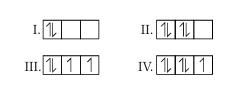
Select the correct options according to Hund's rule and Pauli exclusion principle.
1
Both I and II
2
Both II and III
3
Both I and III
4
Both III and IV
Official Solution
Correct Option:
(4)
Step 1: Understanding the Concept:
Hund's rule states that electrons fill degenerate orbitals singly with parallel spins before pairing. Pauli's exclusion principle states that no two electrons in an atom can have the same set of four quantum numbers. Step 2: Detailed Explanation: • Configuration I: Violates Pauli's principle (two electrons with same spin in same orbital is not allowed, but this shows opposite spins, so it might be correct if it were not for the pairing in the second p orbital without singly filling the first, which violates Hund's rule). • Configuration II: Violates Hund's rule (electrons pair in the first p orbital without occupying the other orbitals singly). • Configuration III: Follows Hund's rule (all p orbitals are singly occupied with parallel spins). • Configuration IV: Follows Pauli's principle (electrons in the same orbital have opposite spins) and is the correct ground state configuration. Configurations III and IV are correct according to the rules. Step 3: Final Answer:
The correct options are III and IV, which corresponds to option (D).
22
PYQ 2016
medium
chemistryID: met-2016
The Pauli exclusion principle applies to the following option.
1
H
2
H
3
H
4
He
Official Solution
Correct Option:
(3)
Step 1: Understanding the Concept:
Pauli's exclusion principle states that no two electrons in an atom can have the same set of four quantum numbers. It applies to systems with at least two electrons. Step 2: Detailed Explanation: • H: Has one electron. Principle does not apply as it deals with the arrangement of multiple electrons. • H : Has zero electrons. Principle does not apply. • H : Has two electrons. The principle applies to the configuration of these two electrons. • He : Has one electron (since He has Z=2, He has one electron). Principle does not apply. Step 3: Final Answer:
H is the correct answer, which corresponds to option (C).
23
PYQ 2017
medium
chemistryID: met-2017
For azimuthal quantum number , can have
1
only one value
2
3 values
3
5 values
4
7 values
Official Solution
Correct Option:
(4)
Step 1: Understanding the Concept:
The magnetic quantum number specifies the orbital orientation. Its values range from to including zero. Step 2: Detailed Explanation:
For , . This gives a total of 7 values. Step 3: Final Answer:
can have 7 values, option (D).
24
PYQ 2017
medium
chemistryID: met-2017
The ionisation energy of nitrogen is larger than that of oxygen because
1
the size of nitrogen atom is smaller
2
there is greater attraction of electrons towards the nucleus
3
half-filled p-orbitals of nitrogen have extra stability
4
None of the above
Official Solution
Correct Option:
(3)
Step 1: Understanding the Concept:
Ionisation energy generally increases across a period, but there is an exception between nitrogen and oxygen. Step 2: Detailed Explanation:
Electronic configurations:
\begin{itemize} \item Nitrogen (Z=7): (half-filled p-subshell) \item Oxygen (Z=8): (one paired electron in p-subshell)
\end{itemize}
The half-filled configuration of nitrogen is more stable due to symmetrical distribution and exchange energy. Removing an electron from this stable configuration requires more energy. In oxygen, the electron is removed from a paired orbital, which experiences electron-electron repulsion, making it easier to remove. Step 3: Final Answer:
The higher ionisation energy of nitrogen is due to the extra stability of its half-filled p-orbitals, option (C).
25
PYQ 2017
medium
chemistryID: met-2017
In hydrogen spectrum, the series of lines appearing in ultra violet region of electromagnetic spectrum are called
1
Balmer lines
2
Lyman lines
3
Pfund lines
4
Brackett lines
Official Solution
Correct Option:
(2)
Step 1: Understanding the Concept:
The hydrogen spectrum consists of several series of lines corresponding to electron transitions from higher energy levels to a fixed lower energy level. Step 2: Detailed Explanation:
\begin{itemize} \item Lyman series: Transitions from n>1 to n = 1. These lie in the ultraviolet region. \item Balmer series: Transitions from n>2 to n = 2. These lie in the visible region. \item Paschen series: Transitions from n>3 to n = 3. These lie in the infrared region. \item Brackett series: Transitions from n>4 to n = 4. These lie in the infrared region. \item Pfund series: Transitions from n>5 to n = 5. These lie in the infrared region.
\end{itemize} Step 3: Final Answer:
The series in the UV region is the Lyman series, option (B).
26
PYQ 2017
medium
chemistryID: met-2017
The set representing the correct order of first ionisation potential is
1
2
3
4
Official Solution
Correct Option:
(2)
Step 1: Understanding the Concept:
Ionisation potential (IP) generally decreases down a group due to increasing atomic size. Step 2: Detailed Explanation: Option (A): is incorrect. IP decreases down the group, so Li>Na>K.
Option (B): is correct. IP decreases down Group 2.
Option (C): is incorrect. Across a period, IP generally increases, but there are exceptions. N has higher IP than O, and C has higher IP than B. The correct order is N>C>B.
Option (D): is incorrect. IP decreases down the group, so C>Si>Ge. Step 3: Final Answer:
The correct order is Be>Mg>Ca, option (B).
27
PYQ 2017
medium
chemistryID: met-2017
For -orbital the values of are
1
2
3
4
Official Solution
Correct Option:
(2)
Step 1: Understanding the Concept:
The magnetic quantum number designates the orbital orientation. For a given azimuthal quantum number , ranges from to including zero. For an -orbital, . Step 2: Detailed Explanation:
If , then can have values: . This gives a total of 7 orbitals. Step 3: Final Answer:
Thus, the correct option is (B).
28
PYQ 2017
medium
chemistryID: met-2017
The energy of second Bohr orbit of the hydrogen atom is , hence the energy of fourth Bohr orbit would be
1
2
3
4
Official Solution
Correct Option:
(4)
Step 1: Understanding the Concept:
The energy of an electron in the nth orbit of a hydrogen atom is given by or generally . Step 2: Detailed Explanation:}}
Given: . For hydrogen, .
So, .
Then, .
Alternatively, since , .
. Step 3: Final Answer:
The energy of the fourth Bohr orbit is , option (D).
29
PYQ 2018
medium
chemistryID: met-2018
In the atomic spectrum of hydrogen, the spectral lines pertaining to electronic transition of to refers to
1
Lyman series
2
Balmer series
3
Paschen series
4
Brackett series
Official Solution
Correct Option:
(2)
Step 1: Understanding the Concept:
Spectral series in hydrogen correspond to transitions to different lower energy levels. Step 2: Detailed Explanation:
Transitions to belong to the Balmer series. Step 3: Final Answer:
The transition to belongs to the Balmer series.
30
PYQ 2018
medium
chemistryID: met-2018
Which of the following sets of quantum numbers is impossible arrangement?
1
2
3
4
Official Solution
Correct Option:
(4)
Step 1: Understanding the Concept:
ranges from to , and ranges from to . Step 2: Detailed Explanation:
For , possible values are . is not possible. Step 3: Final Answer:
The set with is impossible.
31
PYQ 2018
medium
chemistryID: met-2018
If uncertainty in position and velocity are equal, then uncertainty in momentum will be
1
2
3
4
Official Solution
Correct Option:
(1)
Step 1: Understanding the Concept:
Heisenberg's uncertainty principle: . Step 2: Detailed Explanation:
. . So , . Then . Step 3: Final Answer:
.
32
PYQ 2019
medium
chemistryID: met-2019
What is the general electronic configuration for 2nd row transition series?
1
[Ne]3d ,4s
2
[Ar]3d ,4s
3
[Kr]4d ,5s
4
[Xe]5d ,5s
Official Solution
Correct Option:
(3)
Step 1: Understanding the Concept:
2nd row transition series: Y (39) to Cd (48). Step 2: Detailed Explanation:
General configuration: [Kr]4d 5s Step 3: Final Answer:
[Kr]4d ,5s .
33
PYQ 2019
medium
chemistryID: met-2019
Which of the following is not true in Rutherford's nuclear model of atom?
1
Protons and neutrons are present inside nucleus
2
Volume of nucleus is very small as compared to volume of atom
3
The number of protons and neutrons are always equal
4
The number of electrons and protons are always equal
Official Solution
Correct Option:
(3)
Step 1: Understanding the Concept:
Rutherford model didn't know about neutrons. Step 2: Detailed Explanation:
Protons and neutrons are not necessarily equal in number. Step 3: Final Answer:
Statement (C) is not true.
34
PYQ 2019
medium
chemistryID: met-2019
All the s-block elements of the periodic table are placed in the groups ....
1
IA and IIA
2
IIIA and IVA
3
B sub groups
4
VA to VIIA
Official Solution
Correct Option:
(1)
Step 1: Understanding the Concept:
s-block elements have outermost s-electrons. Step 2: Detailed Explanation:
Group 1 (IA) has ns , Group 2 (IIA) has ns . Step 3: Final Answer:
Groups IA and IIA.
35
PYQ 2019
medium
chemistryID: met-2019
The magnetic quantum number for d-orbital is given by
1
2
2
0, ,
3
0, 1, 2
4
5
Official Solution
Correct Option:
(2)
Step 1: Understanding the Concept:
For d-orbital, , to . Step 2: Detailed Explanation:
Step 3: Final Answer:
Magnetic quantum numbers are 0, , .
36
PYQ 2019
medium
chemistryID: met-2019
Which of the following has highest second ionisation energy?
1
Chromium
2
Calcium
3
Iron
4
Cobalt
Official Solution
Correct Option:
(1)
Step 1: Understanding the Concept:
Second IE is energy to remove electron from M . Step 2: Detailed Explanation:
Cr: [Ar]3d 4s Cr : [Ar]3d (half-filled stable)
Removing another electron requires high energy. Step 3: Final Answer:
Chromium has highest second IE.
37
PYQ 2020
medium
chemistryID: met-2020
Which element has maximum first ionisation potential?
1
Cs
2
F
3
Na
4
He
Official Solution
Correct Option:
(4)
Concept:
Ionisation energy increases across a period and decreases down a group. Step 1: Trend in periodic table.
Alkali metals like Cs and Na have very low ionisation energy. Step 2: Comparison.
Fluorine has high ionisation energy but Helium has completely filled shell. Step 3: Conclusion.
Helium has maximum ionisation energy.
38
PYQ 2021
medium
chemistryID: met-2021
Whose name is not associated with the development of periodic table?
1
Prout's
2
Newlands
3
Rutherford
4
Lother Meyer
Official Solution
Correct Option:
(3)
Concept:
Periodic table development involved classification based on atomic properties. Step 1: Contributors.
• Newlands → Law of octaves
• Lothar Meyer → atomic volume periodicity
• Prout → early atomic weight hypothesis Step 2: Rutherford.
Rutherford contributed to atomic structure, not periodic classification.
About Atomic Structure - MET
Atomic Structure is a vital chapter for MET aspirants. Mastering the concepts covered in this chapter is essential for securing a top rank.
By rigorously practicing the previous year questions associated with this chapter, you can identify high-yield topics, understand the examiner's perspective, and boost your confidence during the actual exam.
Frequently Asked Questions
Why focus on Atomic Structure PYQs?
Analyzing PYQs for this specific chapter reveals the most frequently tested concepts and the typical complexity of questions, allowing you to tailor your study plan efficiently.
How to best use this analysis?
Review the topic breakdown to see which sub-topics within Atomic Structure carry the most weight. Then, tackle the questions iteratively to solidify your understanding.