van-Arkel method of purification of metals involves converting the metal to a:
1
Volatile stable compound
2
Non-volatile stable compound
3
Volatile unstable compound
4
None of the above
Official Solution
Correct Option:
(1)
Step 1: Understanding the van-Arkel method. The van-Arkel method is used for the purification of metals by converting the metal into a volatile compound, which can then be decomposed to obtain pure metal. Step 2: Explanation of the options. - (1) Volatile stable compound: This is the correct option. In the van-Arkel method, the metal is first converted into a volatile stable compound.
- (2) Non-volatile stable compound: This is not the method used in van-Arkel's purification technique.
- (3) Volatile unstable compound: While volatility is involved, the compound is stable and not unstable.
- (4) None of the above: This option is incorrect as option (1) is the correct answer. Step 3: Conclusion. The correct answer is (1) Volatile stable compound.
02
PYQ 2013
medium
chemistryID: met-2013
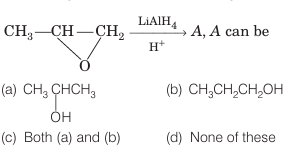
A can be
1
(a)
2
(b)
3
(c)
4
(d)
Official Solution
Correct Option:
(1)
Step 1: Formula / Definition}
Step 2: Calculation / Simplification}
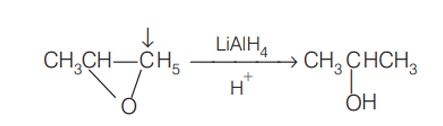
Unsymmetrical epoxide opening follows at less hindered carbon.
attacks terminal carbon.
Ring opens forming alkoxide on secondary carbon.
Protonation yields (Propan-2-ol). Step 3: Final Answer
03
PYQ 2022
medium
chemistryID: met-2022
Mond's process is used for refining ___. Whereas van Arkel method is used for refining ___.
1
lead, zirconium
2
zirconium, nickel
3
nickel, lead
4
nickel, titanium
Official Solution
Correct Option:
(4)
Concept: • Mond’s process refining of nickel using volatile
• Van Arkel method refining of titanium and zirconium using iodide process Step 1: Identify metals.
Mond’s Nickel
Van Arkel Titanium (also Zr) Step 2: Match option.
Correct pair: Nickel, Titanium
About Refining - MET
Refining is a vital chapter for MET aspirants. Mastering the concepts covered in this chapter is essential for securing a top rank.
By rigorously practicing the previous year questions associated with this chapter, you can identify high-yield topics, understand the examiner's perspective, and boost your confidence during the actual exam.
Frequently Asked Questions
Why focus on Refining PYQs?
Analyzing PYQs for this specific chapter reveals the most frequently tested concepts and the typical complexity of questions, allowing you to tailor your study plan efficiently.
How to best use this analysis?
Review the topic breakdown to see which sub-topics within Refining carry the most weight. Then, tackle the questions iteratively to solidify your understanding.