In which of the following complex ion, the central metal ion is in a state of hybridisation?
1
2
3
4
Official Solution
Correct Option:
(1)
Step 1: Concept
hybridization indicates an outer orbital octahedral complex. Step 2: Analysis
is a weak field ligand and cannot pair up electrons in , forcing the use of outer orbitals. Strong ligands like and typically form complexes. Step 3: Conclusion $ [CoF₆]³- 4s, 4p, 4d sp³d²$ hybridization. Final Answer: (A)
02
PYQ 2009
medium
chemistryID: met-2009
The number of significant figures in the numbers and 48000.50 are respectively
1
5 and 6
2
5 and 7
3
2 and 7
4
2 and 6
Official Solution
Correct Option:
(2)
Step 1: Scientific Notation
In , trailing zeros after the decimal point are significant. The power of 10 is ignored. Total: 5 figures (4, 8, 0, 0, 0). Step 2: Decimal Numbers
In 48000.50, all digits are significant. Zeros between non-zero digits (4, 8, and 5) and trailing zeros after a decimal are significant. Total: 7 figures. Final Answer: (b)
03
PYQ 2011
medium
chemistryID: met-2011
Which of the following ions form most stable complex compound?
1
Mn
2
Ni
3
Fe
4
Cu
Official Solution
Correct Option:
(4)
Step 1: Identifying the stability of metal complexes. Copper ions (Cu ) form the most stable complex compounds due to their smaller ionic size and higher charge density compared to the other ions listed. Step 2: Explanation of the options. - (1) Mn : Manganese ions do not form as stable complexes compared to copper .
- (2) Ni : Nickel ions form stable complexes, but not as stable as copper .
- (3) Fe : Iron ions are not as stable as copper ions in forming complexes.
- (4) Cu : Copper ions have a high charge density and form the most stable complexes. Step 3: Conclusion. The correct answer is (4) Cu .
04
PYQ 2011
medium
chemistryID: met-2011
Coordination number of Fe in the complexes [Fe(CN) ] , [Fe(CN) ] and [FeCl ] would be respectively:
1
6, 4, 6
2
6, 6, 4
3
6, 3, 3
4
2, 3, 3
Official Solution
Correct Option:
(2)
Step 1: Understanding the coordination number. Coordination number refers to the number of ligands directly bonded to the central metal ion in a complex. Step 2: Explanation of the options. - (1) 6, 4, 6: This is not correct, as the coordination number for [FeCl ] is 4, not 6.
- (2) 6, 6, 4: This is correct. [Fe(CN) ] and [Fe(CN) ] both have coordination number 6, and [FeCl ] has coordination number 4.
- (3) 6, 3, 3: This is incorrect for the given complexes.
- (4) 2, 3, 3: This is incorrect for all three complexes. Step 3: Conclusion. The correct answer is (2) 6, 6, 4.
05
PYQ 2013
medium
chemistryID: met-2013
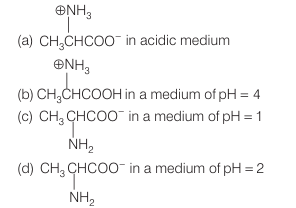
Alanine forms Zwitter ion which exists as
1
A
2
B
3
C
4
D
Official Solution
Correct Option:
(2)
Step 1: Formula / Definition}
Step 2: Calculation / Simplification}
Zwitter ion exists at isoelectric point (around pH ).
Among the given options, pH = 4 is closest to the condition where dipolar ion form is significant.
Thus, alanine exists predominantly as zwitter ion in this medium. Step 3: Final Answer
The complex [Fe(H O) NO] is formed in the ring test for nitrate ion. This complex is formed by charge transfer in which
1
Fe changes to Fe and NO changes to NO
2
Fe changes to Fe and NO changes to NO
3
Fe changes to Fe and NO changes to NO
4
No charge transfer takes place
Official Solution
Correct Option:
(3)
Concept:
Charge transfer in coordination complexes Step 1: Fe initially in Fe state. Step 2: During complex formation, Fe is reduced to Fe . Step 3: NO is oxidized to NO . Step 4: Thus involves charge transfer between Fe and NO. Conclusion:
Correct answer = (C)
08
PYQ 2020
medium
chemistryID: met-2020
Which of the following is an organometallic compound?
1
Lithium acetate
2
Methyl lithium
3
Lithium dimethyl amide
4
Lithium methoxide
Official Solution
Correct Option:
(2)
Concept:
An organometallic compound is defined as a compound containing at least one direct metal-carbon (M–C) bond, where the carbon is part of an organic group. Step 1: Analyze each option. • (A) Lithium acetate — (or ).
Lithium is bonded to oxygen atoms (ionic bond), not directly to carbon. The carbon of the acetate group is bonded to oxygen, not to lithium.
Not organometallic (it is a metal carboxylate salt). • (B) Methyl lithium — .
Lithium is directly bonded to the carbon of the methyl group ( ). This is a direct metal–carbon sigma bond.
Organometallic compound (a classic example of an organolithium reagent). • (C) Lithium dimethyl amide — (or ).
Lithium is bonded to nitrogen, not to carbon. The methyl groups are attached to nitrogen, not directly to lithium.
Not organometallic (it is a metal amide). • (D) Lithium methoxide — (or ).
Lithium is bonded to oxygen (alkoxide ion), not directly to carbon. The methyl group is attached to oxygen.
Not organometallic (it is a metal alkoxide). Step 2: Conclusion.
Only methyl lithium contains a direct lithium–carbon bond, making it the only organometallic compound among the options.
09
PYQ 2020
medium
chemistryID: met-2020
Which of the following complexes is an outer orbital complex?
1
2
3
4
Official Solution
Correct Option:
(3)
Concept:
Outer orbital complexes use hybridization (weak field ligands). Step 1: Check ligand strength.
= weak field → outer orbital. Step 2: Conclusion.
is outer orbital.
10
PYQ 2020
medium
chemistryID: met-2020
What is the value of x on the complex ion?
1
+2
2
-2
3
0 (zero)
4
+4
Official Solution
Correct Option:
(2)
Concept:
Charge of complex = metal + ligands. Step 1: Oxidation state of Ni.
Ni = +2 Step 2: Ligand charge.
Each CN = -1, total = -4 Step 3: Total charge.
11
PYQ 2020
medium
chemistryID: met-2020
The correct representation of a complex ion is:
1
2
3
4
Official Solution
Correct Option:
(4)
Concept:
In naming coordination complexes (and writing their formulas), ligands are arranged in alphabetical order according to their names (ignoring prefixes like di-, tri-, tetra-). Step 1: Identify the ligands and their names.
• → ammine (starts with 'a')
• → aqua (starts with 'a' as well — compare: 'a' of ammine vs 'a' of aqua → then compare second letter: m vs q → 'a' then 'm' comes before 'q'? Actually alphabetical: 'a' then next letter. 'ammine' (a m m i n e) vs 'aqua' (a q u a). 'm' comes before 'q', so ammine comes before aqua.)
• → chloro (starts with 'c', which comes after 'a') Step 2: Correct alphabetical order.
However, both ammine and aqua start with 'a'. Compare second letters: 'm' (ammine) vs 'q' (aqua). Since 'm' comes before 'q', ammine comes before aqua. Thus, the correct sequence is: first, then , then . Step 3: Write the formula.
This matches option (D). Step 4: Why not other options?
• (A) and (B) do not follow alphabetical order.
• (C) has before , which is incorrect because 'aqua' (a) comes before 'chloro' (c).
12
PYQ 2023
medium
chemistryID: met-2023
Match the complexes in Column-I with their hybridisation in Column-II.
Column-I Column-II A. 1. B. 2. C. 3. D. 4.
1
A-1, B-2, C-3, D-4
2
A-2, B-1, C-4, D-3
3
A-1, B-3, C-2, D-4
4
A-2, B-3, C-1, D-4
Official Solution
Correct Option:
(2)
Concept:
Hybridisation depends on:
•Nature of ligand (strong/weak field)
•Geometry (tetrahedral / square planar / octahedral) Step 1: Analyze each complex (A) :}
CO is strong field ligand → tetrahedral complex
(B) :}
CN strong field → square planar
(C) :}
NH weak/moderate field → octahedral outer orbital
(D) :}
CN strong field → inner orbital octahedral
Step 2: Matching
13
PYQ 2024
medium
chemistryID: met-2024
The oxidation state of Cr in , , respectively are:
1
% option
(B)
2
3
4
Official Solution
Correct Option:
(3)
Concept: •Neutral ligands: → charge = 0
•Anionic ligands: , , Step 1: •Complex ion =
• is neutral
Step 2: • is neutral ligand
•Overall molecule is neutral
Step 3: Let oxidation state = Final:
14
PYQ 2024
medium
chemistryID: met-2024
The spin only magnetic moment of is_ _ _ _ (Nearest integer).
Official Solution
Correct Option:
(1)
Concept:
Spin-only magnetic moment:
where = number of unpaired electrons. Step 1: Oxidation state of Ni.
Let oxidation state of Ni be :
Step 2: Electronic configuration of Ni .
Ni (Z = 28):
Ni : Step 3: Geometry and ligand field.
Cl is a weak field ligand. is tetrahedral (Ni with weak field ligands forms tetrahedral complexes). Tetrahedral complexes are always high spin. Step 4: Crystal field splitting for tetrahedral.
For tetrahedral :
- orbital (lower energy): 4 electrons → completely paired (2 pairs)
- orbital (higher energy): 4 electrons → 2 pairs Number of unpaired electrons:
Step 5: Magnetic moment.
Nearest integer = 3.
15
PYQ 2024
medium
chemistryID: met-2024
Match List-I (Compound) with List-II (Hybridisation): List-I & List-II
A. & I.
B. & II.
C. & III.
D. & IV. Choose the correct match:
1
A-IV, B-III, C-I, D-II
2
A-IV, B-III, C-II, D-I
3
A-IV, B-I, C-III, D-II
4
A-IV, B-II, C-III, D-I
Official Solution
Correct Option:
(1)
Concept:
Hybridisation depends on steric number (number of bonds + lone pairs). Step 1: •Coordination number = 5
•Hybridisation =
Step 2: •Coordination number = 5
•Hybridisation =
Step 3: •Total regions = 6 (5 bonds + 1 lone pair)
•Hybridisation =
Step 4: •Coordination number = 5
•Uses inner d-orbitals
•Hybridisation =
About Coordination Compounds - MET
Coordination Compounds is a vital chapter for MET aspirants. Mastering the concepts covered in this chapter is essential for securing a top rank.
By rigorously practicing the previous year questions associated with this chapter, you can identify high-yield topics, understand the examiner's perspective, and boost your confidence during the actual exam.
Frequently Asked Questions
Why focus on Coordination Compounds PYQs?
Analyzing PYQs for this specific chapter reveals the most frequently tested concepts and the typical complexity of questions, allowing you to tailor your study plan efficiently.
How to best use this analysis?
Review the topic breakdown to see which sub-topics within Coordination Compounds carry the most weight. Then, tackle the questions iteratively to solidify your understanding.