Capacitors And Capacitance
8 previous year questions.
High-Yield Trend
Chapter Questions 8 MCQs
(1) Find the capacitance of the system.
(2) If the air between the capacitor is replaced by a dielectric medium of dielectric constant 3, what will be the potential difference between the two conductors?
(3) If the charges on two conductors are changed to +160µC and −160µC, will the capacitance of the system change? Give reason for your answer.
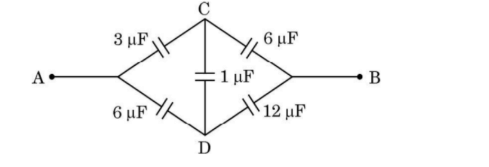
Read the following paragraphs and answer the questions that follow:
A capacitor is a system of two conductors separated by an insulator. In practice, the two conductors have charges and with a potential difference between them. The ratio is a constant, denoted by , and is called the capacitance of the capacitor. It is independent of or . It depends only on the geometrical configuration (shape, size, separation) of the two conductors and the medium separating the conductors.
When a parallel plate capacitor is charged, the electric field is localized between the plates and is uniform throughout. When a slab of a dielectric is inserted between the charged plates (charge density ), the dielectric is polarized by the field. Consequently, opposite charges appear on the faces of the slab, near the plates, with surface charge density of magnitude . For a linear dielectric, is proportional to . Introduction of a dielectric changes the electric field, and hence, the capacitance of a capacitor, and hence, the energy stored in the capacitor. Like resistors, capacitors can also be arranged in series or in parallel or in a combination of series and parallel.
A circuit consisting of a capacitor C, a resistor of resistance R and an ideal battery of emf V, as shown in figure is known as RC series circuit. 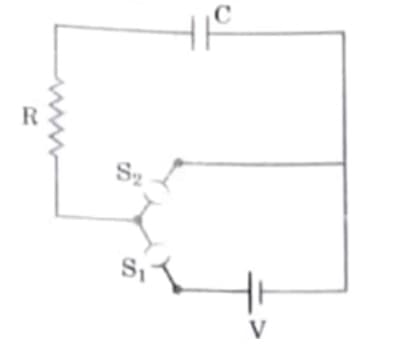
As soon as the circuit is completed by closing key S₁ (keeping S₂ open) charges begin to flow between the capacitor plates and the battery terminals. The charge on the capacitor increases and consequently the potential difference Vc (= q/C) across the capacitor also increases with time. When this potential difference equals the potential difference across the battery, the capacitor is fully charged (Q = VC). During this process of charging, the charge q on the capacitor changes with time t as
The charging current can be obtained by differentiating it and using
Consider the case when R = 20 kΩ, C = 500 μF and V = 10 V.
About Capacitors And Capacitance - CBSE-CLASS-XII
Capacitors And Capacitance is a vital chapter for CBSE-CLASS-XII aspirants. Mastering the concepts covered in this chapter is essential for securing a top rank.
By rigorously practicing the previous year questions associated with this chapter, you can identify high-yield topics, understand the examiner's perspective, and boost your confidence during the actual exam.
Frequently Asked Questions
Why focus on Capacitors And Capacitance PYQs?
Analyzing PYQs for this specific chapter reveals the most frequently tested concepts and the typical complexity of questions, allowing you to tailor your study plan efficiently.
How to best use this analysis?
Review the topic breakdown to see which sub-topics within Capacitors And Capacitance carry the most weight. Then, tackle the questions iteratively to solidify your understanding.