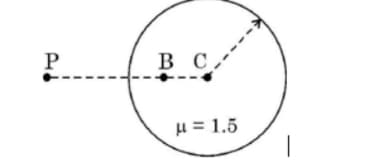
An air bubble is trapped at point B (CB = 20 cm) in a glass sphere of radius 40 cm and refractive index 1.5 as shown in the figure. Find the nature and position of the image of the bubble as seen by an observer at point P.
Official Solution
Correct Option:
(1)
Applying Refraction at Spherical Surface:
Given Information: Radius of the glass sphere, . Refractive index of the glass, . Distance of the bubble from the center of the sphere, . Therefore, the distance of the bubble from the refracting surface (point B), . (Negative because it's opposite the direction of incident light). Refraction at a Spherical Surface: The formula for refraction at a spherical surface is: where: is the refractive index of the medium where the object is located (glass = 1.5) is the refractive index of the medium where the image is formed (air = 1) is the object distance is the image distance is the radius of curvature of the surface Applying the Formula:
(Negative because the center of curvature is on the same side as the incident light). Substituting these values into the formula: Interpretation: The image distance . The negative sign indicates that the image is formed on the same side of the refracting surface as the object (the air bubble). Therefore: Position: The image is located 16 cm from point B. Nature: Since the image is formed on the same side as the object, it is a virtual image. The image of the air bubble is virtual and is located 16 cm from point B on the same side as the bubble.
02
PYQ 2025
easy
physicsID: cbse-cla
A beam of light of wavelength 720 nm in air enters water (refractive index ). Its wavelength in water will be:
1
540 nm
2
480 nm
3
420 nm
4
720 nm
Official Solution
Correct Option:
(1)
When light enters a different medium, its wavelength changes according to the refractive index of the new medium. The relationship between the wavelength in air ( ) and the wavelength in a medium ( ) is given by: Where:
- is the wavelength of light in air,
- is the refractive index of water. Substitute the known values: Thus, the wavelength of the light in water is .
03
PYQ 2025
hard
physicsID: cbse-cla
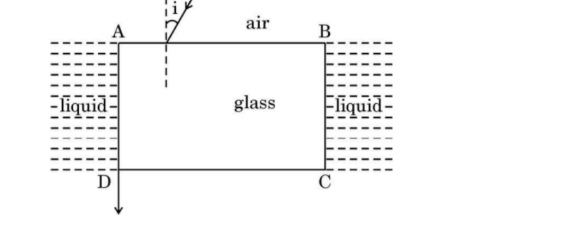
A rectangular glass slab ABCD (refractive index 1.5) is surrounded by a transparent liquid (refractive index 1.25) as shown in the figure. A ray of light is incident on face AB at an angle such that it is refracted out grazing the face AD. Find the value of angle .
Official Solution
Correct Option:
(1)
We use Snell's law to solve this problem, which relates the angle of incidence and refraction between two media: Where:
- and are the refractive indices of the two media,
- is the angle of incidence in the first medium,
- is the angle of refraction in the second medium. Step 1: Conditions for Grazing Refraction
At the glass -liquid interface, the ray is refracted out grazing the face AD, meaning the angle of refraction at the glass -liquid interface must be . Step 2: Using Snell’s Law at the Glass -Liquid Interface
- The refractive index of glass is ,
- The refractive index of the liquid is ,
- The angle of refraction . Using Snell's Law at the interface: Step 3: Calculating the Angle
Now, calculate the angle of incidence : Thus, the angle of incidence .
04
PYQ 2025
easy
physicsID: cbse-cla
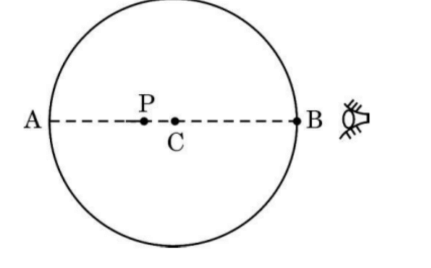
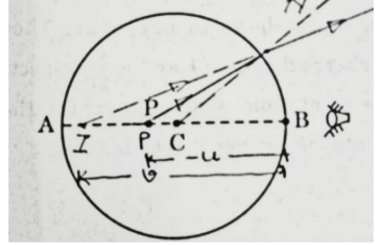
An air bubble is trapped at point P (CP = 1.75 cm) in a spherical glass ball (n = 1.5) of radius 7 cm as shown in the figure. Find the nature and position of the image when viewed from side B. Show the image formation by drawing a ray diagram.
Official Solution
Correct Option:
(1)
For light going from denser to rarer medium: Substitute the given values: Simplifying: Thus: The nature of the image is virtual.
05
PYQ 2025
medium
physicsID: cbse-cla
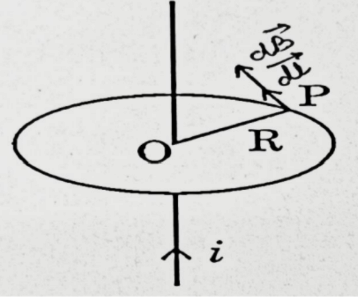
Use Ampere’s law to derive the expression for the magnetic field due to a long straight current-carrying wire of infinite length.
Official Solution
Correct Option:
(1)
Ampere's Law and Magnetic Field Due to a Current-Carrying Wire
According to Ampere’s law, the magnetic field due to a current-carrying conductor can be derived using the following equation:
Where:
represents the line integral around a closed loop
is the magnetic field at a point
is an infinitesimal vector along the loop
is the total current passing through the loop
is the permeability of free space
Assumptions for Deriving the Magnetic Field Due to an Infinitely Long Straight Wire:
The wire carries a current .
The magnetic field around the wire is circular and symmetric, so its magnitude depends only on the radial distance from the wire.
A circular loop of radius is chosen, centered at the wire.
By symmetry, the magnetic field at every point on the loop is tangent to the circle, and the magnitude of is constant at all points on the loop. Hence, the line integral becomes:
Using Ampere’s law:
Solving for :
Final Answer: Thus, the magnetic field at a distance from an infinitely long straight wire carrying a current is:
06
PYQ 2025
medium
physicsID: cbse-cla
A glass slab ( ) of thickness 6 cm is placed over a paper. The shift in the letters printed on the paper will be:
1
2 cm
2
1 cm
3
4 cm
4
3 cm
Official Solution
Correct Option:
(1)
When a glass slab is placed over an object, the apparent shift in position is related to the thickness of the slab and its refractive index. The formula for the apparent shift is given by:
where:
- is the thickness of the slab,
- is the refractive index of the material. Given:
- ,
- . Substituting the values:
Thus, the shift in the letters printed on the paper is 2 cm.
07
PYQ 2025
medium
physicsID: cbse-cla
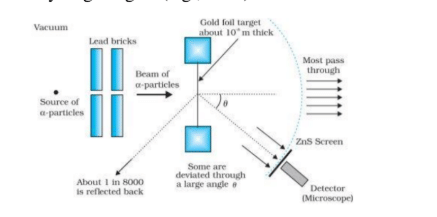
Describe briefly the Geiger-Marsden scattering experiment. Depict the graph showing the variation of the number of scattered particles detected with the scattering angle. How did this graph lead to the discovery of the nucleus?
Official Solution
Correct Option:
(1)
Geiger-Marsden Scattering Experiment: The Geiger-Marsden experiment, conducted in 1909 by Hans Geiger and Ernest Marsden under the guidance of Ernest Rutherford, involved the scattering of alpha particles by a thin gold foil. The primary objective of the experiment was to investigate the structure of the atom by studying how alpha particles interact with matter. In the experiment:
- A beam of alpha particles (helium nuclei) was directed at a thin gold foil.
- A detector surrounded the foil to detect the scattered alpha particles at various angles.
- The alpha particles were expected to pass through the gold foil with little deflection if the atom was composed of uniform matter. However, what they observed was surprising: - While most of the alpha particles passed through the foil with only slight deflections, some alpha particles were deflected by large angles, and some even bounced back at angles close to 180°. This observation led to the conclusion that the atom is not made of uniformly distributed matter, but rather has a small, dense, positively charged core at its center. This core was later identified as the nucleus, which contains most of the atom’s mass. Graph Showing Variation of Number of Scattered Particles with Scattering Angle:
The graph showing the number of scattered particles as a function of scattering angle typically has the number of particles (N) on the y-axis and the scattering angle ( ) on the x-axis. The graph is generally bell-shaped, with most of the alpha particles being scattered at small angles (close to 0°), while fewer particles are scattered at large angles. The number of particles scattered at very large angles (e.g., 180°) is minimal. The sharp increase in the number of particles scattered at small angles and the small number of particles scattered at large angles led to a significant breakthrough in understanding atomic structure. Discovery of the Nucleus:
The results of the Geiger-Marsden experiment led Rutherford to propose that the atom has a small, dense, positively charged nucleus at its center. The fact that a small fraction of alpha particles were scattered at large angles suggested that there was a very small, dense, positively charged center within the atom (the nucleus) that repelled the positively charged alpha particles. This was in stark contrast to the previously accepted plum pudding model, where the positive charge was assumed to be spread out evenly throughout the atom. Thus, the Geiger-Marsden experiment, combined with Rutherford’s analysis, directly contributed to the discovery of the atomic nucleus and the development of the nuclear model of the atom.
08
PYQ 2025
easy
physicsID: cbse-cla
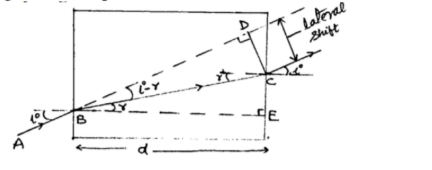
A ray of light is incident at an angle on a parallel sided glass slab of thickness and gets refracted into the slab at angle . Draw a ray diagram to show its path as it emerges out of the slab. Hence, obtain an expression for the lateral shift of the ray. Under what condition will the shift be minimum?
Official Solution
Correct Option:
(1)
Let’s consider the ray diagram for a parallel sided glass slab: 1. A ray of light is incident on the glass slab at an angle .
2. The ray is refracted inside the glass at an angle .
3. The ray then emerges out of the slab at the same angle (because the glass slab is parallel-sided). From the diagram, we see that after the light emerges from the slab, it undergoes a lateral shift due to the thickness of the slab. Derivation of Lateral Shift:
Let the lateral shift be , which is the horizontal displacement of the emergent ray from the original path. The light undergoes refraction twice:
1. First, when it enters the slab at angle , it refracts to angle .
2. Second, when it exits the slab, it refracts back to the same angle . Let the thickness of the slab be , and the distance traveled inside the slab be (since the ray is traveling at angle ). The lateral shift is given by the following formula:
where:
- is the angle of incidence,
- is the angle of refraction,
- is the thickness of the slab. Condition for Minimum Shift:
The lateral shift will be minimum when the angle of incidence is equal to the angle of refraction , i.e., when . This would make the ray pass straight through the slab without any lateral shift. Thus, the condition for the minimum lateral shift is when the incident angle is equal to the refracted angle ( ).
09
PYQ 2026
medium
physicsID: cbse-cla
A tank is filled with a liquid to a height of . The apparent depth of a needle lying at the bottom of the tank is measured to be . Calculate the speed of light in the liquid.
Official Solution
Correct Option:
(1)
Concept:
Refractive index of a medium:
Also:
Where:
(speed of light in vacuum) = speed of light in medium
Step 1: Calculate refractive index. Step 2: Find speed of light in liquid.Final Answer:
About Refraction - CBSE-CLASS-XII
Refraction is a vital chapter for CBSE-CLASS-XII aspirants. Mastering the concepts covered in this chapter is essential for securing a top rank.
By rigorously practicing the previous year questions associated with this chapter, you can identify high-yield topics, understand the examiner's perspective, and boost your confidence during the actual exam.
Frequently Asked Questions
Why focus on Refraction PYQs?
Analyzing PYQs for this specific chapter reveals the most frequently tested concepts and the typical complexity of questions, allowing you to tailor your study plan efficiently.
How to best use this analysis?
Review the topic breakdown to see which sub-topics within Refraction carry the most weight. Then, tackle the questions iteratively to solidify your understanding.