Current Electricity
69 previous year questions.
High-Yield Trend
Chapter Questions 69 MCQs
Reason (R): The drift velocity is superposed over large random velocities of electrons.
\includegraphics[width=0.5\linewidth]{22.png}
\includegraphics[width=0.5\linewidth]{17.png}
% Wheatstone Bridge Diagram Explanation Circuit Diagram and Condition:
The Wheatstone bridge consists of a quadrilateral circuit with four resistors, and , a galvanometer , and a battery. The galvanometer is connected between the junctions of and , and and . The battery is connected across the bridge. % Correct answer Correct Answer: The condition for no current to flow through the galvanometer is when the bridge is balanced, given by the equation:
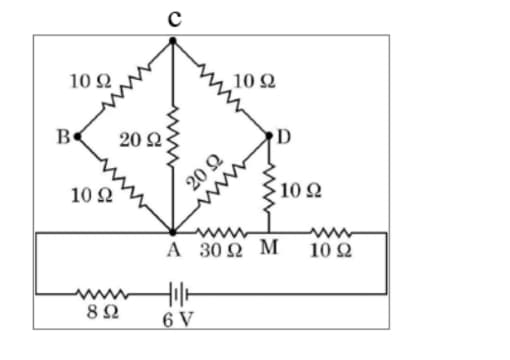
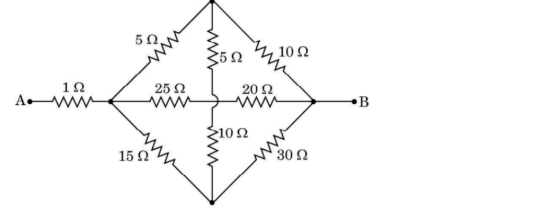
(i) Effective resistance between points A and M, and
(ii) Power supplied by the battery.
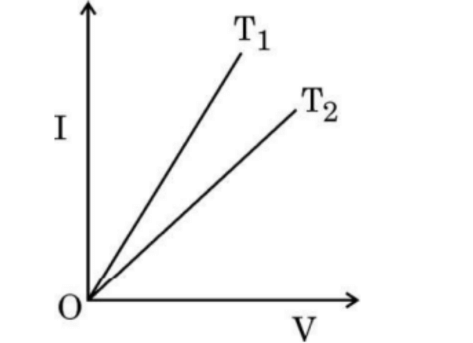
(i) Resistances
(ii) Resistivities
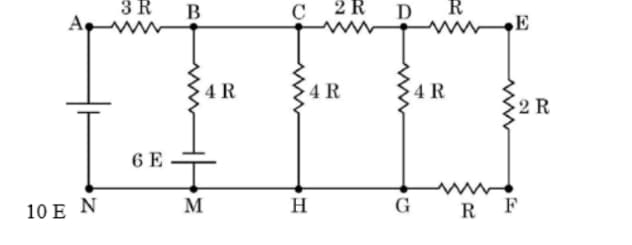
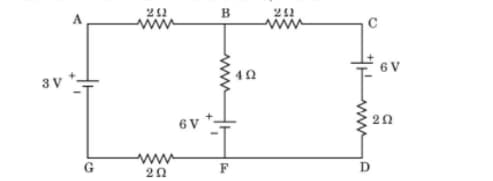
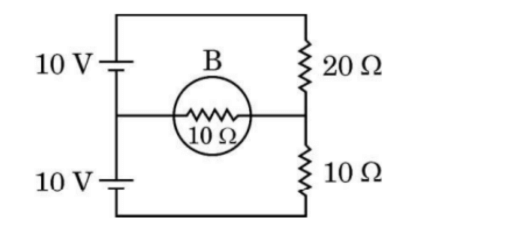
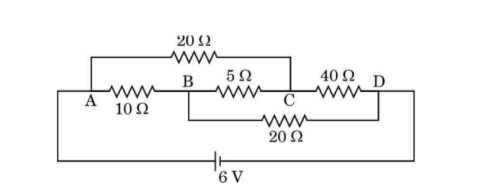
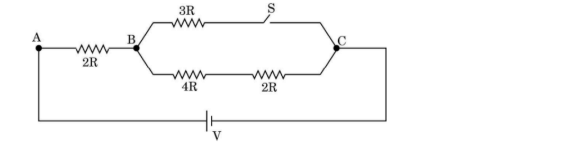
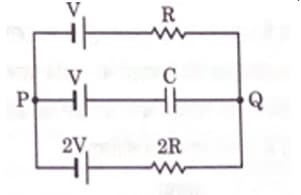
and
A battery of emf and internal resistance is connected to a rheostat. When a current of 2A is drawn from the battery, the potential difference across the rheostat is 5V. The potential difference becomes 4V when a current of 4A is drawn from the battery. Calculate the value of and .
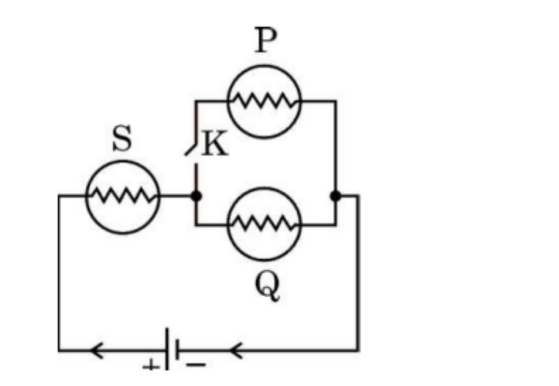
[(i)] Compare the brightness of bulbs P and Q with that of bulb S when key K is closed.
[(ii)] Compare the brightness of the bulbs S and Q when the key K is opened.
Justify your answer in both cases.
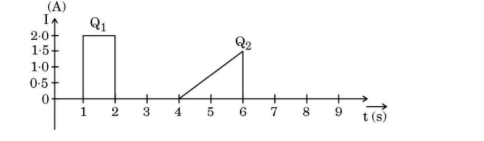
(I) Expression for current I and maximum current:.
(II) Terminal voltage V and its maximum value:.
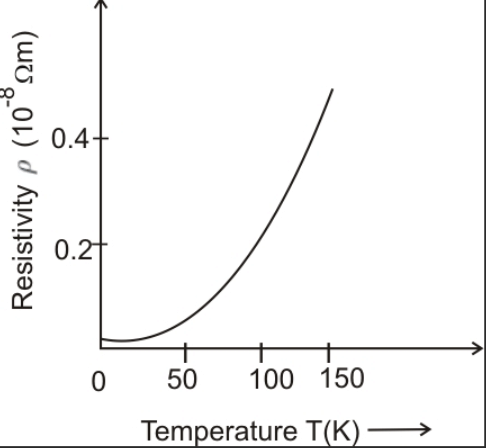
In a metallic conductor, an electron, moving due to thermal motion, suffers collisions with the heavy fixed ions but after collision, it will emerge with the same speed but in random directions. If we consider all the electrons, their average velocity will be zero. When an electric field is applied, electrons move with an average velocity known as drift velocity (vd). The average time between successive collisions is known as relaxation time (τ ). The magnitude of drift velocity per unit electric field is called mobility (μ). An expression for current through the conductor can be obtained in terms of drift velocity, number of electrons per unit volume (n), electronic charge (−e), and the cross-sectional area (A) of the conductor. This expression leads to an expression between current density (-j) and the electric field (E→ ). Hence, an expression for resistivity (ρ) of a metal is obtained. This expression helps us to understand increase in resistivity of a metal with increase in its temperature, in terms of change in the relaxation time (τ ) and change in the number density of electrons (n).
Keeping the cell connected, the length of the conductor is increased to by gradually stretching it.
If and are the initial and final values of resistance, and and are the initial and final values of drift velocity, find the relation between:
(i) and
(ii) and
(i) the equivalent emf of the combination
(ii) the equivalent internal resistance of the combination
(iii) the current drawn from the combination
About Current Electricity - CBSE-CLASS-XII
Current Electricity is a vital chapter for CBSE-CLASS-XII aspirants. Mastering the concepts covered in this chapter is essential for securing a top rank.
By rigorously practicing the previous year questions associated with this chapter, you can identify high-yield topics, understand the examiner's perspective, and boost your confidence during the actual exam.
Frequently Asked Questions
Why focus on Current Electricity PYQs?
Analyzing PYQs for this specific chapter reveals the most frequently tested concepts and the typical complexity of questions, allowing you to tailor your study plan efficiently.
How to best use this analysis?
Review the topic breakdown to see which sub-topics within Current Electricity carry the most weight. Then, tackle the questions iteratively to solidify your understanding.