A particle of mass and charge describes a circular path of radius in a magnetic field. If its mass and charge were and respectively, the radius of its path would be:
1
2
3
4
Official Solution
Correct Option: (4)
The radius of a charged particle moving in a magnetic field is given by the formula:
where:
- is the mass of the particle,
- is the velocity of the particle,
- is the charge of the particle,
- is the magnetic field strength. For the given problem, the radius of the path is for the particle with mass and charge . So, the radius of the path is: Now, if the mass becomes and the charge becomes , the new radius will be:
Comparing this with equation (1), we get: Hence, the new radius of the path is .
02
PYQ 2025
hard
physicsID: cbse-cla
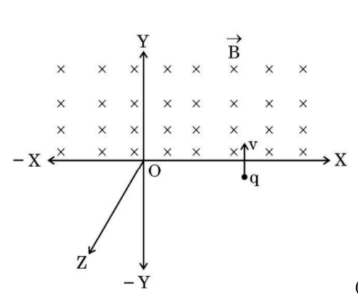
A particle having charge enters a uniform magnetic field as shown in the figure. The particle will describe:
1
a circular path in XZ plane
2
a semicircular path in XY plane
3
a helical path with its axis parallel to Y-axis
4
a semicircular path in YZ plane
Official Solution
Correct Option: (2)
From the figure, the particle has an initial velocity along the positive Y-axis, and the magnetic field is directed into the plane of the paper (denoted by crosses). The magnetic force on a moving charged particle is given by the Lorentz force: - Here, is along and is into the page ( ). - Using the right-hand rule for , the force acts along the direction. - This force acts as the centripetal force, causing the charged particle to undergo circular motion in the XY plane. Since the particle enters perpendicularly and no velocity component exists along the magnetic field, the motion is confined to the plane. The particle describes a semicircular path before possibly exiting the field region. Final answer: Semicircular path in XY plane
03
PYQ 2025
medium
physicsID: cbse-cla
A proton and an -particle enter with the same velocity in a uniform magnetic field such that . The ratio of the radii of their paths is:
1
2
2
3
4
4
Official Solution
Correct Option: (2)
When a charged particle enters a uniform magnetic field perpendicular to its velocity, it experiences a centripetal force due to the Lorentz force, and follows a circular path. The radius of the circular motion is given by the formula:
where: - is the mass of the particle - is the velocity - is the charge - is the magnetic field strength Let’s compute the radius for both particles: For the proton: - mass - charge For the -particle (which is a helium nucleus): - mass (2 protons + 2 neutrons) - charge (due to 2 protons) Now, take the ratio of the radii: Hence,
04
PYQ 2025
hard
physicsID: cbse-cla
A charged particle is moving in a circular path with velocity in a uniform magnetic field . It is made to pass through a sheet of lead and as a consequence, it looses one half of its kinetic energy without change in its direction. How will (1) the radius of its path change? (2) its time period of revolution change?
Official Solution
Correct Option: (1)
(1) The radius of the path will decrease. Since the kinetic energy is reduced by half, the velocity decreases. The radius of a charged particle's path in a magnetic field is given by: Since the velocity is halved, the radius will also be halved.
(2) The time period of revolution will remain unchanged. The time period of revolution for a charged particle moving in a magnetic field is given by: Since the magnetic field and the charge are constant, the time period is independent of the kinetic energy, and hence remains the same.
05
PYQ 2025
medium
physicsID: cbse-cla
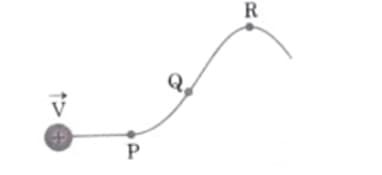
A proton moving with velocity in a non-uniform magnetic field traces a path as shown in the figure. The path followed by the proton is always in the plane of the paper. What is the direction of the magnetic field in the region near points P, Q, and R? What can you say about relative magnitude of magnetic fields at these points?
Official Solution
Correct Option: (1)
Analysis of Proton's Path in a Non-uniform Magnetic Field
Given:
A proton moves with velocity in a plane (paper plane)
The trajectory is curved, suggesting a non-uniform magnetic field
We are to determine the direction and relative magnitude of at points P, Q, and R.
Key Concepts:
The magnetic force on a moving charge is given by:
For circular/curved motion: Thus, a smaller radius indicates a stronger magnetic field.
Direction of magnetic field can be determined using the right-hand rule: - Fingers in direction of - Curl toward (curvature) - Thumb gives
Answer:
➡ Direction of Magnetic Field:
Since the path of the proton (positive charge) curves to the left, the magnetic force is directed toward the center of curvature. Using the right-hand rule with velocity tangents, we find:
At all points P, Q, R, the magnetic field is perpendicular to the plane and directed into the page (denoted by a cross “×”).
➡ Relative Magnitude of Magnetic Field:
Since: The smaller the radius of curvature, the stronger the magnetic field.
Looking at the image:
At point Q: radius is smallest ⇒ is the strongest.
At point R: intermediate radius ⇒ is moderate.
At point P: largest radius ⇒ is the weakest.
✔ Final Answer:
Direction of at P, Q, R: Into the page
Relative magnitudes:
06
PYQ 2025
hard
physicsID: cbse-cla
A particle of mass and charge moving with velocity is subjected to a uniform electric field . The particle will initially have a tendency to move in a circle of radius:
1
in x–y plane
2
in x–z plane
3
in x–y plane
4
in y–z plane
Official Solution
Correct Option: (3)
Given:
- A charged particle of mass and charge
- Initial velocity (i.e., along x-direction)
- Uniform electric field (i.e., along y-direction) As the electric field is perpendicular to the initial velocity, it exerts a continuous force on the particle in the y-direction. This force causes acceleration in the y-direction while the velocity remains in the x-direction. Thus, the particle experiences a centripetal force that curves its path, similar to uniform circular motion in the x–y plane. Using centripetal force:
Hence, the particle moves in a circular path of radius:
And since both the velocity and electric field lie in the x–y plane, the circular motion also occurs in the x–y plane.
07
PYQ 2026
medium
physicsID: cbse-cla
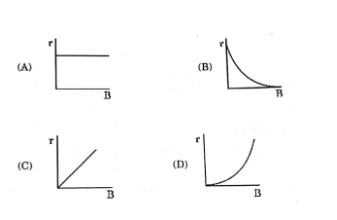
A charged particle is moving in a uniform magnetic field with a constant speed in a circular path of radius . Which of the following graphs represents the variation of radius of the circle, with the magnitude of magnetic field ?
1
A
2
B
3
C
4
D
Official Solution
Correct Option: (2)
The radius of the circular path of a charged particle moving in a magnetic field is related to the magnetic field by the following equation:
where:
- is the mass of the particle,
- is the velocity of the particle,
- is the charge of the particle,
- is the magnetic field strength. From the equation, we can see that is inversely proportional to . As increases, decreases, which means the graph representing this relationship should show a decreasing radius as the magnetic field strength increases. Thus, the correct graph is option (B). Final Answer: (B)