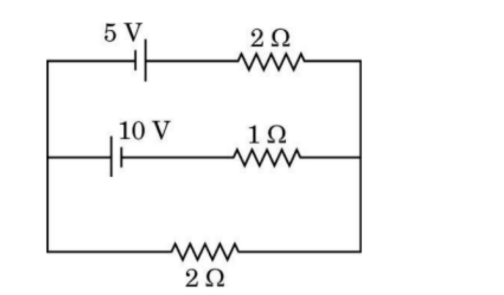
State Kirchhoff’s laws. Apply these laws to find the values of current flowing in the three branches of the given circuit.
Official Solution
Correct Option:
(1)
The given circuit has the following elements:
- A 5 V battery in series with a 2Ω resistor.
- A 10 V battery in series with a 1Ω resistor and a 2Ω resistor. Step 1: Assign currents to the branches: Let the current in the branch with the 5V source and 2Ω resistor be , the current in the branch with the 10V source and 1Ω resistor be , and the current in the branch with the 2Ω resistor be . Step 2: Apply Kirchhoff's Voltage Law (KVL): For loop 1 (containing the 5V source and 2Ω resistor):
For loop 2 (containing the 10V source, 1Ω resistor, and 2Ω resistor):
Apply Kirchhoff's Current Law (KCL):
At the junction where the currents meet, we have:
Substitute into the equation:
Step 3: Solve the system of equations: We have two equations:
1.
2. From the first equation:
Substitute this into the second equation:
Now substitute back into :
Thus, the current values are:
-
-
- The negative sign in indicates that the direction of current in the second branch is opposite to the assumed direction.
02
PYQ 2025
medium
physicsID: cbse-cla
In case (a) above, is Kirchhoff's first rule (junction rule) valid at each plate of the capacitor? Explain.
Official Solution
Correct Option:
(1)
Kirchhoff's First Rule at the Plates of a Capacitor
Kirchhoff's first rule (also known as the junction rule) states that the sum of currents entering a junction is equal to the sum of currents leaving the junction. This rule is based on the conservation of electric charge.
How Kirchhoff's First Rule Applies to a Capacitor:
At each plate of the capacitor, there are two types of currents:
Conduction Current (Ic): This current enters the plate of the capacitor through the external circuit.
Displacement Current (Id): This current exits through the dielectric between the plates of the capacitor, causing a change in the electric field.
Since the displacement current is equal in magnitude to the conduction current in the circuit, the total current entering and leaving each plate of the capacitor is balanced. Therefore, Kirchhoff's first rule holds at each plate because the total current entering (conduction current) equals the total current leaving (displacement current).
Conclusion:
Thus, Kirchhoff's junction rule is valid at each plate of the capacitor, as the conduction and displacement currents balance each other, ensuring the total current entering and leaving the plates remains equal.
03
PYQ 2025
hard
physicsID: cbse-cla
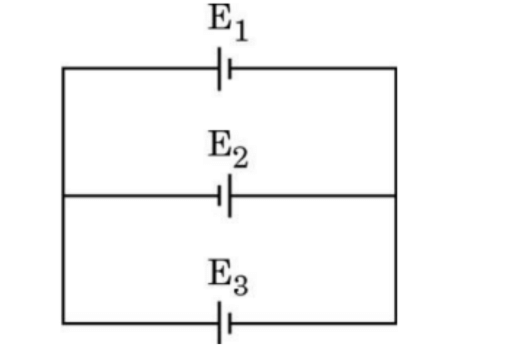
Three batteries E1, E2, and E3 of emfs and internal resistances (4 V, 2 ), (2 V, 4 ) and (6 V, 2 ) respectively are connected as shown in the figure. Find the values of the currents passing through batteries E1, E2, and E3.
Official Solution
Correct Option:
(1)
Let's denote the current flowing through the batteries as , , and . We will use Kirchhoff's Laws to solve for the currents in the circuit. Step 1: Assign direction to the currents. Assume the directions of the currents as shown in the figure. Step 2: Apply Kirchhoff's Voltage Law (KVL). For battery E1, the loop equation is: For battery E2: For battery E3: Substitute the values of , , , and the resistances , , into the equations. Step 3: Solve the system of equations. We now have a system of linear equations. Solving them will give the values of , , and . The values of the currents passing through the batteries are:
About Kirchhoff S Laws - CBSE-CLASS-XII
Kirchhoff S Laws is a vital chapter for CBSE-CLASS-XII aspirants. Mastering the concepts covered in this chapter is essential for securing a top rank.
By rigorously practicing the previous year questions associated with this chapter, you can identify high-yield topics, understand the examiner's perspective, and boost your confidence during the actual exam.
Frequently Asked Questions
Why focus on Kirchhoff S Laws PYQs?
Analyzing PYQs for this specific chapter reveals the most frequently tested concepts and the typical complexity of questions, allowing you to tailor your study plan efficiently.
How to best use this analysis?
Review the topic breakdown to see which sub-topics within Kirchhoff S Laws carry the most weight. Then, tackle the questions iteratively to solidify your understanding.