The Moving Coil Galvanometer
6 previous year questions.
High-Yield Trend
Chapter Questions 6 MCQs
Assertion (A): The deflection in a galvanometer is directly proportional to the current passing through it.
Reason (R): The coil of a galvanometer is suspended in a uniform radial magnetic field.
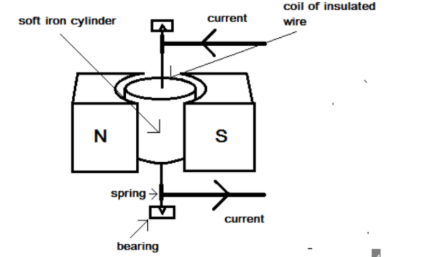
Galvanometer:
A galvanometer is an instrument used to show the direction and strength of the current passing through it. In a galvanometer, a coil placed in a magnetic field experiences a torque and hence gets deflected when a current passes through it.
The name "galvanometer" is derived from the surname of Italian scientist Luigi Galvani, who in 1791 discovered that electric current makes a dead frog’s leg jerk.
A spring attached to the coil provides a counter torque. In equilibrium, the deflecting torque is balanced by the restoring torque of the spring, and we have the relation:
Where:
- is the total number of turns in the coil
- is the area of cross-section of each turn
- is the radial magnetic field
- is the torsional constant of the spring
- is the angular deflection of the coil
As the current that produces full-scale deflection in the galvanometer is very small, the galvanometer alone cannot be used to measure current in electric circuits.
To convert a galvanometer into an ammeter (to measure larger currents), a small resistance called a shunt is connected in parallel to the galvanometer.
To convert it into a voltmeter (to measure potential difference), a high resistance is connected in series with the galvanometer.
About The Moving Coil Galvanometer - CBSE-CLASS-XII
The Moving Coil Galvanometer is a vital chapter for CBSE-CLASS-XII aspirants. Mastering the concepts covered in this chapter is essential for securing a top rank.
By rigorously practicing the previous year questions associated with this chapter, you can identify high-yield topics, understand the examiner's perspective, and boost your confidence during the actual exam.
Frequently Asked Questions
Why focus on The Moving Coil Galvanometer PYQs?
Analyzing PYQs for this specific chapter reveals the most frequently tested concepts and the typical complexity of questions, allowing you to tailor your study plan efficiently.
How to best use this analysis?
Review the topic breakdown to see which sub-topics within The Moving Coil Galvanometer carry the most weight. Then, tackle the questions iteratively to solidify your understanding.