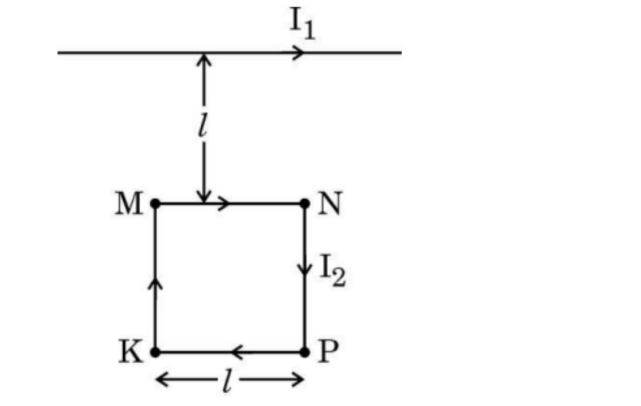
A square loop MNPK of side carrying a current is kept close to a long straight wire in the same plane and the wire carries a steady current as shown in the figure. Obtain the magnitude of magnetic force exerted by the wire on the loop.
Official Solution
Correct Option:
(1)
Step 1: Magnetic Force Between Two Parallel Conductors
The force per unit length between two parallel current-carrying conductors is given by:
F = (μ₀ I₁ I₂ l) / (2 π r)
Where:
F: Force per unit length between the wire and the loop
μ₀: Permeability of free space =
I₁: Current in the wire
I₂: Current in the loop
l: Side length of the square loop
r: Distance between the wire and the loop
Step 2: Force on the Loop
For the square loop:
The magnetic force will act on the sides MN and NP due to the magnetic field generated by the current in the wire.
The other two sides, MK and KP, will not experience any force due to the orientation of the magnetic field
Step 3: Net Force on the Loop
The net force on the square loop is the sum of the forces on the opposite sides MN and NP. These forces will act in opposite directions, leading to a net force based on the distance between the wire and the loop.
Final Answer:
The magnitude of the magnetic force exerted by the wire on the loop can be calculated by substituting the known values into the force formula.
02
PYQ 2025
easy
physicsID: cbse-cla
A particle with charge moving with velocity enters a region with magnetic field . The magnitude of force experienced by the particle is:
1
2
3
4
Official Solution
Correct Option:
(3)
The force on a moving charged particle in a magnetic field is given by the equation:
where: - is the velocity vector - is the magnetic field vector - is the charge of the particle Given that and , the magnitude of the cross product is: Thus, the force experienced by the particle is .
03
PYQ 2025
medium
physicsID: cbse-cla
A straight conductor is carrying a current of 2 A in the direction along it. A uniform magnetic field T is switched on in the region. The force acting on 10 cm length of the conductor is:
1
2
3
4
Official Solution
Correct Option:
(2)
The force on a current-carrying conductor in a magnetic field is given by the formula:
where:
- is the current in the conductor (2 A),
- is the length of the conductor (0.1 m),
- is the magnetic field, and
- is the unit vector along the direction of the current, which is in the -direction. Given:
- ,
- ,
- ,
- . Now, calculate the cross product :
Thus, the cross product is . Now, the force is:
Thus, the correct answer is .
04
PYQ 2026
medium
physicsID: cbse-cla
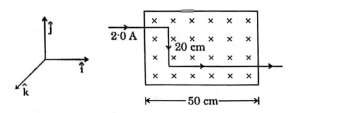
A part of a wire carrying current and bent at at two points is placed in a region of uniform magnetic field , as shown in the figure. Calculate the magnitude of the net force acting on the wire.
Official Solution
Correct Option:
(1)
Concept:
Force on a current-carrying straight conductor:
In a uniform magnetic field, the net force on a bent wire equals the force on the straight line joining its ends (vector sum of segments). Step 1: Geometry of wire. From the figure:
Vertical segment length = Horizontal displacement =
The wire effectively forms an L-shape. Step 2: Net displacement vector. Start to end displacement:
Step 3: Magnetic field. Step 4: Net force.
Substitute:
Step 5: Cross products.
Compute:
So:
Step 6: Magnitude.Final Answer:
05
PYQ 2026
medium
physicsID: cbse-cla
Derive an expression for the force acting on a conductor of length and area of cross-section carrying current and placed in a magnetic field .
Official Solution
Correct Option:
(1)
Concept:
A current-carrying conductor in a magnetic field experiences a magnetic force due to the motion of charge carriers. Force on a moving charge:
Step 1: Consider free electrons. Let:
Number density of electrons = Drift velocity = Volume of conductor =
Total number of electrons:
Step 2: Force on one electron.
(Minus sign for electron charge) Step 3: Total force on all electrons. Step 4: Use current relation.
Current:
So:
(where is direction of current) Substitute:
Step 5: Direction convention. Force direction is defined using conventional current direction (opposite electron motion). Thus:
Where is a vector along the conductor of magnitude . Final Expression:
Magnitude:
where is the angle between current and magnetic field. Conclusion:
A current-carrying conductor experiences a magnetic force perpendicular to both current direction and magnetic field.
About Magnetic Force - CBSE-CLASS-XII
Magnetic Force is a vital chapter for CBSE-CLASS-XII aspirants. Mastering the concepts covered in this chapter is essential for securing a top rank.
By rigorously practicing the previous year questions associated with this chapter, you can identify high-yield topics, understand the examiner's perspective, and boost your confidence during the actual exam.
Frequently Asked Questions
Why focus on Magnetic Force PYQs?
Analyzing PYQs for this specific chapter reveals the most frequently tested concepts and the typical complexity of questions, allowing you to tailor your study plan efficiently.
How to best use this analysis?
Review the topic breakdown to see which sub-topics within Magnetic Force carry the most weight. Then, tackle the questions iteratively to solidify your understanding.