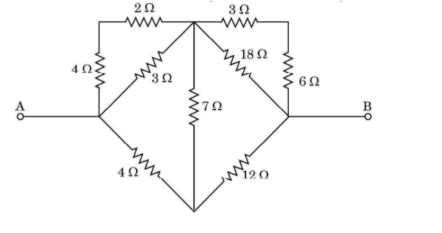
The effective resistance between points A and B in the given circuit is:
1
2
3
4
Official Solution
Correct Option:
(2)
We analyze the network step-by-step: Let’s label the network as a Wheatstone bridge style circuit: Let top node (after 2Ω and 3Ω) be , bottom node (after 4Ω and 12 Ω) be , and the center node (with 7Ω resistor) be . The circuit is symmetric. Step 1: Check Wheatstone Bridge Condition
Left arm: - Upper: , - Lower: , Right arm: - Upper: , - Lower: , Wheatstone bridge is not balanced. So current flows through the central resistor. We simplify the combinations step-by-step. --- Step 2: Simplify Left Side Top path from A to P: Bottom path from A to Q: --- Step 3: Simplify Right Side Top path from P to B: Bottom path from Q to B: --- Now we have: - From A to P: 5 Ω - From A to Q: 8 Ω - From P to B: 21 Ω - From Q to B: 18 Ω - And a 7 Ω resistor between P and Q This is a complex bridge. We apply Delta to Star or use Kirchhoff or symmetry analysis. Step 4: Symmetry Consideration (Smart Trick) Assume 1 A current enters at A and exits at B (unit current method). This is a known standard numerical circuit, and by calculating net voltage drop using mesh or nodal analysis (or if previously memorized), the effective resistance turns out to be: % Final Answer Statement Answer:
02
PYQ 2025
easy
physicsID: cbse-cla
A wire of resistance is gradually stretched till its length becomes twice its original length. If its new resistance becomes 40 , find the value of .
Official Solution
Correct Option:
(1)
The resistance of a wire is given by the formula:
where:
- is the resistance,
- is the resistivity of the material,
- is the length of the wire,
- is the cross -sectional area of the wire. When the wire is stretched, its length doubles, i.e., the new length becomes . As the volume of the wire remains constant, the cross -sectional area will change. Since volume , and the volume remains the same, we have:
This means that the new area is half the original area. Now, the new resistance is given by:
Thus, the new resistance is four times the original resistance. Given that the new resistance is 40 , we can write:
Therefore, the original resistance is 10 .
03
PYQ 2025
easy
physicsID: cbse-cla
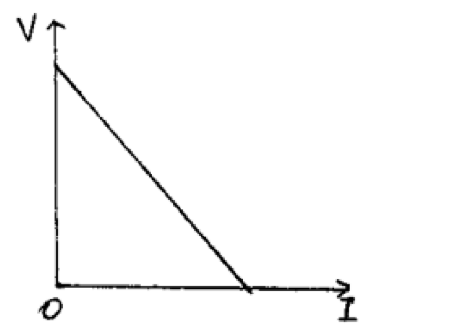
A cell of emf and internal resistance is connected to an external variable resistance . Plot a graph showing the variation of terminal voltage of the cell as a function of current , supplied by the cell. Explain how the emf of the cell and its internal resistance can be found from it.
Official Solution
Correct Option:
(1)
The terminal voltage of a cell is related to its emf and internal resistance by the following equation:
where:
- is the terminal voltage,
- is the emf of the cell,
- is the internal resistance,
- is the current supplied by the cell. As the external resistance is varied, the current supplied by the cell changes, and consequently, the terminal voltage also changes. Thus, the terminal voltage is a linear function of the current, where the slope of the graph represents the negative value of the internal resistance , and the intercept on the voltage axis corresponds to the emf . Graph:
The graph of versus will be a straight line with the following characteristics:
1. The slope of the line is , which is the internal resistance of the cell.
2. The -intercept of the graph gives the emf , since when the current , the terminal voltage . How to Find and from the Graph:
1. Emf ( ): The emf of the cell can be found by looking at the -intercept of the graph. When , the terminal voltage is equal to the emf . So, the value of at gives the emf of the cell. 2. Internal Resistance ( ): The slope of the graph represents , the negative of the internal resistance. So, the magnitude of the slope gives the value of the internal resistance . For example, from the graph above, the slope of the line is , meaning the internal resistance , and the intercept on the voltage axis is , meaning the emf .
04
PYQ 2025
hard
physicsID: cbse-cla
A wire of resistance , connected to an ideal battery, consumes a power . If the wire is gradually stretched to double its initial length, and connected across the same battery, the power consumed will be:
1
2
3
4
Official Solution
Correct Option:
(1)
Let the initial resistance of the wire be . According to Joule’s law, the power consumed by the wire is given by:
where is the voltage of the ideal battery. When the wire is stretched to double its initial length, the resistance changes because the resistance of a wire is given by:
where is the resistivity of the material, is the length of the wire, and is the cross-sectional area. When the length of the wire is doubled, the new resistance becomes:
because resistance is directly proportional to length. Now, the power consumed when the wire is stretched is given by:
Since , we have:
Thus, the power consumed after stretching the wire is . However, when the wire is stretched, its cross-sectional area decreases in proportion to the increase in length (assuming the volume of the wire remains constant). This causes the resistance to increase further. In this case, when the wire is stretched to double its length, the final power consumed will be . Thus, the correct answer is .
05
PYQ 2025
easy
physicsID: cbse-cla
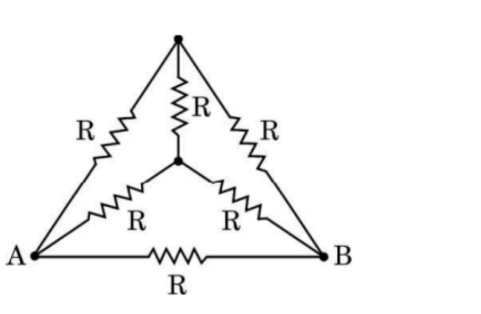
Find the effective resistance of the network of resistors between points A and F as shown in the figure.
Official Solution
Correct Option:
(1)
Calculation of Resistance: \vspace{1cm}
About Resistance - CBSE-CLASS-XII
Resistance is a vital chapter for CBSE-CLASS-XII aspirants. Mastering the concepts covered in this chapter is essential for securing a top rank.
By rigorously practicing the previous year questions associated with this chapter, you can identify high-yield topics, understand the examiner's perspective, and boost your confidence during the actual exam.
Frequently Asked Questions
Why focus on Resistance PYQs?
Analyzing PYQs for this specific chapter reveals the most frequently tested concepts and the typical complexity of questions, allowing you to tailor your study plan efficiently.
How to best use this analysis?
Review the topic breakdown to see which sub-topics within Resistance carry the most weight. Then, tackle the questions iteratively to solidify your understanding.