CBSE-CLASS-XII SERIES Physics
Dual Nature Of Matter
15 previous year questions.
Volume: 15 Ques
Yield: Medium
High-Yield Trend
1
2025 14
2024 Chapter Questions 15 MCQs
01
PYQ 2024
easy
physics ID: cbse-cla
Two beams, A and B whose photon energies are and respectively, illuminate a metallic surface (work function ) successively. The ratio of maximum speed of electrons emitted due to beam A to that due to beam B is:}
1
3
2
9
3
4
02
PYQ 2024
easy
physics ID: cbse-cla
Consider a neutron (mass ) of kinetic energy and a photon of the same energy. Let and be the de Broglie wavelength of the neutron and the wavelength of the photon, respectively. Obtain an expression for .}
03
PYQ 2024
medium
physics ID: cbse-cla
The minimum intensity of white light that our eyes can perceive is about . Calculate the number of photons of this light entering our pupil (area ) per second.
(Take average wavelength of white light and Planck’s constant .) % Correct answer Correct Answer: To find the number of photons, we first calculate the energy per photon using the equation for photon energy: where (Planck's constant), (speed of light), and .
(Take average wavelength of white light and Planck’s constant .) % Correct answer Correct Answer: To find the number of photons, we first calculate the energy per photon using the equation for photon energy: where (Planck's constant), (speed of light), and .
04
PYQ 2024
medium
physics ID: cbse-cla
Assertion (A): Photoelectric effect demonstrates the particle nature of light.
Reason (R): Photoelectric current is proportional to frequency of incident radiation.
Reason (R): Photoelectric current is proportional to frequency of incident radiation.
1
Both Assertion (A) and Reason (R) are true and Reason (R) is the correct explanation of the Assertion (A).
2
Both Assertion (A) and Reason (R) are true, but Reason (R) is not the correct explanation of the Assertion (A).
3
Assertion (A) is true, but Reason (R) is false.
4
Assertion (A) is false and Reason (R) is also false.
05
PYQ 2024
hard
physics ID: cbse-cla
Which one of the following is the correct graph between the maximum kinetic energy ( ) of the emitted photoelectrons and the frequency of incident radiation ( ) for a given photosensitive surface?
\includegraphics[width=0.5\linewidth]{10o.png}
\includegraphics[width=0.5\linewidth]{10o.png}
1
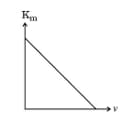
2
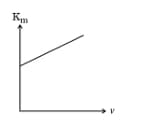
3
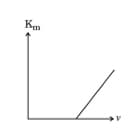
4
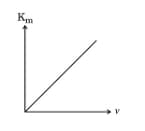
06
PYQ 2024
medium
physics ID: cbse-cla
Write Einstein’s photoelectric equation. How did Millikan prove the validity of this equation?
07
PYQ 2024
medium
physics ID: cbse-cla
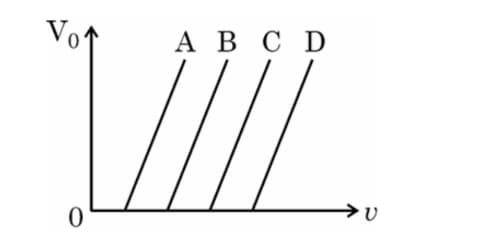
The variation of the stopping potential with the frequency of the incident radiation for four metals A, B, C, and D is shown in the figure. For the same frequency of incident radiation producing photo-electrons in all metals, the kinetic energy of photo-electrons will be maximum for which metal?
1
2
3
4
08
PYQ 2024
medium
physics ID: cbse-cla
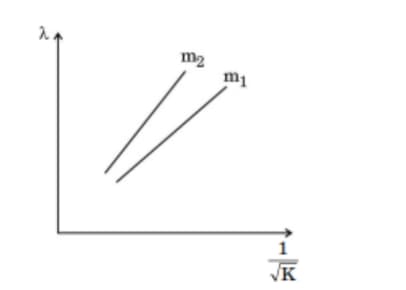
de Broglie wavelength as a function of , for two particles of masses and , is shown in the figure. Here, is the energy of the moving particles. (a) What does the slope of a line represent?
(b) Which of the two particles is heavier?
(c) Is this graph also valid for a photon? Justify your answer in each case.
(b) Which of the two particles is heavier?
(c) Is this graph also valid for a photon? Justify your answer in each case.
09
PYQ 2024
medium
physics ID: cbse-cla
Assertion (A): Photoelectric current increases with an increase in intensity of incident radiation, for a given frequency of incident radiation and the accelerating potential.
Reason (R): Increase in the intensity of incident radiation results in an increase in the number of photoelectrons emitted per second and hence an increase in the photocurrent.
Reason (R): Increase in the intensity of incident radiation results in an increase in the number of photoelectrons emitted per second and hence an increase in the photocurrent.
1
Both Assertion (A) and Reason (R) are true and Reason (R) is the correct explanation of the Assertion (A).
2
Both Assertion (A) and Reason (R) are true, but Reason (R) is not the correct explanation of the Assertion (A).
3
Assertion (A) is true, but Reason (R) is false.
4
Assertion (A) is false and Reason (R) is also false.
10
PYQ 2024
easy
physics ID: cbse-cla
The work function for a photosensitive surface is 3.315 eV. The cut-off wavelength for photoemission of electrons from this surface is:
1
150 nm
2
200 nm
3
375 nm
4
500 nm
11
PYQ 2024
medium
physics ID: cbse-cla
Assertion (A): In photoelectric effect, the kinetic energy of the emitted photoelectrons increases with increase in the intensity of the incident light.
Reason (R): Photoelectric current depends on the wavelength of the incident light.
Reason (R): Photoelectric current depends on the wavelength of the incident light.
1
Both Assertion (A) and Reason (R) are true and Reason (R) is the correct explanation of the Assertion (A).
2
Both Assertion (A) and Reason (R) are true, but Reason (R) is not the correct explanation of the Assertion (A).
3
Assertion (A) is true, but Reason (R) is false.
4
Assertion (A) is false and Reason (R) is also false.
12
PYQ 2024
medium
physics ID: cbse-cla
The waves associated with a moving electron and a moving proton have the same wavelength . It implies that they have the same:
1
momentum
2
angular momentum
3
speed
4
energy
13
PYQ 2024
medium
physics ID: cbse-cla
A proton and an -particle are accelerated through different potentials and respectively so that they have the same de Broglie wavelengths. Find .
14
PYQ 2024
medium
physics ID: cbse-cla
The quantum nature of light explains the observations on the photoelectric effect as:
1
There is a minimum frequency of incident radiation below which no electrons are emitted.
2
The maximum kinetic energy of photoelectrons depends only on the frequency of incident radiation.
3
When the metal surface is illuminated, electrons are ejected from the surface after some time.
4
The photoelectric current is independent of the intensity of incident radiation.
15
PYQ 2025
easy
physics ID: cbse-cla
Choose the correct statement:
1
Photons of light show diffraction whereas electrons do not show diffraction.
2
Electrons have momentum whereas photons do not have momentum.
3
Photons of light and electrons both exhibit dual nature.
4
All electromagnetic radiations do not have photons.
About Dual Nature Of Matter - CBSE-CLASS-XII
Dual Nature Of Matter is a vital chapter for CBSE-CLASS-XII aspirants. Mastering the concepts covered in this chapter is essential for securing a top rank.
By rigorously practicing the previous year questions associated with this chapter, you can identify high-yield topics, understand the examiner's perspective, and boost your confidence during the actual exam.
Frequently Asked Questions
Why focus on Dual Nature Of Matter PYQs?
Analyzing PYQs for this specific chapter reveals the most frequently tested concepts and the typical complexity of questions, allowing you to tailor your study plan efficiently.
How to best use this analysis?
Review the topic breakdown to see which sub-topics within Dual Nature Of Matter carry the most weight. Then, tackle the questions iteratively to solidify your understanding.