Semiconductors
7 previous year questions.
High-Yield Trend
Chapter Questions 7 MCQs
Assertion (A): The impurities in p-type Si are not pentavalent atoms.
Reason (R): The hole density in the valence band in a p-type semiconductor is almost equal to the acceptor density.
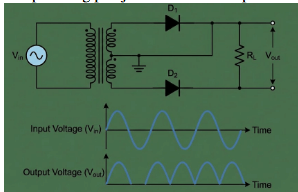
Extrinsic semiconductors are made by doping pure or intrinsic semiconductors with suitable impurity. There are two types of dopants used in doping, Si or Ge, and using them p-type and n-type semiconductors can be obtained. A p-n junction is the basic building block of many semiconductor devices. Two important processes occur during the formation of a p-n junction: diffusion and drift. When such a junction is formed, a ’depletion layer’ is created consisting of immobile ion-cores. This is responsible for a junction potential barrier. The width of a depletion layer and the height of potential barrier changes when a junction is forward-biased or reverse-biased. A semiconductor diode is basically a p-n junction with metallic contacts provided at the ends for application of an external voltage. Using diodes, alternating voltages can be rectified.
About Semiconductors - CBSE-CLASS-XII
Semiconductors is a vital chapter for CBSE-CLASS-XII aspirants. Mastering the concepts covered in this chapter is essential for securing a top rank.
By rigorously practicing the previous year questions associated with this chapter, you can identify high-yield topics, understand the examiner's perspective, and boost your confidence during the actual exam.
Frequently Asked Questions
Why focus on Semiconductors PYQs?
Analyzing PYQs for this specific chapter reveals the most frequently tested concepts and the typical complexity of questions, allowing you to tailor your study plan efficiently.
How to best use this analysis?
Review the topic breakdown to see which sub-topics within Semiconductors carry the most weight. Then, tackle the questions iteratively to solidify your understanding.