A loop carrying a current clockwise is placed in plane, in a uniform magnetic field directed along -axis. The tendency of the loop will be to:
1
move along -axis
2
move along -axis
3
shrink
4
expand
Official Solution
Correct Option: (3)
The magnetic field exerts a force on each segment of the current-carrying loop. Due to the interaction between the magnetic field and the current, the magnetic forces tend to pull the loop inward, reducing its area. This tendency to shrink can be explained by the Lorentz force acting on the current elements, which generates a net torque compressing the loop. Thus, the loop tends to:
02
PYQ 2024
hard
physicsID: cbse-cla
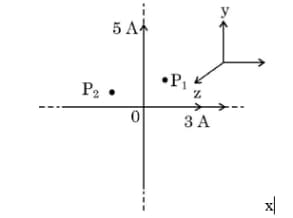
Two long insulated straight wires carrying currents of and are arranged in the XY plane as shown in the figure. Find the magnitude and direction of the net magnetic fields at points and .
Official Solution
Correct Option: (1)
Magnetic Field Due to Current-Carrying Wires
1: Magnetic Field Due to a Long Straight Wire The magnetic field at a distance from an infinitely long straight wire carrying current is given by Ampère’s Law: where: - Tm/A is the permeability of free space, - = Current in the wire, - = Perpendicular distance from the wire. Using the right-hand rule, the direction of the field is determined.
2: Magnetic Field at Point 2.1: Contribution from the 3A Current Wire Let the distance from the wire to be . 2.2: Contribution from the 5A Current Wire Let the distance from the wire to be . 2.3: Net Magnetic Field at Using vector addition, find the resultant magnetic field: where is the angle between the field vectors.
3: Magnetic Field at Point , considering different distances. Final Answer: After calculating the values, Directions: Use the right-hand rule to determine field directions.
03
PYQ 2024
medium
physicsID: cbse-cla
An electron moving with a velocity enters a region of uniform magnetic field . Find the radius of the circular path described by it. While rotating, does the electron trace a linear path too? If so, calculate the linear distance covered by it during the period of one revolution.}
Official Solution
Correct Option: (1)
Given Data
Velocity of the electron, Magnetic field,
Magnetic Force The magnetic force on a moving charge is given by: For an electron, , where is the elementary charge ( ). The cross product is: Therefore, the force is:
Radius of Circular Path The centripetal force required for circular motion is provided by the magnetic force: where is the mass of the electron ( ) and is the component of velocity perpendicular to . The perpendicular component of velocity is . Equating the magnetic force to the centripetal force: Linear Distance Covered The electron also has a velocity component parallel to the magnetic field ( ), which causes it to move linearly along the field direction. The time period for one revolution is: The linear distance covered during one revolution is: Final Answer The radius of the circular path is approximately . The electron traces a helical path, and the linear distance covered during one revolution is approximately .
04
PYQ 2024
medium
physicsID: cbse-cla
Two long straight parallel wires separated by 20 cm carry 5 A and 10 A current respectively, in the same direction. Find the magnitude and direction of the net magnetic field at a point midway between them.
Official Solution
Correct Option: (1)
Step 1: The magnetic field at a point due to a long straight current-carrying conductor is given by Ampere's law:
where: is the magnetic field at a distance from the wire, is the current in the wire, is the distance from the wire, is the permeability of free space ( ). Step 2: For two wires carrying currents in the same direction, the magnetic field due to each wire at a point midway between them (which is at a distance from each wire) can be calculated using the formula above. For the first wire with current :
For the second wire with current : Step 3: Since the currents are in the same direction, the magnetic fields due to the two wires at the midway point will be in opposite directions. Therefore, the net magnetic field at the point midway between the wires is the difference between the two fields: Step 4: The direction of the magnetic field can be determined by using the right-hand rule. The magnetic field due to the first wire is directed into the page, and the magnetic field due to the second wire is directed out of the page. Since the fields are in opposite directions, the net magnetic field will be directed out of the page. Thus, the magnitude of the net magnetic field is , and the direction is out of the page.
05
PYQ 2024
medium
physicsID: cbse-cla
State and explain Ampere’s circuital law.
Official Solution
Correct Option: (1)
Step 1: Ampere's circuital law states that the line integral of the magnetic field around a closed loop is proportional to the total current enclosed by the loop. Mathematically, it is expressed as:
where: is the line integral of the magnetic field around a closed loop, is the permeability of free space ( ), is the total current enclosed by the loop. Step 2: The law implies that the magnetic field around a current-carrying conductor is directly proportional to the current flowing through the conductor. It is commonly used to determine the magnetic field around simple geometries like straight wires, solenoids, and loops.
06
PYQ 2024
easy
physicsID: cbse-cla
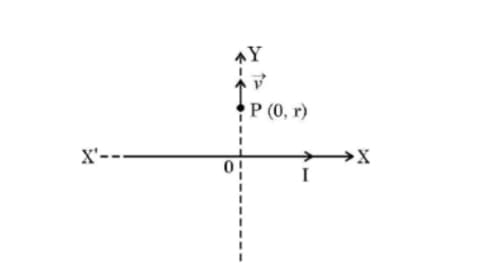
An infinite straight conductor is kept along axis and carries a current . A charge at point starts moving with velocity as shown in figure. Find the direction and magnitude of force initially experienced by the charge.
Official Solution
Correct Option: (1)
The magnetic field due to an infinite straight conductor carrying a current at a distance is given by:
where is the direction of the magnetic field (in the azimuthal direction around the wire). The force on the charge moving with velocity in the magnetic field is given by:
Substitute and :
Using the right-hand rule, the direction of is (towards the -axis). Thus:
Final Answer: The force is directed towards the -axis with magnitude:
07
PYQ 2024
medium
physicsID: cbse-cla
Two long straight parallel conductors A and B, kept at a distance , carry current in opposite directions. A third identical conductor C, kept at a distance from A, carries current in the same direction as A. The net magnetic force on unit length of C is:
1
2
3
4
Official Solution
Correct Option: (3)
Magnetic Force Between Conductors
1: Force Between Two Parallel Conductors
The magnetic force per unit length between two parallel conductors with currents and is given by the formula: where:
- is the permeability of free space,
- and are the currents in the conductors,
- is the distance between the conductors. 2: Force on Conductor C
- The force on conductor C is due to the magnetic fields created by A and B.
- The force between A and C is: This force is attractive, as both currents in A and C are in the same direction. Hence, the force is towards A. - The force between B and C is: This force is repulsive, as the currents in B and C are in opposite directions. 3: Net Force on C
The net force on conductor C is the difference between the attractive force from A and the repulsive force from B: Thus, the net force on C is directed towards A. Therefore, the correct answer is:
08
PYQ 2024
medium
physicsID: cbse-cla
Derive an expression for magnetic force acting on a straight conductor of length carrying current in an external magnetic field . Is it valid when the conductor is in zig-zag form? Justify.
Official Solution
Correct Option: (1)
Step 1: The magnetic force on a current-carrying conductor of length is given by the formula:
where:
- is the current in the conductor,
- is the length of the conductor,
- is the external magnetic field,
- is the unit vector in the direction of the current. Step 2: The force is calculated by the cross-product of the magnetic field and the direction of current. The magnitude of the force is:
where is the angle between the magnetic field and the conductor. Step 3: The direction of the force is given by the right-hand rule, which states that if the right-hand thumb is pointed in the direction of the current, and the fingers are pointed in the direction of the magnetic field, the palm faces in the direction of the force. Step 4: When the conductor is in zig-zag form, the expression still holds, but the total length of the conductor will change. The force calculation will need to account for the effective length and the direction of current in each segment of the conductor. In the zig-zag case, the segments' contribution to the force will depend on the angle between each segment's direction of current and the magnetic field. Thus, while the general formula applies, the overall force will depend on the geometry of the zig-zag shape.
09
PYQ 2024
medium
physicsID: cbse-cla
Assertion (A): The energy of a charged particle moving in a magnetic field does not change. % Reason (R) Reason (R): It is because the work done by the magnetic force on the charge moving in a magnetic field is zero.
1
If both Assertion (A) and Reason (R) are true and Reason (R) is the correct explanation of Assertion (A).
2
If both Assertion (A) and Reason (R) are true and Reason (R) is not the correct explanation of Assertion (A).
3
If Assertion (A) is true but Reason (R) is false.
4
If both Assertion (A) and Reason (R) are false.
Official Solution
Correct Option: (1)
The energy of a charged particle remains constant while moving in a magnetic field because the magnetic force does no work on the particle. This is due to the fact that the magnetic force is always perpendicular to the velocity of the charged particle, and hence it does not change the kinetic energy. Since the magnetic force does no work on the charged particle, the energy remains unchanged. Thus, both the assertion and the reason are true, and the reason correctly explains the assertion.
10
PYQ 2024
medium
physicsID: cbse-cla
A proton with kinetic energy moving horizontally from north to south, enters a uniform magnetic field directed eastward. Calculate:}
\textbf{(a) the speed of the proton,
Official Solution
Correct Option: (1)
\normalfont a) The velocity is given by the equation: Substituting the values: b) The acceleration is given by the equation: Substituting the values: c) The radius of the path is given by: Substituting the values:
11
PYQ 2024
medium
physicsID: cbse-cla
Assertion (A): Two long parallel wires, freely suspended and connected in series to a battery, move apart. Reason (R):Two wires carrying current in opposite directions repel each other.
1
Both Assertion (A) and Reason (R) are true and Reason (R) is the correct explanation of the Assertion (A).
2
Both Assertion (A) and Reason (R) are true, but Reason (R) is not the correct explanation of the Assertion (A).
3
Assertion (A) is true, but Reason (R) is false.
4
Assertion (A) is false and Reason (R) is also false.
Official Solution
Correct Option: (1)
The assertion states that two long parallel wires, freely suspended and connected to a battery in series, move apart. This behavior is due to the magnetic forces acting on the wires. When electric current flows through the wires, they generate magnetic fields around them. The reason states that two wires carrying current in opposite directions repel each other. This is a result of the force between two parallel currents, described by Ampère's Law. When currents flow in opposite directions in parallel wires, the magnetic fields generated by the wires exert a repulsive force on each other, causing the wires to move apart. Thus, both the assertion and the reason are true, and the reason correctly explains the assertion. Thus, the correct answer is:
12
PYQ 2024
medium
physicsID: cbse-cla
A long wire lies along -axis. It carries a current of in positive -direction. A magnetic field exists in the region. The force on the wire is:}
1
2
3
4
Official Solution
Correct Option: (2)
The magnetic force on a current-carrying wire is given by:
where:
\begin{itemize} \item is the current, \item is the length vector of the wire, \item .
\end{itemize} Step 1: Compute :}
Expand the determinant:
Simplify:
Thus:
Step 2: Calculate :}
Simplify:
Thus, the force on the wire is:
13
PYQ 2024
medium
physicsID: cbse-cla
A particle of mass and charge is moving with velocity . If it is subjected to a magnetic field , it will move in a:
1
straight line path
2
circular path
3
helical path
4
parabolic path
Official Solution
Correct Option: (3)
Motion of a Charged Particle in a Magnetic Field - The Lorentz Force on a charged particle moving in a magnetic field is: - Given and , we calculate the cross-product: - Since and , we get: - The force acts perpendicular to the velocity component in the -plane, causing circular motion in that plane.
- The velocity component along -direction remains unchanged, leading to a helical path. Thus, the correct answer is (C) helical path.
14
PYQ 2024
medium
physicsID: cbse-cla
Define mutual inductance. Write its SI unit.
Official Solution
Correct Option: (1)
Definition of Mutual Inductance - Mutual inductance ( ) is the property of two coils in which a change in current in one coil induces an electromotive force (emf) in the other due to electromagnetic induction.
- The induced emf in the secondary coil is given by: where is the current in the primary coil. - The SI unit of mutual inductance is Henry (H), where 1 Henry = 1 Weber per Ampere (1 H = 1 Wb/A).
15
PYQ 2024
medium
physicsID: cbse-cla
A straight wire is kept horizontally along the east-west direction. If a steady current flows in the wire from east to west, the magnetic field at a point above the wire will point towards:
1
East
2
West
3
North
4
South
Official Solution
Correct Option: (3)
Application of Right-Hand Thumb Rule: - The magnetic field due to a current-carrying wire follows the right-hand thumb rule: - Point the thumb in the direction of current (east to west). - The curled fingers indicate the direction of the magnetic field around the wire. - At a point above the wire, the magnetic field is directed towards the north. Thus, the correct answer is North.
16
PYQ 2025
easy
physicsID: cbse-cla
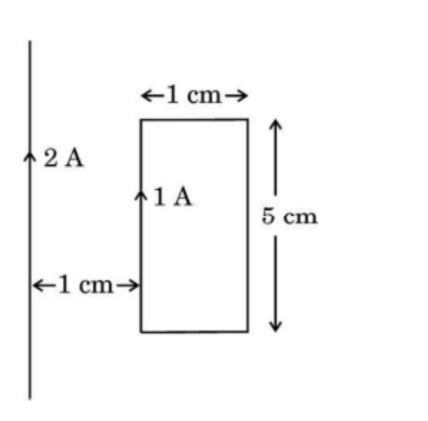
A rectangular loop carries a current of 1 A. A straight long wire carrying 2 A current is kept near the loop in the same plane as shown in the figure. Find:
(i) the torque acting on the loop, and
(ii) the magnitude and direction of the net force on the loop.
Official Solution
Correct Option: (1)
Given: - Current in straight wire: - Current in loop: - Width of loop: - Height of loop: - Distance from wire to left side of loop: - Distance to right side of loop: \vspace{0.3cm}
(i) Torque acting on the loop:
There is no net torque acting on the loop. Reason: - Each vertical side of the loop experiences a magnetic force due to the magnetic field of the straight wire. - The forces on the two vertical sides (left and right) are equal in magnitude and opposite in direction, but they act at equal distances from the center, and hence produce no net torque (they cancel each other out). - The horizontal sides (top and bottom) experience forces in opposite directions, but being collinear, they do not form a couple either. \vspace{0.3cm}
(ii) Net force on the loop:
Let’s calculate the net magnetic force on the loop due to the current in the straight wire. Magnetic field due to long wire at a distance :
Force on a current-carrying wire in magnetic field:
Calculate force on left side (distance = 1 cm = 0.01 m):
Calculate force on right side (distance = 2 cm = 0.02 m):
Direction:
- On left vertical side: force is attractive (toward the wire). - On right vertical side: force is repulsive (away from the wire). Net force:
Substitute values:
Direction: The net force is toward the wire, because the attractive force on the closer side is greater than the repulsive force on the farther side. \vspace{0.3cm}
Final Answer:
(i) Torque on the loop:
(ii) Net force: toward the wire
17
PYQ 2025
easy
physicsID: cbse-cla
(I) Write Ampere’s circuital law in mathematical form and explain the terms used. (II) As the current-carrying solenoid is made longer, the magnetic field produced outside it approaches zero. Why? (III) A flexible loop of irregular shape carrying current, when located in an external magnetic field, changes to a circular shape. Give reason.
Official Solution
Correct Option: (1)
(I) Ampere’s Circuital Law: Ampere’s circuital law states that the line integral of the magnetic field around any closed loop is equal to times the net current enclosed by the loop: Where:
is the magnetic field vector
is an infinitesimal vector element of the closed path
is the permeability of free space
is the total current enclosed by the loop
This law is analogous to Gauss’s law in electrostatics and is applicable in highly symmetric situations (e.g., long straight wires, solenoids).
(II) Magnetic Field Outside a Long Solenoid: As the solenoid becomes longer, the magnetic field lines inside become more uniform and denser, while the field lines outside begin to cancel due to opposite currents in adjacent turns.
In the ideal case of an infinitely long solenoid, the field outside is:
Reason: The field lines from each turn outside the solenoid point in different directions and tend to cancel each other out due to symmetry. Hence, as length increases, the external field weakens and tends toward zero.
(III) Flexible Loop Becoming Circular in Magnetic Field: A current-carrying loop placed in an external magnetic field experiences a force that tends to minimize its potential energy. The magnetic pressure acts along the wire, pulling it into a shape that encloses maximum area for minimum perimeter — a circle. Reason: According to Lenz's law and the tendency to minimize magnetic potential energy, the system favors a configuration with maximum magnetic flux linkage — which occurs when the loop is circular. Thus, a flexible irregular loop deforms into a circle.
18
PYQ 2025
medium
physicsID: cbse-cla
Write vector form of Biot–Savart law.
Official Solution
Correct Option: (1)
The vector form of Biot–Savart law is:
where: - is the magnetic field, - is the permeability of free space, - is the current, - is a vector element of the current-carrying wire, - is the unit vector from the element to the field point, - is the distance between them.
19
PYQ 2025
medium
physicsID: cbse-cla
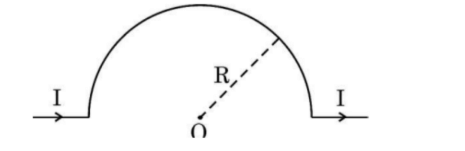
The value of magnetic field at point in the given figure is:
1
2
3
4
Official Solution
Correct Option: (3)
The wire forms a semicircular arc of radius , with current flowing through it. The magnetic field at the center of a circular arc carrying current is given by the formula: where is the angle subtended by the arc at the center in radians. Here, since the arc is a semicircle:
So,
Thus, the magnetic field at point is:
20
PYQ 2025
easy
physicsID: cbse-cla
A 1 cm segment of a wire lying along the x-axis carries a current of 0.5 A along the -direction. A magnetic field is switched on in the region. The force acting on the segment is:
1
2
3
4
Official Solution
Correct Option: (2)
To determine the force acting on a wire segment due to a magnetic field, we use the formula for the magnetic force on a current-carrying wire:
Where:
is the current (0.5 A), is the length vector of the wire, and is the magnetic field vector.
The wire lies along the x-axis, and is 1 cm long, so its length vector is:
Given the magnetic field vector:
Convert milliteslas to teslas:
Now, compute the cross product :
Using the cross product rule:
Calculate:
The magnitude of current , so:
Convert to micro Newtons ( ):
Therefore, the force on the segment is: .
21
PYQ 2025
medium
physicsID: cbse-cla
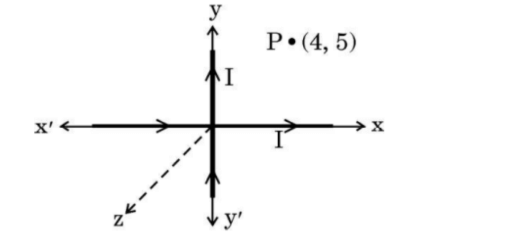
Two insulated long straight wires, each carrying current are kept along and axes as shown in the figure. Find the magnitude and direction of the resultant magnetic field at point .
Official Solution
Correct Option: (1)
At point :
- Distance from wire along y-axis =
- Distance from wire along x-axis = Magnetic field due to a long straight wire at a perpendicular distance is:
So, Magnetic field due to y-axis wire at : Magnetic field due to x-axis wire at : Since both are into the page, resultant magnetic field is the vector sum:
Direction:
- is due to vertical wire, directed along negative z-axis. - is due to horizontal wire, also directed along negative z-axis. So the resultant magnetic field is also into the page (–z direction).
22
PYQ 2025
medium
physicsID: cbse-cla
Derive an expression for the torque acting on a rectangular current loop suspended in a uniform magnetic field.
Official Solution
Correct Option: (1)
The torque acting on a current loop in a magnetic field is given by:
where is the magnetic moment of the loop, and is the magnetic field. The magnetic moment is given by:
where is the current, is the area of the loop, and is the unit vector normal to the plane of the loop. The magnitude of the torque is:
where is the angle between the magnetic moment and the magnetic field. Substituting for , we get:
Thus, the expression for the torque acting on the rectangular current loop is:
23
PYQ 2025
easy
physicsID: cbse-cla
A current carrying circular loop of area produces a magnetic field at its centre. Show that the magnetic moment of the loop is:
Official Solution
Correct Option: (1)
The magnetic moment of a current loop is defined as: where is the current and is the area of the loop. The magnetic field produced by a current at the centre of a circular loop of radius is given by: From this, we can solve for : Now, substitute this value of into the equation for the magnetic moment: Since the area of the loop is related to the radius by , substitute into the equation: Thus, the magnetic moment of the loop is:
24
PYQ 2025
medium
physicsID: cbse-cla
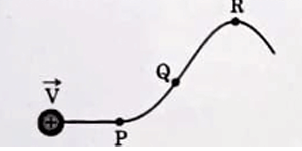
A proton moving with velocity in a non-uniform magnetic field traces a path as shown in the figure. The path followed by the proton is always in the plane of the paper. What is the direction of the magnetic field in the region near points P, Q, and R? What can you say about relative magnitude of magnetic fields at these points?
Official Solution
Correct Option: (1)
The direction of the magnetic field can be determined using the right-hand rule for the Lorentz force. The magnetic force on a charged particle is given by: where is the velocity of the proton and is the magnetic field. The force is always perpendicular to the velocity and the magnetic field.
At point P, since the proton is moving to the right (towards point Q), the magnetic force must act in a direction perpendicular to the velocity. If we assume that the proton is deflected upward at point P, the magnetic field at P must be directed out of the plane of the paper (towards the observer).
At point Q, the proton's path is curved in such a way that the magnetic field is still out of the plane, as indicated by the direction of deflection. At point R, where the proton is moving downward, the force acting on the proton would indicate that the magnetic field is likely still out of the plane of the paper.
Regarding the magnitude of the magnetic field at these points, we can infer that the magnetic field is stronger where the proton's velocity changes more rapidly. Therefore, the magnetic field is likely strongest at point P, followed by point Q, and weakest at point R. Thus, the magnetic field is directed out of the plane of the paper and is strongest at point P, followed by Q, and weakest at point R.
25
PYQ 2025
medium
physicsID: cbse-cla
A 1 cm segment of a wire lying along the x-axis carries current of along the -direction. A magnetic field is switched on, in the region. The force acting on the segment is:
1
2
3
4
Official Solution
Correct Option: (4)
To find the force acting on the wire segment, we use the formula for the magnetic force on a current-carrying conductor: , where is the current, is the length vector of the wire, and is the magnetic field. Given values are , , and . First, convert the magnetic field units: , so .