CBSE-CLASS-XII SERIES
Physics

Optics

33 previous year questions.

Volume: 33 Ques
Yield: High

High-Yield Trend

21
2025
12
2024

Chapter Questions
33 MCQs

01
PYQ 2024
easy
physics ID: cbse-cla
The magnifying power of an astronomical telescope is 24. In normal adjustment, the distance between its two lenses is 150 cm. Find the focal length of the objective lens.
02
PYQ 2024
hard
physics ID: cbse-cla
Assertion (A): A convex lens, when immersed in a liquid, disappears.
Reason (R): The refractive indices of the material of the lens and the liquid are equal.
1
Both Assertion (A) and Reason (R) are true and Reason (R) is the correct explanation of the Assertion (A).
2
Both Assertion (A) and Reason (R) are true, but Reason (R) is not the correct explanation of the Assertion (A).
3
Assertion (A) is true, but Reason (R) is false.
4
Assertion (A) is false and Reason (R) is also false.
03
PYQ 2024
easy
physics ID: cbse-cla
For a simple microscope, the angular size of the object equals the angular size of the image. Yet it offers magnification. Explain how this is possible.
04
PYQ 2024
medium
physics ID: cbse-cla
Both plane and convex mirrors produce virtual images of objects. Can they produce real images under some circumstances? Explain.
05
PYQ 2024
medium
physics ID: cbse-cla
In normal adjustment, for a refracting telescope, the distance between the objective and the eyepiece lens is 1.00 m. If the magnifying power of the telescope is 19, find the focal length of the objective and the eyepiece lens.
06
PYQ 2024
medium
physics ID: cbse-cla
Trace the path of a ray of light showing refraction through a triangular prism and hence obtain an expression for the angle of deviation ( ) in terms of , , and , where symbols have their usual meanings. Draw a graph showing the variation of the angle of deviation with the angle of incidence.
07
PYQ 2024
medium
physics ID: cbse-cla
Two coplanar and concentric circular loops and are placed coaxially with their centres coinciding. The radii of and are 1 cm and 100 cm respectively. Calculate the mutual inductance of the loops. (Take )
08
PYQ 2024
medium
physics ID: cbse-cla
A beam of light coming parallel to the principal axis of a convex lens of focal length 16 cm is incident on it. Another convex lens of focal length 12 cm is placed coaxially at a distance 40 cm from . The nature and distance of the final image from will be:
1
Real, 24 cm
2
Virtual, 12 cm
3
Real, 32 cm
4
Virtual, 18 cm
09
PYQ 2024
medium
physics ID: cbse-cla
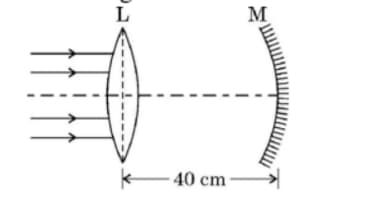
A thin convex lens of focal length 10 cm and a concave mirror of focal length 15 cm are placed coaxially 40 cm apart as shown in the figure. A beam of light coming parallel to the principal axis is incident on the lens. The final image will be formed at a distance of:
A thin convex lens
1
10 cm, left of lens
2
10 cm, right of lens
3
20 cm, left of lens
4
20 cm, right of lens
10
PYQ 2024
medium
physics ID: cbse-cla
The focal length of an equiconvex lens:
1
Increases when the lens is dipped in water.
2
Increases when the wavelength of incident light decreases.
3
Increases with decrease in the radius of curvature of its surface.
4
Decreases when the lens is cut into two identical parts along its principal axis.
11
PYQ 2024
medium
physics ID: cbse-cla
A thin converging lens of focal length 20 cm and a thin diverging lens of focal length 15 cm are placed coaxially in contact. The power of the combination is:
1
D
2
D
3
D
4
D
12
PYQ 2024
medium
physics ID: cbse-cla
A ray of light is incident normally on one face of an equilateral glass prism of refractive index . When the prism is completely immersed in a transparent medium, it is observed that the emergent ray just grazes the adjacent face. Find the refractive index of the medium.
13
PYQ 2025
hard
physics ID: cbse-cla
A double convex lens of glass has both faces of the same radius of curvature 17 cm. Find its focal length if it is immersed in water. The refractive indices of glass and water are 1.5 and 1.33 respectively.
14
PYQ 2025
easy
physics ID: cbse-cla
Assertion (A): A ray of light is incident normally on the face of a prism. The emergent ray will graze along the opposite face of the prism when the critical angle at glass-air interface is equal to the angle of the prism.
Reason (R): The refractive index of a prism depends on angle of the prism.
1
Both Assertion (A) and Reason (R) are true and Reason (R) is the correct explanation of the Assertion (A).
2
Both Assertion (A) and Reason (R) are true, but Reason (R) is not the correct explanation of the Assertion (A).
3
Assertion (A) is true, but Reason (R) is false.
4
Both Assertion (A) and Reason (R) are false.
15
PYQ 2025
easy
physics ID: cbse-cla
A compound microscope has an objective and an eyepiece of focal lengths and , respectively. To obtain a large magnification of a small object, the microscope should have:
1
and small, and
2
and small, and
3
and large, and
4
and large, and
16
PYQ 2025
medium
physics ID: cbse-cla
The distance of an object from the first focal point of a biconvex lens is and distance of the image from second focal point is . The focal length of the lens is:
1
2
3
4
17
PYQ 2025
easy
physics ID: cbse-cla
In Young's double slit experiment, the separation between the two slits is 1.0 mm and the screen is 1.0 m away from the slits. A beam of light consisting of two wavelengths, 500 nm and 600 nm, is used to obtain interference fringes. Calculate:
(a) The distance between the first maxima for the two wavelengths.
(b) The least distance from the central maximum, where the bright fringes due to both the wavelengths coincide.
18
PYQ 2025
easy
physics ID: cbse-cla
Find the focal length of the plano-convex lens of refractive index 1.5 and radius of curvature 10 cm when it is immersed in a liquid of refractive index 1.25.
19
PYQ 2025
medium
physics ID: cbse-cla
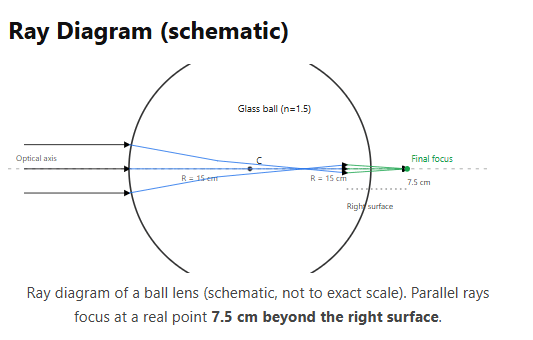
A beam of light coming from a distant source is refracted by a spherical glass ball (refractive index 1.5) of radius 15 cm. Draw the ray diagram and obtain the position of the final image formed.
20
PYQ 2025
hard
physics ID: cbse-cla
A point object is placed in air at a distance in front of a convex surface of radius of curvature , separating air from a medium of refractive index (where ). Find the nature and position of the image formed.
21
PYQ 2025
medium
physics ID: cbse-cla
A convex lens of focal length 10 cm, a concave lens of focal length 15 cm, and a third lens of unknown focal length are placed coaxially in contact. If the focal length of the combination is +12 cm, find the nature and focal length of the third lens, if all lenses are thin. Will the answer change if the lenses were thick?
22
PYQ 2025
hard
physics ID: cbse-cla
A spherical convex surface of radius of curvature separates glass (refractive index ) from air. Light from a point source placed in air at a distance from the surface falls on it. Find the position and nature of the image formed.
23
PYQ 2025
easy
physics ID: cbse-cla
A point source is placed at the bottom of a tank containing a transparent liquid (refractive index ) to a depth H. The area of the surface of the liquid through which light from the source can emerge out is:
1

2

3

4

24
PYQ 2025
easy
physics ID: cbse-cla
The speed of light in two media '1' and '2' are and ( ) respectively. For a ray of light to undergo total internal reflection at the interface of these two media, it must be incident from:
1
medium '1' and at an angle greater than
2
medium '1' and at an angle greater than
3
medium '2' and at an angle greater than
4
medium '2' and at an angle greater than
25
PYQ 2025
easy
physics ID: cbse-cla
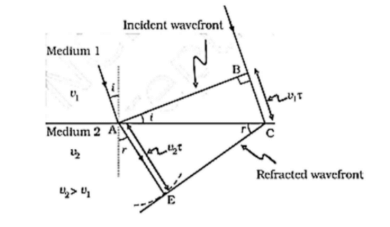
A plane wave travelling in a medium is incident on a plane surface separating this medium from a rarer medium. Draw a diagram to show refraction of the wave. Hence, verify Snell’s law.
26
PYQ 2025
easy
physics ID: cbse-cla
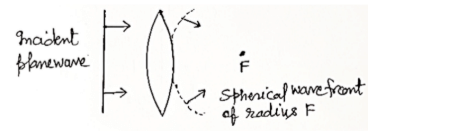
Define ‘wavefront’ of a light wave. A plane wavefront is refracted from a convex lens. Draw the shape of the refracted wavefront.
27
PYQ 2025
hard
physics ID: cbse-cla
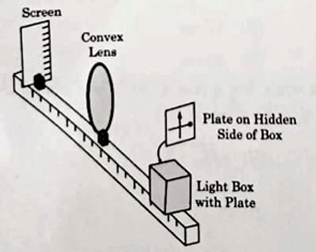
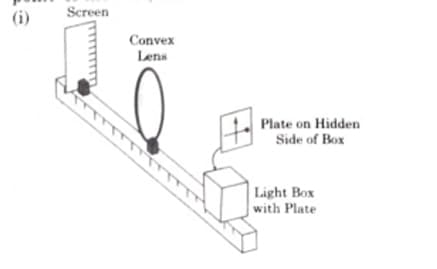
If an object in case (i) above is 20 cm from the lens and the screen is 50 cm away from the object, the focal length of the lens used is:
1
10 cm
2

16 cm

3

12 cm

4
20 cm
28
PYQ 2025
medium
physics ID: cbse-cla

In Young’s double slit experimental set-up, the intensity of the central maximum is . Calculate the intensity at a point where the path difference between two interfering waves is .
29
PYQ 2025
medium
physics ID: cbse-cla
A thin lens is a transparent optical medium bounded by two surfaces, at least one of which should be spherical. Applying the formula for image formation by a single spherical surface successively at the two surfaces of a lens, one can obtain the 'lens maker formula' and then the 'lens formula'. A lens has two foci - called 'first focal point' and 'second focal point' of the lens, one on each side.
thinlens isatransparentopticalmedium
30
PYQ 2025
medium
physics ID: cbse-cla
A convex lens of focal length is cut into two equal parts perpendicular to the principal axis. The focal length of each part will be:
1

2

3

4

31
PYQ 2025
easy
physics ID: cbse-cla

A thin lens is a transparent optical medium bounded by two surfaces, at least one of which should be spherical. Applying the formula for image formation by a single spherical surface successively at the two surfaces of a lens, one can obtain the 'lens maker formula' and then the 'lens formula'. A lens has two foci - called 'first focal point' and 'second focal point' of the lens, one on each side.
thin lens is a transparent optical medium bounded by two surfaces
Consider the arrangement shown in figure. A black vertical arrow and a horizontal thick line with a ball are painted on a glass plate. It serves as the object. When the plate is illuminated, its real image is formed on the screen.

32
PYQ 2025
easy
physics ID: cbse-cla

When light travels from an optically denser medium to an optically rarer medium, at the interface it is partly reflected back into the same medium and partly refracted to the second medium. The angle of incidence corresponding to an angle of refraction 90° is called the critical angle (ic) for the given pair of media. This angle is related to the refractive index of medium 1 with respect to medium 2. Refraction of light through a prism involves refraction at two plane interfaces. A relation for the refractive index of the material of the prism can be obtained in terms of the refracting angle of the prism and the angle of minimum deviation. For a thin prism, this relation reduces to a simple equation. Laws of refraction are also valid for refraction of light at a spherical interface. When an object is placed in front of a spherical surface separating two media, its image is formed. A relation between object and image distance, in terms of refractive indices of two media and the radius of curvature of the spherical surface can be obtained. Using this relation for two surfaces of lens, ’lensemaker formula’ is obtained.

33
PYQ 2025
medium
physics ID: cbse-cla
In a Young's double-slit experiment, two light waves, each of intensity , interfere at a point, having a path difference on the screen. Find the intensity at this point.